Movement into and out of cells
Contents: 8 sections
The three processes side by side
| What moves | Direction | Needs a membrane? | Needs energy from respiration? | |
|---|---|---|---|---|
| Diffusion | Any particle | Down its concentration gradient, high to low | No | No |
| Osmosis | Water only | Down the water potential gradient, high to low | Yes, partially permeable | No |
| Active transport | Dissolved ions and molecules | Against the gradient, low to high | Yes, with carrier proteins | Yes |
Almost every question on this topic is answered from one row of that table, so it is worth learning as a whole rather than as three separate definitions.
Diffusion
Diffusion is the net movement of particles from a region of higher concentration to a region of lower concentration, down a concentration gradient, as a result of their random movement.
Nothing pushes the particles. They are already moving at random in all directions, all the time. If there are more of them on one side than the other, then simply by chance more will wander across from the crowded side than back, so the net movement is one way. Once the concentrations are equal the particles keep moving, but the movements now cancel and there is no net change.
The word net is worth a mark on its own, because it is what stops the definition from claiming that particles stop moving at the end.
Three factors set the rate.
- Temperature. Higher temperature gives the particles more kinetic energy, so they move faster and spread more quickly.
- Concentration gradient. A steeper gradient means a bigger imbalance driving the net movement, so diffusion is faster.
- Distance. A shorter distance means each particle has less ground to cover.
Surface area matters too: a larger area gives more room for particles to cross at once.
This is why exchange surfaces in the body look the way they do. Alveoli and villi have walls one cell thick, so the diffusion distance is as short as it can be, and both are folded into enormous surface areas. Breathing and the blood supply keep the gradients steep by constantly removing what has crossed.
Diffusion moves oxygen and carbon dioxide in and out of cells, and moves digested food from the small intestine into the blood.
Osmosis
Osmosis is the net movement of water molecules from a region of higher water potential to a region of lower water potential, through a partially permeable membrane.
You will also meet it worded as movement from a dilute solution to a concentrated one. Those two wordings agree, and seeing why is the key to the whole topic. A dilute solution is the one with more water molecules in it, so it has the higher water potential. Water moving from dilute to concentrated is therefore water moving down its own gradient, exactly like any other diffusing particle.
Students trip here because they remember "high concentration to low concentration" and apply it to the solute. That phrase always refers to the particle that is actually moving, and in osmosis the particle that moves is water.
Partially permeable is the other load-bearing phrase. The membrane lets water through but holds the dissolved solute back, and that selectivity is the entire reason water alone moves. If the membrane were fully permeable the solute would even itself out by ordinary diffusion and no osmosis would be observed. This is also why the cell wall cannot be the membrane in the definition: cellulose walls are fully permeable.
What solutions do to cells
Plant cell in pure or dilute solution. The outside has the higher water potential, so water enters by osmosis. The vacuole swells, the cytoplasm presses out against the cell wall, and the cell becomes turgid. The wall is strong enough to resist, so the cell does not burst, and the outward pressure is what keeps a stem upright and a leaf flat.
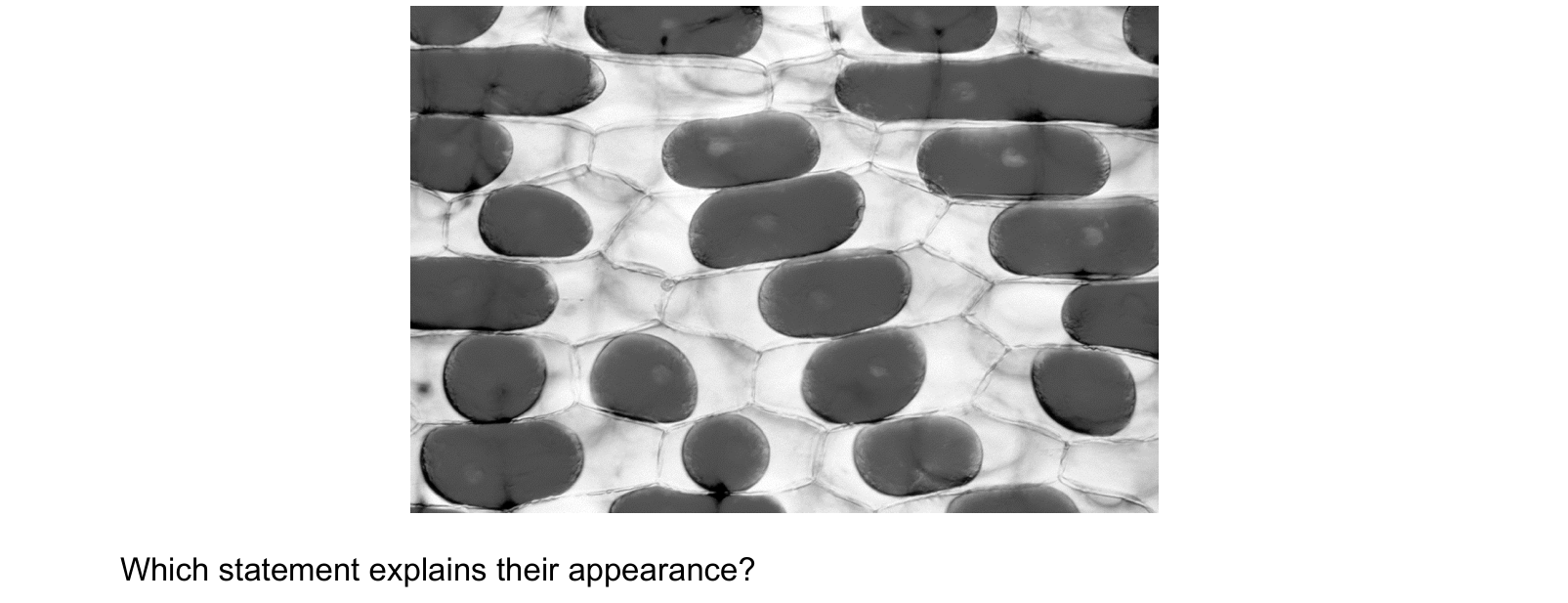
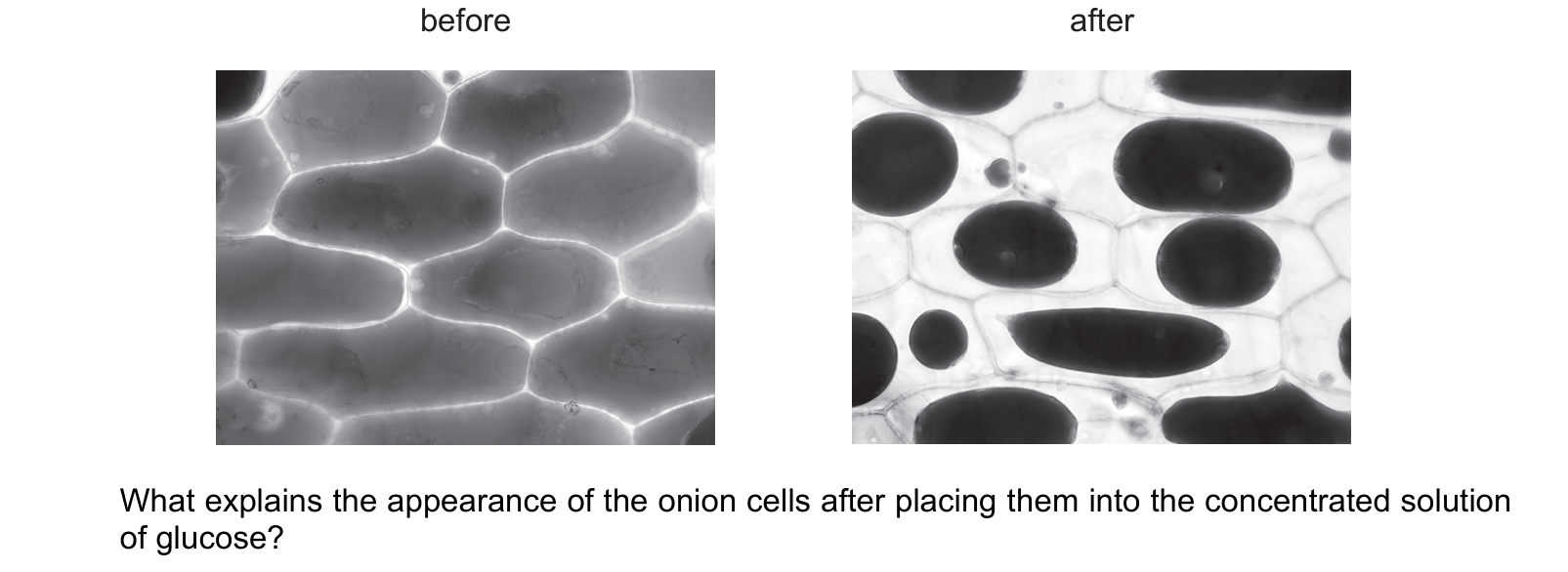
Plant cell in concentrated solution. The outside now has the lower water potential, so water leaves. The cell first goes limp, or flaccid, and if enough water leaves, the cytoplasm and membrane pull away from the cell wall altogether. That is plasmolysis, and a plasmolysed plant wilts.
Animal cell in pure water. Water enters, but there is no wall to resist the swelling, so the cell bursts. In a red blood cell this is called haemolysis. It is the clearest illustration of what the cell wall is for.
Animal cell in concentrated solution. Water leaves and the cell shrinks and crinkles.
Worked example. Strips of potato are left in sucrose solutions of different concentrations and reweighed. In the most dilute solution the strips gain mass, and in the most concentrated they lose mass. At one concentration in between there is no change at all. What does that concentration tell you?
At that point there is no net movement of water, so the water potential of the solution equals the water potential inside the potato cells. Finding it is the point of the experiment. Notice that a gain in mass means water moved in, which means the solution outside was the more dilute of the two.
Active transport
Active transport is the movement of particles through a cell membrane from a region of lower concentration to a region of higher concentration, against the concentration gradient, using energy released by respiration.
Two things make it different from diffusion, and both are worth stating. It goes the "wrong" way, uphill against the gradient, and going uphill costs energy. Specific carrier proteins in the membrane do the work, which is why active transport can be selective about which ion it takes.
It matters because cells often need more of something than there is outside. A root hair cell sits in soil water where nitrate ions are far more dilute than they already are inside the root, so diffusion would take nitrate the wrong way. Active transport pulls it in anyway. The same happens when glucose is absorbed from the small intestine at the end of a meal, once diffusion alone has stopped being enough.
Cells that carry out a lot of active transport contain many mitochondria, because mitochondria are where respiration releases the energy. That is a favourite one-mark question: if a diagram shows a cell stuffed with mitochondria, it is doing something that costs energy.
Which processes cost energy
Diffusion and osmosis are passive. They are driven by the random movement the particles already have, so they need no energy from respiration and would keep happening in a dead cell.
Processes that do use energy from respiration include active transport, muscle contraction, cell division, protein synthesis and growth. Respiration itself is not on the list, because respiration is the process that releases the energy rather than one that spends it.
Common mistakes
- Saying osmosis is the movement of sugar or solute molecules. It is water.
- Leaving "partially permeable" out of the definition of osmosis, or writing "cell wall" instead.
- Saying water moves from high concentration to low concentration without saying high concentration of what, which reverses the answer if the reader thinks of the solute.
- Dropping the word "net" from the definition of diffusion.
- Claiming particles stop moving once concentrations are equal.
- Saying active transport moves particles down a gradient.
- Forgetting to mention energy from respiration when defining active transport.
- Listing respiration as a process that uses energy.
- Saying a plant cell bursts in pure water. The cell wall prevents that.
- Using "flaccid" and "plasmolysed" as though they mean the same thing. Plasmolysis is the further stage, where the membrane pulls away from the wall.
Check you have it
Question 1
The photograph shows red onion cells placed in a concentrated salt solution.
Which statement explains their appearance?
Answer: B.
Question 2
The photographs show some onion cells before and after being placed in a concentrated solution of glucose.
before after
What explains the appearance of the onion cells after placing them into the concentrated solution of glucose?
Answer: D.
Question 3
Which structure in a plant cell allows osmosis to occur? Use the source image for W22 Paper 13, question 2.

Answer: D.
What the syllabus asks for on this topicSyllabus points
Syllabus points
- Define diffusion and describe its role in living organisms.
- State the factors that affect the rate of diffusion.
- Define osmosis in terms of water potential and a partially permeable membrane.
- Describe the effect of solutions of different concentrations on plant and animal cells.
- Define active transport and state where it is used.
- Say which of the three processes need energy from respiration and which do not.
Related CIE 0654 Co-ordinated Sciences topics
Not the topic you were looking for? Describe what you are stuck on in your own words and we will take you to the notes that answer it.