The Periodic Table
Contents: 7 sections
How the table is arranged
Elements are placed in order of proton number. A vertical column is a group and a horizontal row is a period.
Two rules do most of the work in this topic:
- The group number equals the number of electrons in the outer shell. Group I elements have one, Group VII have seven.
- The period number equals the number of occupied electron shells.
Elements in the same group behave similarly because they have the same number of outer electrons, and it is the outer electrons that take part in chemical reactions.
Metals are on the left, non-metals on the right. Metals lose electrons to form positive ions; non-metals gain electrons to form negative ions.
The charge on the ion follows from the group:
| Group | Outer electrons | Ion formed |
|---|---|---|
| I | 1 | 1+ |
| II | 2 | 2+ |
| III | 3 | 3+ |
| V | 5 | 3− |
| VI | 6 | 2− |
| VII | 7 | 1− |
| 0 | 8 (2 for helium) | None |
Worked example. Lithium is in Group I and bromine is in Group VII. What is the formula of lithium bromide?
Lithium loses one electron to give Li⁺ and bromine gains one to give Br⁻. One of each balances the charge, so the formula is LiBr.
Do not be tempted into LiBr₂ by the group number 7. The group number tells you the outer electrons, and a Group VII atom needs to gain only one electron to fill its shell, not seven.
Group I: the alkali metals
Lithium, sodium, potassium and the rest. They are soft enough to cut with a knife, have low melting points and low densities, and are shiny when freshly cut but tarnish quickly in air.
They all react with cold water to give a metal hydroxide and hydrogen, and the solution formed is alkaline, which is where the name comes from:
2Na + 2H₂O → 2NaOH + H₂
Going down the group, reactivity INCREASES. Lithium fizzes steadily, sodium melts into a ball and darts about, potassium bursts into a lilac flame.
The explanation is the one Cambridge wants written out. Going down the group, each atom has one more full shell, so the single outer electron is further from the nucleus and is shielded by more inner shells. It is therefore held less strongly and is lost more easily, and since a Group I atom reacts by losing that electron, losing it more easily means reacting more readily.
Melting point decreases down the group, which runs the other way from reactivity. The metal ions get larger, so the attraction between them and the sea of delocalised electrons weakens, and less energy is needed to break the lattice apart.
That opposition catches people out. Reactivity is about losing the outer electron; melting point is about how tightly the whole lattice holds together. They are different questions, so they need not move together.
Group I metals are soft for a related reason: each atom contributes only one delocalised electron, so the metallic bonding is weak.
Group VII: the halogens
Fluorine, chlorine, bromine, iodine. They are non-metals and exist as diatomic molecules: F₂, Cl₂, Br₂, I₂.
They form 1− ions and react with metals to make salts, such as sodium chloride.
Going down the group:
- Colours get darker: pale yellow fluorine, green chlorine, red-brown bromine, grey-black iodine.
- Melting and boiling points increase, so the state changes from gas to liquid to solid. Fluorine and chlorine are gases, bromine is a liquid, iodine is a solid. The molecules get larger, so the forces between them get stronger.
- Density increases.
- Reactivity DECREASES.
Reactivity falls down Group VII and rises down Group I, and this is the single most examined contrast in the topic. Importing the Group I trend into Group VII is the commonest error on the whole Periodic Table.
The reason the two groups behave oppositely is worth holding on to. A Group I metal reacts by losing an electron, and a bigger atom loses one more easily, so getting bigger helps. A halogen reacts by gaining an electron, and a bigger atom holds an incoming electron less strongly, because the outer shell is further from the nucleus and more shielded. The same change helps one and hinders the other.
Displacement. A more reactive halogen displaces a less reactive one from a solution of its salt:
Cl₂ + 2KI → 2KCl + I₂
The solution turns brown as iodine is released. Iodine cannot displace chloride or bromide, because it is the least reactive of the three. This is also how a question about a hypothetical element below iodine, such as astatine, is answered: it will be a dark solid, and it will not displace iodine from potassium iodide.
Transition elements
The block in the middle of the table, including iron, copper, nickel, chromium and zinc. Compared with Group I metals they are:
- Harder, stronger and denser, with higher melting points.
- Less reactive, so they do not react vigorously with water or air.
Their characteristic chemical properties are:
- They form coloured compounds.
- They have variable oxidation states, so iron forms both Fe²⁺ and Fe³⁺, which is why compounds must be named iron(II) sulfate or iron(III) oxide.
- They and their compounds are useful as catalysts, such as iron in the Haber process and vanadium(V) oxide in the Contact process.
The coloured-compound question has a favourite distractor. The halogens themselves are strikingly coloured, chlorine green and bromine red-brown, but their compounds are not: sodium chloride is a white solid giving a colourless solution. Read whether the question asks about the elements or their compounds.
Noble gases
Group 0: helium, neon, argon and the rest. They are:
- Monatomic, existing as single atoms rather than molecules. This is the one group that is monatomic, and claiming the halogens are monatomic is a standard wrong option.
- Very unreactive, because their outer shell is already full, so they have no tendency to gain, lose or share electrons.
Their uses follow directly from their unreactivity: helium in balloons and airships because it is light and will not burn, argon in filament lamps and as a shield in welding to keep oxygen away, and neon in advertising signs.
Common mistakes
- Saying reactivity increases down Group VII.
- Saying reactivity decreases down Group I.
- Explaining a Group I trend correctly and then applying the same words to Group VII.
- Saying the halogens are monatomic.
- Writing LiBr₂ or Na₇Cl from the group numbers.
- Saying elements in a group are similar because they have the same number of shells. It is the outer electrons that matter.
- Saying transition elements are in Group I, or that Group I metals form coloured compounds.
- Answering "halogens" to a question about coloured compounds, when the elements rather than the compounds are the coloured ones.
- Saying melting point increases down Group I.
- Saying noble gases are unreactive because they have no electrons in the outer shell. It is full, not empty.
Check you have it
Question 1
An airship containing an unreactive gas floats in air, as shown.
Which gas is used to fill the airship?

Answer: B.
Question 2
The halogens are elements in Group VII of the Periodic Table. They are ......1...... non-metals. They become ......2...... in colour down the group. Which words complete gaps 1 and 2? 1 2 Use the source image for M24 Paper 12, question 22.
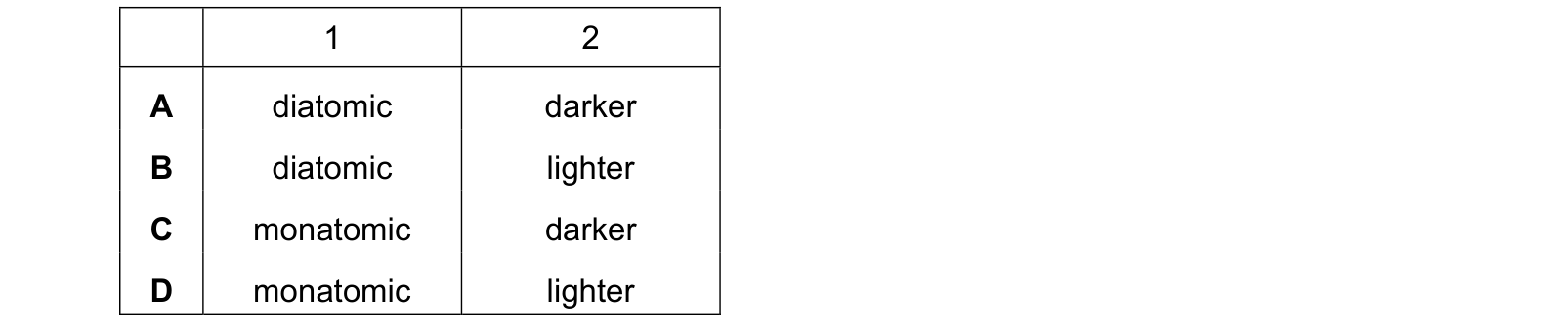
Answer: A.
Question 3
The properties of the elements in Group VII of the Periodic Table change going down the group.
Which change in properties is correct?
Answer: A.
What the syllabus asks for on this topicSyllabus points
Syllabus points
- Describe the Periodic Table as an arrangement of elements in order of proton number.
- Use the group number to predict the number of outer electrons and the charge on the ion formed.
- Describe the trends in Group I and explain them.
- Describe the trends in Group VII and explain them.
- Describe the properties of the transition elements and of the noble gases.
- Relate the position of an element to whether it is a metal or a non-metal.
Related CIE 0654 Co-ordinated Sciences topics
Not the topic you were looking for? Describe what you are stuck on in your own words and we will take you to the notes that answer it.