42 past-paper questions on this unit. Five of them are below. Answer on the page: each one is marked the moment you pick, the correct option is shown whether or not you found it, and the full explanation opens either way.
CIE 0654 Co-ordinated SciencesPaper 1 and Paper 2 MCQsFree account
The Periodic Table: five questions to try now
Real past-paper questions, the answer key from the mark scheme, and the explanation that goes with it. No account needed to answer them.
Question 1
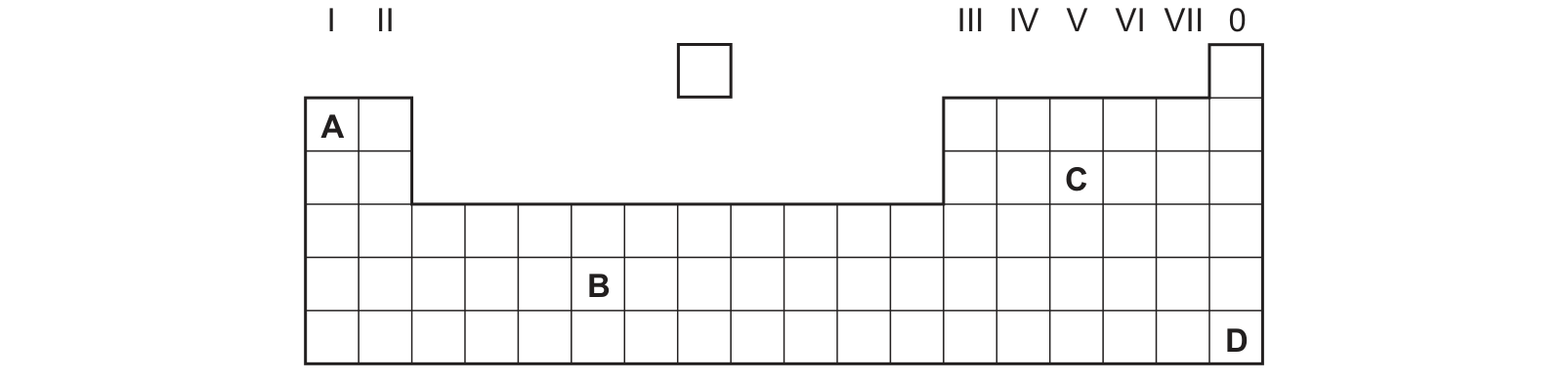
Element X is a dense solid with a high melting point. Which letter shows the position of X in the Periodic Table? Use the source image for S24 Paper 21, question 23.
Answer: B.
A dense solid with a high melting point points to a transition element, since those metals have strong metallic bonding and tightly packed atoms, and they occupy the central block between groups II and III, which is where B lies. A sits in group I, and the alkali metals are soft enough to cut with a knife, light enough to float on water and low enough in melting point that sodium melts in a hot beaker. C sits in group V among the non-metals of the upper right region, which are gases or low melting solids. D sits in group 0, the noble gases, which are gases at room temperature because their atoms form no bonds with one another.
Question 2
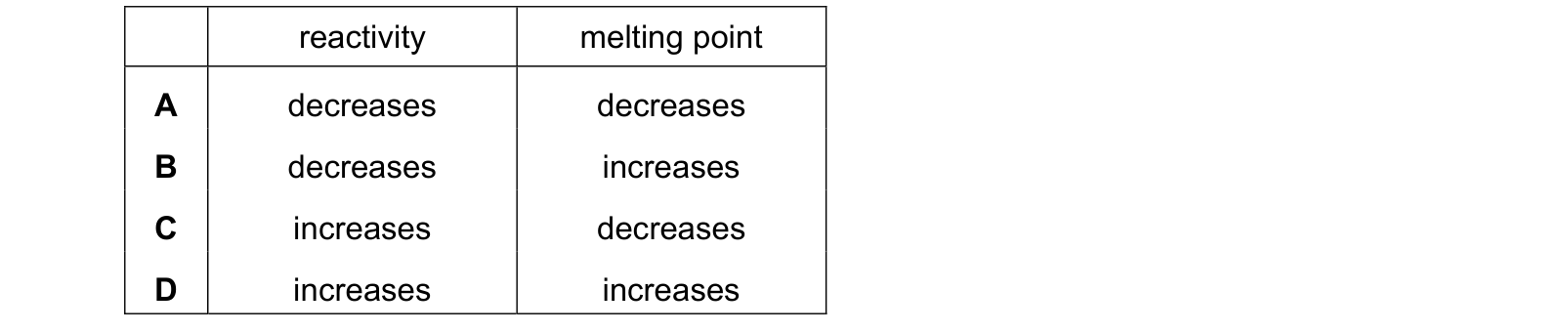
Which row about the trends in the elements going down Group I of the Periodic Table is correct? Each answer gives, in order: reactivity; melting point.
Answer: C.
Going down Group I each atom has one more full shell, so the single outer electron sits further from the nucleus and is better shielded and therefore lost more easily, which makes reactivity increase. Melting point moves the other way: the metal ions become larger, so the attraction between them and the sea of delocalised electrons weakens and less energy is needed to break the lattice apart. Anyone who chooses a decreasing reactivity is usually importing the Group VII trend, where reactivity genuinely does fall down the group, but a halogen has to gain an electron and a larger atom attracts one less strongly, which is the opposite requirement to a Group I metal losing one. The other trap is assuming a more reactive metal must be more strongly bonded and so melt higher, but reactivity depends on losing the outer electron while melting point depends on how tightly the lattice holds together.
Question 3
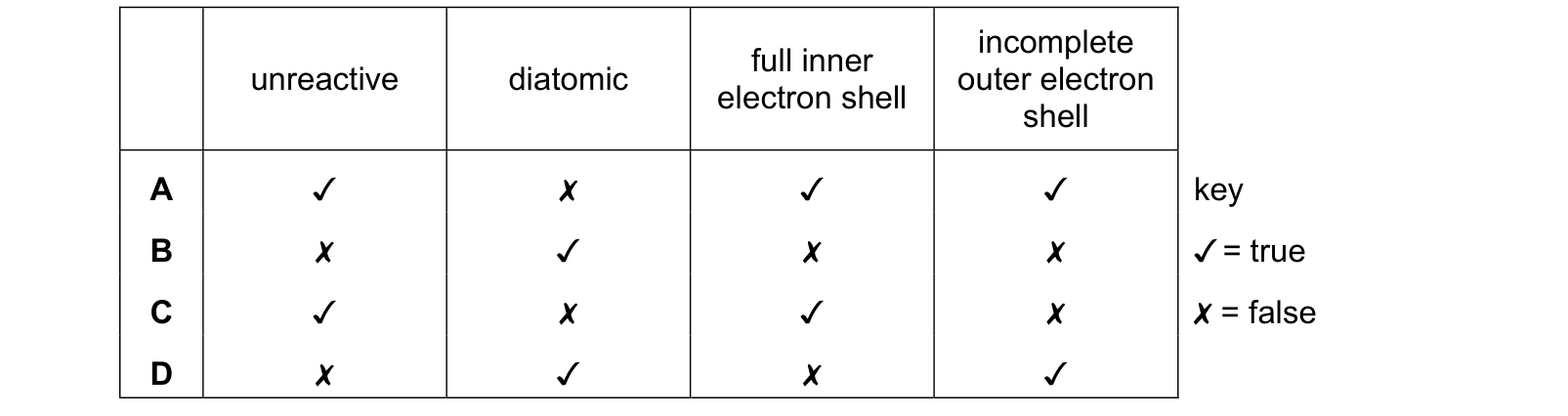
Neon is in Group Vlll of the Periodic Table. Which row about neon is correct? incomplete full inner unreactive diatomic outer electron electron shell shell Use the source image for S24 Paper 23, question 22.
Answer: C.
Neon is a noble gas, so its outer shell is already full with eight electrons, which is exactly why it is unreactive and why it exists as separate single atoms rather than as molecules. The first two columns therefore read tick then cross, since neon is unreactive but monatomic rather than diatomic. Its inner shell is full as well, holding the first two electrons, so that column is ticked, and the final column is crossed because a full outer shell is the opposite of an incomplete one, which makes C correct. A goes wrong only in the last column, claiming an incomplete outer shell, yet an incomplete shell is what makes an element reactive. B and D both call neon diatomic, confusing it with elements such as chlorine or oxygen, whose atoms must pair up to fill their shells.
Question 4
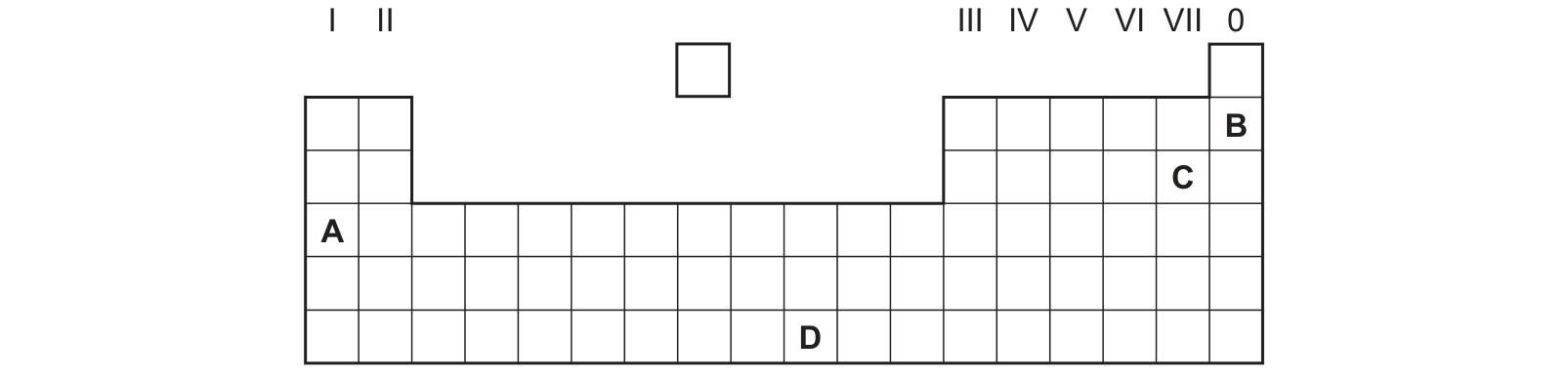
Element X increases the rate of some reactions. Element X is unchanged at the end of these reactions. What is the position of element X in the Periodic Table? Use the source image for M24 Paper 12, question 23.
Answer: D.
A substance that speeds a reaction and is chemically unchanged at the end is a catalyst, and the familiar catalysts are transition elements such as iron, nickel and platinum. Transition elements occupy the wide central block between group II and group III, which is where D sits, so D is correct. A lies in group I, the alkali metals, which are far too reactive to survive a reaction unchanged and would attack water or acid themselves. B lies in group 0, and a noble gas is so unreactive that it takes no part in a reaction at all, catalytic or otherwise. C lies in group VII, and a halogen would be used up as a reactant rather than recovered untouched.
Question 5
Elements in Group VI share similar chemical and physical trends as elements in Group VII. Which statement about the elements of Group VI is correct?
Answer: B.
Group VI follows the same kind of trends as Group VII, and one of them is that boiling points rise down the group as the molecules get larger and the forces between them get stronger, so sulfur, which is higher up, boils at a lower temperature than tellurium. The statement about selenium displacing sulfur is the tempting one, because displacement is the classic Group VII demonstration and the question openly invites the analogy, but the analogy runs the other way: reactivity falls down a group of non metals, so a higher element displaces a lower one and never the reverse. Group VI elements are non metals with six outer electrons, so they gain two electrons and form negative ions when they react with a metal such as sodium, never positive ones. Colour deepens rather than lightens down the group, just as it does among the halogens.
These questions are drawn from past CIE 0654 Co-ordinated Sciences papers and filtered to the periodic table. You answer, you find out immediately whether you were right, and you get the reasoning for the correct option and for each distractor. Wrong answers go to a mistakes locker so you can come back to exactly those.
Practice is free. You need an account only so your progress and your mistakes are still there next time.
These are the errors that cost marks on the periodic table, taken from our own topic notes. Read them before you practise and you will recognise the traps in the questions.
Saying reactivity increases down Group VII.
Saying reactivity decreases down Group I.
Explaining a Group I trend correctly and then applying the same words to Group VII.
Saying the halogens are monatomic.
Writing LiBr₂ or Na₇Cl from the group numbers.
Saying elements in a group are similar because they have the same number of shells. It is the outer electrons that matter.
Saying transition elements are in Group I, or that Group I metals form coloured compounds.
Answering "halogens" to a question about coloured compounds, when the elements rather than the compounds are the coloured ones.