Chemical energetics
Contents: 7 sections
Exothermic and endothermic
Exothermic reactions give out energy to the surroundings, so the mixture and its container get hotter.
Endothermic reactions take in energy from the surroundings, so the mixture and its container get colder.
A memory hook that survives exam pressure: exo for exit, endo for entering.
The single most reliable way to lose marks here is to describe the wrong side of the transfer. The reaction gives energy out, so the surroundings warm up. A reaction cannot warm the very surroundings it is drawing energy out of, so "endothermic reactions raise the temperature of the mixture" is self-contradictory as well as wrong.
| Exothermic | Endothermic |
|---|---|
| Combustion of any fuel | Thermal decomposition, such as heating calcium carbonate |
| Neutralisation of an acid by an alkali | Photosynthesis |
| Respiration | Dissolving ammonium nitrate in water |
| Displacement of a metal | Melting ice and evaporating water |
| Most metal and acid reactions | Electrolysis |
Respiration is exothermic and photosynthesis is endothermic. Respiration breaks glucose down and releases the energy stored in it, which is why you warm up when you exercise. Photosynthesis absorbs light energy in order to build glucose, which is why a plant in the dark cannot do it at all. Watch the order in which a question lists the two, because the answer rows are often ordered the other way round from the question sentence.
Worked example. Four reactions are started and their temperatures recorded. Which are endothermic?
| Reaction | Initial / °C | Final / °C |
|---|---|---|
| 1 | 22 | 16 |
| 2 | 22 | 27 |
| 3 | 20 | 28 |
| 4 | 20 | 18 |
An endothermic reaction takes heat in, so the temperature falls. Reaction 1 falls by 22 − 16 = 6 °C and reaction 4 falls by 20 − 18 = 2 °C, so 1 and 4 are endothermic. Reactions 2 and 3 rise, so they are exothermic. The size of the change does not matter; only its direction does.
Beware absolute words. "Exothermic reactions always produce a large temperature rise" is false, because the size of the rise depends on how much energy is released and how much material is present. A single counterexample sinks any statement containing always.
Why energy is given out or taken in
Every chemical reaction does two things:
- Breaking bonds takes energy in. Bond breaking is always endothermic.
- Making bonds gives energy out. Bond making is always exothermic.
Which of the two is larger decides the reaction.
- If more energy is released making bonds than was absorbed breaking them, the reaction is exothermic overall.
- If more energy is absorbed breaking bonds than is released making them, the reaction is endothermic overall.
That is the explanation to give when a question asks why a reaction is exothermic. Saying "because it gives out heat" restates the question; naming the bonds answers it.
Energy level diagrams
Draw energy on the vertical axis and the progress of the reaction across the bottom.
Exothermic: the products are lower than the reactants, because energy has left the chemicals. The energy change, ΔH, is negative.
Endothermic: the products are higher than the reactants, because energy has entered the chemicals. ΔH is positive.
Two features are labelled on both:
- The energy change (ΔH) is the vertical gap between the reactants and the products.
- The activation energy (Ea) is the vertical gap from the reactants up to the top of the hump. It is the minimum energy colliding particles must have for a reaction to happen at all.
Every reaction has an activation energy, including exothermic ones. That is why petrol does not ignite on its own even though burning it releases a great deal of energy: the mixture needs a spark to get the first particles over the barrier.
Calculating an energy change from bond energies
$Δ H = energy to break bonds - energy released making bonds$
Worked example. H₂ + Cl₂ → 2HCl. Bond energies in kJ/mol: H−H 436, Cl−Cl 242, H−Cl 431.
Bonds broken: one H−H and one Cl−Cl.
436 + 242 = 678 kJ absorbed
Bonds made: two H−Cl.
2 × 431 = 862 kJ released
ΔH = 678 − 862 = −184 kJ/mol
The answer is negative, so the reaction is exothermic, which fits the fact that more energy came out of bond making than went into bond breaking.
Three habits protect this calculation. Count the bonds in the balanced equation, so a 2 in front means two lots of every bond in that molecule. Always work out broken minus made, in that order. And check the sign against the chemistry: an exothermic reaction must give a negative answer, so a positive one usually means the subtraction was done the wrong way round.
Rate of reaction
Rate is about how fast, and energy change is about how much. The two are independent: rusting is exothermic and takes years, while a fast endothermic change still cools its surroundings.
A reaction happens when particles collide with at least the activation energy. Anything that increases the number of such collisions per second increases the rate.
| Change | Effect on rate | Why |
|---|---|---|
| Higher temperature | Faster | Particles move faster, so they collide more often, and a greater proportion of collisions carry the activation energy |
| Higher concentration | Faster | More particles in the same volume, so they collide more frequently |
| Higher pressure, for gases | Faster | Same reason: the particles are closer together |
| Smaller pieces, larger surface area | Faster | More of the solid is exposed for collisions |
| Catalyst | Faster | Provides an alternative pathway with a lower activation energy |
Two distinctions decide the harder questions.
Temperature does two things; concentration does one. Raising the concentration puts more particles in the way of each other, so collisions become more frequent, but it does not make them more energetic, because collision energy depends on temperature. So "the particles collide with greater energy" is the wrong explanation for a concentration effect.
Heating does not lower the activation energy. The activation energy is the height of the barrier for that reaction pathway, and heating the mixture does not move the barrier; it simply gets more particles over it. Lowering the barrier is what a catalyst does, by offering a different route. Confusing those two effects is the trap in one of the most common questions on the topic.
A catalyst speeds a reaction up and is not used up, so it can be recovered unchanged at the end and only a small amount is needed.
Common mistakes
- Saying an endothermic reaction makes the surroundings warmer.
- Describing a temperature rise as endothermic because "energy is being made".
- Saying bond breaking releases energy.
- Explaining why a reaction is exothermic by saying it gives out heat, without mentioning bonds.
- Giving a positive ΔH for an exothermic reaction.
- Calculating bonds made minus bonds broken instead of the other way round.
- Forgetting to multiply the bonds by the numbers in the balanced equation.
- Saying a higher concentration makes particles collide with more energy.
- Saying a higher temperature lowers the activation energy.
- Saying a fast reaction must be exothermic, or that rate and energy change are linked.
- Saying a catalyst is used up, or that it changes the energy change of the reaction. It changes only the activation energy.
Check you have it
Question 1
Which energy level diagram shows the activation energy for an exothermic reaction? Use the source image for W24 Paper 23, question 17.
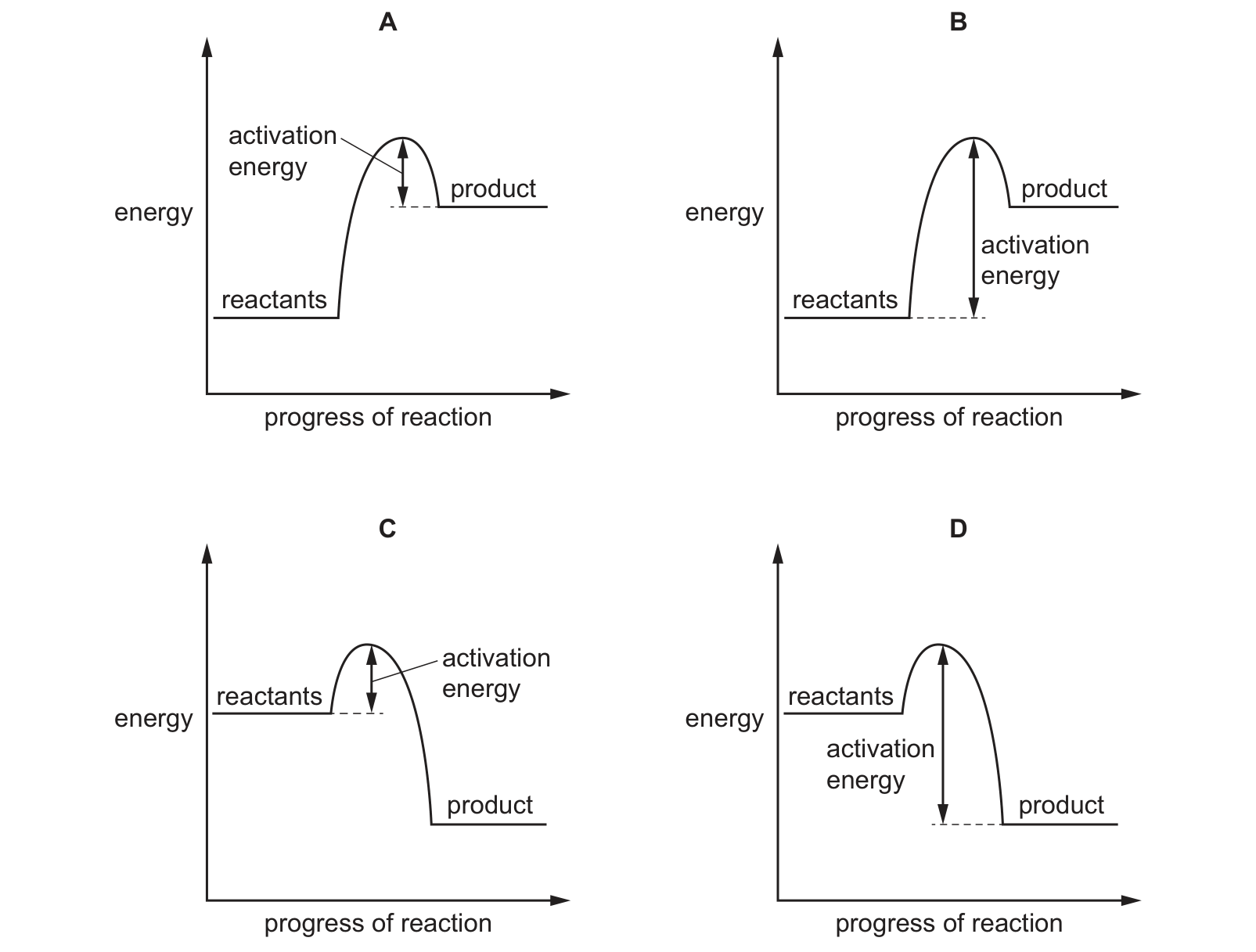
Answer: C.
Question 2
Which energy level diagram correctly represents an exothermic reaction? Use the source image for W22 Paper 23, question 19.
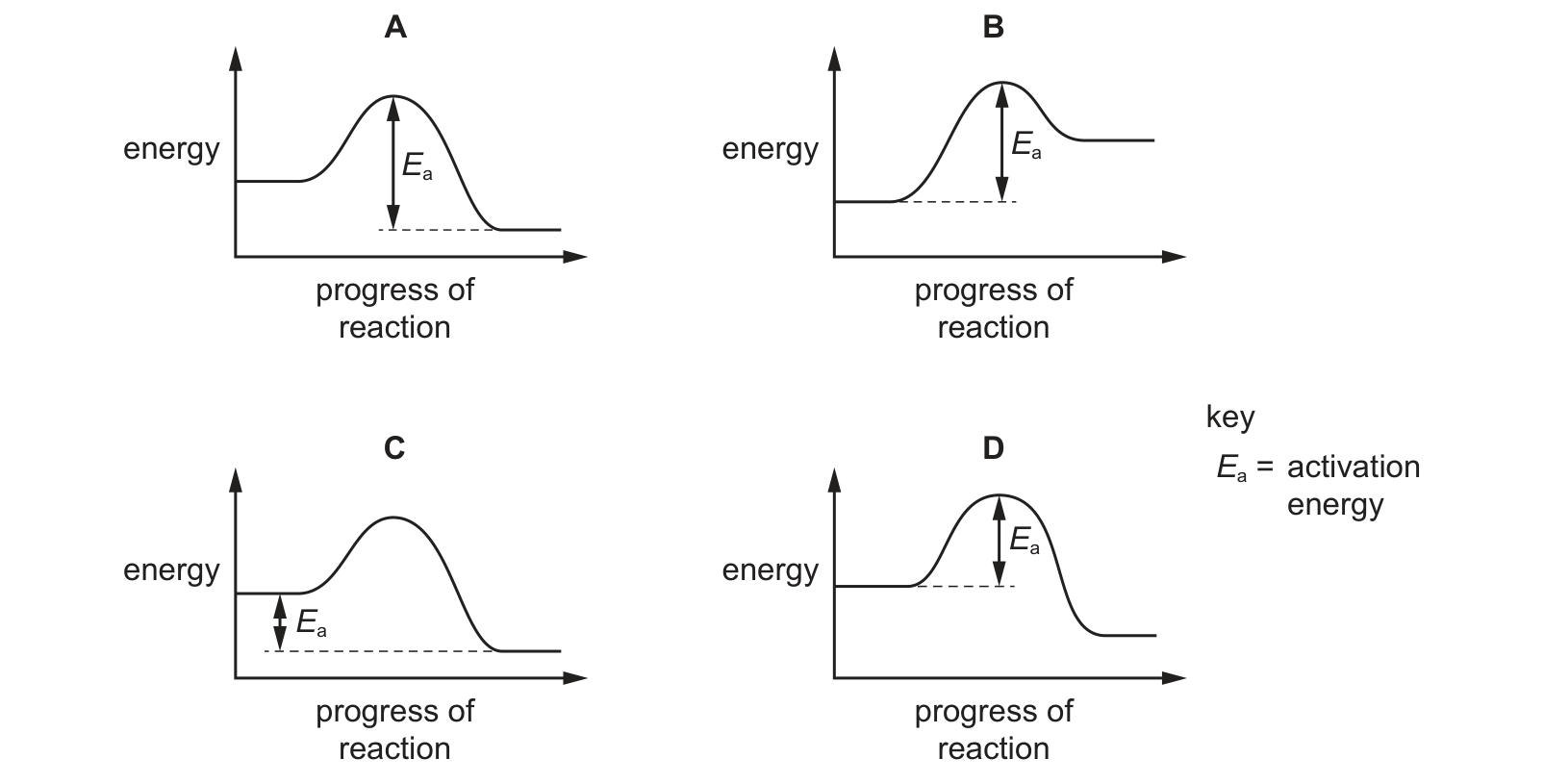
Answer: D.
Question 3
The temperature of solution Q is 21 °C. The temperature of solution P is 24 °C.
The two solutions are mixed. The temperature of the mixture is 31 °C.
Which statement is correct?
Answer: D.
What the syllabus asks for on this topicSyllabus points
Syllabus points
- State that a reaction that gives out heat is exothermic and one that takes heat in is endothermic.
- Interpret and draw energy level diagrams, marking the reactants, products, activation energy and energy change.
- Explain an energy change in terms of the energy needed to break bonds and the energy released when bonds form.
- Calculate an energy change from bond energies.
- Explain how temperature, concentration and a catalyst change the rate of a reaction.
Related CIE 0654 Co-ordinated Sciences topics
Not the topic you were looking for? Describe what you are stuck on in your own words and we will take you to the notes that answer it.