Coordination and response
Contents: 7 sections
The nervous system
The central nervous system is the brain and spinal cord. The peripheral nervous system is the nerves connecting it to the rest of the body.
Three kinds of neurone:
- Sensory carries impulses from receptors to the CNS.
- Relay connects neurones inside the CNS.
- Motor carries impulses from the CNS to effectors, which are muscles or glands.
A reflex action is fast, automatic and protective, and it does not require conscious thought. The pathway is the reflex arc:
stimulus → receptor → sensory neurone → relay neurone (in the spinal cord) → motor neurone → effector → response
Pulling a hand from a hot object is the standard example. It is fast precisely because the impulse does not need to travel to the brain and back before the muscle acts.
A synapse is the gap between two neurones. The impulse cannot jump it, so the first neurone releases a neurotransmitter, which diffuses across and starts an impulse in the next. Because only one side releases the chemical, synapses make the impulse travel one way only.
The eye
| Part | Function |
|---|---|
| Cornea | Refracts light, doing most of the focusing |
| Iris | Controls how much light enters |
| Pupil | The hole light passes through |
| Lens | Fine focusing, changes shape |
| Retina | Contains the light receptors |
| Optic nerve | Carries impulses to the brain |
In bright light the circular muscles of the iris contract and the pupil gets smaller, protecting the retina. In dim light the radial muscles contract and the pupil gets larger, letting more light in. This is a reflex.
Focusing is done by the lens changing shape. For a near object the ciliary muscles contract, the suspensory ligaments slacken and the lens becomes fatter. For a distant object the ciliary muscles relax, the ligaments pull tight and the lens becomes thinner.
The counter-intuitive part, and the part most often got wrong, is that the ligaments are slack when the muscle contracts.
Hormones
A hormone is a chemical made by a gland, carried in the blood, and acting on target organs.
| Nervous | Hormonal | |
|---|---|---|
| Transmitted by | Neurones | Blood |
| Speed | Very fast | Slower |
| Duration | Short | Longer |
| Target | Precise | Widespread |
Adrenaline, from the adrenal glands, prepares the body for action: heart rate and breathing rate rise, and blood glucose rises, delivering more glucose and oxygen to the muscles.
Homeostasis
Homeostasis is keeping a constant internal environment.
Blood glucose. After a meal glucose rises; the pancreas releases insulin, which makes the liver convert glucose into glycogen, and glucose falls. If glucose falls too low the pancreas releases glucagon, which converts glycogen back into glucose.
In type 1 diabetes the pancreas does not make enough insulin, so blood glucose stays high and glucose appears in the urine. It is treated with insulin injections and by controlling diet.
Temperature. When too hot: sweat is produced and evaporates, taking energy from the skin; vasodilation widens the blood vessels near the surface so more blood flows there and more energy is lost.
When too cold: vasoconstriction narrows those vessels, shivering generates energy from muscle contraction, and hairs are raised to trap air.
The vessels do not move up and down in the skin, which is a common misreading. They widen and narrow.
Plant responses
A tropism is a growth response towards or away from a stimulus.
- Phototropism is a response to light. Shoots are positively phototropic and grow towards it.
- Gravitropism is a response to gravity. Roots are positively gravitropic and grow downwards.
Auxin is the hormone responsible. In a shoot lit from one side, auxin accumulates on the shaded side, where it makes the cells elongate more. That side grows longer, so the shoot bends towards the light.
Auxin promotes elongation in shoots. Getting the direction the wrong way round is the classic error, and it produces a shoot bending away from light, which is not what happens.
Common mistakes
- Saying a reflex impulse travels to the brain first.
- Saying an impulse jumps the synapse electrically.
- Saying the lens does most of the focusing. The cornea does; the lens fine-tunes.
- Saying suspensory ligaments tighten when the ciliary muscles contract.
- Saying insulin converts glycogen to glucose. That is glucagon.
- Saying blood vessels move deeper into the skin when cold.
- Saying auxin makes the lit side of a shoot grow faster.
Check you have it
Question 1
A plant was placed horizontally in complete darkness.
The diagram shows how the plant had grown after one week. Which response has the shoot made?

Answer: A.
Question 2
The diagram shows a neurone and associated structures. Which type of neurone is shown and in which direction do impulses travel? Each answer gives, in order: type of neurone; direction of impulse.
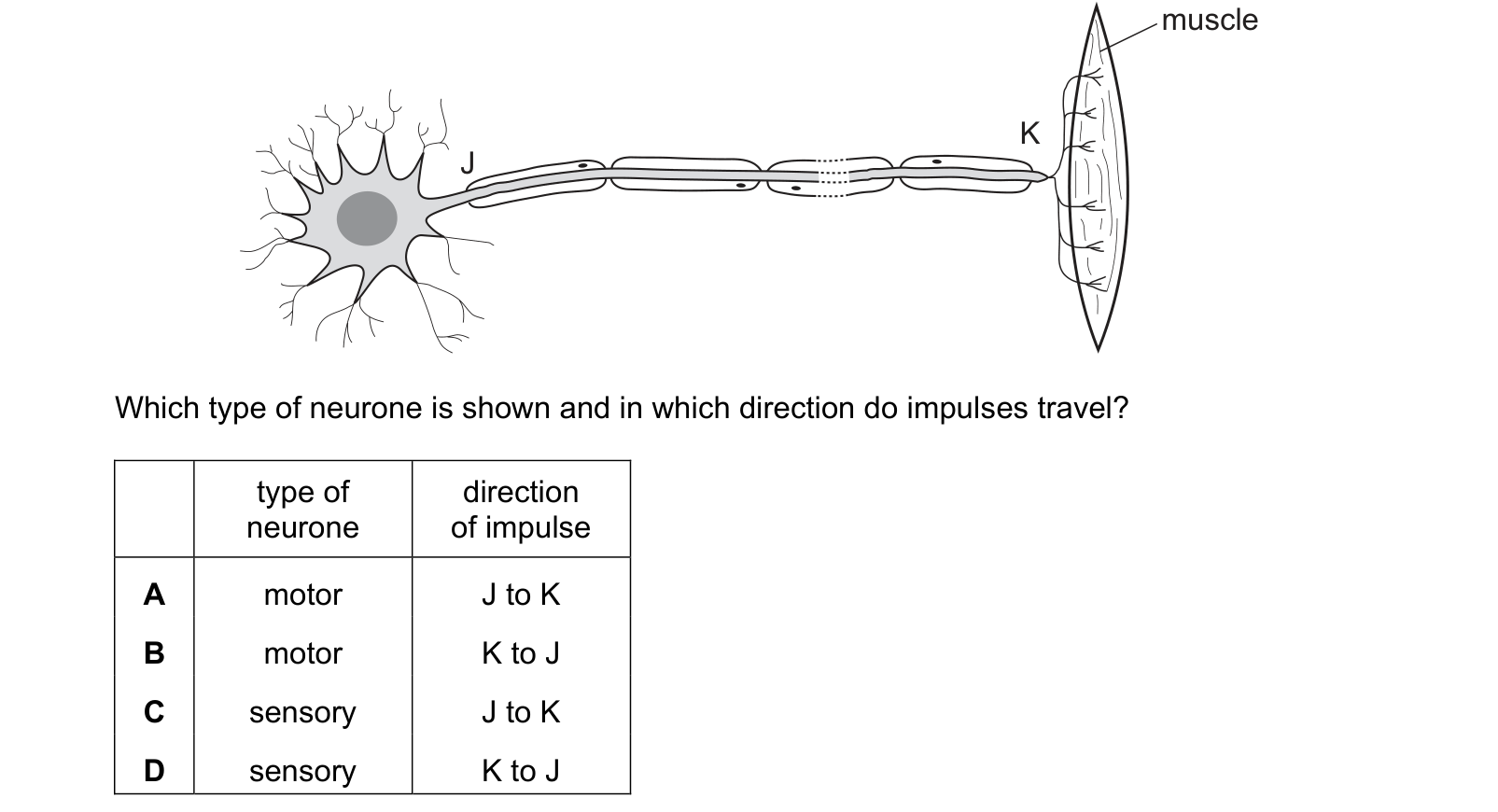
Answer: A.
Question 3
Which activities increase the secretion of adrenaline in the human body? watching a running to relaxing in frightening catch a bus the sun horror film Use the source image for W24 Paper 12, question 9.
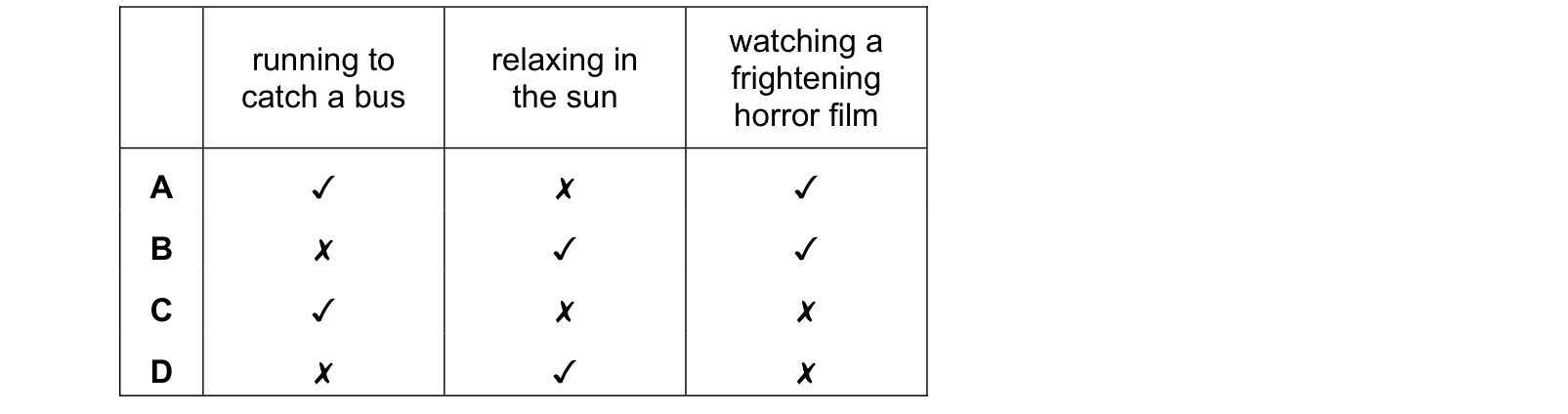
Answer: A.
What the syllabus asks for on this topicSyllabus points
Syllabus points
- Describe the nervous system and the reflex arc.
- Describe the structure and function of the eye.
- Describe the role of hormones, including adrenaline and insulin.
- Explain homeostasis, using temperature and blood glucose control.
- Describe tropic responses in plants.
Related CIE 0654 Co-ordinated Sciences topics
Not the topic you were looking for? Describe what you are stuck on in your own words and we will take you to the notes that answer it.