46 past-paper questions on this unit. Five of them are below. Answer on the page: each one is marked the moment you pick, the correct option is shown whether or not you found it, and the full explanation opens either way.
CIE 0654 Co-ordinated SciencesPaper 1 and Paper 2 MCQsFree account
Coordination and response: five questions to try now
Real past-paper questions, the answer key from the mark scheme, and the explanation that goes with it. No account needed to answer them.
Question 1
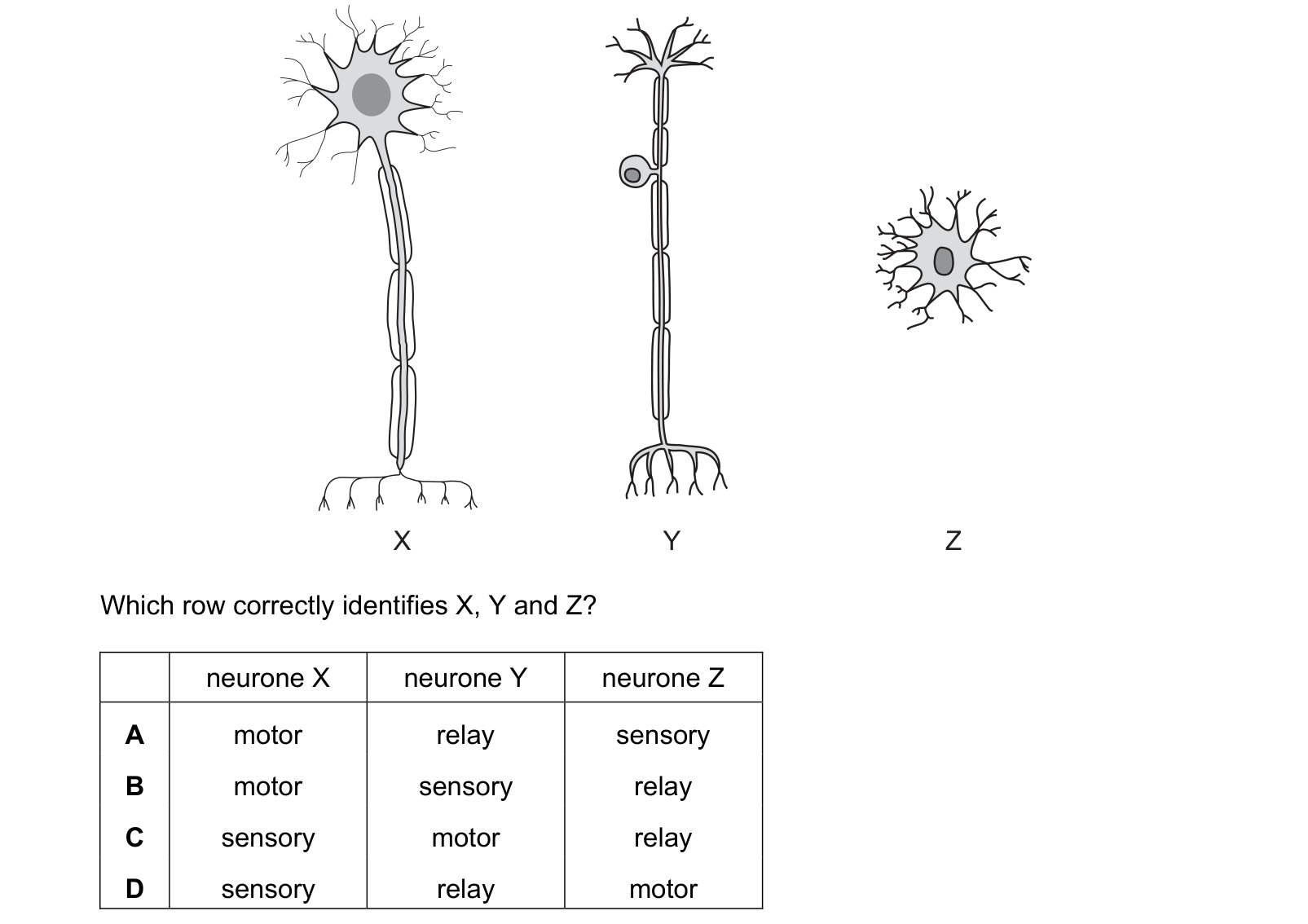
The diagram shows three different neurones which form the reflex arc. Which row correctly identifies X, Y and Z? Each answer gives, in order: neurone X; neurone Y; neurone Z.
Answer: B.
A motor neurone has its cell body at one end with dendrites branching directly off it, and a single long fibre that ends in fine branches spread over a muscle, which is the shape drawn at X. A sensory neurone is recognised because its cell body sits partway along the fibre, carried by a short stalk, instead of at the end, which is exactly what Y shows. A relay neurone is short, has no extended fibre and carries many branching processes from a central cell body, so Z is the relay neurone of the spinal cord. The two rows that call X sensory ignore the position of its cell body, which sits at the end of the fibre rather than to one side of it. The two rows that make Y the relay neurone hand a fibre of considerable length to a cell whose whole job is to link two other neurones across the width of the spinal cord.
Question 2
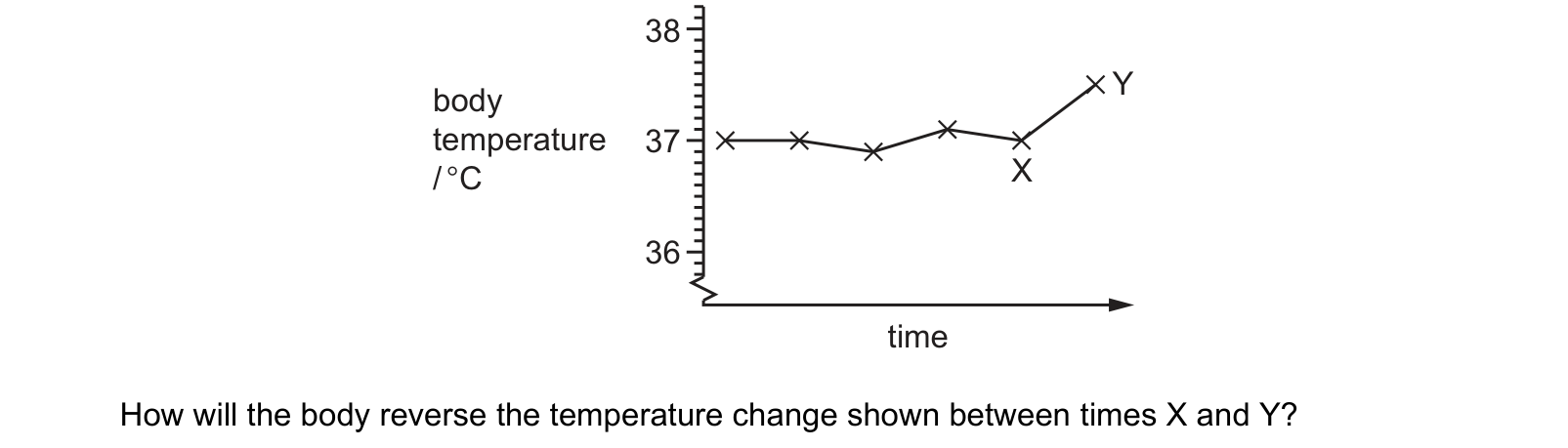
The graph shows the variation of body temperature over time of a healthy person at rest. How will the body reverse the temperature change shown between times X and Y?
Answer: D.
Between X and Y the body temperature climbs from about 37.0 degrees C to about 37.5 degrees C, so the correction the body needs is one that cools it. Sweating does exactly that, because the water in sweat takes latent heat from the skin as it evaporates. Shivering is the opposite response, since rapid muscle contraction releases heat and is used when the body is too cold. Changing the breathing rate answers the levels of oxygen and carbon dioxide rather than temperature, and slowing it would remove no heat. Slowing the pulse would reduce blood flow to the skin, which traps heat inside the body rather than releasing it.
Question 3
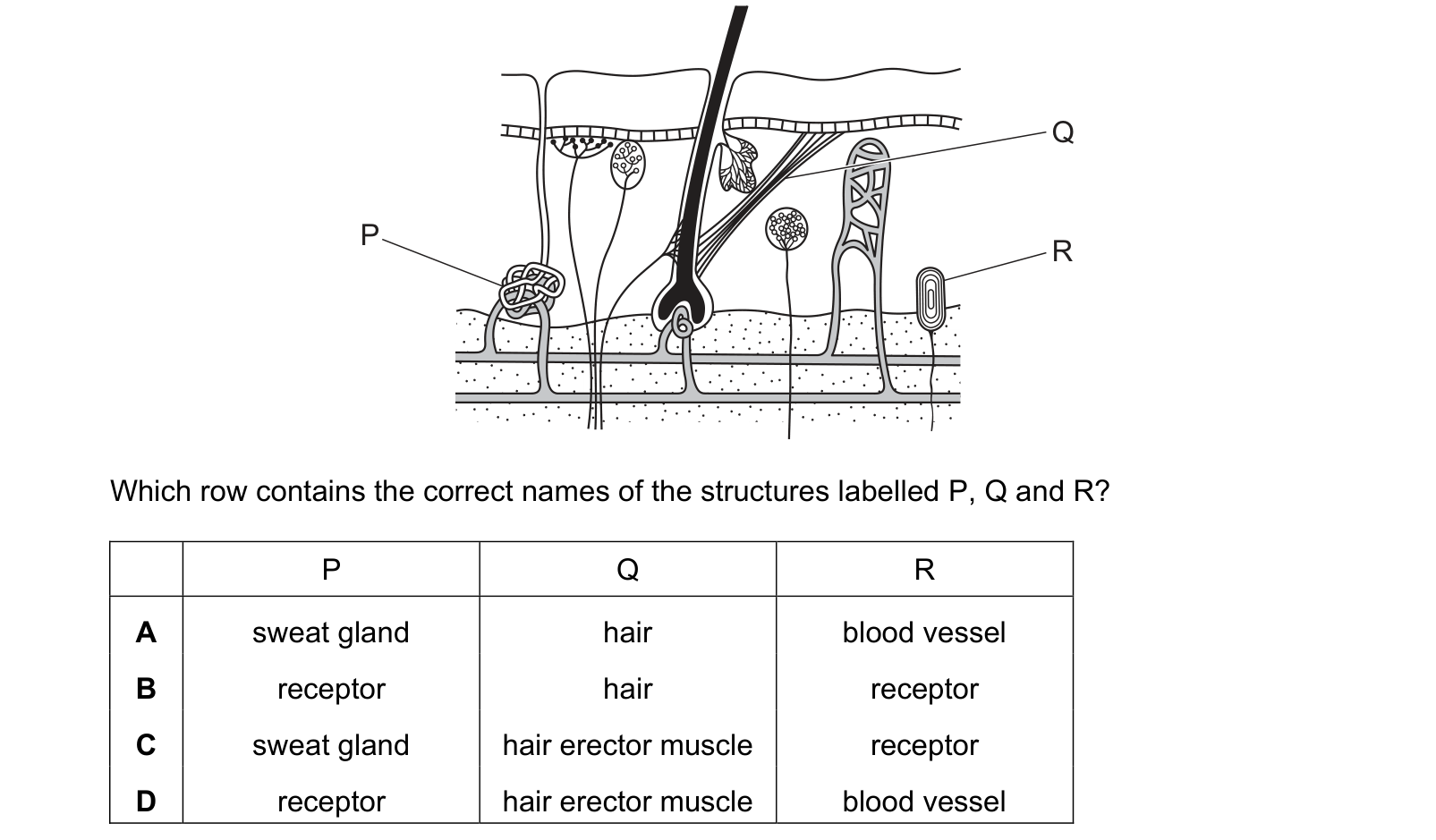
The diagram shows a section through the skin. Which row contains the correct names of the structures labelled P, Q and R? Each answer gives, in order: P; Q; R.
Answer: C.
P points to a tightly coiled tube deep in the dermis with a duct running up to the surface, which is a sweat gland, the structure that cools the body by releasing sweat that then evaporates. Q points to the band of tissue that slants from the base of the follicle to the epidermis, the hair erector muscle that pulls the hair upright when it contracts, and R marks a small self contained oval capsule, which is a sensory receptor. C is the only row with all three names right. A calls Q the hair, but the hair is the thick shaft drawn passing out through the skin, and Q lies alongside it rather than being it. B calls P a receptor, which ignores the coiled duct carrying sweat up to the surface.
Question 4
The graph shows the pulse rate over a period of time. At which point is adrenaline released into the blood? Use the source image for M23 Paper 12, question 9.
Answer: A.
Adrenaline is released in fear, excitement or exercise, and one of its effects is to make the heart beat faster, so it must reach the blood just before the pulse rate starts to climb. On this trace the line leaves its resting level at the first marked point, so that is where the hormone enters the blood. The point where the pulse reaches its plateau marks the moment the response is complete rather than the moment it was triggered, so taking it confuses the effect with its cause. The point at the start of the fall is where the adrenaline is being broken down and its concentration is dropping, which is the reverse of release. The last point, where the pulse has settled back at its resting level, is later still and shows no adrenaline effect remaining.
Question 5
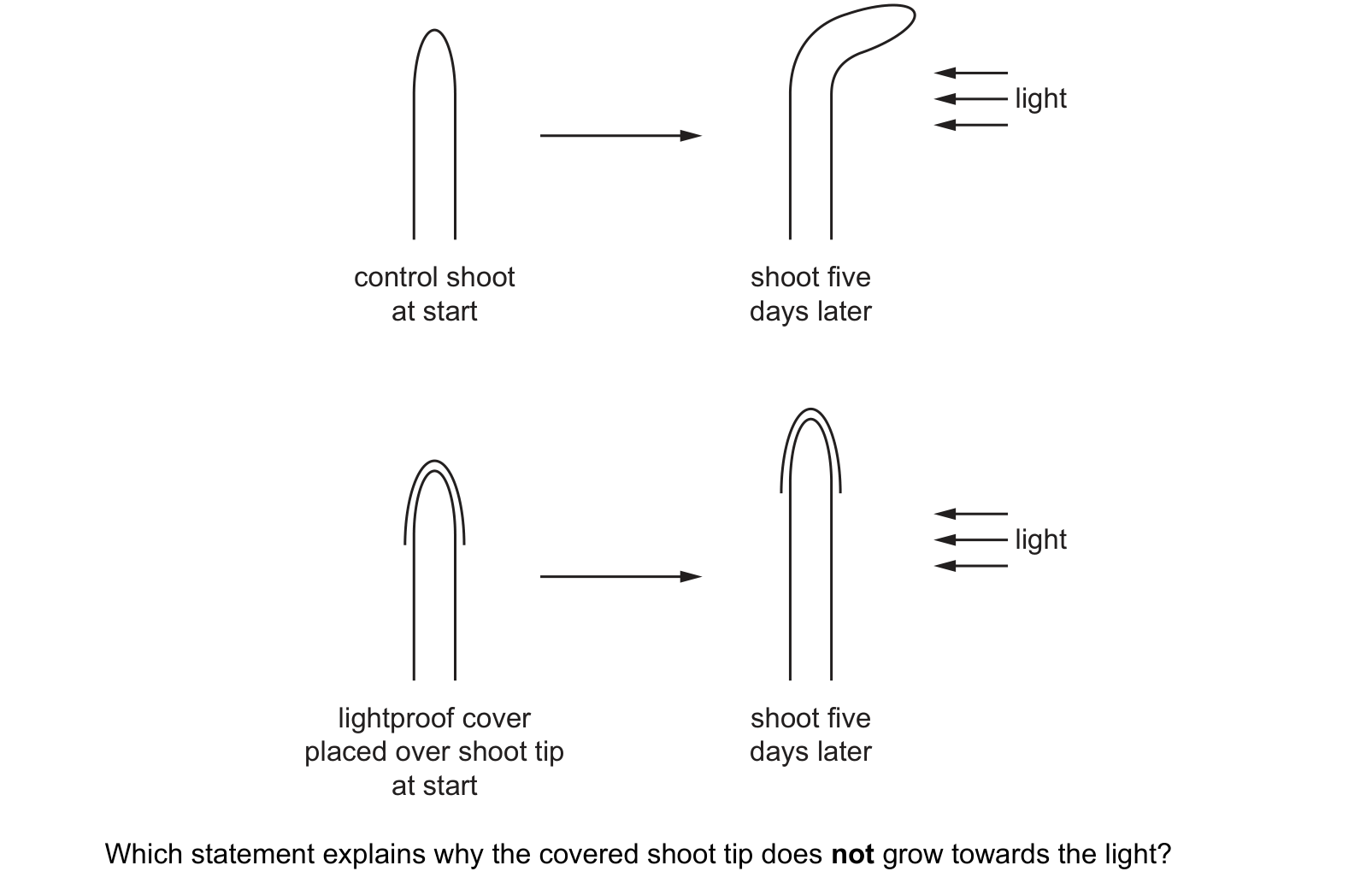
The diagram shows an experiment using the shoots of seedlings. placed over shoot tip days later at start Which statement explains why the covered shoot tip does not grow towards the light?
Answer: B.
The shoot tip is where light direction is detected and where auxin is made, and a shoot bends towards light because auxin gathers on the shaded side, so those cells elongate more than the lit ones. Covering the tip stops it sensing any difference between the two sides, so the auxin stays evenly spread, both sides elongate equally and the shoot grows straight upwards. Saying the cover reduces auxin production is ruled out by the picture, in which the covered shoot has still grown taller, and growth in length depends on auxin. Saying the cover stops auxin diffusing out of the tip fails for the same reason, since a shoot receiving no auxin would not elongate at all. Saying the cover stimulates elongation without auxin invents a mechanism, because a lightproof cap is a barrier and not a stimulus.
These questions are drawn from past CIE 0654 Co-ordinated Sciences papers and filtered to coordination and response. You answer, you find out immediately whether you were right, and you get the reasoning for the correct option and for each distractor. Wrong answers go to a mistakes locker so you can come back to exactly those.
Practice is free. You need an account only so your progress and your mistakes are still there next time.
These are the errors that cost marks on coordination and response, taken from our own topic notes. Read them before you practise and you will recognise the traps in the questions.
Saying a reflex impulse travels to the brain first.
Saying an impulse jumps the synapse electrically.
Saying the lens does most of the focusing. The cornea does; the lens fine-tunes.
Saying suspensory ligaments tighten when the ciliary muscles contract.
Saying insulin converts glycogen to glucose. That is glucagon.
Saying blood vessels move deeper into the skin when cold.
Saying auxin makes the lit side of a shoot grow faster.