Biological molecules
Contents: 6 sections
Elements and building blocks
| Molecule | Elements | Built from |
|---|---|---|
| Carbohydrate | C, H, O | Simple sugars such as glucose |
| Fat (lipid) | C, H, O | Three fatty acids and one glycerol |
| Protein | C, H, O, N | Amino acids |
Nitrogen is the discriminator. Carbohydrates and fats contain only carbon, hydrogen and oxygen; only protein adds nitrogen. Many questions are answered from that one fact. Some proteins also contain sulfur.
Carbohydrates and fats share the same three elements but in different proportions: fats hold much less oxygen relative to carbon and hydrogen, which is why they store more energy per gram.
Starch and glycogen are large molecules built from many glucose units. Starch is the plant store, glycogen the animal store. Both are insoluble, which is what makes them good stores: they do not dissolve and upset the water balance of the cell, and they cannot diffuse out.
The food tests
These are examined more often than anything else in the topic, so learn the reagent, the condition and both colours.
| Test for | Reagent | Method | Positive result |
|---|---|---|---|
| Starch | Iodine solution | Add drops at room temperature | Orange-brown to blue-black |
| Reducing sugar | Benedict's solution | Add and heat in a water bath | Blue to brick red |
| Protein | Biuret solution | Add at room temperature | Blue to purple |
| Fat | Ethanol, then water | Dissolve in ethanol, pour into water | Cloudy white emulsion |
Two details decide marks. Benedict's must be heated; without heating there is no colour change even with sugar present. And the Benedict's result is graded: with a little sugar it goes green, then yellow, then orange, then brick red with a lot, so the test gives a rough idea of quantity as well as presence.
Always give both colours. "Turns blue-black" earns the mark; "goes dark" does not.
Enzymes in one paragraph
Enzymes are proteins that act as biological catalysts: they speed up reactions and are not used up. Each has an active site with a shape complementary to its substrate, which is why each enzyme works on one reaction only.
Raising the temperature speeds an enzyme up to an optimum, then activity falls sharply as the enzyme denatures and the active site changes shape. Denaturing is permanent; the enzyme does not recover on cooling. Extremes of pH denature enzymes too.
Say denatured, not "killed". An enzyme was never alive.
DNA
DNA is the molecule that carries the genetic code. It is a double helix, two strands twisted together.
The strands are held by bases, which pair in a fixed way: A with T, and C with G. That complementary pairing is what lets DNA be copied accurately, because each strand carries the information needed to rebuild the other.
A gene is a length of DNA that codes for one protein, by setting the order of amino acids in it. Because enzymes are proteins, genes ultimately control the reactions of the cell.
A chromosome is a long molecule of DNA carrying many genes. A human body cell has 46 chromosomes, in 23 pairs.
Common mistakes
- Saying carbohydrates contain nitrogen.
- Saying fats are made of amino acids, or proteins of glucose.
- Forgetting to heat Benedict's solution.
- Giving only the final colour instead of the change.
- Saying iodine goes black. It goes blue-black, from orange-brown.
- Saying an enzyme is killed rather than denatured.
- Pairing A with C, or G with T.
- Saying a gene is the same thing as a chromosome.
Check you have it
Question 1
Three food tests are carried out on a sample of food. The results are shown. food test final colour Benedict’s blue biuret blue iodine blue-black From these results, which nutrient is in the food?

Answer: C.
Question 2
What is required to test for the presence of a reducing sugar? Benedict’s biuret heat solution solution Use the source image for W24 Paper 12, question 3.
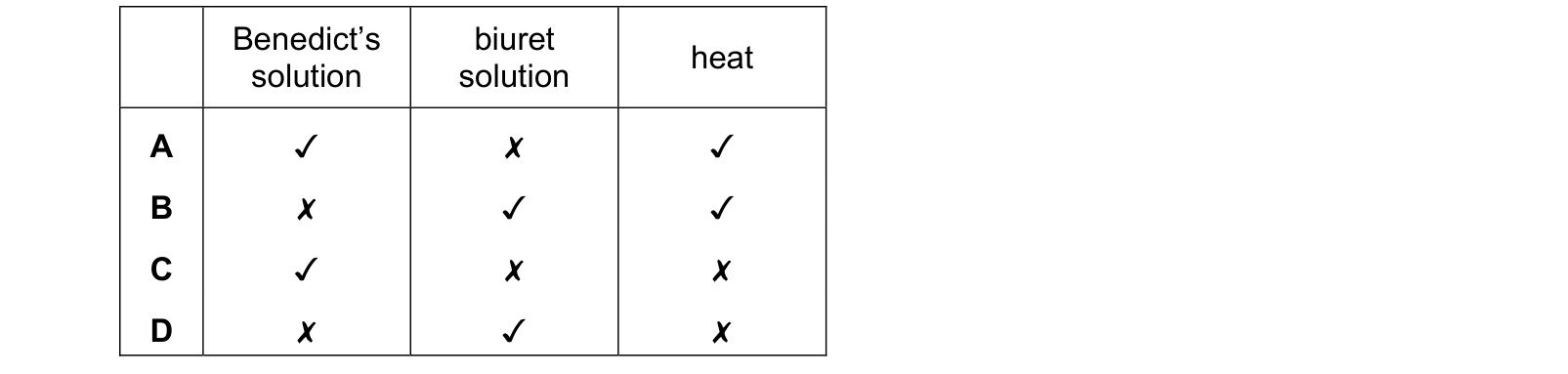
Answer: A.
Question 3
What is required to test for the presence of a reducing sugar? Benedict’s biuret heat solution solution Use the source image for W24 Paper 13, question 3.
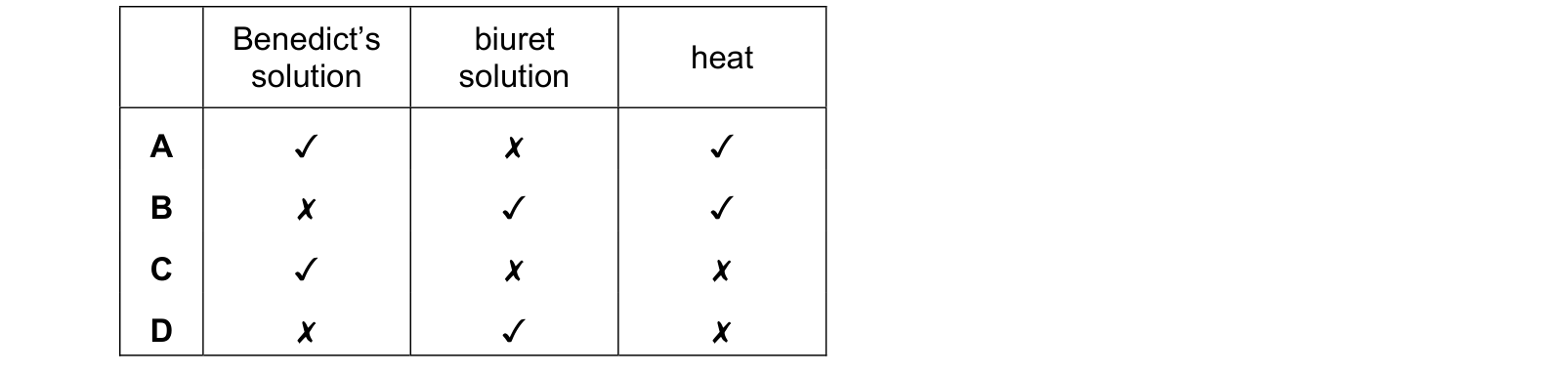
Answer: A.
What the syllabus asks for on this topicSyllabus points
Syllabus points
- State the elements in carbohydrates, fats and proteins.
- Name the small units that build each large molecule.
- Describe the food tests for starch, reducing sugars, protein and fats.
- Describe the structure and role of DNA in outline.
Related CIE 0654 Co-ordinated Sciences topics
Not the topic you were looking for? Describe what you are stuck on in your own words and we will take you to the notes that answer it.