Acids, bases and salts
Contents: 6 sections
Acids and bases
An acid produces H⁺ ions in aqueous solution. A base is a substance that neutralises an acid; a base that dissolves in water is an alkali, and produces OH⁻ ions.
The pH scale runs from 0 to 14:
- pH below 7 is acidic, and the lower the number the more acidic.
- pH 7 is neutral: pure water, sodium chloride solution.
- pH above 7 is alkaline.
| Indicator | In acid | In alkali |
|---|---|---|
| Litmus | Red | Blue |
| Methyl orange | Red | Yellow |
| Thymolphthalein | Colourless | Blue |
| Universal indicator | Red through orange | Blue through purple |
Universal indicator gives a range of colours and so estimates pH; litmus only tells you which side of neutral you are on.
The three reactions of acids
Every acid question is built from these, and each has a fixed pair of products.
acid + metal → salt + hydrogen
Only for metals above hydrogen in the reactivity series. The gas pops with a lighted splint.
acid + base (or metal oxide) → salt + water
This is neutralisation in its plainest form.
acid + carbonate → salt + water + carbon dioxide
The gas turns limewater milky, which is the standard test.
Naming the salt takes the metal from the base and the rest from the acid:
- hydrochloric acid gives chlorides
- sulfuric acid gives sulfates
- nitric acid gives nitrates
So magnesium plus sulfuric acid gives magnesium sulfate and hydrogen; copper carbonate plus nitric acid gives copper nitrate, water and carbon dioxide.
Making salts
A soluble salt from an insoluble base. Warm the acid, add the metal oxide or carbonate in excess so all the acid is used up, filter off the leftover solid, then crystallise the filtrate by evaporating some of the water and leaving it to cool.
Using excess and filtering is the whole point of the method: it guarantees no acid is left in the product without needing an indicator.
A soluble salt from an alkali. Both reactants are solutions, so nothing can be filtered off and excess cannot be used. Use titration instead: find the exact volume of acid that neutralises the alkali using an indicator, then repeat with those volumes and no indicator, and crystallise.
An insoluble salt. Mix two solutions that contain the right ions, and the salt appears as a precipitate. Filter it, wash it with distilled water, and dry it. Barium sulfate is made this way from barium nitrate and sodium sulfate.
Knowing which method to choose depends on solubility. Sodium, potassium and ammonium salts are all soluble; all nitrates are soluble; most chlorides are soluble except silver and lead; most sulfates are soluble except barium, calcium and lead; most carbonates are insoluble except sodium, potassium and ammonium.
Testing for gases
| Gas | Test | Result |
|---|---|---|
| Hydrogen | Lighted splint | Squeaky pop |
| Oxygen | Glowing splint | Relights |
| Carbon dioxide | Bubble through limewater | Turns milky |
| Ammonia | Damp red litmus | Turns blue |
| Chlorine | Damp litmus | Bleached white |
The two splint tests are easy to swap. Hydrogen needs a lighted splint and pops; oxygen needs a glowing one and relights it.
Common mistakes
- Saying an acid produces OH⁻ ions.
- Saying pH 0 is neutral, or that the scale runs 1 to 10.
- Forgetting the water in acid plus base, or the carbon dioxide in acid plus carbonate.
- Saying an acid plus a metal gives water.
- Using excess solid with an alkali, which cannot be filtered off.
- Leaving the indicator in during the final titration, which contaminates the salt.
- Swapping the lighted and glowing splint tests.
- Saying limewater turns milky with any gas. It is specific to carbon dioxide.
Check you have it
Question 1
What reacts with ammonia gas? hydrochloric sodium acid hydroxide Use the source image for M24 Paper 12, question 21.
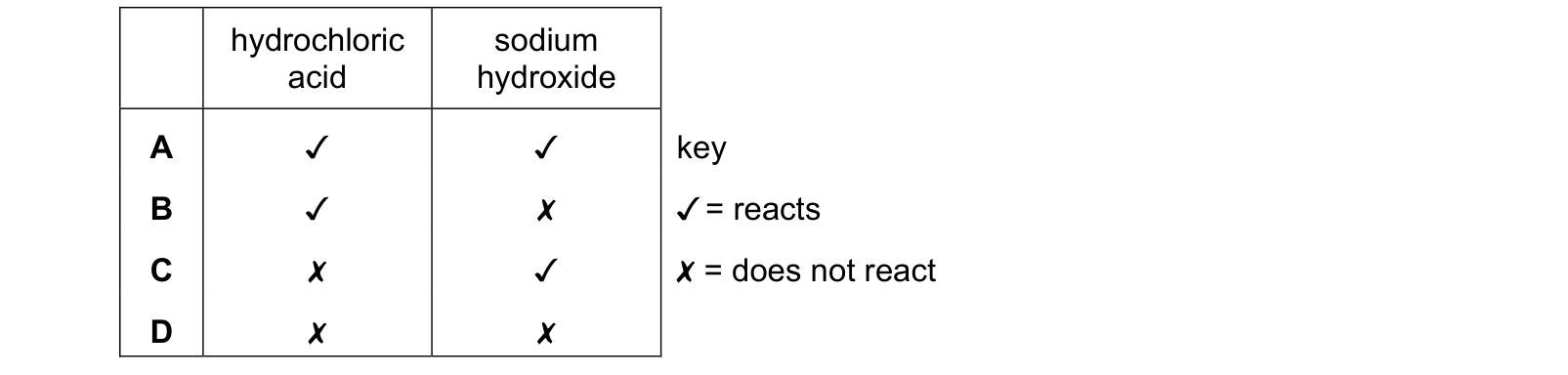
Answer: B.
Question 2
What reacts with ammonia gas? hydrochloric sodium acid hydroxide Use the source image for S21 Paper 11, question 20.
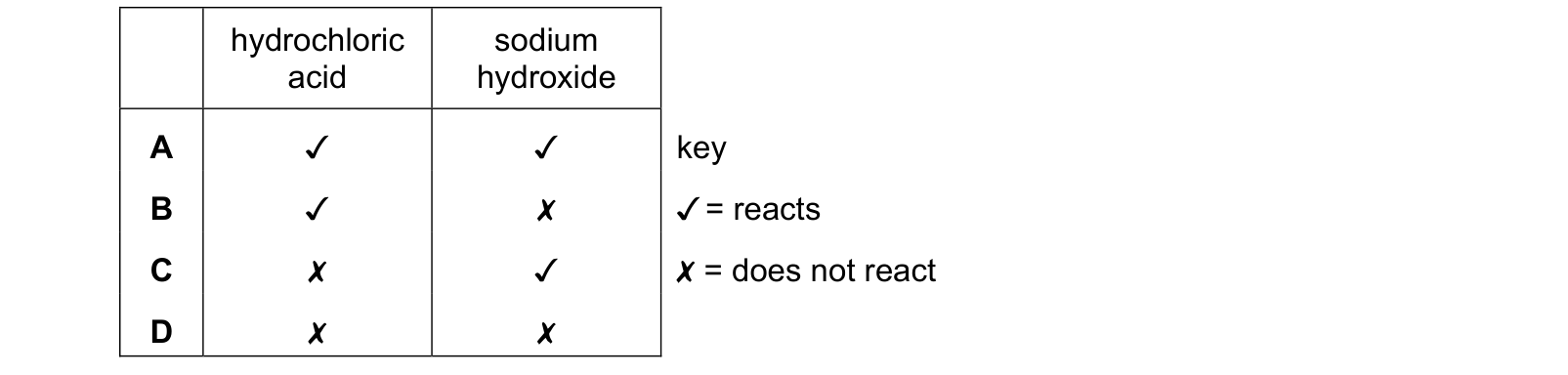
Answer: B.
Question 3
What reacts with ammonia gas? hydrochloric sodium acid hydroxide Use the source image for S21 Paper 12, question 20.
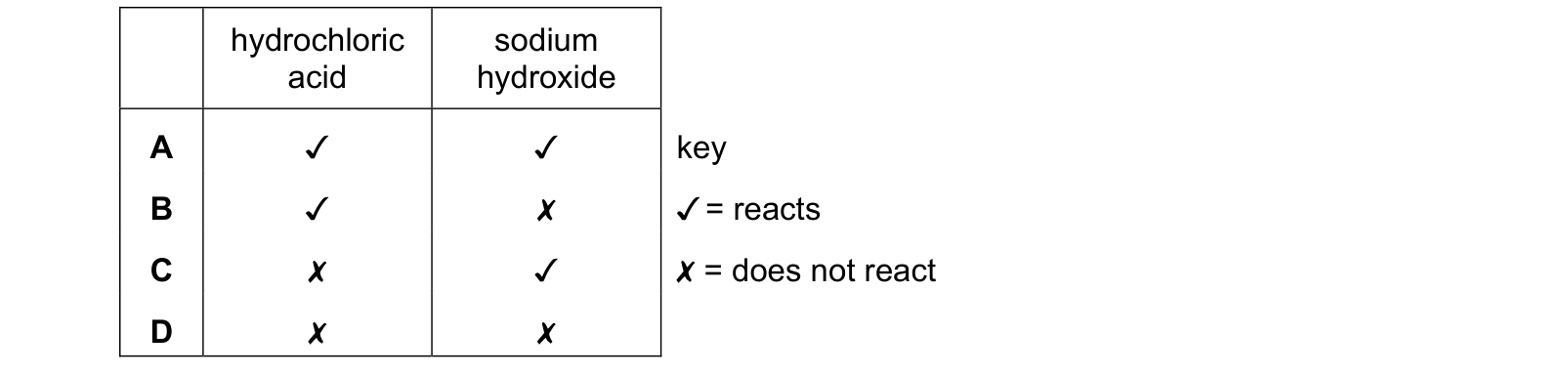
Answer: B.
What the syllabus asks for on this topicSyllabus points
Syllabus points
- Describe the characteristic properties of acids and bases and use the pH scale.
- Describe neutralisation and the reactions of acids.
- Describe the preparation of soluble and insoluble salts.
- Use indicators and test for common gases.
Related CIE 0654 Co-ordinated Sciences topics
Not the topic you were looking for? Describe what you are stuck on in your own words and we will take you to the notes that answer it.