78 past-paper questions on this unit. Five of them are below. Answer on the page: each one is marked the moment you pick, the correct option is shown whether or not you found it, and the full explanation opens either way.
CIE 0654 Co-ordinated SciencesPaper 1 and Paper 2 MCQsFree account
Acids, bases and salts: five questions to try now
Real past-paper questions, the answer key from the mark scheme, and the explanation that goes with it. No account needed to answer them.
Question 1
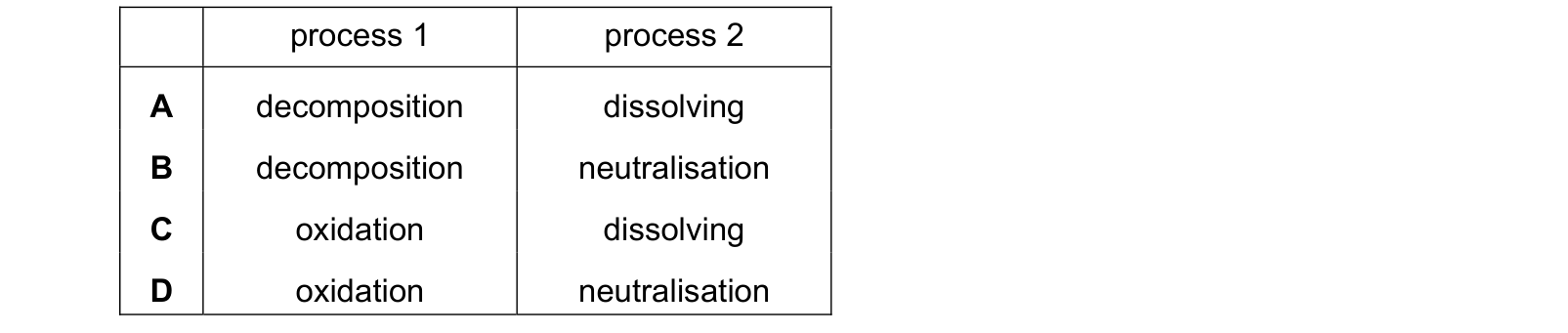
Limestone is converted to lime in process 1. Limestone is used to treat industrial waste in process 2. What are processes 1 and 2? Each answer gives, in order: process 1; process 2.
Answer: B.
Heating limestone in a kiln breaks calcium carbonate down into calcium oxide and carbon dioxide, and one compound splitting into simpler ones on heating is thermal decomposition. Treating acidic industrial waste with limestone is neutralisation, because the carbonate removes hydrogen ions to give a calcium salt, water and carbon dioxide. Calling process 1 oxidation is tempting because a kiln is hot and heating in air sounds like burning, but nothing in this change gains oxygen and no oxygen from the air takes part. Calling process 2 dissolving is tempting because the limestone disappears into the waste, yet dissolving would leave calcium carbonate chemically unchanged and recoverable by evaporation, whereas here it has reacted away and fizzed off carbon dioxide.
Question 2
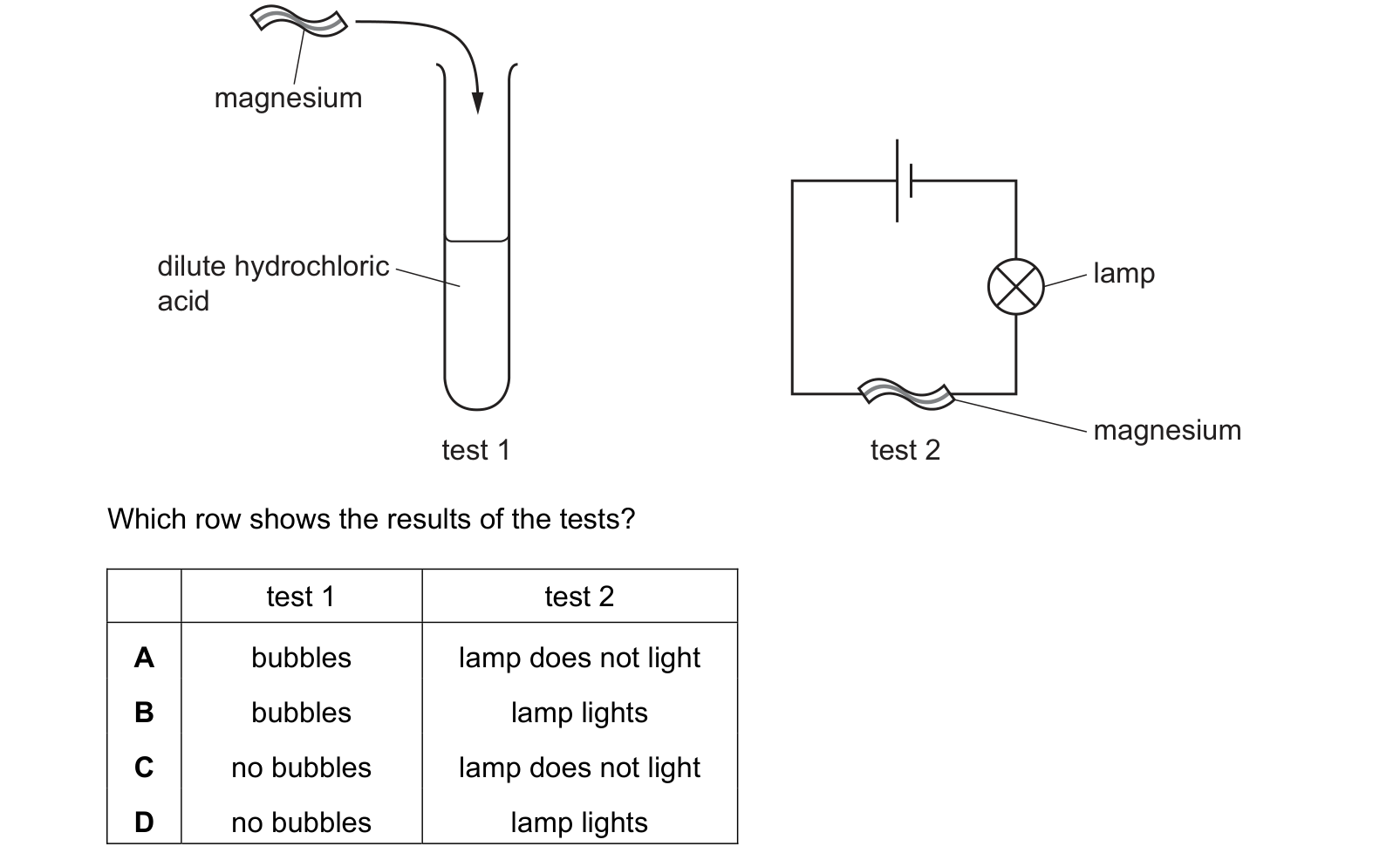
Magnesium is tested as shown. dilute hydrochloric lamp acid Which row shows the results of the tests? Each answer gives, in order: test 1; test 2.
Answer: B.
Magnesium stands above hydrogen in the reactivity series, so it displaces hydrogen from dilute hydrochloric acid, and bubbles of hydrogen appear in the first test, with magnesium chloride left in the solution. Magnesium is also a metal, so its delocalised electrons carry a current, the circuit is complete in the second test and the lamp lights, which makes B correct. A gets the acid test right but says the lamp stays dark, treating a metal as an insulator. C and D both claim no bubbles, which would place magnesium below hydrogen in the reactivity series, alongside copper or silver.
Question 3
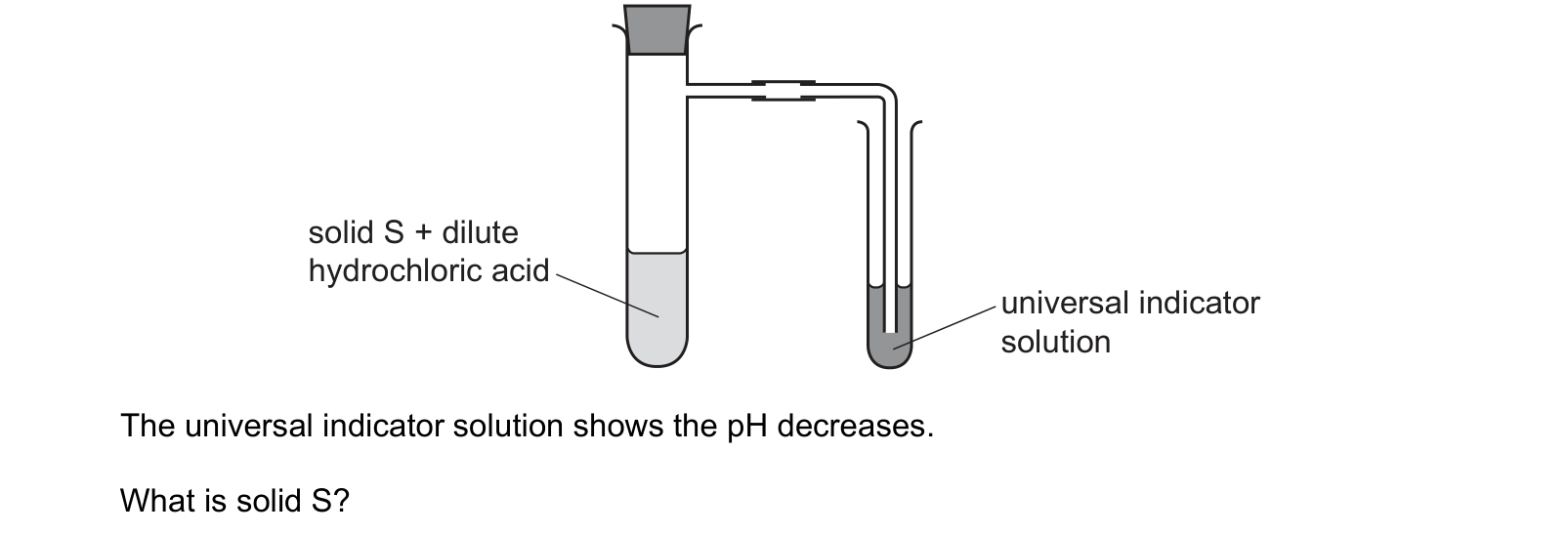
Solid S is added to dilute hydrochloric acid in the apparatus shown. The universal indicator solution shows the pH decreases. What is solid S?
Answer: B.
The gas made in the tube bubbles through the universal indicator, and the pH there falls, so the gas must dissolve to form an acid. Carbon dioxide does exactly that, giving carbonic acid, and a carbonate is the only one of these solids that releases carbon dioxide when acid is added, so solid S is zinc carbonate and B is correct. A, zinc, would react to give hydrogen, which is neutral and would leave the indicator unchanged. C and D, zinc hydroxide and zinc oxide, both neutralise the acid to give a salt and water with no gas at all, so nothing would pass along the delivery tube.
Question 4
A piece of magnesium ribbon is placed in dilute hydrochloric acid. The magnesium reacts and bubbles of a colourless gas are formed. What is the word equation for this reaction?
Answer: A.
A metal reacting with an acid gives a salt and hydrogen, so magnesium with hydrochloric acid gives magnesium chloride and hydrogen, and the colourless gas bubbling off can be confirmed with a lighted splint, which produces a squeaky pop. Any equation offering carbon dioxide is the tempting kind, because fizzing is so strongly associated with that gas, but there is no carbon atom anywhere in magnesium or in hydrochloric acid, so carbon dioxide cannot possibly be formed. The equation that adds water alongside hydrogen borrows from a different reaction, since it is a metal oxide or hydroxide reacting with an acid that gives a salt and water. Keeping the three patterns separate is the whole skill: metal with acid gives hydrogen, metal oxide with acid gives water, and carbonate with acid gives both water and carbon dioxide.
Question 5
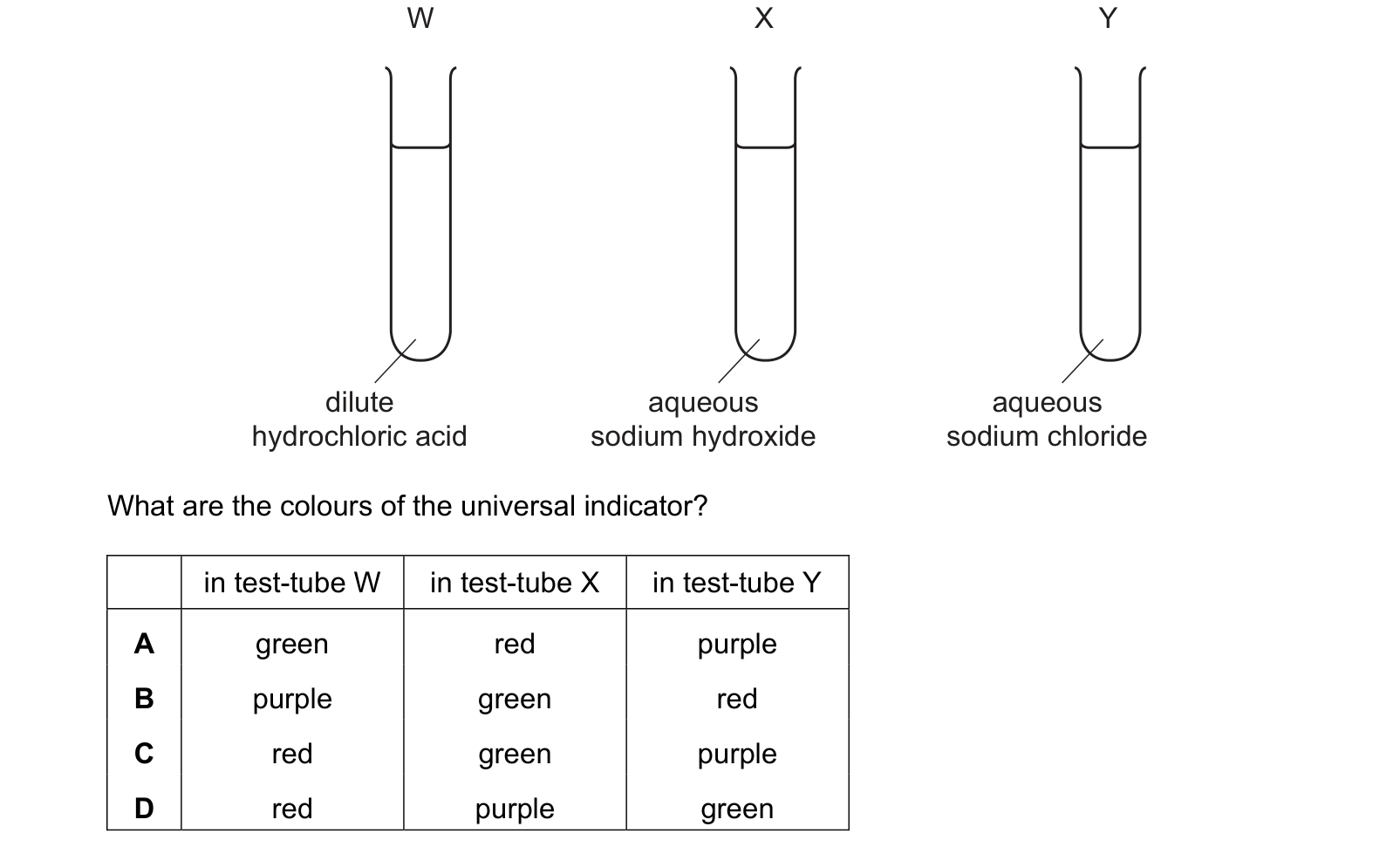
Universal indicator solution is added to test-tubes W, X and Y. W X Y What are the colours of the universal indicator?
Answer: D.
Universal indicator turns red in a strongly acidic solution, green when the solution is neutral and purple in a strongly alkaline one. Dilute hydrochloric acid in W is a strong acid, so the indicator turns red, aqueous sodium hydroxide in X is a strong alkali, so it turns purple, and sodium chloride solution in Y is the salt of a strong acid and a strong alkali, so it is neutral and the indicator stays green, which makes D correct. C starts with red correctly but then swaps the alkali and the neutral salt, handing green to sodium hydroxide. B calls the acid purple, reversing the two ends of the scale, and A calls it green, treating an acid as neutral.
These questions are drawn from past CIE 0654 Co-ordinated Sciences papers and filtered to acids, bases and salts. You answer, you find out immediately whether you were right, and you get the reasoning for the correct option and for each distractor. Wrong answers go to a mistakes locker so you can come back to exactly those.
Practice is free. You need an account only so your progress and your mistakes are still there next time.
These are the errors that cost marks on acids, bases and salts, taken from our own topic notes. Read them before you practise and you will recognise the traps in the questions.
Saying an acid produces OH⁻ ions.
Saying pH 0 is neutral, or that the scale runs 1 to 10.
Forgetting the water in acid plus base, or the carbon dioxide in acid plus carbonate.
Saying an acid plus a metal gives water.
Using excess solid with an alkali, which cannot be filtered off.
Leaving the indicator in during the final titration, which contaminates the salt.
Swapping the lighted and glowing splint tests.
Saying limewater turns milky with any gas. It is specific to carbon dioxide.