Metals
Contents: 9 sections
Properties of metals
Metals are shiny when freshly cut, good conductors of heat and electricity, malleable so they can be hammered into shape, ductile so they can be drawn into wire, and usually have high melting points and high densities. They are sonorous, meaning they ring when struck.
All of this comes from metallic bonding: a lattice of positive metal ions in a sea of delocalised electrons. Those free electrons carry charge and heat through the metal, which is why metals conduct, and the layers of ions can slide over one another without breaking the bonding, which is why metals are malleable rather than brittle.
Non-metals are dull, brittle, poor conductors and usually have low melting points. Graphite is the exception that conducts electricity.
The reactivity series
From most reactive at the top:
potassium, sodium, calcium, magnesium, aluminium, CARBON, zinc, iron, HYDROGEN, copper, silver, gold
Carbon and hydrogen are non-metals put into the list as markers. Carbon's position decides which metals can be extracted by heating with carbon; hydrogen's position decides which metals react with dilute acids.
| Metal | Cold water | Steam | Dilute acid |
|---|---|---|---|
| Potassium, sodium | Violent | Too dangerous | Explosive |
| Calcium | Steady fizzing | Reacts | Vigorous |
| Magnesium | Very slow | Vigorous when heated | Rapid |
| Zinc, iron | No reaction | React when heated | Steady to slow fizzing |
| Copper, silver, gold | No reaction | No reaction | No reaction |
The products differ, and the difference is examined:
- Metal + cold water → metal hydroxide + hydrogen
- Metal + steam → metal oxide + hydrogen
- Metal + dilute acid → salt + hydrogen
Every metal above hydrogen reacts with dilute acid to give hydrogen. Copper, silver and gold are below it and do not react at all.
Displacement is the other tool: a more reactive metal displaces a less reactive one from a solution of its salt.
Zn + CuSO₄ → ZnSO₄ + Cu
The blue solution fades and a pink-brown deposit of copper appears on the zinc. Copper added to zinc sulfate solution does nothing, because copper is the less reactive of the two. In half-equations, the more reactive metal is the one that loses electrons more readily, and that single idea explains the whole series.
Deducing an order from results. Cambridge gives a grid of experiments and asks for the order. Work by pairs, and apply two rules. A reaction shows the added metal is the more reactive; no reaction shows it is the less reactive. And a metal that reacts with cold water outranks one that only reacts with steam, which outranks one that only reacts with acid.
Extraction
Where a metal sits relative to carbon decides how it is extracted.
- Below carbon (zinc, iron, copper, and the metals below them): extracted by reduction with carbon, which is much cheaper.
- Above carbon (aluminium, magnesium, calcium, sodium, potassium): carbon cannot take the oxygen from their oxides, so they must be extracted by electrolysis of a molten compound.
The dividing line is carbon, not the top of the series. Magnesium looks tame beside sodium and potassium, and it is still above carbon, so magnesium oxide will not give up its oxygen to carbon and magnesium is extracted electrolytically.
Gold and silver are so unreactive that they are found as the element itself and need no chemical extraction at all.
The blast furnace
Raw materials in at the top: iron ore (hematite, Fe₂O₃), coke (carbon), and limestone (calcium carbonate). Hot air is blown in near the bottom.
Reducing the ore:
- The coke burns in the hot air: C + O₂ → CO₂. This provides the heat.
- More coke reduces that carbon dioxide: C + CO₂ → 2CO. This makes the reducing agent.
- Carbon monoxide reduces the ore: Fe₂O₃ + 3CO → 2Fe + 3CO₂. Molten iron runs to the bottom.
Removing the acidic impurity:
- The limestone decomposes in the heat: CaCO₃ → CaO + CO₂.
- The basic calcium oxide neutralises the acidic silicon dioxide impurity: CaO + SiO₂ → CaSiO₃, molten calcium silicate, which floats on the denser iron as slag and is tapped off separately.
Keep those two jobs apart, because the standard question asks which equations remove the impurity and offers the reduction equations as distractors. Equations 4 and 5 make the slag; equations 1 to 3 free the iron. Coke is the fuel and the source of the reducing agent, so it is the tempting but wrong answer to "what is added to make slag": that is limestone.
Aluminium, by contrast, is extracted by electrolysis of purified aluminium oxide from the ore bauxite, dissolved in molten cryolite. Hematite is the ore of iron, not of aluminium, and a question offering "aluminium from hematite" or "aluminium by heating with carbon" is testing both halves of the comparison at once.
Rusting
Iron rusts only when both water and oxygen are present. Rust is hydrated iron(III) oxide.
The classic experiment uses three sealed test tubes with a nail in each: one with water and air, one with boiled water and a layer of oil to exclude air, and one with air dried by anhydrous calcium chloride. Only the first rusts, which proves both conditions are needed. Salt does not cause rusting, but it speeds it up.
Prevention by barrier, keeping the water and oxygen away: painting, greasing, coating with plastic, and plating with another metal such as chromium or tin.
Prevention by sacrificial protection, which works differently and is the part that earns explanation marks.
Sacrificial protection
A more reactive metal is attached to, or coats, the iron. Zinc is the usual choice, and coating iron with zinc is called galvanising.
Zinc is above iron in the reactivity series, so zinc atoms lose electrons more readily than iron atoms. The zinc therefore corrodes in preference to the iron and feeds electrons to it, keeping the iron as atoms rather than letting it become Fe²⁺ ions.
The point worth stating, because it is what the question is usually driving at, is that this still works when the coating is scratched. A paint layer stops protecting the moment it is broken, since the barrier has gone. Zinc keeps protecting exposed iron because the protection is chemical rather than physical.
Blocks of zinc or magnesium bolted to a ship's hull or to an underground pipe work the same way and are replaced when they are eaten away.
Aluminium looks like a counterexample and is not. Aluminium is more reactive than iron and yet resists corrosion, because it reacts so readily that it forms an instant thin layer of aluminium oxide that is tough, impermeable and firmly attached, sealing the metal beneath. Rust flakes away and exposes fresh iron, so iron corrosion keeps going.
Alloys
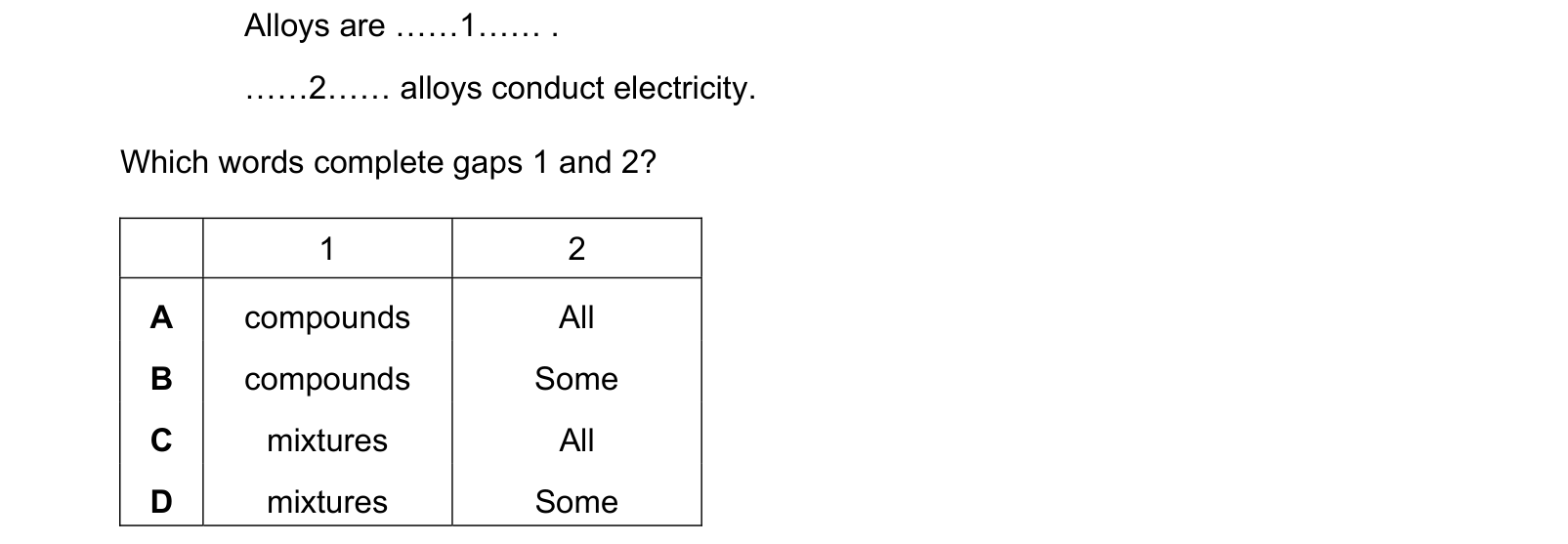
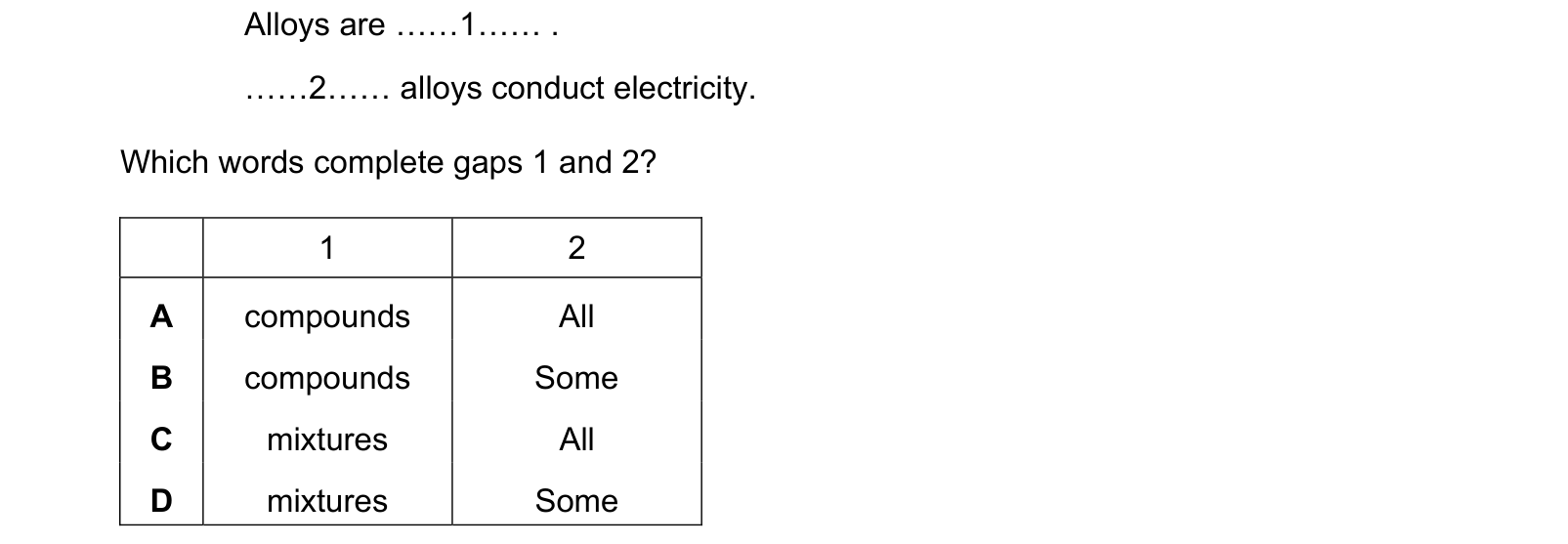
An alloy is a mixture of a metal with one or more other elements.
| Alloy | Made from | Property gained |
|---|---|---|
| Brass | Copper and zinc | Harder than copper, does not corrode |
| Bronze | Copper and tin | Hard, resists corrosion |
| Steel | Iron and carbon | Much harder and stronger than iron |
| Stainless steel | Iron, carbon, chromium and nickel | Resists rusting |
| Duralumin | Aluminium and copper | Low density and strong, used in aircraft |
Brass and bronze are routinely swapped. Brass has zinc; bronze has tin.
Why an alloy is harder than the pure metal. In a pure metal the atoms are all the same size and lie in regular layers that can slide over one another, which is what makes the metal soft. Adding atoms of a different size disrupts the layers, so they can no longer slide easily, and the alloy is harder.
Aluminium is chosen for aircraft because its alloys have a low density, it is malleable so panels can be pressed to shape, and it resists corrosion. Being more reactive than iron is a true statement about aluminium and is not a reason to build an aeroplane out of it.
Common mistakes
- Leaving carbon and hydrogen out of the reactivity series, and then being unable to answer the extraction question.
- Saying copper reacts with dilute hydrochloric acid to give hydrogen.
- Writing a hydroxide as the product of a metal with steam, or an oxide as the product with cold water.
- Using the top of the series rather than carbon as the dividing line for extraction, so that magnesium is smelted with carbon.
- Saying coke or carbon monoxide is added to make slag. Limestone is.
- Including the ore-reduction equations among the slag-forming ones.
- Saying aluminium is extracted from hematite, or that cryolite is the ore.
- Saying rusting needs only oxygen, or only water.
- Saying galvanised iron rusts as soon as the zinc is scratched.
- Explaining sacrificial protection as a barrier rather than by the more reactive metal losing electrons more readily.
- Swapping brass and bronze.
- Saying an alloy is a compound, or that it is harder because the atoms bond more strongly. The layers are disrupted so they cannot slide.
Check you have it
Question 1
Alloys are formed by dissolving one metal in another. Alloys are ……1…… . ……2…… alloys conduct electricity. Which words complete gaps 1 and 2? 1 2 Use the source image for W22 Paper 22, question 23.
Answer: C.
Question 2
Alloys are formed by dissolving one metal in another. Alloys are ««1«« . ««2«« alloys conduct electricity. Which words complete gaps 1 and 2? 1 2 Use the source image for W22 Paper 23, question 23.
Answer: C.
Question 3
Part of the reactivity series is shown. calcium most reactive carbon iron hydrogen lead copper gold least reactive Which statement is correct?

Answer: D.
What the syllabus asks for on this topicSyllabus points
Syllabus points
- Describe the general physical properties of metals and compare them with non-metals.
- State the order of the reactivity series and deduce an order from experimental results.
- Describe the extraction of iron in the blast furnace, and explain why some metals need electrolysis instead.
- Describe the conditions needed for iron to rust and the methods used to prevent it.
- Explain sacrificial protection in terms of reactivity.
- Describe alloys and explain why they are harder than pure metals.
Related CIE 0654 Co-ordinated Sciences topics
Not the topic you were looking for? Describe what you are stuck on in your own words and we will take you to the notes that answer it.