36 past-paper questions on this unit. Five of them are below. Answer on the page: each one is marked the moment you pick, the correct option is shown whether or not you found it, and the full explanation opens either way.
CIE 0654 Co-ordinated SciencesPaper 1 and Paper 2 MCQsFree account
Metals: five questions to try now
Real past-paper questions, the answer key from the mark scheme, and the explanation that goes with it. No account needed to answer them.
Question 1
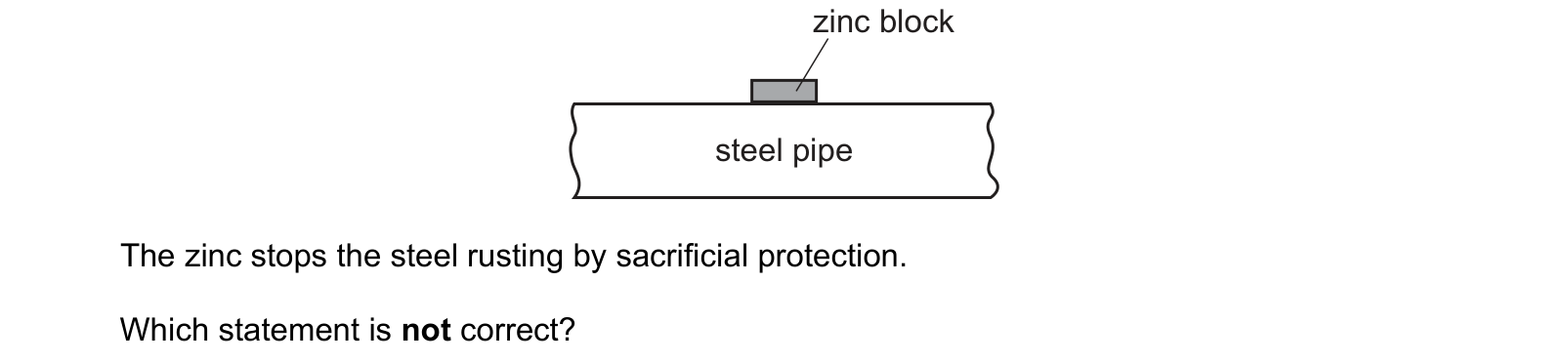
A block of zinc is attached to an underground steel pipe as shown. The zinc stops the steel rusting by sacrificial protection. Which statement is not correct?
Answer: C.
Sacrificial protection works because zinc stands above iron in the reactivity series, so the zinc loses electrons more readily and is oxidised instead of the iron, and those electrons pass into the steel and keep the iron as metal rather than as iron ions. A, B and D each state one part of that mechanism and are true. C is the statement that is not correct, because a small block bolted to the pipe covers only a tiny patch and leaves the rest of the steel in contact with air and water. Keeping oxygen away is how paint, grease or a full coating of zinc protects iron, and that is a barrier method rather than sacrificial protection.
Question 2
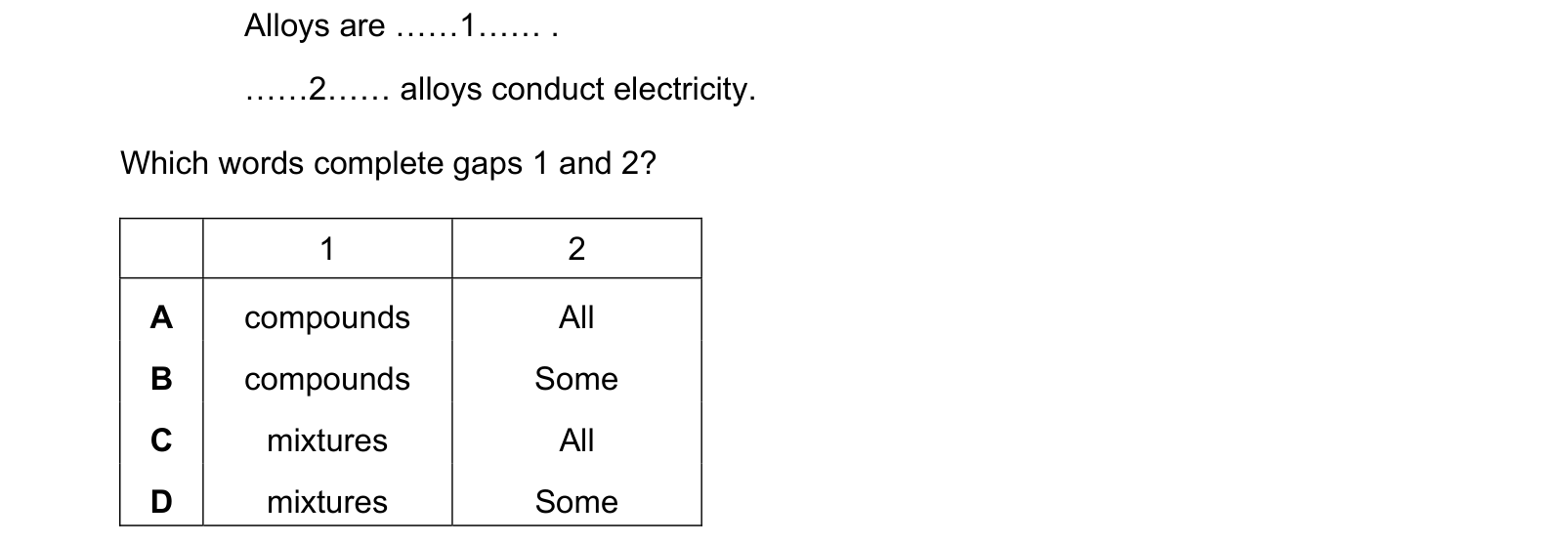
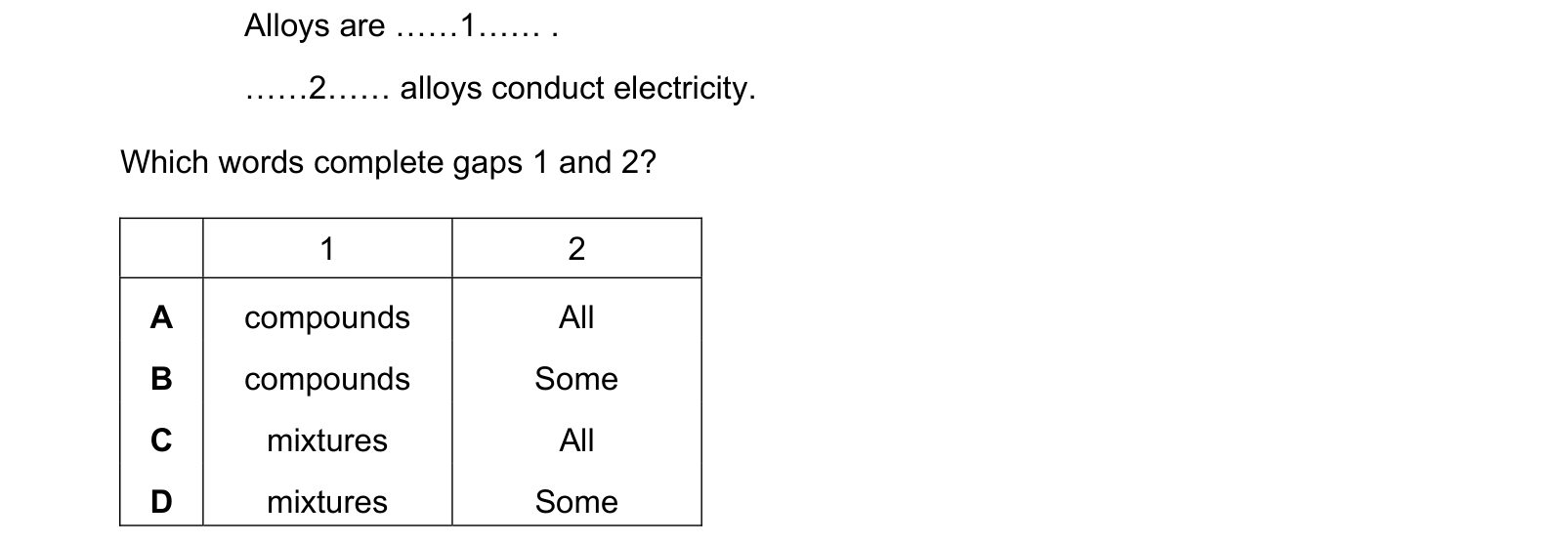
Alloys are formed by dissolving one metal in another. Alloys are ……1…… . ……2…… alloys conduct electricity. Which words complete gaps 1 and 2? 1 2 Use the source image for W22 Paper 11, question 23.
Answer: C.
An alloy is made by mixing metals while they are molten, and the atoms simply sit together in one lattice with no fixed ratio and no chemical bond between the two elements, so an alloy is a mixture rather than a compound. Every alloy is still a metallic structure with a sea of delocalised electrons free to drift, so all alloys conduct electricity, which makes C correct. A and B call alloys compounds, yet the proportions in an alloy can be varied at will, which no compound allows. B and D say only some alloys conduct, whereas the delocalised electrons that carry the current are present in every one of them.
Question 3
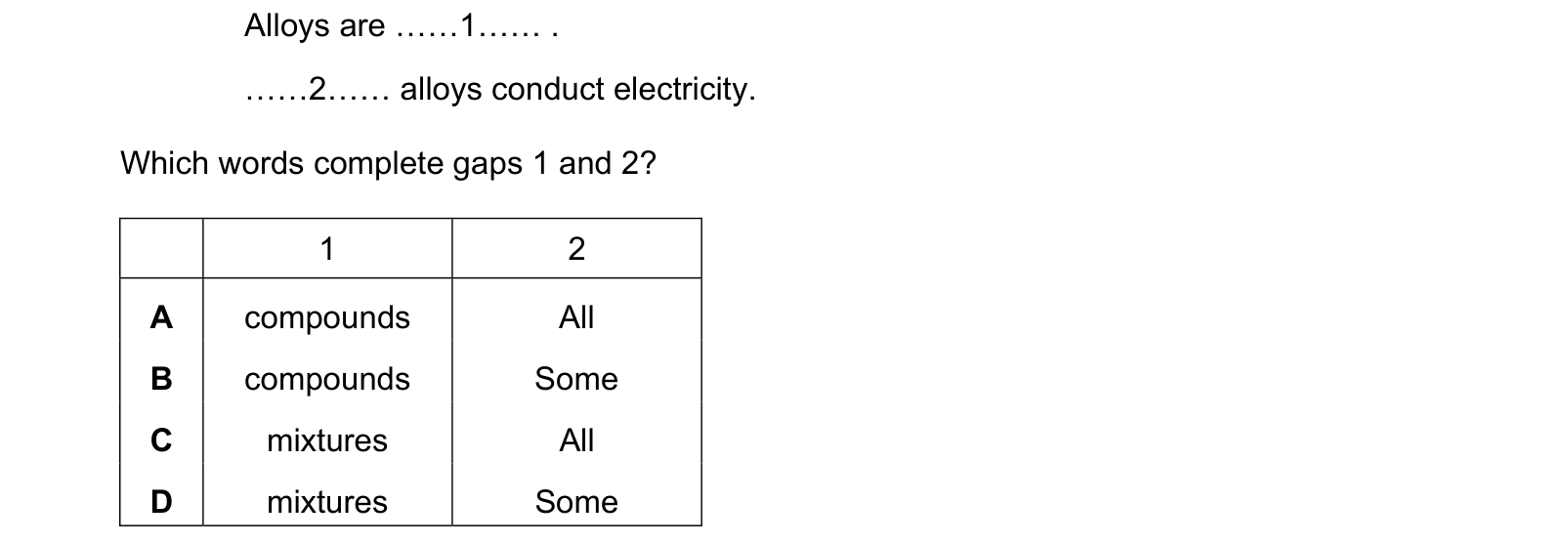
Alloys are formed by dissolving one metal in another. Alloys are ……1…… . ……2…… alloys conduct electricity. Which words complete gaps 1 and 2? 1 2 Use the source image for W22 Paper 12, question 23.
Answer: C.
An alloy is made by mixing metals while they are molten, and the atoms simply sit together in one lattice with no fixed ratio and no chemical bond between the two elements, so an alloy is a mixture rather than a compound. Every alloy is still a metallic structure with a sea of delocalised electrons free to drift, so all alloys conduct electricity, which makes C correct. A and B call alloys compounds, yet the proportions in an alloy can be varied at will, which no compound allows. B and D say only some alloys conduct, whereas the delocalised electrons that carry the current are present in every one of them.
Question 4
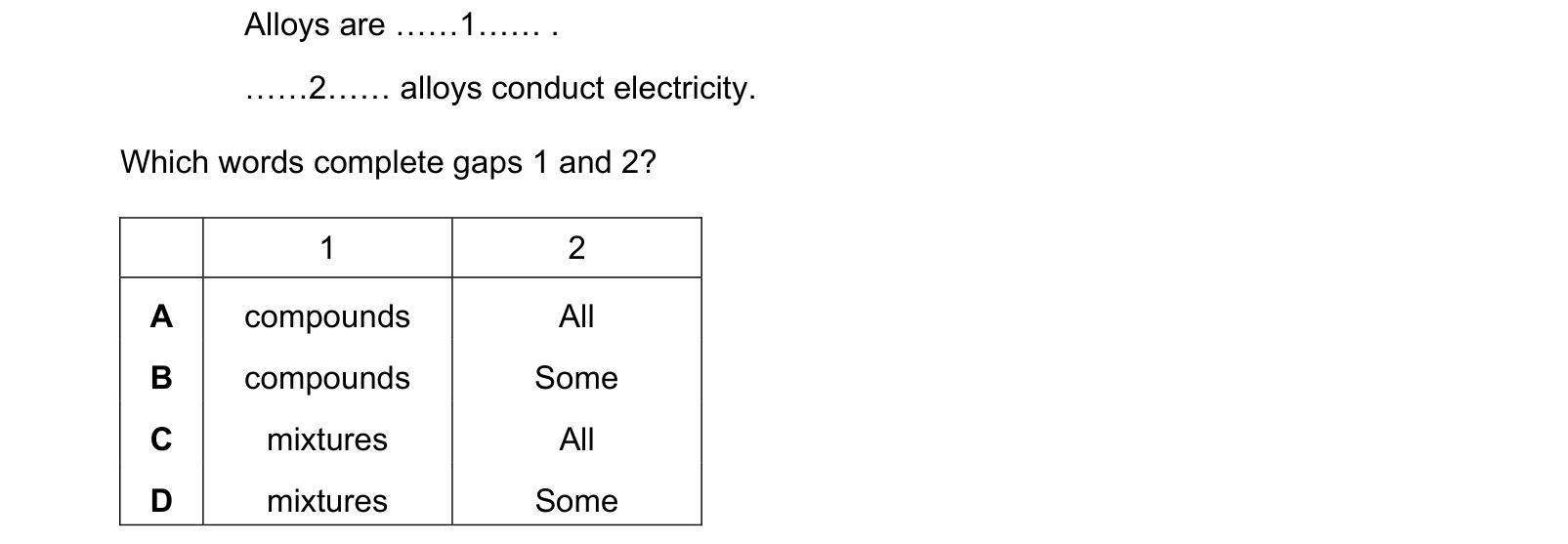
Alloys are formed by dissolving one metal in another. Alloys are ……1…… . ……2…… alloys conduct electricity. Which words complete gaps 1 and 2? 1 2 Use the source image for W22 Paper 13, question 23.
Answer: C.
An alloy is made by mixing metals while they are molten, and the atoms simply sit together in one lattice with no fixed ratio and no chemical bond between the two elements, so an alloy is a mixture rather than a compound. Every alloy is still a metallic structure with a sea of delocalised electrons free to drift, so all alloys conduct electricity, which makes C correct. A and B call alloys compounds, yet the proportions in an alloy can be varied at will, which no compound allows. B and D say only some alloys conduct, whereas the delocalised electrons that carry the current are present in every one of them.
Question 5
Alloys are formed by dissolving one metal in another. Alloys are ……1…… . ……2…… alloys conduct electricity. Which words complete gaps 1 and 2? 1 2 Use the source image for W22 Paper 21, question 23.
Answer: C.
An alloy is made by mixing metals while they are molten, and the atoms simply sit together in one lattice with no fixed ratio and no chemical bond between the two elements, so an alloy is a mixture rather than a compound. Every alloy is still a metallic structure with a sea of delocalised electrons free to drift, so all alloys conduct electricity, which makes C correct. A and B call alloys compounds, yet the proportions in an alloy can be varied at will, which no compound allows. B and D say only some alloys conduct, whereas the delocalised electrons that carry the current are present in every one of them.
These questions are drawn from past CIE 0654 Co-ordinated Sciences papers and filtered to metals. You answer, you find out immediately whether you were right, and you get the reasoning for the correct option and for each distractor. Wrong answers go to a mistakes locker so you can come back to exactly those.
Practice is free. You need an account only so your progress and your mistakes are still there next time.
These are the errors that cost marks on metals, taken from our own topic notes. Read them before you practise and you will recognise the traps in the questions.
Leaving carbon and hydrogen out of the reactivity series, and then being unable to answer the extraction question.
Saying copper reacts with dilute hydrochloric acid to give hydrogen.
Writing a hydroxide as the product of a metal with steam, or an oxide as the product with cold water.
Using the top of the series rather than carbon as the dividing line for extraction, so that magnesium is smelted with carbon.
Saying coke or carbon monoxide is added to make slag. Limestone is.
Including the ore-reduction equations among the slag-forming ones.
Saying aluminium is extracted from hematite, or that cryolite is the ore.
Saying rusting needs only oxygen, or only water.
Revise it first
If any of the above is unfamiliar, work through the notes before practising: Metals revision notes.