Organic chemistry
Contents: 8 sections
Homologous series
A homologous series is a family of compounds with the same general formula and similar chemical properties, where each member differs from the next by CH₂. Members show a gradual trend in physical properties: as the chain gets longer, boiling point rises and viscosity increases.
Alkanes: general formula CnH₂n₊₂. Methane CH₄, ethane C₂H₆, propane C₃H₈, butane C₄H₁₀. All bonds are single, so alkanes are saturated.
Alkenes: general formula CnH₂n. Ethene C₂H₄, propene C₃H₆, butene C₄H₈. Each contains a carbon to carbon double bond, so alkenes are unsaturated.
The names carry the information. The prefix gives the number of carbons (meth 1, eth 2, prop 3, but 4) and the ending gives the family (-ane saturated, -ene double bond).
The test that separates them
Add aqueous bromine, which is orange.
- With an alkene the colour goes from orange to colourless, because bromine adds across the double bond.
- With an alkane there is no change.
Say "orange to colourless" rather than "clear": a solution can be clear and still coloured, and the mark is for the colour change.
Petroleum
Petroleum, or crude oil, is a mixture of hydrocarbons, separated by fractional distillation in a column that is hot at the bottom and cooler at the top.
Fractions with short chains have low boiling points, so they rise highest before condensing. Longer chains condense low down.
From the top down: refinery gas, gasoline (petrol), naphtha, kerosene (paraffin), diesel, fuel oil, bitumen.
| Fraction | Use |
|---|---|
| Refinery gas | Bottled gas for heating and cooking |
| Gasoline | Fuel for cars |
| Naphtha | Feedstock for making chemicals |
| Kerosene | Fuel for aircraft |
| Diesel | Fuel for lorries and some cars |
| Fuel oil | Fuel for ships and power stations |
| Bitumen | Surfacing roads and roofs |
Going down the column, the fractions become darker, more viscous, less easily ignited, and higher boiling.
Combustion
Complete combustion, with plenty of oxygen, gives carbon dioxide and water.
Incomplete combustion, with a limited supply, gives carbon monoxide and carbon (soot) as well as water. Carbon monoxide is the danger: it is colourless, odourless, and it binds to haemoglobin so the blood can no longer carry oxygen.
Cracking
Cracking breaks long-chain alkanes into shorter, more useful molecules, using a catalyst and a high temperature.
It is done because the demand for short-chain fuels such as petrol is far greater than the supply from distillation, while the supply of long fractions exceeds demand.
Cracking always produces at least one alkene, which matters because alkenes are the feedstock for plastics.
A worked example: C₁₀H₂₂ cracks to C₈H₁₈ plus C₂H₄. Count the atoms to check, 10 carbons on each side and 22 hydrogens on each side.
Polymers
Addition polymerisation joins many small unsaturated molecules, called monomers, into one long chain, the polymer. The double bonds open and nothing else is produced: an addition polymerisation has no other product.
Ethene gives poly(ethene); propene gives poly(propene); chloroethene gives poly(chloroethene), better known as PVC.
Most addition polymers are non-biodegradable, so they persist in landfill and in the sea. Burning them disposes of them but can release toxic gases, and PVC in particular releases hydrogen chloride.
Common mistakes
- Writing "clear" instead of "colourless" for the bromine test.
- Saying an alkane decolourises bromine water.
- Getting the general formulas the wrong way round.
- Saying the fractionating column is cool at the bottom.
- Saying cracking produces only alkanes. It must produce an alkene.
- Writing an unbalanced cracking equation.
- Saying addition polymerisation releases water. That is condensation polymerisation.
Check you have it
Question 1
Hexane and octane are liquid hydrocarbons that mix together. Which apparatus is used to separate a mixture of these two liquids? Use the source image for S23 Paper 22, question 14.
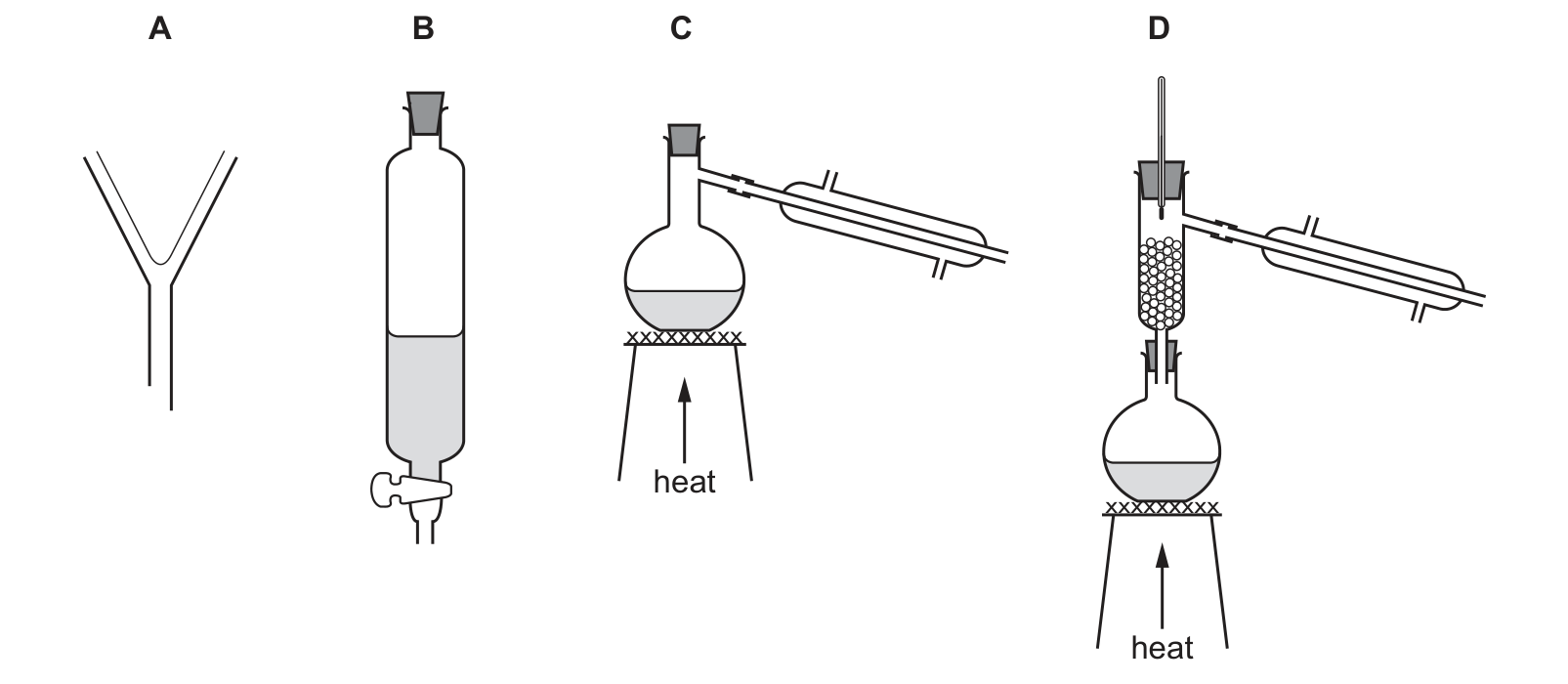
Answer: D.
Question 2
The flow chart shows some chemical substances and processes. Which row identifies compound X and process Y? Each answer gives, in order: compound X; process Y.
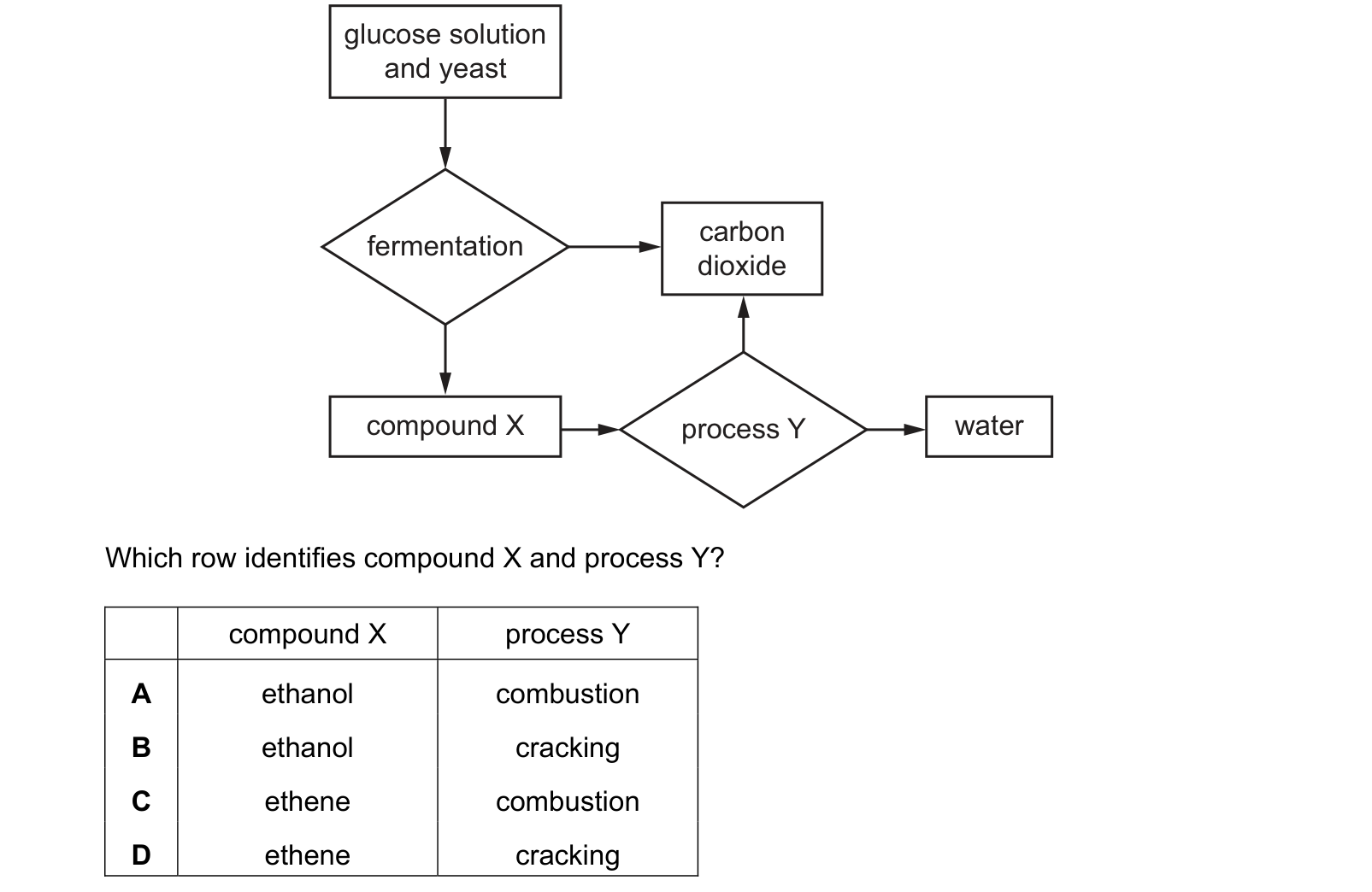
Answer: A.
Question 3
The structure of the monomer chloroethene is shown. What is the structure of the polymer formed from this monomer? Use the source image for W22 Paper 21, question 27.
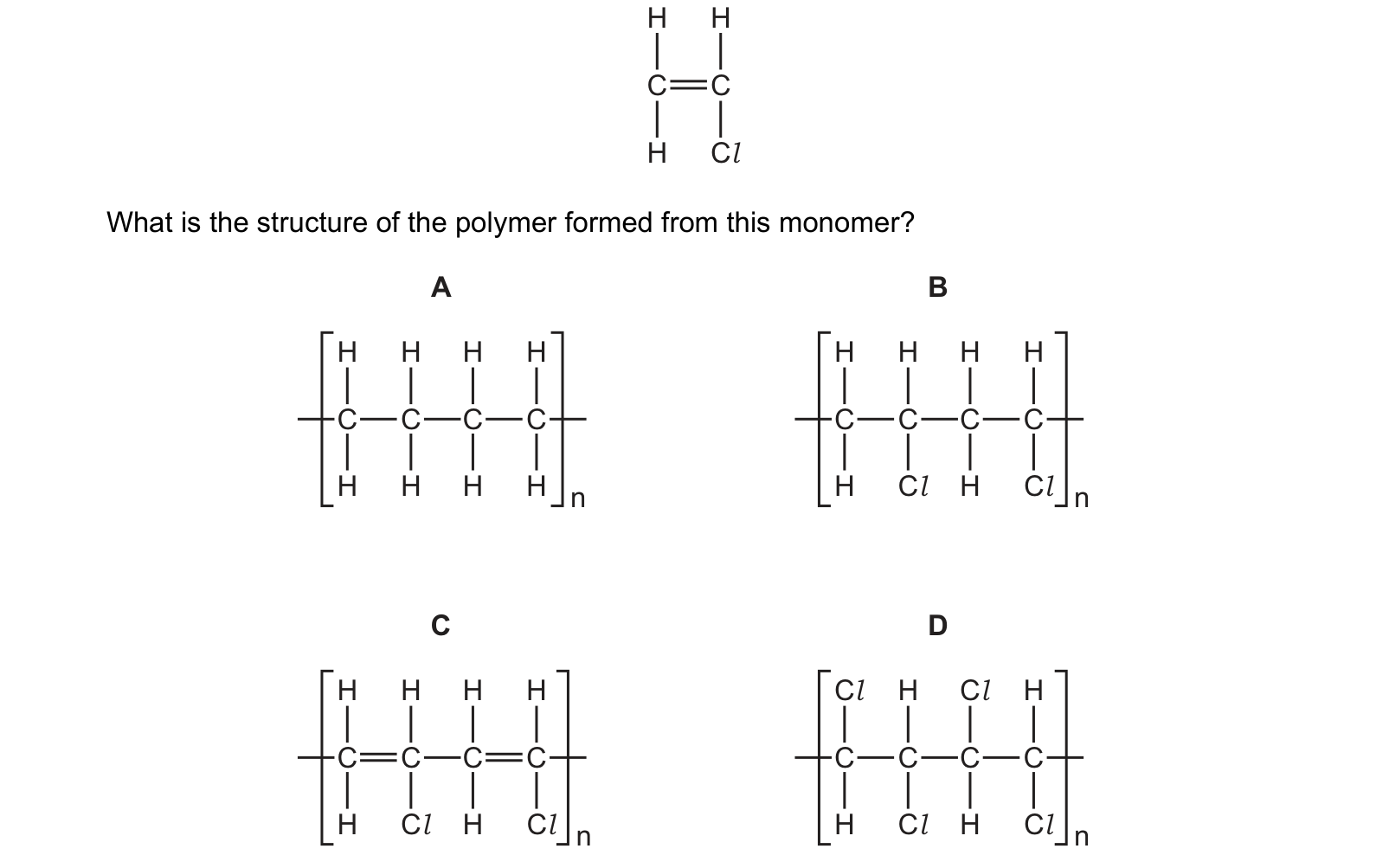
Answer: B.
What the syllabus asks for on this topicSyllabus points
Syllabus points
- Name and describe the alkanes and alkenes as homologous series.
- Distinguish saturated from unsaturated compounds and test for unsaturation.
- Describe the fractional distillation of petroleum and the uses of the fractions.
- Describe combustion, cracking and addition polymerisation.
Related CIE 0654 Co-ordinated Sciences topics
Not the topic you were looking for? Describe what you are stuck on in your own words and we will take you to the notes that answer it.