110 past-paper questions on this unit. Five of them are below. Answer on the page: each one is marked the moment you pick, the correct option is shown whether or not you found it, and the full explanation opens either way.
CIE 0654 Co-ordinated SciencesPaper 1 and Paper 2 MCQsFree account
Organic chemistry: five questions to try now
Real past-paper questions, the answer key from the mark scheme, and the explanation that goes with it. No account needed to answer them.
Question 1
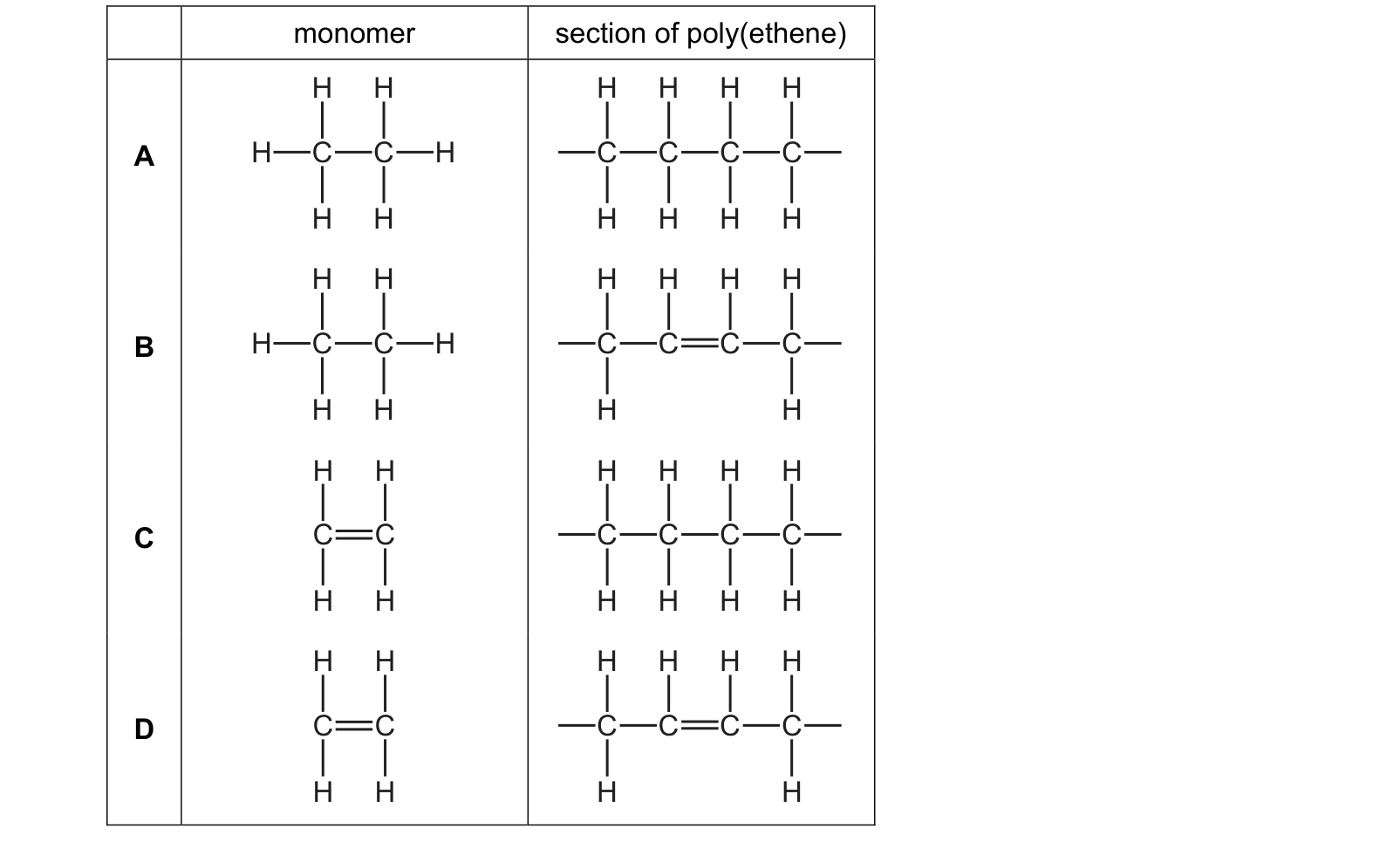
Which row shows the structure of the monomer used to make poly(ethene) and the structure of a section of poly(ethene)? Use the source image for S21 Paper 11, question 27.
Answer: C.
Ethene is the monomer, and its molecule must contain a carbon to carbon double bond, since addition polymerisation works by opening that bond so each unit can join the next. The polymer that results has only single bonds along its chain, with two hydrogen atoms on every carbon, and C is the only row pairing an unsaturated monomer with a saturated chain. D starts from the right monomer but leaves a double bond in the polymer, which would mean the bond never opened and no addition took place. A and B both give ethane as the monomer, a saturated molecule with no double bond to open, so it cannot polymerise at all, and B compounds the error by drawing a double bond in the product instead.
Question 2
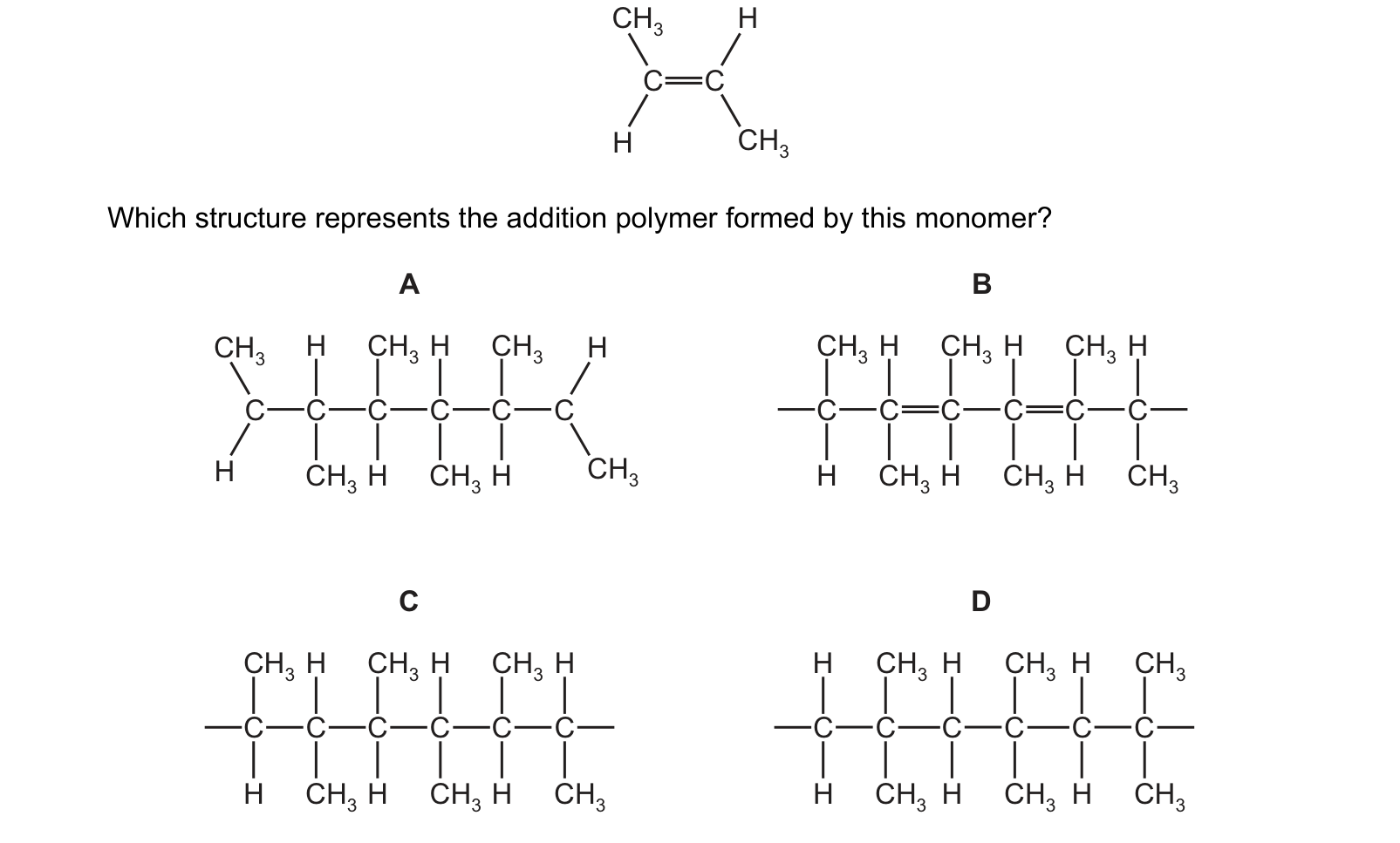
The structure of a monomer is shown. CH3 H Which structure represents the addition polymer formed by this monomer? Use the source image for S22 Paper 23, question 27.
Answer: C.
The monomer carries a methyl group and a hydrogen on each end of the double bond, so when addition polymerisation opens that bond the chain holds a methyl and a hydrogen on every carbon, with the methyl groups alternating from one side of the chain to the other. C shows that repeating pattern with single bonds throughout and open bonds at each end, which is how a section of a polymer is drawn. B keeps double bonds inside the chain, so the monomer bonds would never have opened to form the links. D puts two methyl groups on one carbon and two hydrogens on another, which belongs to a different monomer. A has the right side groups but caps both ends with complete bonds, so it is one finite molecule rather than part of a chain.
Question 3
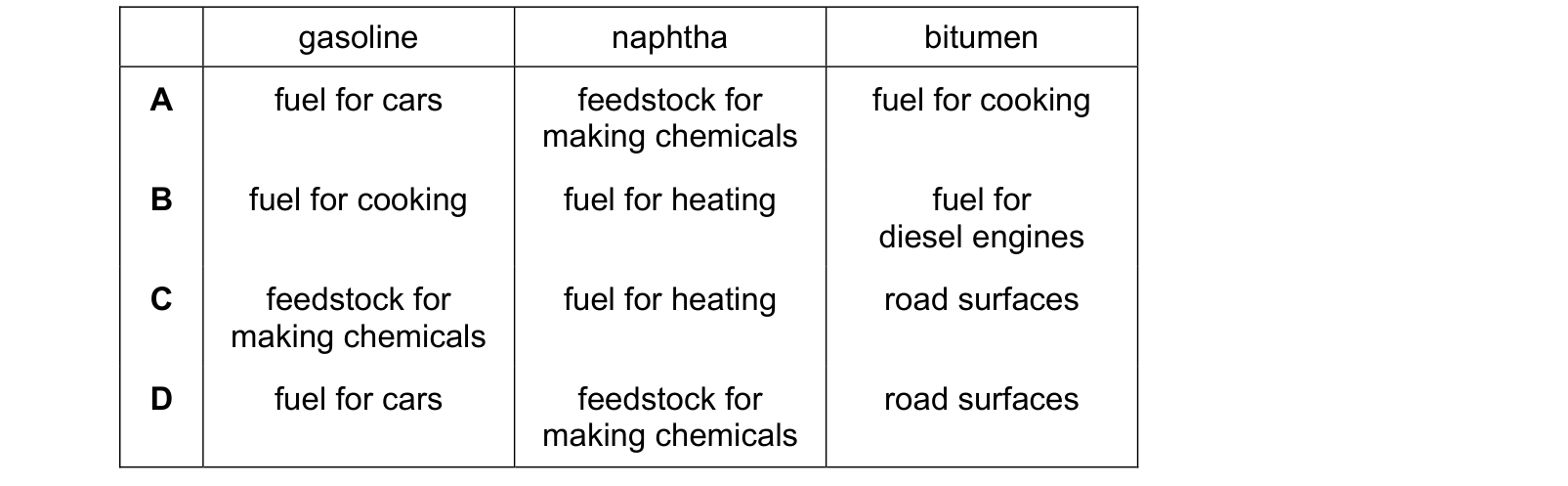
Petroleum is separated into useful fractions by fractional distillation. Which row shows the uses of the named fractions? Each answer gives, in order: gasoline; naphtha; bitumen.
Answer: D.
The uses of the fractions follow their chain lengths, so gasoline, with short chains that vaporise easily, fuels cars, naphtha goes to the chemical industry as feedstock for making plastics and other products, and bitumen, the thick residue with the longest chains, is spread on roads. The row that gets gasoline and naphtha right but calls bitumen a fuel for cooking is the tempting one, because two thirds of it is correct, but cooking gas is refinery gas, the lightest fraction of all, while bitumen is so viscous it barely flows and would never vaporise to burn. Any row that describes gasoline as a chemical feedstock has swapped it with naphtha, which sits next to it in the column and is genuinely used that way. Matching the physical properties to the job is the safest route through this kind of question.
Question 4
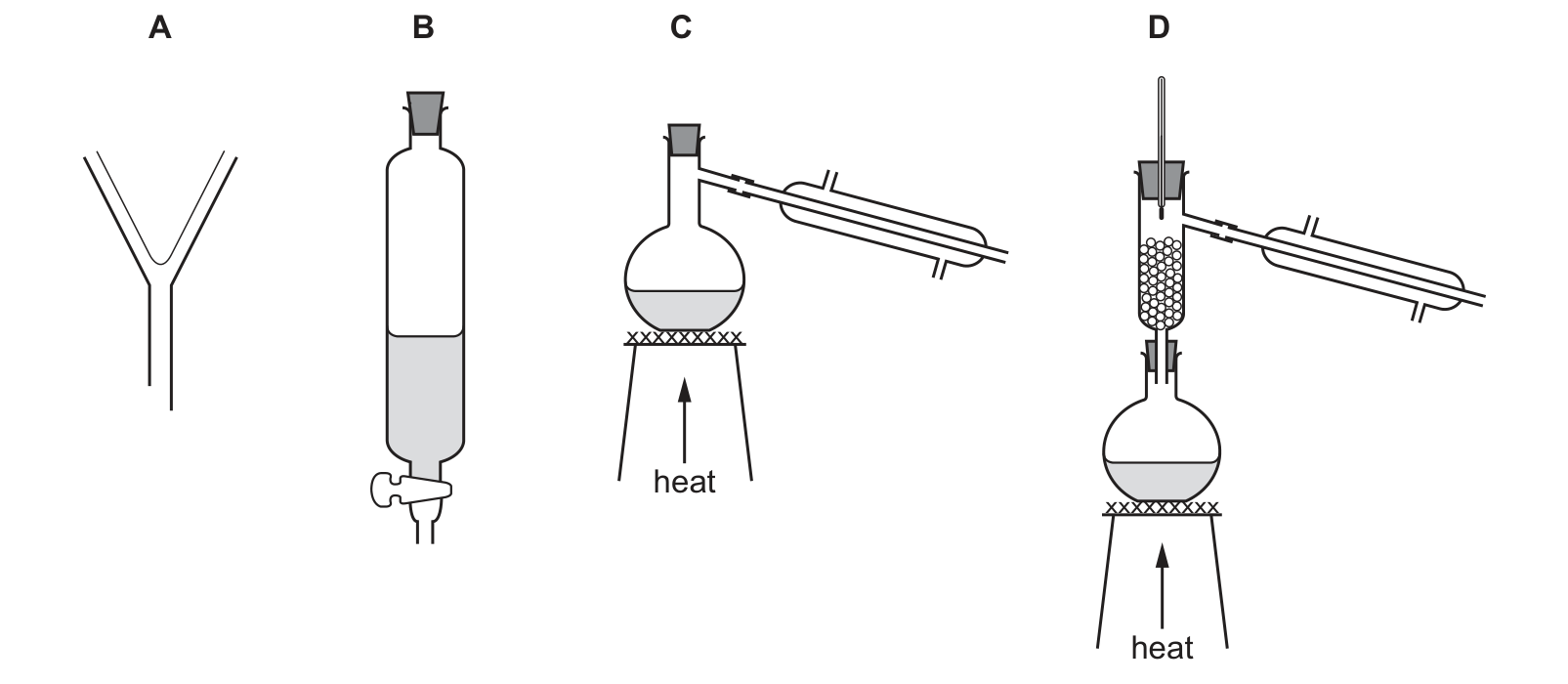
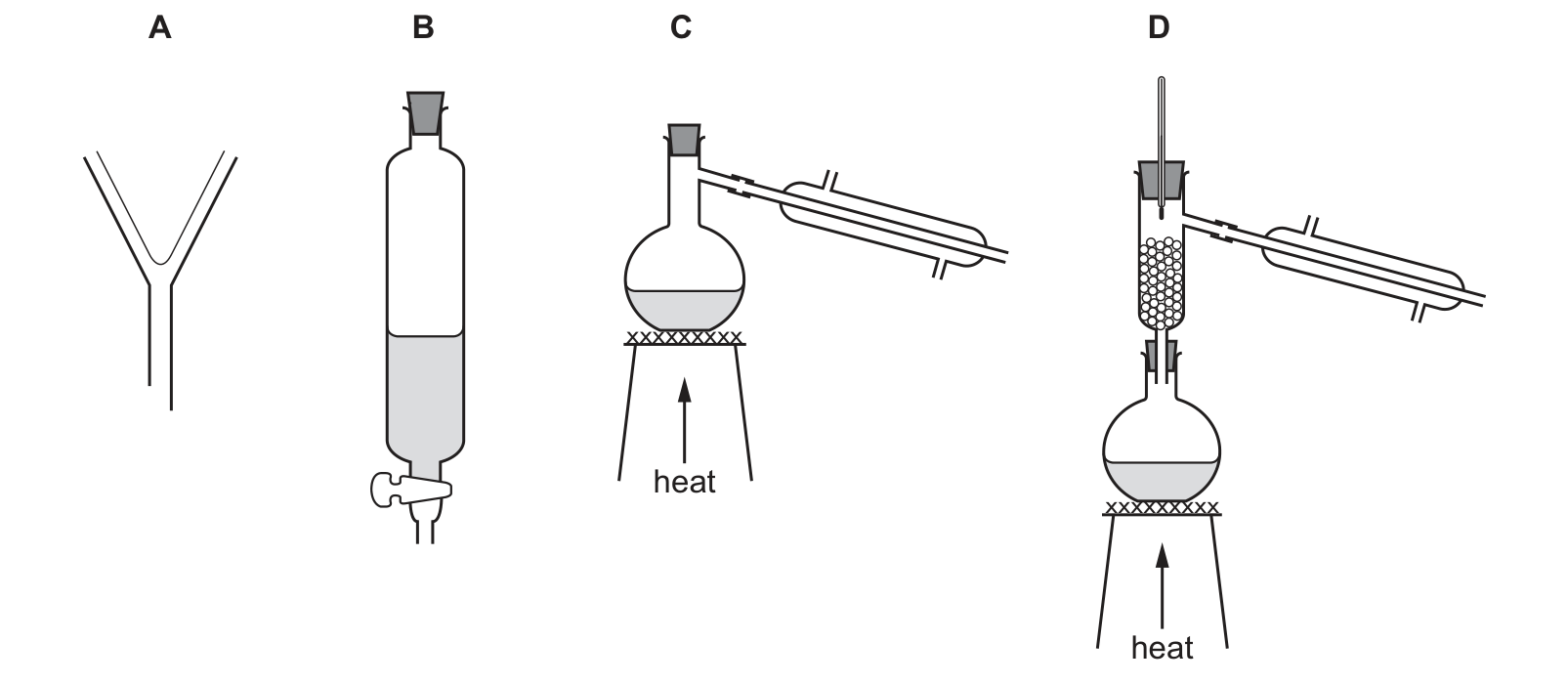
Hexane and octane are liquid hydrocarbons that mix together. Which apparatus is used to separate a mixture of these two liquids? Use the source image for S23 Paper 12, question 14.
Answer: D.
Hexane and octane mix completely and both are liquids, so they can be separated only by using their different boiling points, and boiling points as close as these call for a fractionating column. D is the apparatus with that packed column above the flask, a thermometer at the top and a condenser, and the repeated evaporation and condensation inside the column let the more volatile hexane reach the condenser first. C is simple distillation with no column, so the vapour arriving at the condenser would still carry a good deal of the second liquid. B is a separating funnel, which works only when two liquids form separate layers, and these two mix. A is a funnel for filtering, which separates an insoluble solid from a liquid rather than one liquid from another.
Question 5
Hexane and octane are liquid hydrocarbons that mix together. Which apparatus is used to separate a mixture of these two liquids? Use the source image for S23 Paper 13, question 14.
Answer: D.
Hexane and octane mix completely and both are liquids, so they can be separated only by using their different boiling points, and boiling points as close as these call for a fractionating column. D is the apparatus with that packed column above the flask, a thermometer at the top and a condenser, and the repeated evaporation and condensation inside the column let the more volatile hexane reach the condenser first. C is simple distillation with no column, so the vapour arriving at the condenser would still carry a good deal of the second liquid. B is a separating funnel, which works only when two liquids form separate layers, and these two mix. A is a funnel for filtering, which separates an insoluble solid from a liquid rather than one liquid from another.
These questions are drawn from past CIE 0654 Co-ordinated Sciences papers and filtered to organic chemistry. You answer, you find out immediately whether you were right, and you get the reasoning for the correct option and for each distractor. Wrong answers go to a mistakes locker so you can come back to exactly those.
Practice is free. You need an account only so your progress and your mistakes are still there next time.
These are the errors that cost marks on organic chemistry, taken from our own topic notes. Read them before you practise and you will recognise the traps in the questions.
Writing "clear" instead of "colourless" for the bromine test.
Saying an alkane decolourises bromine water.
Getting the general formulas the wrong way round.
Saying the fractionating column is cool at the bottom.
Saying cracking produces only alkanes. It must produce an alkene.
Writing an unbalanced cracking equation.
Saying addition polymerisation releases water. That is condensation polymerisation.