Experimental techniques and chemical analysis
Contents: 9 sections
Choosing the right separation
This is the most examined idea in the topic, and almost every question is answered by asking one thing first: is the thing you want to remove dissolved or not?
| Method | Separates | Use it when |
|---|---|---|
| Filtration | An insoluble solid from a liquid | Something is floating about undissolved |
| Crystallisation | A dissolved solid from its solvent | You want the solid back, and the liquid does not matter |
| Simple distillation | A liquid from a dissolved solid | You want the liquid back, pure |
| Fractional distillation | Two or more liquids with different boiling points | Separating a mixture of liquids, such as crude oil or ethanol and water |
| Chromatography | Dissolved substances from one another | Analysing a mixture of dyes or inks |
Filtration. The insoluble solid stays on the filter paper as the residue; the liquid that passes through is the filtrate. Filtration can only remove what is undissolved, so it cannot take a dissolved impurity out of a solution.
Crystallisation. Heat the solution to evaporate some of the water until it is saturated, test by dipping a cold glass rod to see whether crystals form on it, then leave the hot saturated solution to cool slowly. The solid becomes less soluble as the liquid cools, so crystals separate out. Filter them off and dry them between filter papers. Do not evaporate to dryness, because that leaves the impurities behind with the crystals and drives off water of crystallisation.
Distillation. The solution is heated, the solvent boils off, and the vapour passes into a condenser where cold water flowing in the outer jacket cools it back to a liquid. The distillate collected is the pure solvent, and the dissolved solid stays behind in the flask. This is how drinking water is obtained from sea water.
Worked example. A solution contains a soluble salt and an insoluble impurity. Which two processes give pure salt crystals, and in which order?
Filtration, then crystallisation. The order is the whole question. Filter first, while the salt is still dissolved, so the impurity is caught on the paper and the salt solution goes through. Then crystallise that filtrate. Distilling first would boil the solution dry with the impurity still in the flask, so the solid left would be salt and impurity mixed together, which is exactly where you started.
Chromatography
A spot of the mixture is placed on a pencil baseline near the bottom of the paper, and the paper is stood in solvent with the baseline above the solvent level. The solvent rises through the paper and carries the substances with it. The more soluble a substance is in the solvent, the further it travels.
Two practical details are marks. The baseline is drawn in pencil, because ink would dissolve and run up the paper with the samples. And the baseline must be above the solvent, or the spots would simply dissolve into the solvent trough instead of moving up the paper.
$Rf = (distance moved by the spot) ÷ (distance moved by the solvent)$
Worked example. A spot moves 3.6 cm while the solvent front moves 8.0 cm.
Rf = 3.6 / 8.0 = 0.45
An Rf value is always between 0 and 1, because a spot cannot travel further than the solvent that carries it, so an answer above 1 means the two distances were divided the wrong way round. Rf has no unit.
Substances that do not show up are made visible with a locating agent.
Tests for gases
| Gas | Test | Positive result |
|---|---|---|
| Hydrogen | Lighted splint | Burns with a squeaky pop |
| Oxygen | Glowing splint | Relights it |
| Carbon dioxide | Bubble through limewater | Turns it milky |
| Chlorine | Damp litmus paper | Bleaches it white |
| Ammonia | Damp red litmus paper | Turns it blue |
Watch which splint. A lighted splint tests for hydrogen and a glowing splint tests for oxygen, and the two are routinely swapped.
Chlorine turns damp blue litmus red first, because it is acidic, and then bleaches it. A gas that turns damp red litmus blue is alkaline, which points to ammonia and never to chlorine.
Flame tests
Hold a clean nichrome wire dipped in the sample in a hot blue flame.
| Ion | Flame colour |
|---|---|
| Lithium | Red |
| Sodium | Yellow |
| Potassium | Lilac |
| Calcium | Orange-red |
| Copper(II) | Blue-green |
Lithium and sodium sit next to each other in the same group and are the pair most often confused: lithium red, sodium yellow. Sodium's yellow is persistent and very bright, which is why the wire has to be properly clean before a test.
Tests with sodium hydroxide
Add aqueous sodium hydroxide to a solution of the unknown and look at the precipitate.
| Ion | Precipitate |
|---|---|
| Copper(II) | Blue |
| Iron(II) | Dirty green |
| Iron(III) | Red-brown |
| Calcium | White, insoluble in excess |
| Zinc | White, dissolving in excess to a colourless solution |
| Aluminium | White, dissolving in excess to a colourless solution |
Zinc, aluminium and calcium all give a white precipitate, so the excess test is what separates them: zinc and aluminium dissolve again when more sodium hydroxide is added, and calcium does not.
Warming the mixture with aluminium powder is the test for nitrate: the nitrate is reduced and gives off ammonia, which turns damp red litmus blue.
Tests for anions
| Ion | Test | Positive result |
|---|---|---|
| Carbonate | Add dilute acid | Fizzes, and the gas turns limewater milky |
| Chloride | Add dilute nitric acid, then aqueous silver nitrate | White precipitate |
| Bromide | Same | Cream precipitate |
| Iodide | Same | Yellow precipitate |
| Sulfate | Add dilute nitric acid, then aqueous barium nitrate | White precipitate |
| Nitrate | Add aqueous sodium hydroxide and aluminium, warm | Ammonia given off |
The acid added first is not optional. Carbonate ions would give a precipitate with both silver nitrate and barium nitrate, so a carbonate in the sample would be mistaken for a chloride or a sulfate. The acid destroys any carbonate first, which is why the reagent is described as acidified.
Worked example. A solution gives a blue precipitate with sodium hydroxide, no precipitate with acidified silver nitrate, and a white precipitate with acidified barium nitrate. What is it?
Take the tests in order and let each narrow the field. The blue precipitate fixes the cation as copper(II), which rules out both iron salts. No precipitate with silver nitrate means no chloride, which rules out copper(II) chloride even though it passed the first test. The white precipitate with barium nitrate confirms sulfate. The substance is copper(II) sulfate.
Purity
A pure substance melts and boils at a fixed, sharp temperature. Pure water boils at exactly 100 °C and freezes at exactly 0 °C at normal pressure.
An impurity lowers the melting point and raises the boiling point, and it makes the change happen over a range of temperature rather than sharply. So a sharp melting point is evidence of purity, and a smeared one is evidence of an impurity.
Purity matters most in food and in medicines, where an impurity may be harmful or may change the dose.
Common mistakes
- Using crystallisation or distillation to remove an insoluble impurity, when only filtration can.
- Crystallising before filtering, so the impurity ends up in the crystals.
- Saying filtration removes dissolved substances.
- Confusing the lighted splint and the glowing splint tests.
- Drawing the chromatography baseline in ink.
- Starting the chromatogram with the baseline below the solvent level.
- Calculating Rf as solvent distance divided by spot distance, giving an answer above 1.
- Giving Rf a unit.
- Swapping lithium and sodium flame colours.
- Leaving the acid out of the silver nitrate or barium nitrate test, so a carbonate is read as a chloride or a sulfate.
- Saying an impurity raises the melting point.
Check you have it
Question 1
The initial and final readings on a sensitive thermometer used in an experiment are shown. What is the temperature change for this experiment?
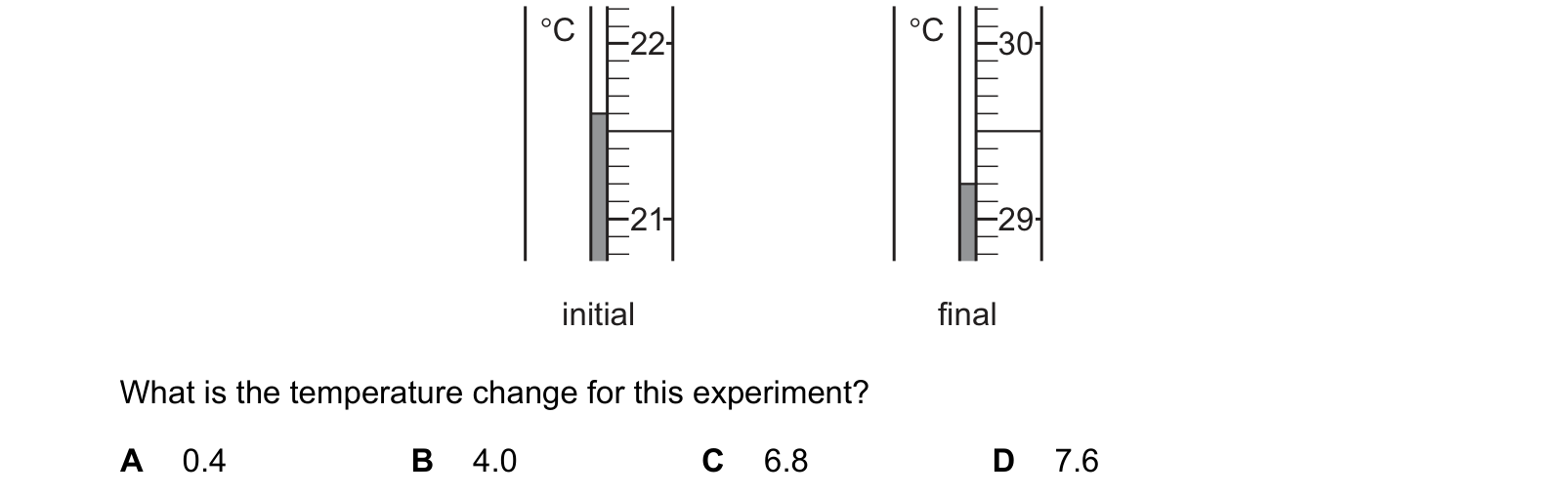
Answer: D.
Question 2
The colours in an ink are separated by chromatography. Which diagram shows the assembled apparatus? Use the source image for W23 Paper 13, question 14.
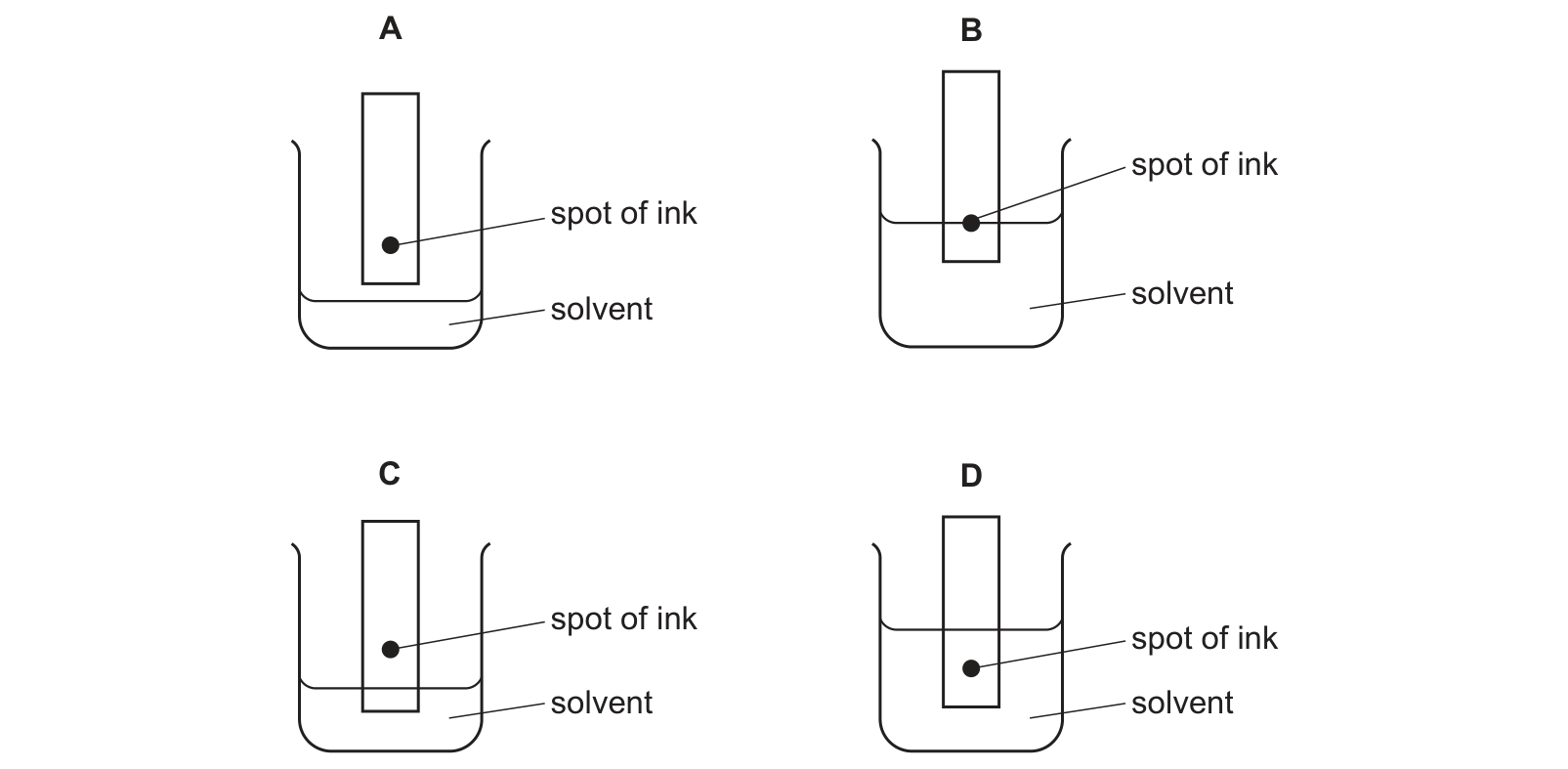
Answer: C.
Question 3
The colours in an ink are separated by chromatography. Which diagram shows the assembled apparatus? Use the source image for W23 Paper 23, question 14.
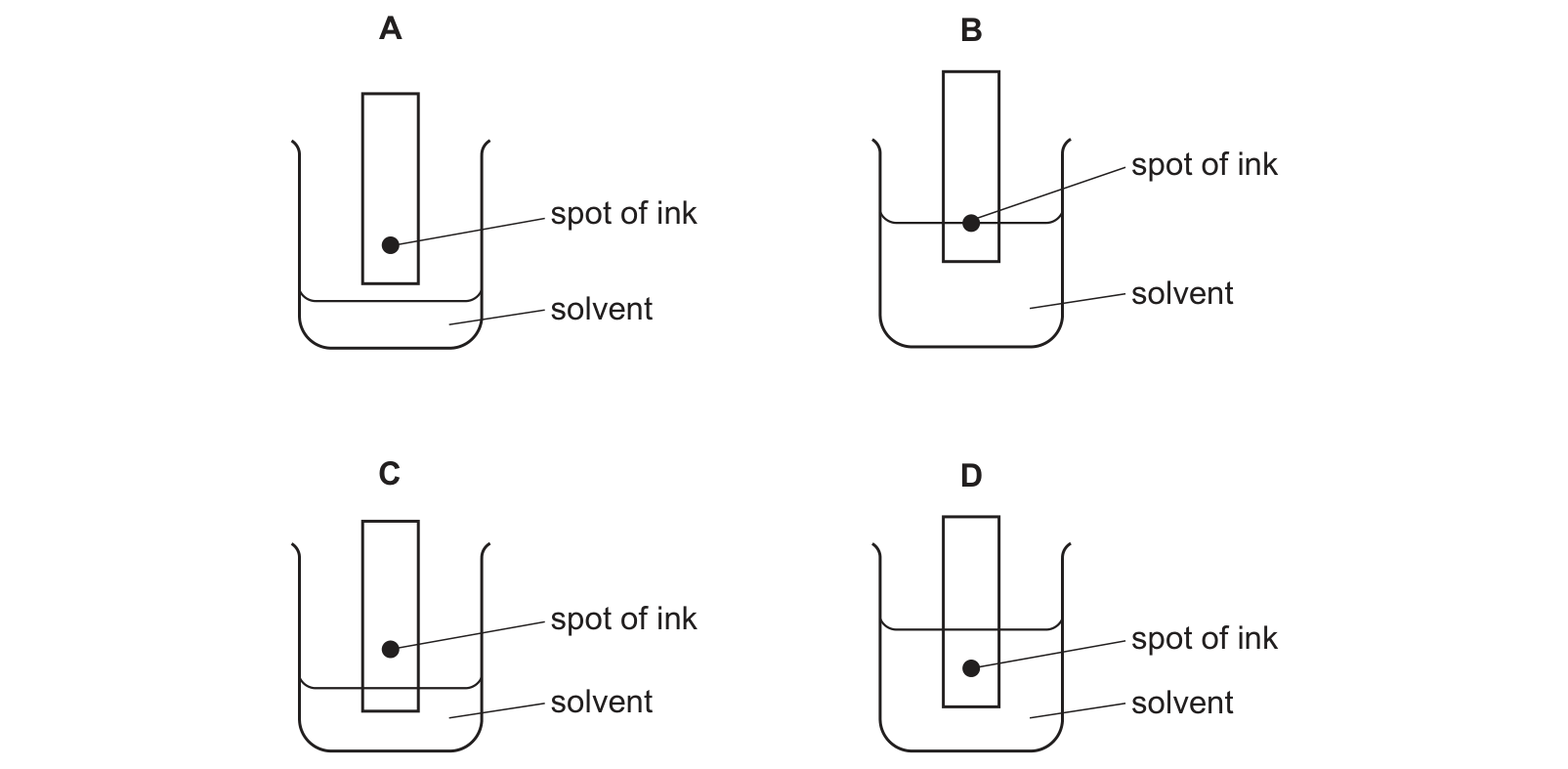
Answer: C.
What the syllabus asks for on this topicSyllabus points
Syllabus points
- Name the apparatus used to measure time, temperature, mass and volume.
- Describe filtration, crystallisation, distillation and paper chromatography, and choose the right one for a given mixture.
- Interpret a chromatogram and calculate an Rf value.
- Describe the tests for the common gases.
- Describe flame tests and the tests for cations and for anions.
- State the criteria of purity for a substance.
Related CIE 0654 Co-ordinated Sciences topics
Not the topic you were looking for? Describe what you are stuck on in your own words and we will take you to the notes that answer it.