Experimental techniques and chemical analysis Exam Questions
40 past-paper questions on this unit. Five of them are below. Answer on the page: each one is marked the moment you pick, the correct option is shown whether or not you found it, and the full explanation opens either way.
CIE 0654 Co-ordinated SciencesPaper 1 and Paper 2 MCQsFree account
Experimental techniques and chemical analysis: five questions to try now
Real past-paper questions, the answer key from the mark scheme, and the explanation that goes with it. No account needed to answer them.
Question 1
The results of two tests on compound P are shown. test observation flame test red flame addition of acidified silver nitrate white precipitate What is P?
Answer: B.
Two tests are given and the compound must satisfy both, so the answer needs a metal that gives a red flame and a halide that gives a white precipitate with acidified silver nitrate. A red flame identifies lithium, since sodium gives a strong yellow flame that is impossible to mistake for red, and a white precipitate identifies chloride, since silver chloride is white. Lithium bromide is the tempting alternative, because the flame test half is exactly right, but silver bromide is a cream precipitate rather than a white one, and the colour is the only thing separating the two halides here. Working through both tests rather than stopping at the first is the whole point of a question with two observations.
Question 2
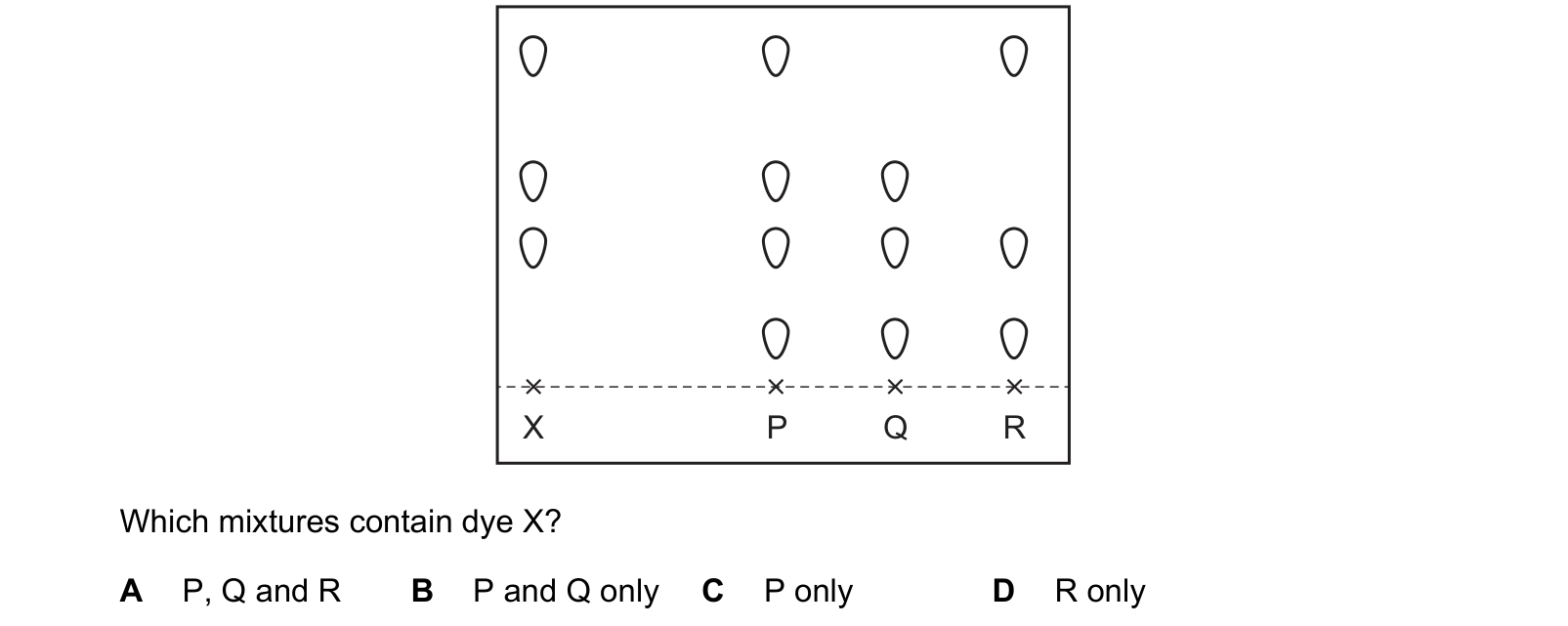
Dye X is a mixture of different coloured substances. Chromatography is used to compare X with three other mixtures, P, Q and R. The results are shown. Which mixtures contain dye X?
Answer: C.
A mixture contains dye X only if every one of the spots in X appears in it at the same height, since each height corresponds to one substance with its own Rf value. X gives three spots, and P shows all three of them along with a fourth spot of its own, so P contains X and C is correct. Q matches the two lower spots but has nothing level with the highest spot in X, so one of those dyes is missing from it. R matches the top spot and one lower spot but leaves a gap where the middle spot of X should be. An extra spot does not disqualify a mixture, whereas a missing one always does.
Question 3
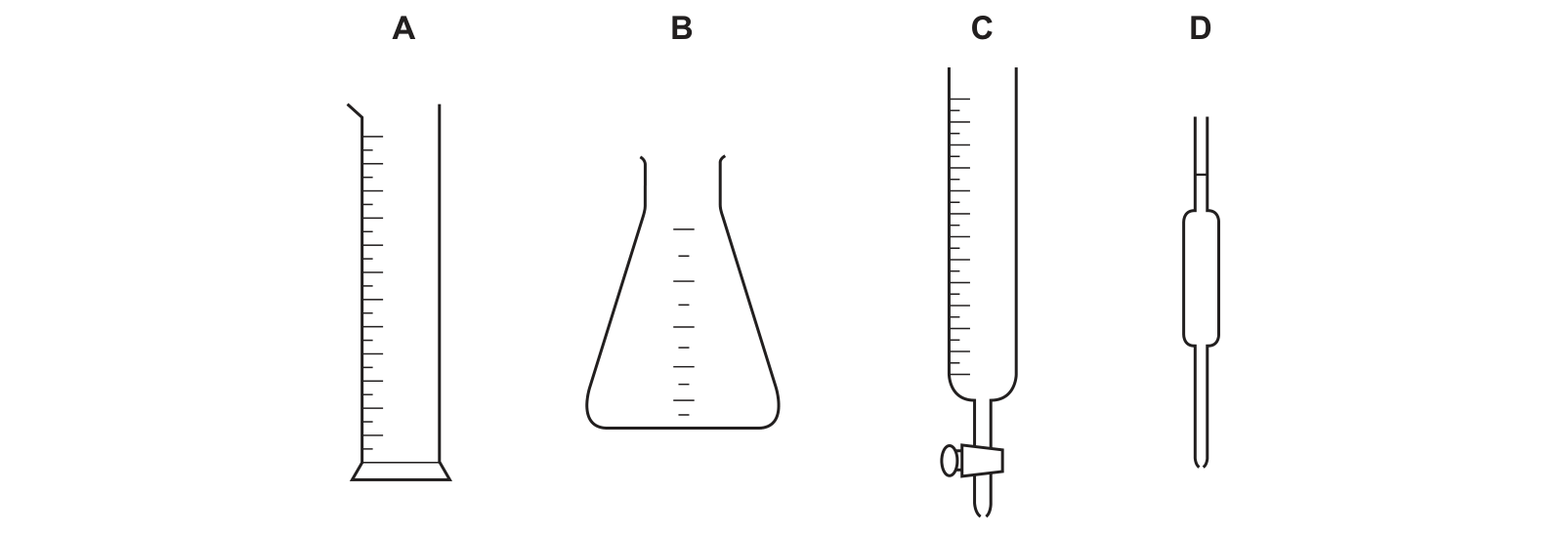
Which piece of apparatus is used to measure the change in the volume of a liquid most accurately? Use the source image for S22 Paper 12, question 14.
Answer: C.
Measuring a change in volume means taking a reading before and a reading after and subtracting, so the apparatus needs a fine graduated scale that can be read wherever the liquid happens to stand. The burette does exactly this, with a tap that releases liquid in controlled amounts and divisions fine enough to read to about 0.05 cm cubed, which is why it is the standard instrument for titrations. The pipette is the tempting alternative because it is the most precise piece of glassware shown, but it delivers one single fixed volume and carries no working scale, so it can never report a change of some chosen size. The measuring cylinder does have a scale, yet its divisions are coarse, often 1 cm cubed, and subtracting two such readings adds their uncertainties together. The conical flask carries only rough graduations meant for judging an approximate level, since it is designed for swirling a reaction rather than for measuring.
Question 4
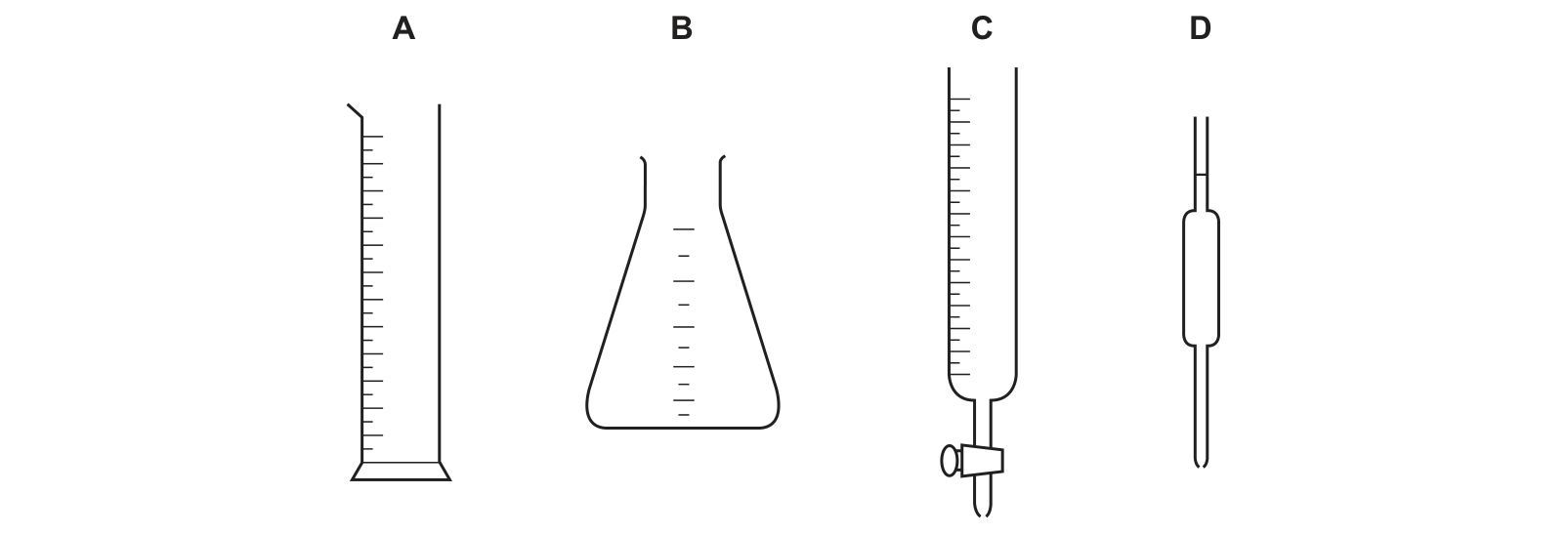
Which piece of apparatus is used to measure the change in the volume of a liquid most accurately? Use the source image for S22 Paper 13, question 14.
Answer: C.
Measuring a change in volume means taking a reading before and a reading after and subtracting, so the apparatus needs a fine graduated scale that can be read wherever the liquid happens to stand. The burette does exactly this, with a tap that releases liquid in controlled amounts and divisions fine enough to read to about 0.05 cm cubed, which is why it is the standard instrument for titrations. The pipette is the tempting alternative because it is the most precise piece of glassware shown, but it delivers one single fixed volume and carries no working scale, so it can never report a change of some chosen size. The measuring cylinder does have a scale, yet its divisions are coarse, often 1 cm cubed, and subtracting two such readings adds their uncertainties together. The conical flask carries only rough graduations meant for judging an approximate level, since it is designed for swirling a reaction rather than for measuring.
Question 5
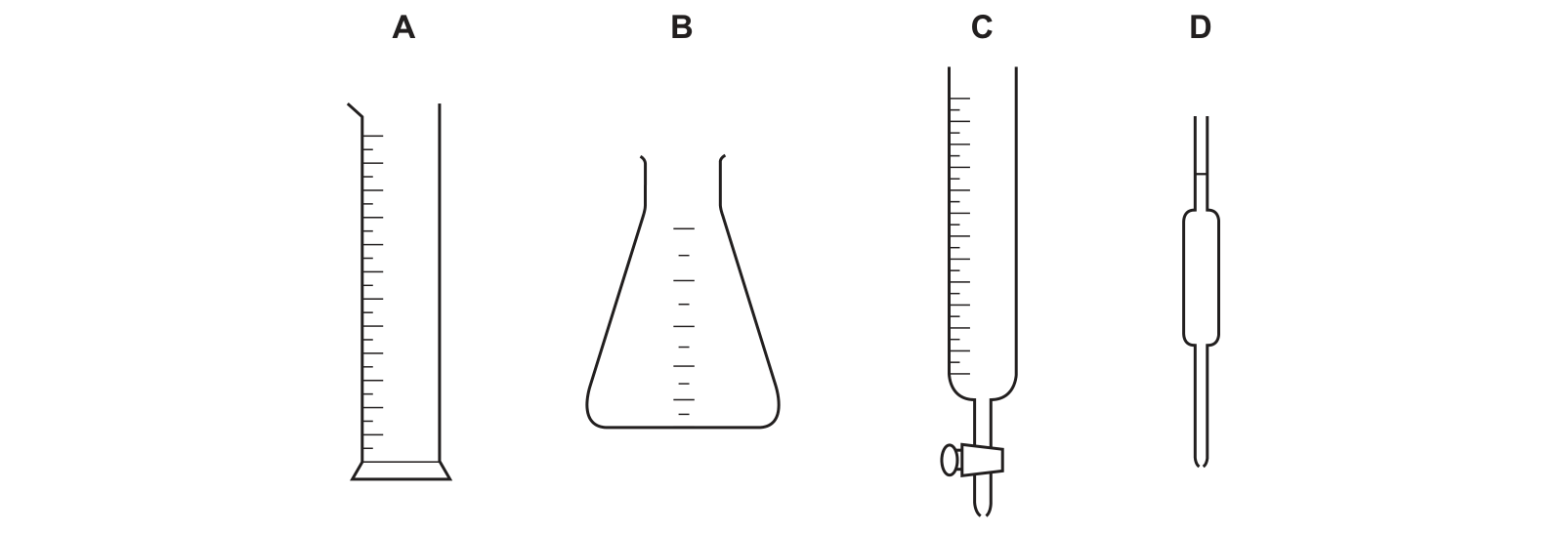
Which piece of apparatus is used to measure the change in the volume of a liquid most accurately? Use the source image for S22 Paper 22, question 14.
Answer: C.
Measuring a change in volume means taking a reading before and a reading after and subtracting, so the apparatus needs a fine graduated scale that can be read wherever the liquid happens to stand. The burette does exactly this, with a tap that releases liquid in controlled amounts and divisions fine enough to read to about 0.05 cm cubed, which is why it is the standard instrument for titrations. The pipette is the tempting alternative because it is the most precise piece of glassware shown, but it delivers one single fixed volume and carries no working scale, so it can never report a change of some chosen size. The measuring cylinder does have a scale, yet its divisions are coarse, often 1 cm cubed, and subtracting two such readings adds their uncertainties together. The conical flask carries only rough graduations meant for judging an approximate level, since it is designed for swirling a reaction rather than for measuring.
These questions are drawn from past CIE 0654 Co-ordinated Sciences papers and filtered to experimental techniques and chemical analysis. You answer, you find out immediately whether you were right, and you get the reasoning for the correct option and for each distractor. Wrong answers go to a mistakes locker so you can come back to exactly those.
Practice is free. You need an account only so your progress and your mistakes are still there next time.
These are the errors that cost marks on experimental techniques and chemical analysis, taken from our own topic notes. Read them before you practise and you will recognise the traps in the questions.
Using crystallisation or distillation to remove an insoluble impurity, when only filtration can.
Crystallising before filtering, so the impurity ends up in the crystals.
Saying filtration removes dissolved substances.
Confusing the lighted splint and the glowing splint tests.
Drawing the chromatography baseline in ink.
Starting the chromatogram with the baseline below the solvent level.
Calculating Rf as solvent distance divided by spot distance, giving an answer above 1.