Excretion in humans
Contents: 7 sections
What counts as excretion
Excretion is the removal from organisms of the toxic products of metabolism, of substances in excess of requirements, and of substances that have no use.
The phrase "products of metabolism" is what makes the definition work. Every excretory product was made by the body's own chemistry. That is why passing faeces is egestion and not excretion: undigested food never took part in a chemical reaction inside a cell, so getting rid of it is not the removal of a metabolic product at all. This distinction is examined more often than anything else in the topic.
| Excretory product | Where it is made | Excreted by |
|---|---|---|
| Carbon dioxide | Every respiring cell | The lungs |
| Urea | The liver, from surplus amino acids | The kidneys, in urine |
| Excess water and salts | From food and drink, and from respiration | The kidneys, in urine, and the skin in sweat |
Notice that the lungs are excretory organs. Students who think of excretion as urine only lose the carbon dioxide mark.
Sweating is a slightly awkward case worth understanding rather than memorising. Its purpose is cooling, so it is not primarily an excretory process, but water and salts really are removed in it, so sweat does carry excretory products out.
Urea and deamination
Protein in the diet is digested into amino acids, which are absorbed into the blood. The body uses amino acids to build its own proteins, but surplus amino acids cannot be stored, and they cannot simply be left in the blood because they are toxic.
So the liver carries out deamination: the nitrogen-containing amino group is removed from the amino acid. The remainder of the molecule is a carbohydrate-like compound that can be respired or converted to fat, and the amino group becomes ammonia, which is extremely toxic and is immediately converted into the much less toxic urea.
Urea then travels dissolved in the blood plasma from the liver to the kidneys, and the kidneys remove it. Two points follow that are worth stating clearly, because questions are built on both:
- The liver makes urea; the kidney removes it. Saying the kidney makes urea is the classic error. The kidney is a filter, not a factory.
- Urea is in the blood between the two organs, so the concentration of urea is higher in the blood leaving the liver and lower in the blood leaving the kidney.
This is also why a high-protein diet increases the amount of urea excreted. More surplus amino acids means more deamination.
The urinary system
| Part | Function |
|---|---|
| Kidney | Filters the blood and makes urine |
| Ureter | Carries urine from the kidney to the bladder |
| Bladder | Stores urine |
| Urethra | Carries urine out of the body |
| Renal artery | Brings blood to the kidney |
| Renal vein | Takes blood away from the kidney |
The ureter and the urethra are easy to confuse, and the spelling matters. There are two ureters, one from each kidney, and one urethra leaving the bladder.
How the kidney works
The kidney works in two stages, and understanding the order explains everything else about it.
1. Filtration. Blood arrives under high pressure in the renal artery. In each of the kidney's million or so tiny filtering units, the pressure forces small molecules out of the blood: water, glucose, salts and urea all pass through. Blood cells and large protein molecules are too big to pass and stay in the blood.
2. Reabsorption. Filtering is deliberately indiscriminate, so useful substances have been lost along with the waste and must be taken back. Moving along the tubule, the kidney reabsorbs:
- All of the glucose. Glucose is far too valuable to lose, so a healthy person has no glucose in the urine at all. Glucose appearing in urine is a sign of diabetes, where there is more glucose in the blood than the kidney can reabsorb.
- Most of the water, the amount depending on how much the body needs to keep.
- Some of the salts, again according to need.
What is left is urine: water, urea and salts. Urea is not reabsorbed, because it is the waste the whole process exists to remove.
The two-stage design looks wasteful, and the reason it is used is worth knowing. Filtering everything small and then taking back what is wanted is far simpler than trying to select the waste molecule by molecule, and it lets the kidney adjust the amount of water and salt kept back from moment to moment.
Comparing the blood in and out
Worked example. How does blood in the renal vein differ from blood in the renal artery?
The blood leaving the kidney contains:
- Less urea, because urea has been removed. This is the main answer.
- Less water and fewer salts, if the body had a surplus of either.
- Less oxygen and more carbon dioxide, because the kidney cells have been respiring, exactly like any other organ.
Glucose is unchanged, because all of it was reabsorbed. That is the detail that separates a full answer from a partial one, and writing "less glucose" is a common slip.
Dialysis does the same job artificially when the kidneys fail. Blood is passed on one side of a partially permeable membrane, with dialysis fluid on the other. The fluid contains the correct concentrations of glucose and salts, so those do not diffuse out, but it contains no urea, so urea diffuses out of the blood down its concentration gradient. A kidney transplant is the alternative, and its risk is rejection by the immune system.
Common mistakes
- Calling egestion excretion.
- Forgetting that the lungs are an excretory organ, and that carbon dioxide is an excretory product.
- Saying the kidney makes urea. The liver makes it.
- Saying urea is made from carbohydrate or fat. It is made from surplus amino acids.
- Confusing the ureter with the urethra.
- Saying the kidney filters out only the waste. It filters out all small molecules and then reabsorbs the useful ones.
- Saying protein is filtered into the urine. Protein molecules are too large to pass through.
- Saying blood leaving the kidney has less glucose. All the glucose is reabsorbed, so it is unchanged.
- Saying glucose in the urine is normal.
- Saying dialysis fluid contains no glucose, when it must contain glucose at the correct concentration so that none is lost.
Check you have it
Question 1
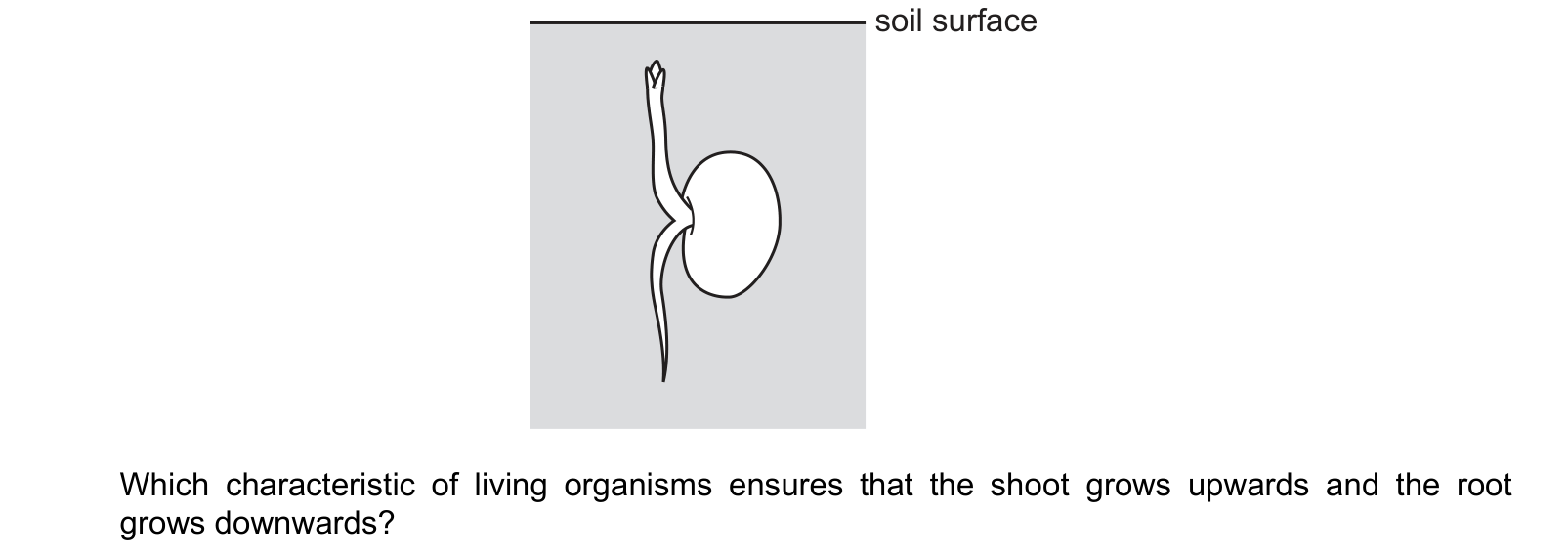
The diagram shows a germinating seed below the soil surface.
Which characteristic of living organisms ensures that the shoot grows upwards and the root grows downwards?
Answer: D.
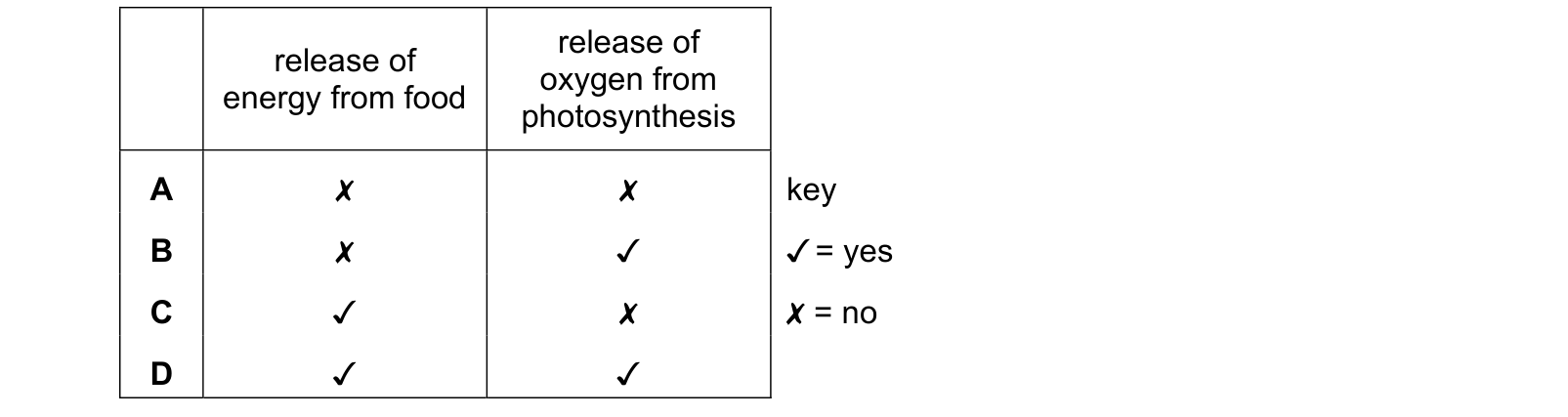
Question 2
Which processes are examples of excretion? release of release of oxygen from energy from food photosynthesis Use the source image for S24 Paper 22, question 1.
Answer: B.
Question 3
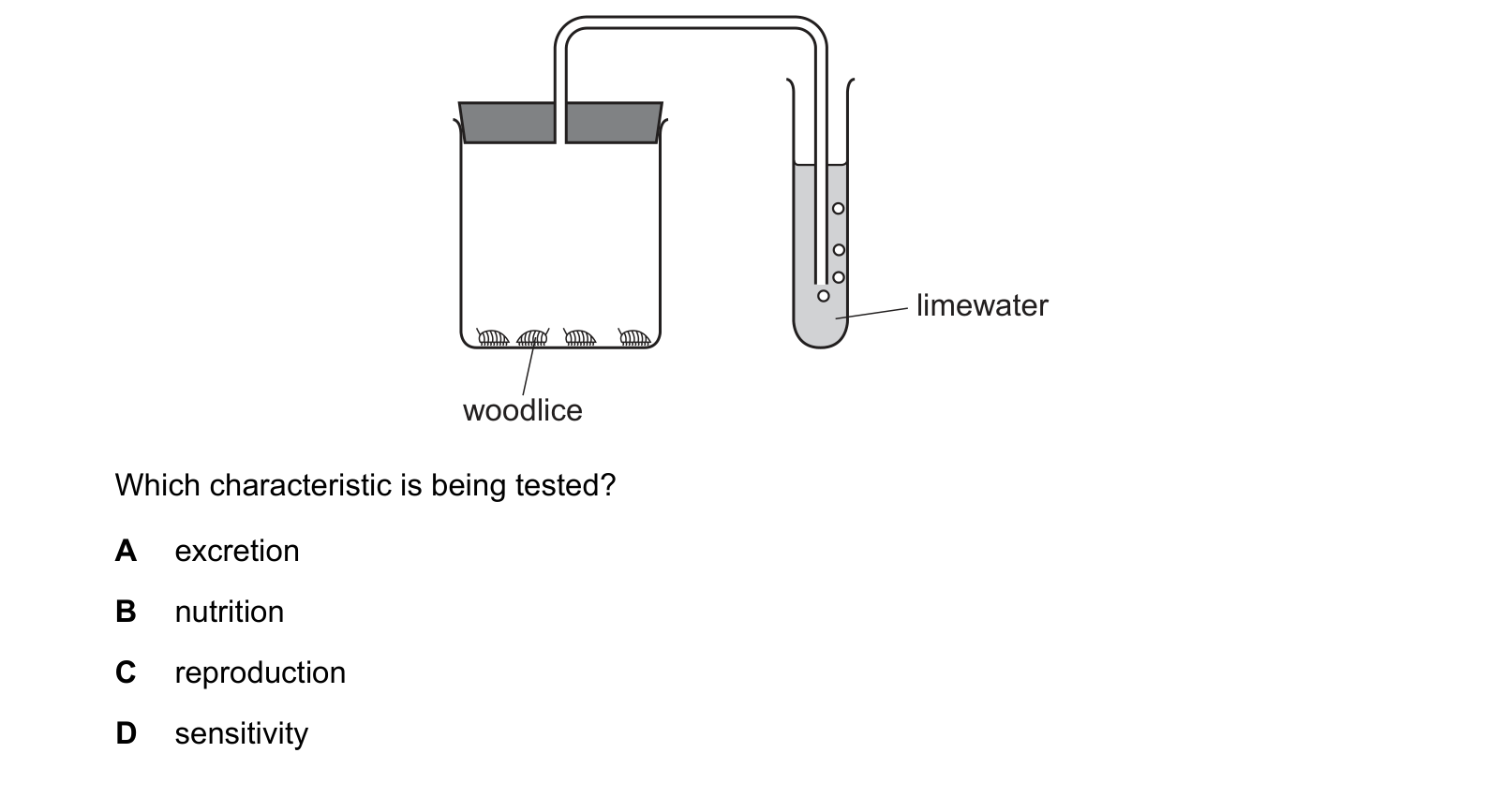
The diagram shows some apparatus that can be used to test for one of the characteristics of life. Which characteristic is being tested?
Answer: A.
What the syllabus asks for on this topicSyllabus points
Syllabus points
- Define excretion and name the excretory products of humans and the organ that removes each.
- Describe deamination and state where urea is made.
- Name the parts of the urinary system and state the function of each.
- Outline how the kidney filters the blood and reabsorbs what the body needs.
- Explain the difference in composition between blood entering and leaving the kidney.
Related CIE 0654 Co-ordinated Sciences topics
Not the topic you were looking for? Describe what you are stuck on in your own words and we will take you to the notes that answer it.