Three past-paper questions are below. Answer on the page: each one is marked the moment you pick, the correct option is shown whether or not you found it, and the full explanation opens either way.
CIE 0654 Co-ordinated SciencesPaper 1 and Paper 2 MCQsFree account
Excretion in humans: three questions to try now
Real past-paper questions, the answer key from the mark scheme, and the explanation that goes with it. No account needed to answer them.
Question 1
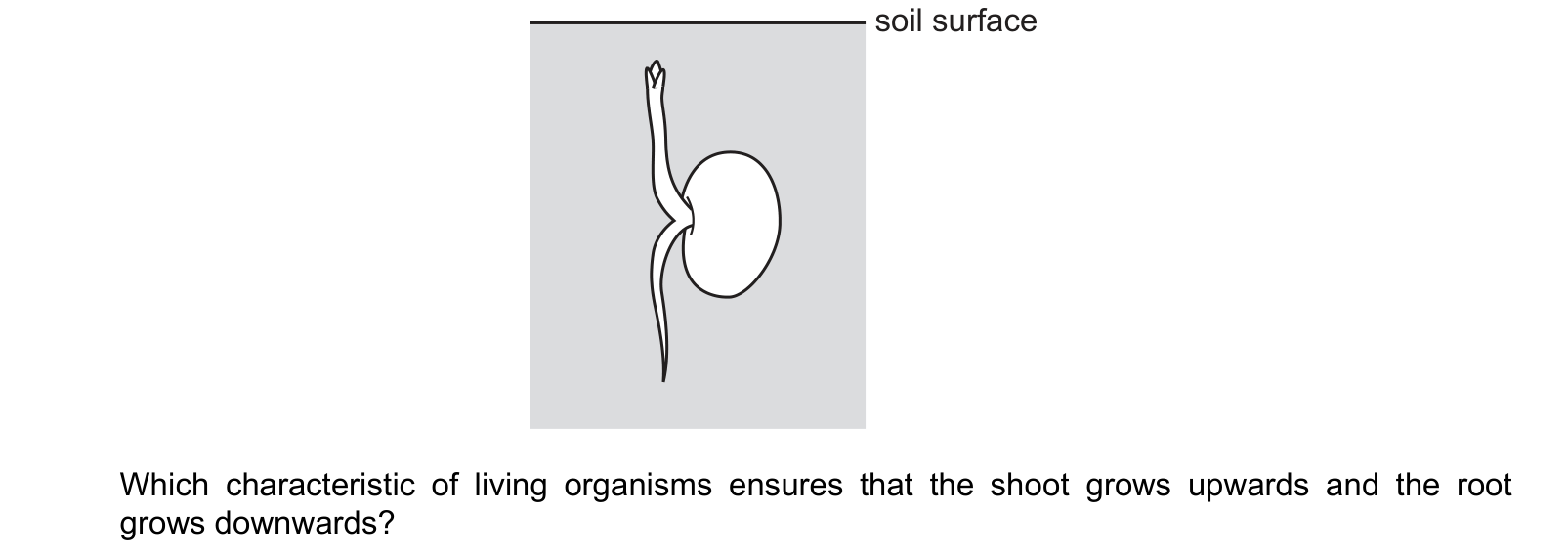
The diagram shows a germinating seed below the soil surface. Which characteristic of living organisms ensures that the shoot grows upwards and the root grows downwards?
Answer: D.
Sensitivity is the ability to detect and respond to a stimulus, and the stimulus here is gravity: the root grows towards the pull of gravity while the shoot grows away from it. Below the soil surface there is no light for the shoot to bend towards, so gravity is the only cue available and detecting it is what keeps each organ pointing the right way. Nutrition is the taking in of materials for energy, growth and development, and although the seed is drawing on its food store, that supplies the growth rather than steering its direction. Excretion is the removal of the waste products of metabolism, which has no bearing on which way a root points. Reproduction is the production of new individuals, and the seed is already the product of that process rather than an example of it happening here.
Question 2
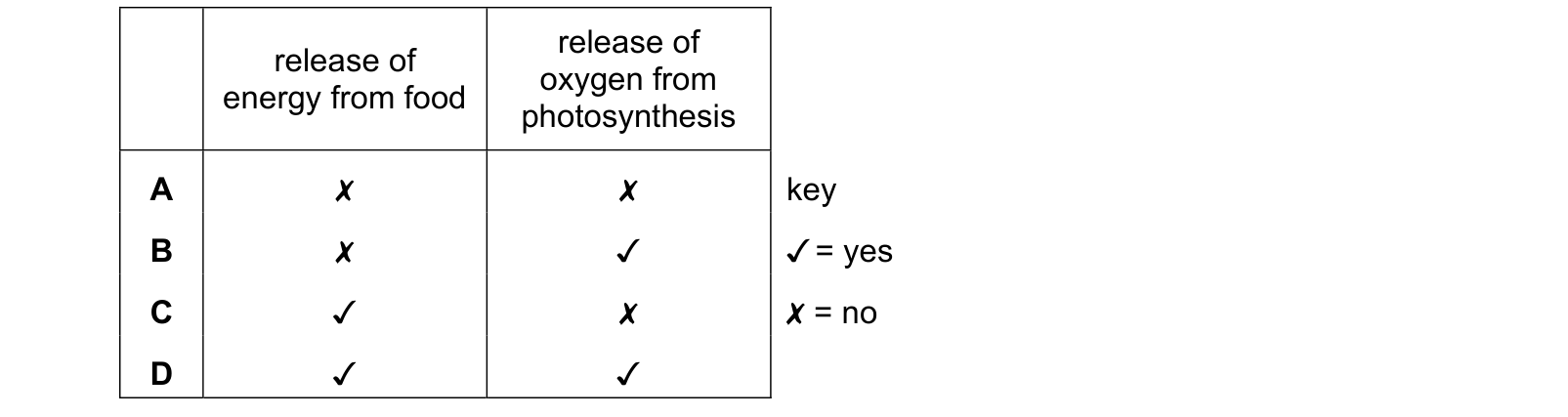
Which processes are examples of excretion? release of release of oxygen from energy from food photosynthesis Use the source image for S24 Paper 22, question 1.
Answer: B.
Excretion is the removal from an organism of the waste products of metabolism, together with substances present in excess of requirements. Oxygen made during photosynthesis is a by-product the plant cannot use in that quantity, and losing it through the stomata is therefore excretion, so that column must be ticked. Releasing energy from food is respiration, and energy is not a substance at all, so nothing is being removed and that column stays unticked. The two rows ticking the release of energy confuse a process that supplies the organism with one that rids it of waste. The row that leaves both columns unticked overlooks the oxygen, which really is a waste product leaving the plant.
Question 3
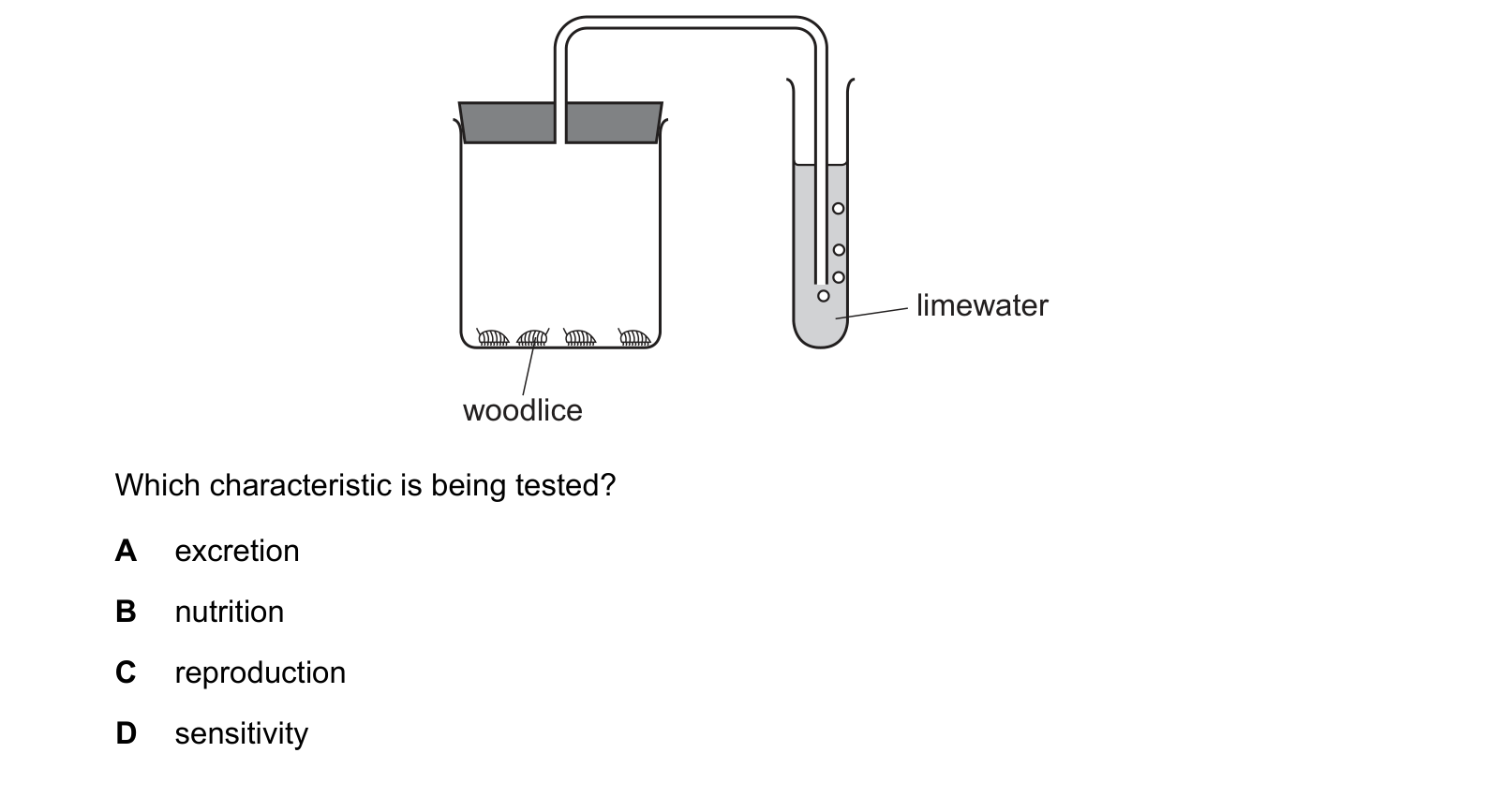
The diagram shows some apparatus that can be used to test for one of the characteristics of life. Which characteristic is being tested?
Answer: A.
The tube of limewater collects gas leaving the container of woodlice and turns milky if carbon dioxide is present, so the apparatus is detecting something the animals give out. Carbon dioxide is a waste product made by respiration in their cells, and removing the waste products of metabolism is the definition of excretion, so that is the characteristic being tested. Nutrition would require food to be supplied and its use followed, and the sealed container offers the woodlice nothing to eat. Sensitivity would require a stimulus such as light or damp to be applied and the animals watched for a response, which nothing in the apparatus provides. Reproduction would need the woodlice followed over generations for new individuals, which a one hour gas test cannot show.
These questions are drawn from past CIE 0654 Co-ordinated Sciences papers. You answer, you find out immediately whether you were right, and you get the reasoning for the correct option and for each distractor. Wrong answers go to a mistakes locker so you can come back to exactly those.
Practice is free. You need an account only so your progress and your mistakes are still there next time.
These are the errors that cost marks on excretion in humans, taken from our own topic notes. Read them before you practise and you will recognise the traps in the questions.
Calling egestion excretion.
Forgetting that the lungs are an excretory organ, and that carbon dioxide is an excretory product.
Saying the kidney makes urea. The liver makes it.
Saying urea is made from carbohydrate or fat. It is made from surplus amino acids.
Confusing the ureter with the urethra.
Saying the kidney filters out only the waste. It filters out all small molecules and then reabsorbs the useful ones.
Saying protein is filtered into the urine. Protein molecules are too large to pass through.
Saying blood leaving the kidney has less glucose. All the glucose is reabsorbed, so it is unchanged.