Reproduction
Contents: 6 sections
Asexual and sexual
| Asexual | Sexual | |
|---|---|---|
| Parents | One | Two |
| Gametes? | No | Yes |
| Offspring | Genetically identical clones | Genetically different |
| Variation | None | Yes |
| Speed | Fast | Slower |
Variation is the point of sexual reproduction. It means a population can adapt when conditions change, whereas a disease that kills one clone can kill them all. Asexual reproduction wins when conditions are stable and speed matters.
Flowering plants
The anther and filament make up the stamen, the male part. The stigma, style and ovary make up the carpel, the female part.
Pollination is the transfer of pollen from an anther to a stigma. Self-pollination is within the same plant; cross-pollination is between plants, and it produces more variation.
| Insect-pollinated | Wind-pollinated | |
|---|---|---|
| Petals | Large, brightly coloured, scented | Small, green, no scent |
| Nectar | Present | Absent |
| Pollen | Sticky or spiky, less of it | Smooth, light, a great deal |
| Anthers | Inside the flower | Hanging outside |
| Stigma | Inside, sticky | Outside, large and feathery |
Fertilisation is different from pollination, and confusing the two is the standard error. After pollination the pollen grain grows a pollen tube down the style; fertilisation is the moment the male nucleus fuses with the female nucleus in the ovule.
Afterwards the ovule becomes the seed and the ovary becomes the fruit.
Germination needs water, oxygen and a suitable temperature. Light is not required, and seeds are not photosynthesising yet: they use the food store in the seed.
Human reproduction
Male: testes make sperm and testosterone; the sperm duct carries sperm; the prostate adds fluid; the urethra carries semen out.
Female: ovaries release eggs; the oviduct carries the egg towards the uterus and is where fertilisation happens; the uterus is where the embryo implants and develops; the cervix is its neck.
| Sperm | Egg | |
|---|---|---|
| Size | Very small | Much larger |
| Number | Millions | One at a time |
| Movement | Swims with a tail | Cannot move itself |
| Food store | Almost none | Large |
Fertilisation is the fusion of the sperm nucleus with the egg nucleus, forming a zygote. The zygote divides to form an embryo, which travels to the uterus and implants in its lining.
The placenta then supplies the fetus. Food and oxygen diffuse from mother to fetus; carbon dioxide and urea diffuse the other way. The two blood supplies come very close but do not mix, which keeps the mother's blood pressure from damaging the fetus and keeps their blood groups separate. The umbilical cord connects the fetus to the placenta, and the amniotic fluid cushions it against knocks.
The menstrual cycle
Roughly 28 days, counted from the first day of bleeding.
- Days 1 to 5: the uterus lining breaks down and is lost.
- Days 6 to 13: oestrogen from the ovary repairs and thickens the lining.
- Day 14 or thereabouts: ovulation, an egg is released.
- Days 15 to 28: progesterone maintains the thickened lining.
If the egg is not fertilised, progesterone falls and the lining breaks down, starting the next cycle. If it is fertilised, progesterone stays high and the lining is kept.
The two hormones divide the work simply: oestrogen builds the lining, progesterone maintains it.
Common mistakes
- Using pollination and fertilisation as though they meant the same thing.
- Saying the ovary becomes the seed. The ovule becomes the seed; the ovary becomes the fruit.
- Saying germinating seeds need light.
- Saying fertilisation happens in the uterus. It happens in the oviduct.
- Saying the mother's and fetus's blood mix in the placenta.
- Swapping oestrogen and progesterone.
- Saying asexual offspring show variation.
Check you have it
Question 1
Which row about human gametes is correct? flagellum energy store shows gamete present present motility Use the source image for S21 Paper 22, question 10.
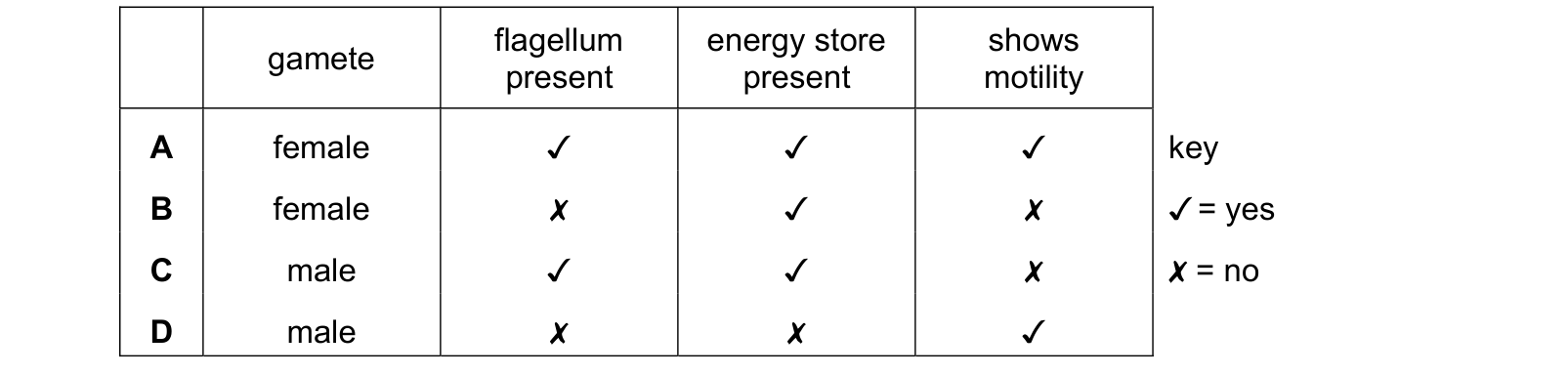
Answer: B.
Question 2
The diagram shows human gamete formation and fertilisation. Which row is correct? Each answer gives, in order: structure V; structure W; structure Z.
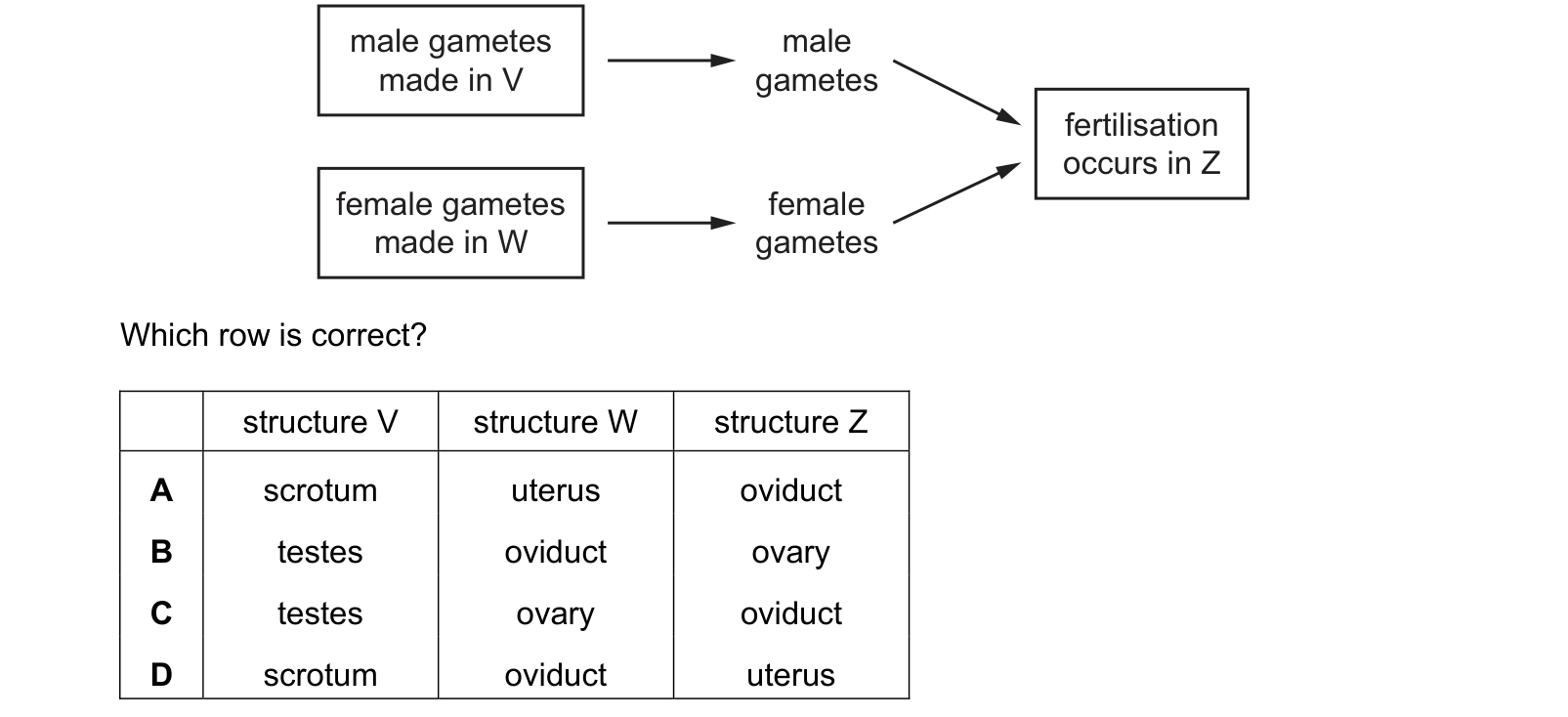
Answer: C.
Question 3
The diagram shows a cross-section of a carpel of an insect-pollinated flower. Which row correctly shows the processes that have taken place? Use the source image for W22 Paper 13, question 10.
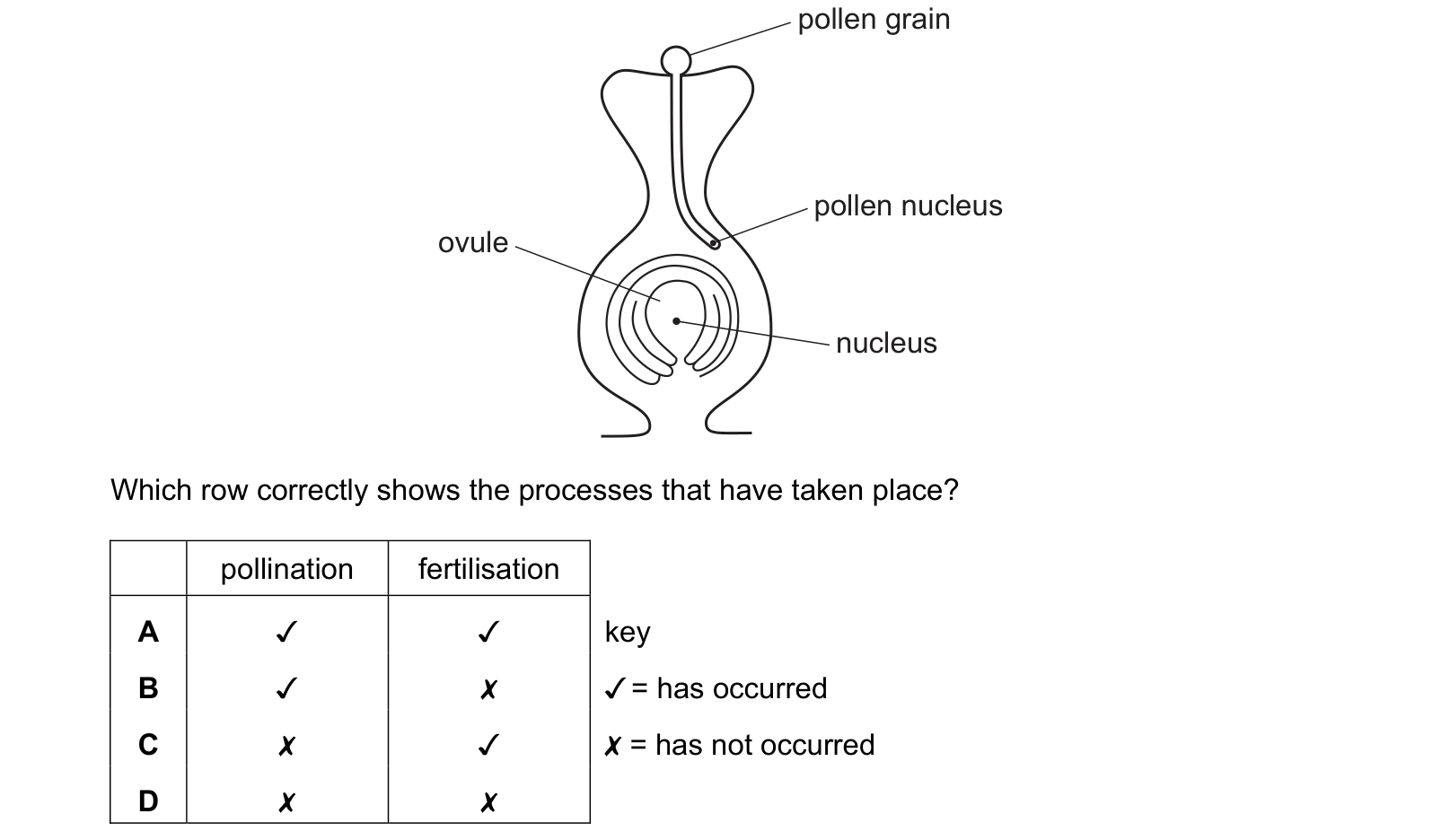
Answer: B.
What the syllabus asks for on this topicSyllabus points
Syllabus points
- Compare asexual and sexual reproduction.
- Describe sexual reproduction in flowering plants, including pollination, fertilisation and germination.
- Describe the human reproductive system, fertilisation and development.
- Describe the menstrual cycle and the role of the sex hormones.
Related CIE 0654 Co-ordinated Sciences topics
Not the topic you were looking for? Describe what you are stuck on in your own words and we will take you to the notes that answer it.