Plant nutrition
Contents: 8 sections
The equations
carbon dioxide + water → glucose + oxygen, in the presence of light and chlorophyll.
6CO₂ + 6H₂O → C₆H₁₂O₆ + 6O₂
Light and chlorophyll are written above and below the arrow rather than on the left, because neither is a reactant. Light is the energy source, and chlorophyll is a pigment that absorbs it and is not used up.
Two things are worth noticing in that symbol equation, because both are examined.
The ratio is six carbon dioxide molecules to one glucose. So twelve molecules of carbon dioxide would make 12 / 6 = 2 molecules of glucose, and the same reasoning works whatever number the question gives you.
Read the equation backwards and you get aerobic respiration. The same four substances appear on the opposite sides. That is why a question asking for the raw materials of photosynthesis so often offers "oxygen and glucose" as a distractor: it is a real answer, just to the other question. Photosynthesis takes in carbon dioxide through the stomata and stores energy; respiration releases carbon dioxide and releases energy.
Photosynthesis is the process by which plants make their own organic nutrients, which is what makes them producers and why every food chain starts with one.
What happens to the glucose
The glucose is not simply left lying about. A plant uses it for:
- Respiration, to release energy.
- Storage as starch, which is insoluble, so it does not affect the water potential of the cell and cannot diffuse away.
- Cellulose, for cell walls.
- Sucrose, the soluble form in which sugar is transported in the phloem.
- Proteins, once nitrogen from nitrate ions has been added.
Starch is stored rather than glucose for a reason worth being able to state: storing thousands of glucose molecules loose in a cell would drag water in by osmosis and burst it.
Limiting factors
A limiting factor is the factor in shortest supply, which is holding the rate back. Raise it and the rate rises; raise anything else and nothing happens.
Three factors are examined:
- Light intensity. More light means more energy absorbed by chlorophyll, so a faster rate, until something else runs short.
- Carbon dioxide concentration. Carbon dioxide is only about 0.04% of the air, so it is very often the factor that runs out first.
- Temperature. Photosynthesis is controlled by enzymes, so the rate rises with temperature to an optimum and then falls sharply as the enzymes denature.
The graph of rate against light intensity is the one to recognise. It climbs steeply at first, then flattens into a plateau. The steep part is where light is limiting. The plateau is where light is no longer limiting, because carbon dioxide or temperature has become the constraint instead. Raising the light further on the plateau changes nothing at all, and that is the point of the question.
Notice that temperature behaves differently from the other two. Light and carbon dioxide only ever help; more is never worse. Temperature has an optimum, because the enzymes are proteins and heat destroys them.
Investigating photosynthesis
Rate from bubbles. Pondweed in water gives off oxygen, and counting bubbles per minute, or collecting and measuring the gas, gives a measure of the rate. Move the lamp closer or further away to change the light intensity. Use a heat shield or a water bath, because a lamp warms the water as well as lighting it, and without that control you cannot tell which factor produced the change.
Testing a leaf for starch. Boil the leaf in water to kill it and break the cell membranes, boil it in ethanol to remove the chlorophyll so the colour change is visible, dip it in hot water to soften it because ethanol makes it brittle, then add iodine solution. Blue-black means starch, so photosynthesis has happened.
Designing the controls. This is where most marks are lost. To test whether carbon dioxide is needed, the control plant must sit in a clear container with the carbon dioxide removed by an absorbent such as soda lime. It is tempting to use a black container, but that removes the light as well, so you would have changed two things at once and the result would prove nothing. Only the factor being tested may differ.
Any plant used in a starch test must first be destarched by leaving it in the dark for a day or two, so that any starch found afterwards was definitely made during the experiment.
The leaf
| Part | Adaptation | Why |
|---|---|---|
| Waxy cuticle | Transparent and waterproof | Lets light through and reduces water loss |
| Upper epidermis | Thin and transparent, no chloroplasts | Light passes straight through to the cells below |
| Palisade mesophyll | Column shaped, packed with chloroplasts, near the top | Absorbs the most light |
| Spongy mesophyll | Loosely packed with large air spaces | Lets carbon dioxide diffuse quickly to every cell |
| Stomata | Pores, mostly on the lower surface | Let carbon dioxide in and oxygen and water vapour out |
| Guard cells | A pair around each stoma, with unevenly thickened walls | Take in water and become turgid, which bows them apart and opens the pore |
| Xylem and phloem | Vessels in the vein | Bring water in and take sugars away |
A leaf is broad and thin because that gives a large surface area for catching light and a short diffusion distance for gases.
Oxygen made in a palisade cell leaves it by diffusion, because photosynthesis has made the concentration inside the cell higher than in the air spaces. The gas moves down its own concentration gradient. No energy and no osmosis are involved.
Mineral ions
| Ion | Needed for | Symptom of shortage |
|---|---|---|
| Nitrate | Making amino acids, and so proteins | Stunted growth, and older leaves turn yellow |
| Magnesium | Making chlorophyll | Yellow leaves, because chlorophyll cannot be made |
Magnesium sits at the centre of every chlorophyll molecule, which is why a plant short of it cannot make the green pigment. Nitrogen is the element in the amino group of every amino acid, which is why nitrate is what a plant needs to turn the sugar it has made into protein for growth.
Both deficiencies leave a pale, poorly growing plant, so the shared symptom has two different causes, and swapping the two ions is the commonest error in the topic. Hold on to the fact that magnesium is a metal and chlorophyll contains a metal atom, while protein is built around carbon chains and nitrogen, not metals.
These ions are absorbed from the soil by the roots by active transport, since they are usually more concentrated inside the root than in the soil water outside.
Common mistakes
- Writing light or chlorophyll on the left-hand side of the equation as a raw material.
- Giving "carbon dioxide and water" as the products. Those are the raw materials, and they are the products of respiration.
- Saying plants respire only at night. Plants respire constantly; in daylight photosynthesis simply outpaces it.
- Saying chlorophyll is used up during photosynthesis.
- Swapping the roles of nitrate and magnesium ions.
- Using a black container as the control when testing whether carbon dioxide is needed, which changes two variables at once.
- Forgetting to destarch the plant before a starch test.
- Leaving out the ethanol step, or heating ethanol with a naked flame, which is a safety mark as well as a method mark.
- Saying more light always means more photosynthesis, when the graph has plateaued and something else is limiting.
Check you have it
Question 1
Which processes are examples of excretion? release of release of oxygen from energy from food photosynthesis Use the source image for S24 Paper 22, question 1.
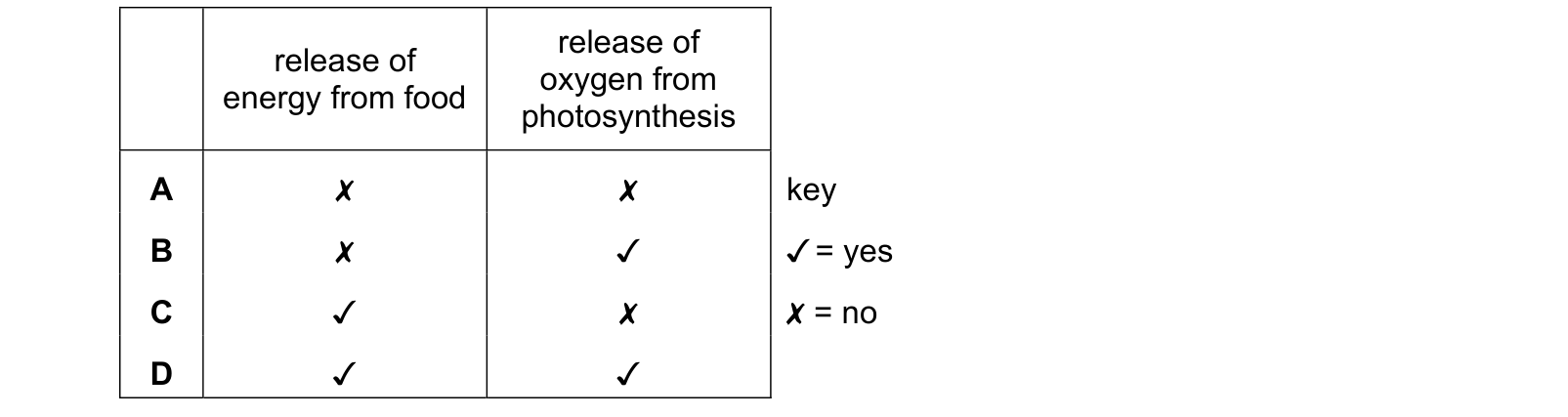
Answer: B.
Question 2
Which row shows the correct raw materials and products of photosynthesis? raw materials products Use the source image for W23 Paper 22, question 5.
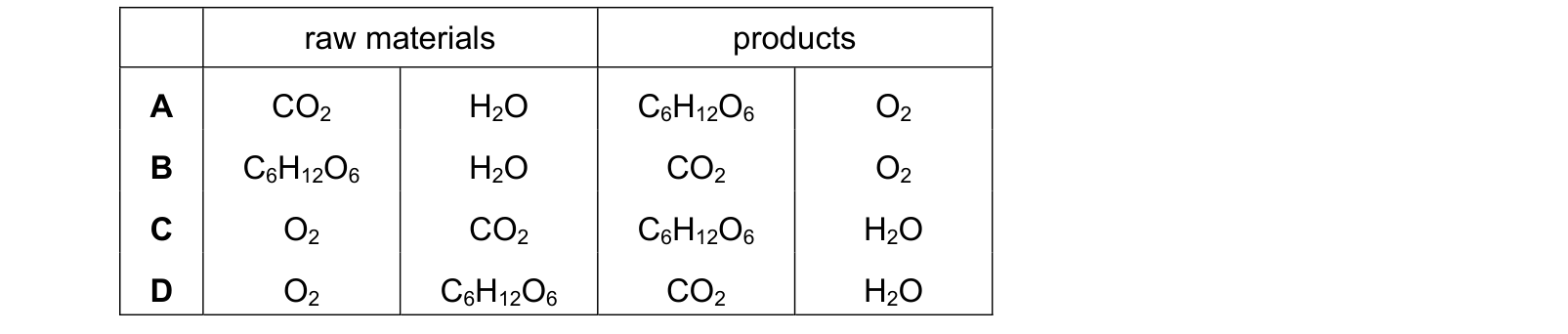
Answer: A.
Question 3
The diagram shows some of the uses in a plant of the initial carbohydrate made by photosynthesis.
initial carbohydrate Which statement is correct?
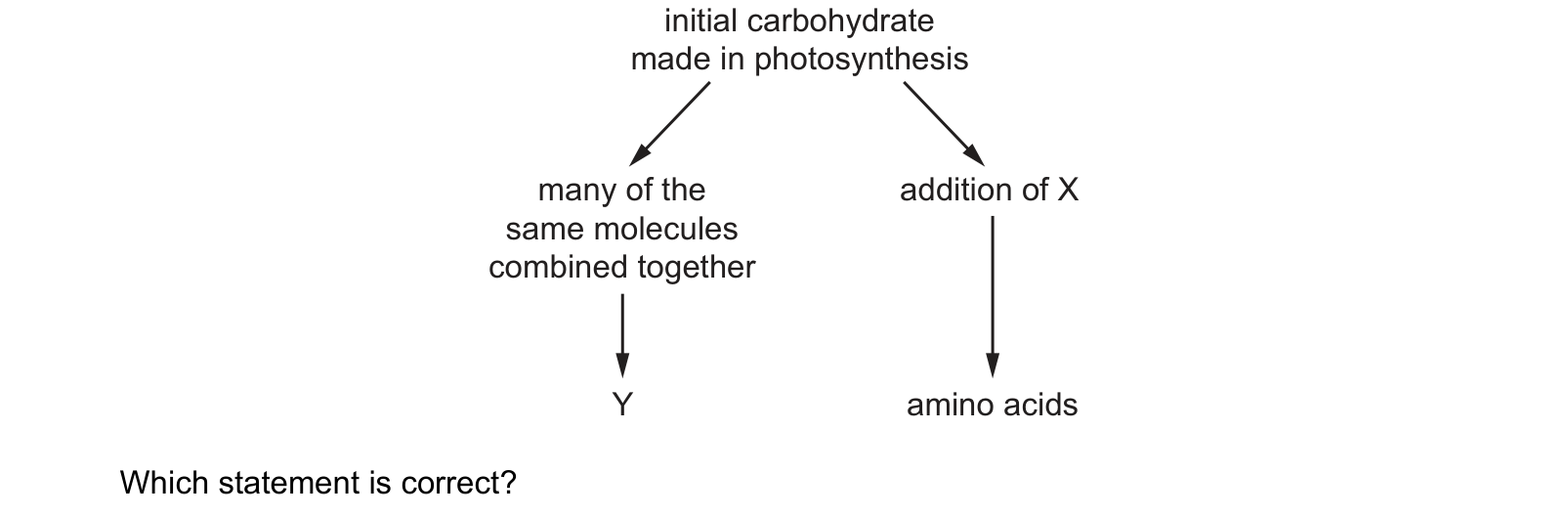
Answer: C.
What the syllabus asks for on this topicSyllabus points
Syllabus points
- State the word equation and the balanced symbol equation for photosynthesis.
- State that chlorophyll traps light energy and transfers it to chemical energy in glucose.
- Investigate and describe the effect of light intensity, carbon dioxide concentration and temperature on the rate of photosynthesis.
- Identify the parts of a leaf and explain how each is adapted to photosynthesis.
- State the role of nitrate ions and magnesium ions in a plant, and the symptoms of a shortage of each.
Related CIE 0654 Co-ordinated Sciences topics
Not the topic you were looking for? Describe what you are stuck on in your own words and we will take you to the notes that answer it.