Organisms and their environment
Contents: 9 sections
The vocabulary
| Term | Definition |
|---|---|
| Producer | An organism that makes its own organic nutrients, usually using light energy in photosynthesis |
| Consumer | An organism that gets its energy by feeding on other organisms |
| Herbivore | An animal that gets its energy by eating plants |
| Carnivore | An animal that gets its energy by eating other animals |
| Decomposer | An organism that gets its energy from dead or waste organic material |
| Food chain | A diagram showing the transfer of energy from one organism to the next, beginning with a producer |
| Food web | A network of interconnected food chains |
| Trophic level | The position of an organism in a food chain, web or pyramid |
The arrows in a food chain show the direction the energy travels, so they point from the eaten to the eater. Drawing them the other way, from predator to prey, is a favourite error and reverses the meaning of the whole diagram.
In the chain grass → rabbit → fox, grass is the producer and the first trophic level, the rabbit is a herbivore and the primary consumer in the second trophic level, and the fox is a carnivore and the secondary consumer in the third.
Decomposers are usually drawn to one side of a food chain rather than in it. They feed on the dead remains and waste of organisms at every level, so they take energy directly from all of them. A carnivore at the top is the tempting answer to "which organisms obtain energy from every trophic level", but a carnivore eats only other consumers, so any energy it receives from a plant has passed through a herbivore on the way and is indirect.
Where the energy comes from
The Sun is the principal source of energy for all biological systems. Energy enters a food chain in one place only: producers absorb light energy and use it in photosynthesis to make organic nutrients.
That single sentence answers a whole family of questions. When you are asked how an organism in the first trophic level gains energy, the answer is by absorbing light from the Sun. "By eating plants" is the tempting alternative, but an organism that eats plants is a herbivore in the second trophic level. The first level is the plants themselves.
Energy losses along the chain
Only about 10% of the energy in one trophic level reaches the next. The rest is lost as:
- Heat from respiration, which is the largest loss.
- Undigested material in faeces, egested rather than absorbed.
- Excretory products such as urea.
- Parts not eaten, such as bones, roots and bark.
This is the reason food chains rarely have more than four or five trophic levels. Energy falls by roughly a factor of ten at each step, so after four or five steps there is not enough left to support a viable population of anything larger. That is the answer to "what determines the number of trophic levels", and it is worth phrasing as the efficiency of energy transfer between levels rather than as anything about competition or protein content.
The same arithmetic explains why feeding people on crops supports more of them than feeding people on meat. Eating the producers directly cuts out one step in which about 90% of the energy would have been lost.
Pyramids
A pyramid of numbers shows how many organisms are at each trophic level. It is easy to construct from a food chain but can come out an odd shape: one oak tree supports thousands of insects, so the bar for the producer is narrower than the bar above it.
A pyramid of biomass shows the total dry mass of the organisms at each level. It is almost always a true pyramid, because the mass at each level must be supported by the mass below it and about 90% of the energy has been lost on the way.
The pyramid of biomass is the more useful of the two for exactly that reason: it does not care whether the producer is one huge tree or a million tiny algae.
The carbon cycle
Carbon moves between the atmosphere and living things by a small number of processes, and you should be able to name which one moves it in which direction.
Carbon dioxide removed from the air:
- Photosynthesis, by producers.
Carbon dioxide returned to the air:
- Respiration, by every living organism including plants.
- Decomposition of dead organisms and waste by decomposers, which is their respiration.
- Combustion of wood and of fossil fuels.
Fossil fuels formed from the remains of organisms that were not decomposed, so their carbon has been out of circulation for millions of years. Burning them returns it all at once, which is why the concentration of carbon dioxide in the atmosphere is rising.
The nitrogen cycle in outline
Plants cannot use nitrogen gas, even though it makes up about 78% of the air. They absorb nitrogen as nitrate ions from the soil and use it to make amino acids and then proteins.
- Decomposers break down dead organisms and waste, releasing ammonium compounds.
- Nitrifying bacteria convert those into nitrates.
- Nitrogen-fixing bacteria, many of them living in the root nodules of legumes such as peas and beans, convert nitrogen gas from the air into compounds plants can use.
- Denitrifying bacteria convert nitrates back into nitrogen gas, which is why waterlogged soils lose fertility.
- Lightning also fixes a small amount of nitrogen.
Animals get their nitrogen by eating plants or other animals, never from the air.
Eutrophication
This is one of the most reliably examined sequences in the whole biology chapter, and the order matters.
- Excess nitrate enters the water, leached from over-applied fertiliser or from untreated sewage.
- Producers, mainly algae, grow rapidly, forming a bloom over the surface.
- The bloom blocks the light, so the plants beneath it die, and the algae themselves soon die as nutrients run out.
- Decomposers multiply and respire aerobically as they break down all that dead material.
- Their respiration uses up the dissolved oxygen in the water.
- Fish and other aquatic animals die, because there is not enough oxygen left.
So the thing that falls is the dissolved oxygen, and it falls because of the decomposers rather than directly because of the fertiliser. Everything else in the sequence rises: producer growth rises, decomposer numbers rise, and their respiration rises.
The step most often left out is the death of the producers between the bloom and the decomposers. Without it the sequence has decomposers appearing with nothing to decompose.
Common mistakes
- Drawing food chain arrows from the eater to the eaten.
- Saying the first trophic level gains energy by eating plants.
- Calling a decomposer a carnivore, or leaving decomposers out of the chain altogether.
- Saying carnivores obtain energy from every trophic level.
- Saying food chains are short because of competition, rather than because of energy loss between levels.
- Saying the energy lost between levels simply disappears, without naming respiration, faeces, excretion or uneaten parts.
- Saying plants do not respire, or that plants only respire at night, in the carbon cycle.
- Saying plants absorb nitrogen gas from the air.
- Giving the eutrophication sequence with the decomposers before the death of the producers.
- Saying eutrophication kills fish by poisoning them. They suffocate, because the decomposers have used the oxygen.
Check you have it
Question 1
Which row about a process in the carbon cycle is correct? Each answer gives, in order: process; effect on level of atmospheric carbon dioxide.
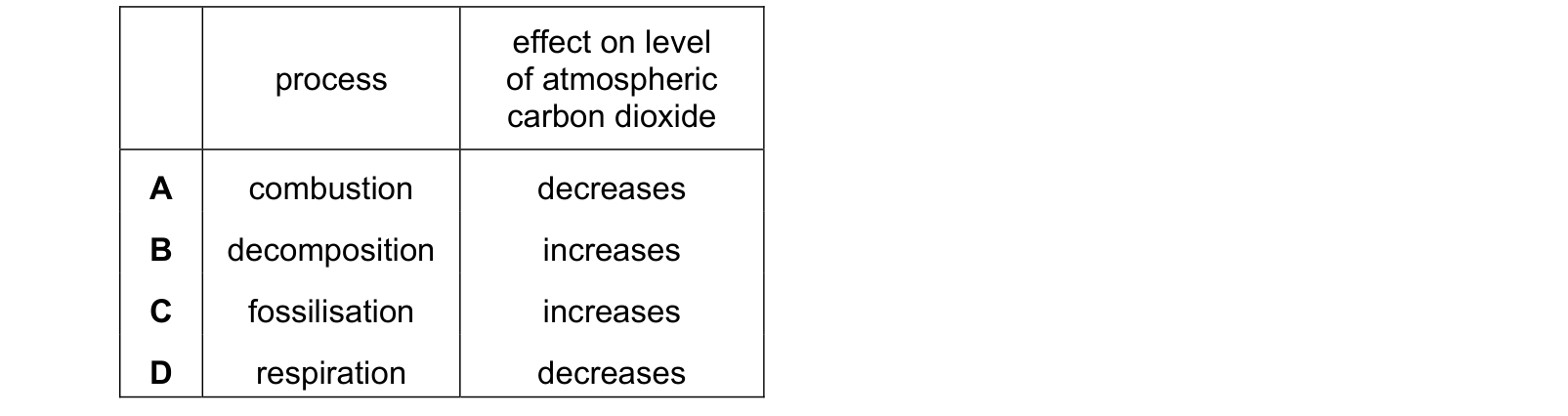
Answer: B.
Question 2
The diagram shows a simplified carbon cycle. Which labelled arrow represents respiration? Use the source image for W21 Paper 11, question 13.

Answer: C.
Question 3
The diagram shows a simplified carbon cycle. Which labelled arrow represents respiration? Use the source image for W21 Paper 12, question 13.

Answer: C.
What the syllabus asks for on this topicSyllabus points
Syllabus points
- State that the Sun is the principal source of energy input to biological systems.
- Define producer, consumer, herbivore, carnivore, decomposer, food chain, food web and trophic level.
- Interpret food chains, food webs and pyramids of numbers and biomass.
- Explain why food chains rarely have more than four or five trophic levels.
- Describe the carbon cycle and the nitrogen cycle in outline.
- Describe the effects of eutrophication.
Related CIE 0654 Co-ordinated Sciences topics
Not the topic you were looking for? Describe what you are stuck on in your own words and we will take you to the notes that answer it.