73 past-paper questions on this unit. Five of them are below. Answer on the page: each one is marked the moment you pick, the correct option is shown whether or not you found it, and the full explanation opens either way.
CIE 0654 Co-ordinated SciencesPaper 1 and Paper 2 MCQsFree account
Organisms and their environment: five questions to try now
Real past-paper questions, the answer key from the mark scheme, and the explanation that goes with it. No account needed to answer them.
Question 1
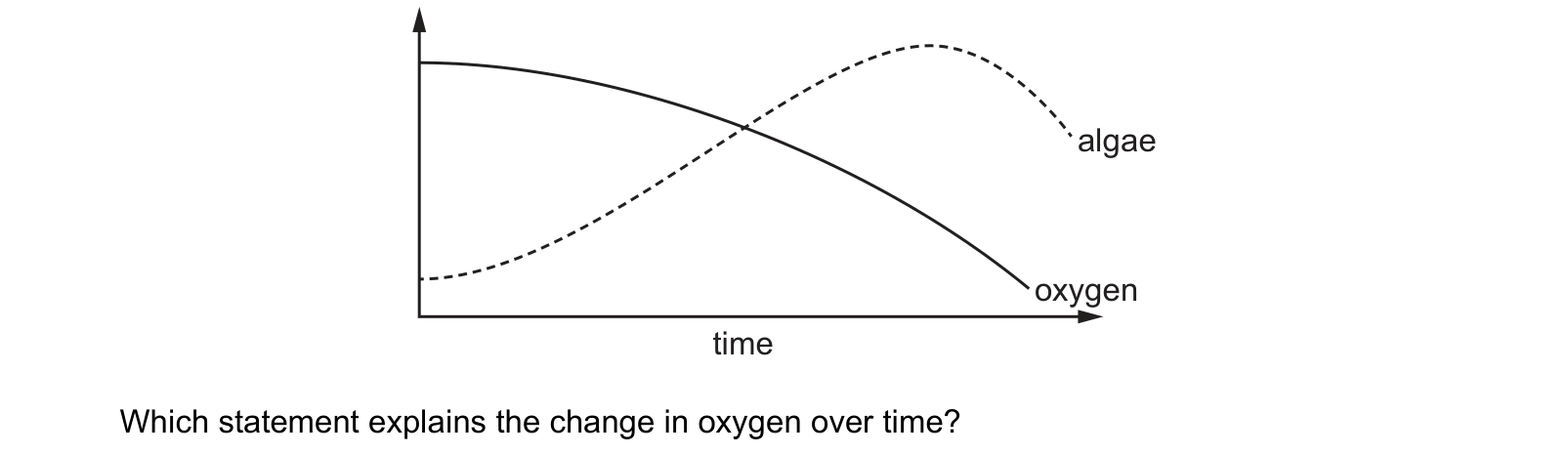
When fertiliser is washed into lakes, it leads to changes in the oxygen concentration and the population of algae. Which statement explains the change in oxygen over time?
Answer: B.
The oxygen trace falls steadily while the algae rise and then decline, and the steepest loss of oxygen comes after the algae have peaked, which points to something consuming oxygen once the algae start to die. Fertiliser nitrate lets the algae multiply, the dense growth shades and kills the plants below, and all that dead material feeds decomposer bacteria whose aerobic respiration takes dissolved oxygen out of the water. Saying the algae use oxygen for photosynthesis reverses the process, since photosynthesis releases oxygen rather than consuming it. Saying the algae use oxygen for respiration at least names a process that does consume oxygen, but algae photosynthesise in daylight and release more than they respire, so a growing algal population would raise the oxygen rather than strip it. Saying nitrates react with the oxygen invents a chemical reaction that does not occur in the lake, when the loss is entirely biological.
Question 2
The diagram shows gas exchange by two groups of organisms during the hours of darkness. the atmosphere Which letters represent gases that are part of the carbon cycle?
Answer: B.
The only gas in this diagram that carries carbon is carbon dioxide, so the question is which arrows move carbon dioxide. During darkness there is no photosynthesis, so producers and consumers alike are only respiring, taking in oxygen and giving out carbon dioxide. That makes every arrow leaving an organism for the atmosphere a carbon dioxide arrow and every arrow entering an organism an oxygen arrow, so P leaving the producers and R leaving the consumers are the two that belong to the carbon cycle. Q and S run from the atmosphere into the organisms and therefore carry oxygen, which belongs to the oxygen cycle instead. Every other row includes Q or S and so pairs a carbon-carrying gas with one that carries no carbon at all.
Question 3
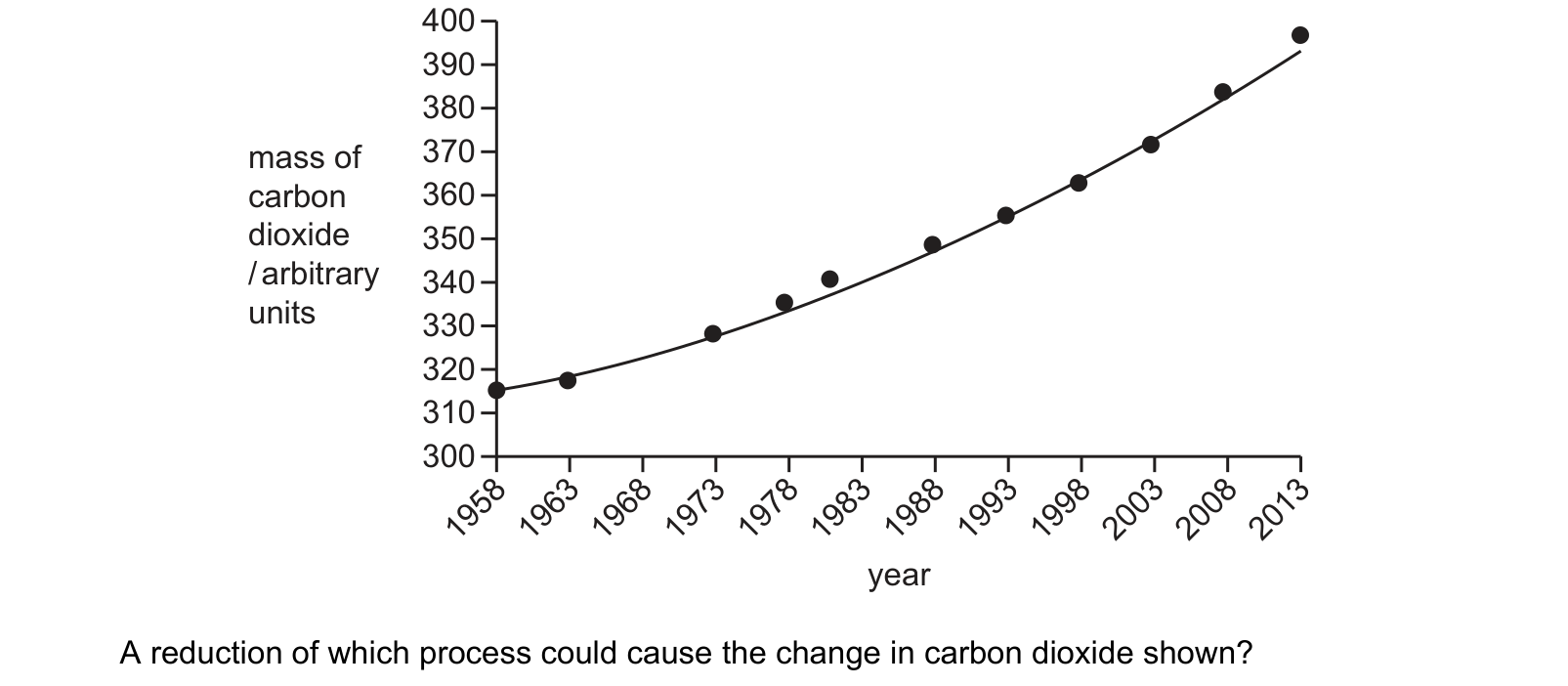
The graph shows the change in atmospheric carbon dioxide levels over time. year A reduction of which process could cause the change in carbon dioxide shown?
Answer: C.
Photosynthesis is the only one of these four processes that removes carbon dioxide from the air, since plants take it in and lock the carbon into glucose. If photosynthesis is reduced, for instance by clearing forests, less carbon dioxide is taken out and the level in the atmosphere climbs, which is the rise the graph shows, so C is correct. A, combustion, adds carbon dioxide to the air, so reducing it would slow the rise rather than cause it. D, respiration, also releases carbon dioxide, and so does B, decomposition, as microorganisms break down dead material. Ask which way each process moves carbon dioxide before deciding what a reduction of it would do.
Question 4
A producer is an organism which makes its own organic nutrients. Which process does a producer use and what is the source of energy? Each answer gives, in order: process; source of energy.
Answer: C.
A producer makes its own organic nutrients by photosynthesis, using light energy from the Sun that chlorophyll absorbs and transfers into the chemical bonds of glucose. Pairing photosynthesis with dead organic matter is the tempting error, because it names the right process, but dead matter is a store of energy that some other organism fixed earlier, and using it is what decomposers do rather than producers. Any row naming respiration has the process backwards, since respiration releases energy by breaking organic nutrients down rather than making them, and every producer respires as well as photosynthesises. The reason this distinction matters is that sunlight is the only energy input to almost every food chain, so the producers are the point where that energy enters.
Question 5
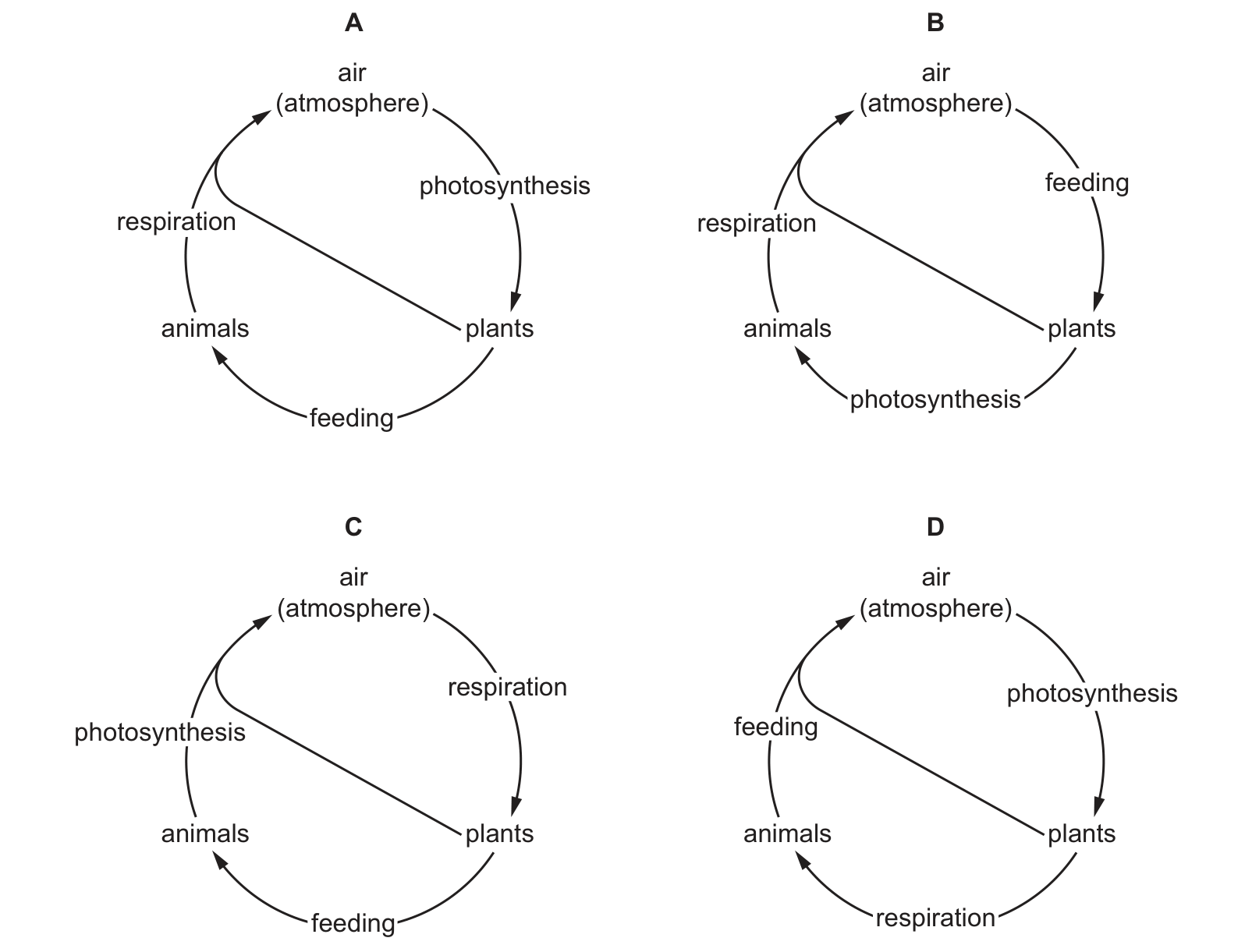
A student draws four different attempts at part of the carbon cycle. Which diagram is correct? Use the source image for M23 Paper 12, question 13.
Answer: A.
Every arrow has to carry the process that really moves carbon in that direction: photosynthesis takes carbon dioxide from the air into plants, feeding passes carbon compounds from plants into animals, and respiration returns carbon dioxide from plants and animals to the air. Only the first diagram labels all of its arrows that way. The diagram that marks the air to plant arrow as feeding would have plants eating the atmosphere, and it then calls the plant to animal arrow photosynthesis, which no animal can perform. The diagram that marks the air to plant arrow as respiration has that process backwards, since respiration releases carbon dioxide instead of absorbing it, and it makes animals photosynthesise on the way back. The diagram that labels the plant to animal arrow respiration and the animal to air arrow feeding takes two correct processes and swaps them into positions where neither describes what its arrow does.
These questions are drawn from past CIE 0654 Co-ordinated Sciences papers and filtered to organisms and their environment. You answer, you find out immediately whether you were right, and you get the reasoning for the correct option and for each distractor. Wrong answers go to a mistakes locker so you can come back to exactly those.
Practice is free. You need an account only so your progress and your mistakes are still there next time.
These are the errors that cost marks on organisms and their environment, taken from our own topic notes. Read them before you practise and you will recognise the traps in the questions.
Drawing food chain arrows from the eater to the eaten.
Saying the first trophic level gains energy by eating plants.
Calling a decomposer a carnivore, or leaving decomposers out of the chain altogether.
Saying carnivores obtain energy from every trophic level.
Saying food chains are short because of competition, rather than because of energy loss between levels.
Saying the energy lost between levels simply disappears, without naming respiration, faeces, excretion or uneaten parts.
Saying plants do not respire, or that plants only respire at night, in the carbon cycle.