Drugs
Contents: 7 sections
What a drug is
A drug is any substance taken into the body that modifies or affects chemical reactions in the body.
That definition is deliberately wide. It covers medicines, alcohol, nicotine and caffeine alike. A drug is not by definition harmful or illegal, so answers that define a drug as "an illegal substance" or "something that makes you ill" do not earn the mark.
Tobacco smoke
Almost every question in this topic comes down to matching one component of tobacco smoke to one effect, so learn them as a table and learn it in both directions.
| Component | What it does |
|---|---|
| Nicotine | The addictive component. It is a stimulant, and it raises heart rate and blood pressure |
| Tar | The carcinogen. It settles in the lungs, damages the DNA of the cells lining them and causes lung cancer. It also paralyses the cilia |
| Carbon monoxide | Binds to haemoglobin in red blood cells, so less oxygen can be carried |
| Smoke particles | Irritate the lining of the airways, causing coughing and increased mucus |
The pairing to hold on to is nicotine addicts, tar causes cancer, carbon monoxide starves you of oxygen. Questions are built by swapping the first two, so "nicotine causes lung cancer" and "carbon monoxide is addictive" are the standard distractors.
Why carbon monoxide is so dangerous is worth understanding rather than memorising. Haemoglobin binds carbon monoxide far more readily than it binds oxygen, and it does not let go again. So a red blood cell that has picked up carbon monoxide is permanently out of service for carrying oxygen. That is why a smoker gets breathless quickly, and why a pregnant smoker's baby is often born underweight: the fetus is short of oxygen throughout its development.
What smoking does to the lungs
The cilia lining the airways normally sweep mucus, with its trapped dust and pathogens, up to the throat. Smoke paralyses the cilia, so the mucus is no longer cleared.
Everything else follows from that one fact.
- Mucus accumulates in the airways, which is the direct result of paralysed cilia and the cause of a smoker's cough.
- Pathogens stay in the lungs instead of being swept out, so chest infections and bronchitis become frequent.
- Persistent coughing damages the delicate alveoli walls, which break down and merge into fewer, larger spaces. That reduces the surface area for gas exchange, and the result is emphysema: permanent breathlessness that never improves.
- Tar in contact with the lining of the airways damages the DNA of those cells, causing uncontrolled cell division and lung cancer.
If a question asks for the direct result of paralysed cilia, the answer is that mucus accumulates. Lung cancer and reduced oxygen uptake are genuine consequences of smoking, but they arrive by other routes.
Smoking also damages the circulatory system. It raises blood pressure and speeds up the build-up of fatty deposits in the arteries, so it is a major risk factor for coronary heart disease and for stroke.
Alcohol
Alcohol is a depressant: it slows down the nervous system.
Short-term effects come from that slowing: reaction times get longer, judgement and self-control are reduced, speech becomes slurred, and coordination and balance are lost. This is why drink-driving is so dangerous, and dangerous in a particular way, because the same drug that lengthens reaction time also removes the judgement needed to notice it has.
Long-term effects include liver damage, since the liver is the organ that breaks alcohol down and is damaged by doing so. Cirrhosis is the scarring of liver tissue, which stops the liver carrying out its other jobs, including deamination and the breakdown of toxins. Alcohol is also addictive, and heavy use can cause brain damage and social harm.
Antibiotics
Antibiotics kill bacteria or stop them multiplying. They have no effect on viruses.
The reason is structural, and stating it earns the mark. Antibiotics work by attacking structures and processes that bacterial cells have, such as the bacterial cell wall. A virus is not a cell. It has no cell wall, no cytoplasm and no metabolism of its own; it reproduces inside a host cell using that cell's machinery. There is nothing there for an antibiotic to attack, and anything that destroyed the host cell's machinery would destroy your own cells too.
So taking antibiotics for a cold or for influenza achieves nothing, because both are viral.
Antibiotic resistance is a clear example of natural selection, and it is worth being able to tell as a sequence:
- Bacteria in a population vary, and mutation occasionally produces one that is resistant to a particular antibiotic.
- When the antibiotic is used, the non-resistant bacteria are killed.
- The resistant one survives and reproduces, with nothing left to compete with it.
- Its offspring inherit the resistance, so the whole population becomes resistant.
The antibiotic did not create the resistance. It selected for a variant that was already there, which is the point students most often get the wrong way round.
Resistance is limited by using antibiotics only when they are genuinely needed, never for viral infections, and by finishing the whole course even after you feel better. Stopping early leaves the least susceptible bacteria alive, which is exactly the selection you are trying to avoid.
Common mistakes
- Defining a drug as an illegal or harmful substance.
- Saying nicotine causes lung cancer, or that tar is the addictive component.
- Saying carbon monoxide is addictive, or that it causes cancer.
- Saying carbon monoxide damages the lungs. It acts on haemoglobin in the blood.
- Saying smoke stops oxygen diffusing, when the question asks for the direct result of paralysed cilia.
- Describing alcohol as a stimulant. It is a depressant.
- Saying alcohol damages the kidneys rather than the liver.
- Saying antibiotics kill viruses.
- Saying an antibiotic causes bacteria to become resistant, rather than selecting bacteria that already were.
- Saying you should stop taking antibiotics once you feel better.
Check you have it
Question 1
Cigarette smoke paralyses the cilia in the gas exchange system.
What is the direct result of this?
Answer: A.
Question 2
Which row is correct about the components of tobacco smoke and their effects? Each answer gives, in order: component; effect.
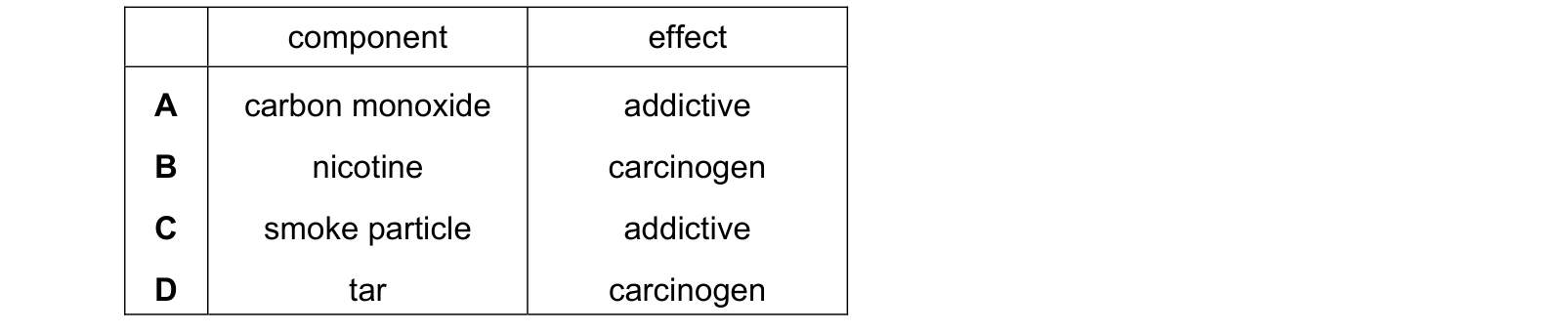
Answer: D.
Question 3
Which component of tobacco smoke reduces the amount of oxygen that red blood cells can carry to the cells of the body?
Answer: B.
What the syllabus asks for on this topicSyllabus points
Syllabus points
- Define a drug.
- Describe the effects of alcohol on the body.
- Name the harmful components of tobacco smoke and state the effect of each.
- Describe the effects of smoking on the gas exchange system and on the circulatory system.
- Describe the use of antibiotics and explain why they do not work against viruses.
- Explain how antibiotic resistance arises and how it can be limited.
Related CIE 0654 Co-ordinated Sciences topics
Not the topic you were looking for? Describe what you are stuck on in your own words and we will take you to the notes that answer it.