Characteristics and classification of living organisms
Contents: 6 sections
The seven characteristics
Every living organism, from a bacterium to a whale, does all seven of these. That is what "living" means in this syllabus, and it is why the list is worth learning as definitions rather than as a mnemonic alone.
| Characteristic | Definition to write down |
|---|---|
| Movement | An action by an organism causing a change of position or place |
| Respiration | The chemical reactions in cells that break down nutrient molecules and release energy for metabolism |
| Sensitivity | The ability to detect and respond to changes in the internal or external environment |
| Growth | A permanent increase in size and dry mass |
| Reproduction | The processes that make more of the same kind of organism |
| Excretion | The removal of the toxic waste products of metabolism and of substances in excess of requirements |
| Nutrition | The taking in of materials for energy, growth and development |
The mnemonic is MRS GREN. It is useful for remembering the seven, but the marks are for the definitions, so learn the right-hand column.
Why the definitions are worded so carefully
Cambridge writes questions by swapping the definitions between the characteristics. Option A gives the name "excretion" attached to the definition of sensitivity, option B gives "nutrition" attached to the definition of excretion, and so on. If you know the seven names but not which sentence goes with which, every option looks half right. Reading the right-hand column above out loud until each pairing is automatic is the single most useful hour you can spend on this topic.
Four wordings carry most of the marks.
Respiration is not breathing. Respiration is a chemical reaction happening inside every cell of every organism at every moment. Breathing is the muscular movement of air in and out of lungs, which plants, insects and bacteria do not do at all. A question asking for a characteristic of all living organisms can never have "breathing" as the answer for exactly this reason.
Excretion is not egestion. Excretion gets rid of substances the organism's own chemistry made, such as carbon dioxide from respiration and urea made in the liver from surplus amino acids. Egestion pushes out undigested food that never entered a cell in the first place. Faeces were never part of your metabolism, so passing them is egestion, not excretion.
Growth means dry mass, not just size. A plant that soaks up water swells, but that water can be lost again by evaporation and the plant is no bigger in substance. Dry mass is what is left once the water is driven off, so an increase in dry mass is real new material and is permanent.
Sensitivity begins with detection. Movement is only a change of position, and a leaf blown by the wind moves without anything being detected. Sensitivity requires a stimulus to be sensed first, and the response then follows from it.
Reading a described situation
The commonest question type gives you a scene and asks which characteristics it shows. Work through it by asking what is actually happening, not what could be happening.
Worked example. A plant shoot bends towards a window. Which characteristics does this show?
The plant has detected the direction the light is coming from, so that is sensitivity. The bend is produced by cells on the shaded side getting permanently longer, so that is growth. Nutrition is the tempting third answer, because bending towards the light does help the plant photosynthesise later on. Resist it. The benefit of a response is not the same as the characteristic the response demonstrates, and nothing is taken in by the act of bending.
The same reasoning handles gravitropism, where roots grow down and shoots grow up. Sensitivity plus growth again.
Worked example. A lion is chasing a zebra. Which characteristic is it not showing?
Movement and sensitivity are obvious. Respiration is the tempting answer, because it is the only one you cannot see, but the lion's leg muscles are respiring harder than ever, since respiration is what releases the energy for the chase. Nutrition is the answer: the lion has not caught anything yet, so nothing is being taken in.
Two rules come out of these. Respiration is never the answer to "which is not happening", because it is happening in every living cell all the time. And a characteristic you cannot see is still happening.
Classification
Classification is the sorting of organisms into groups by shared features. Two ideas are worth carrying:
- A species is a group of organisms that can reproduce to produce fertile offspring.
- The binomial system gives every species a two-part name, genus first with a capital letter, then species with a small letter, both in italics: Homo sapiens, Panthera leo. It is used worldwide so that scientists writing in different languages know they mean the same organism.
Organisms are grouped by how closely related they are, and the modern evidence for that is the similarity of their DNA base sequences. The more similar the sequences, the more recently the two species shared an ancestor.
Common mistakes
- Answering "breathing" when the question asks for a characteristic of all living organisms.
- Calling the passing of faeces excretion. It is egestion.
- Defining respiration as breathing, or as taking in oxygen.
- Defining growth as an increase in size only, leaving out dry mass.
- Saying respiration has stopped because an activity is not visible.
- Including nutrition whenever a plant grows towards light, because photosynthesis will follow.
- Attaching the definition of sensitivity to the word movement, when movement needs no detection.
- Writing a binomial name with both words capitalised, or the genus in lower case.
Check you have it
Question 1
Which characteristic of living organisms is described as the chemical reactions in cells that break down nutrient molecules and release energy?
Answer: D.
Question 2
Soya seeds contain a lot of protein and are often fed to farm animals.
Which characteristic of living things will benefit from the soya seeds?
Answer: B.
Question 3
Which row about characteristics of living things is correct? Each answer gives, in order: name of process; definition of process.
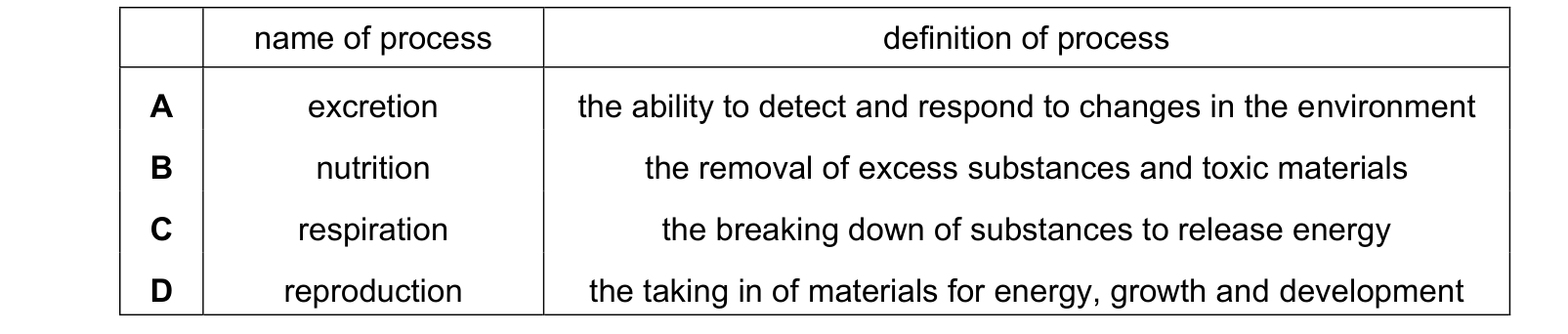
Answer: C.
What the syllabus asks for on this topicSyllabus points
Syllabus points
- List the seven characteristics shared by all living organisms.
- Give the definition of each characteristic in the wording the mark scheme uses.
- Decide which characteristic or characteristics an observed behaviour demonstrates.
- Distinguish a characteristic of all living things from a process only some organisms carry out.
Related CIE 0654 Co-ordinated Sciences topics
Not the topic you were looking for? Describe what you are stuck on in your own words and we will take you to the notes that answer it.