Characteristics and classification of living organisms Exam Questions
Five past-paper questions are below. Answer on the page: each one is marked the moment you pick, the correct option is shown whether or not you found it, and the full explanation opens either way.
CIE 0654 Co-ordinated SciencesPaper 1 and Paper 2 MCQsFree account
Characteristics and classification of living organisms: five questions to try now
Real past-paper questions, the answer key from the mark scheme, and the explanation that goes with it. No account needed to answer them.
Question 1
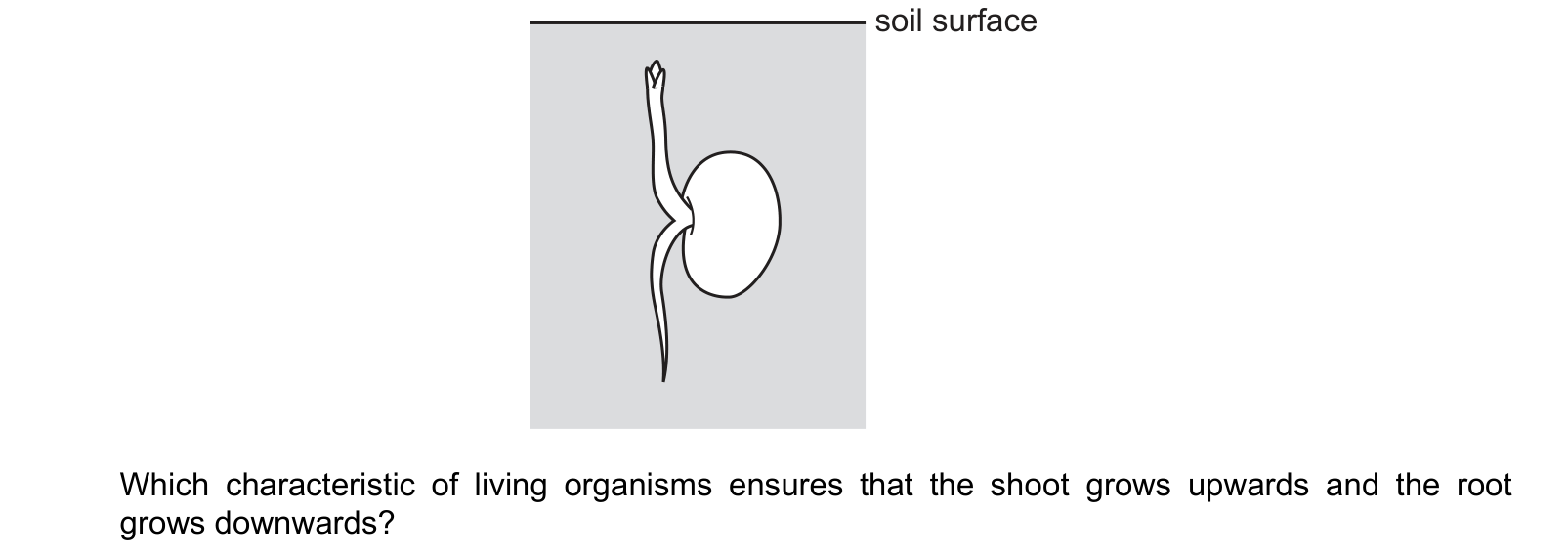
The diagram shows a germinating seed below the soil surface. Which characteristic of living organisms ensures that the shoot grows upwards and the root grows downwards?
Answer: D.
Sensitivity is the ability to detect and respond to a stimulus, and the stimulus here is gravity: the root grows towards the pull of gravity while the shoot grows away from it. Below the soil surface there is no light for the shoot to bend towards, so gravity is the only cue available and detecting it is what keeps each organ pointing the right way. Nutrition is the taking in of materials for energy, growth and development, and although the seed is drawing on its food store, that supplies the growth rather than steering its direction. Excretion is the removal of the waste products of metabolism, which has no bearing on which way a root points. Reproduction is the production of new individuals, and the seed is already the product of that process rather than an example of it happening here.
Question 2
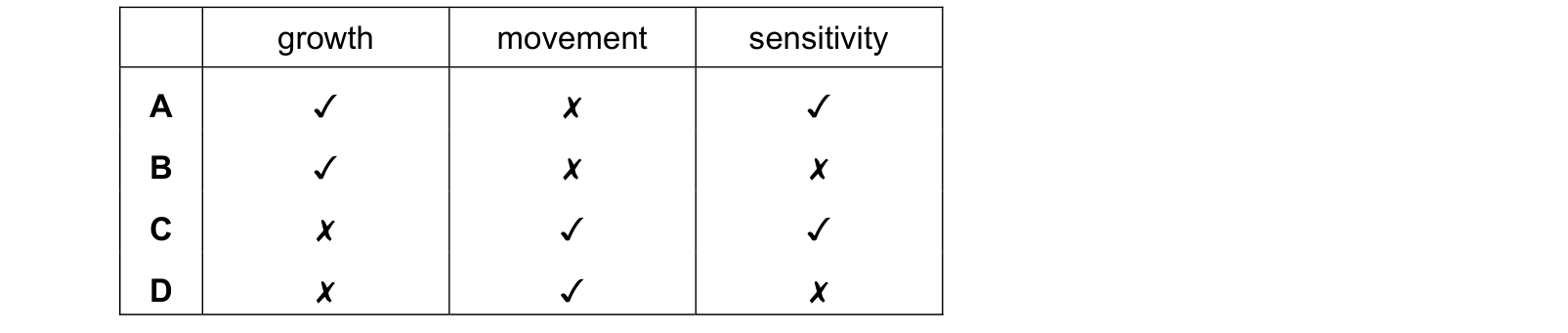
Auxin is a chemical that is produced in shoot tips. With which characteristics of living things is auxin involved? growth movement sensitivity Use the source image for W24 Paper 22, question 1.
Answer: A.
Auxin is made in the shoot tip and spreads down the shoot, where it makes cells elongate, so it is directly involved in growth. It also brings about the plant's response to a stimulus, since light shining from one side pushes auxin to the shaded side and the extra elongation there bends the shoot towards the light, which is sensitivity. That bending comes from cells growing at different rates rather than from the plant propelling any part of itself, so movement is not the characteristic auxin provides, and A is the row ticking growth and sensitivity alone. C and D both tick movement for that reason, and B ticks growth but crosses sensitivity, missing the response to light that auxin exists to produce.
Question 3
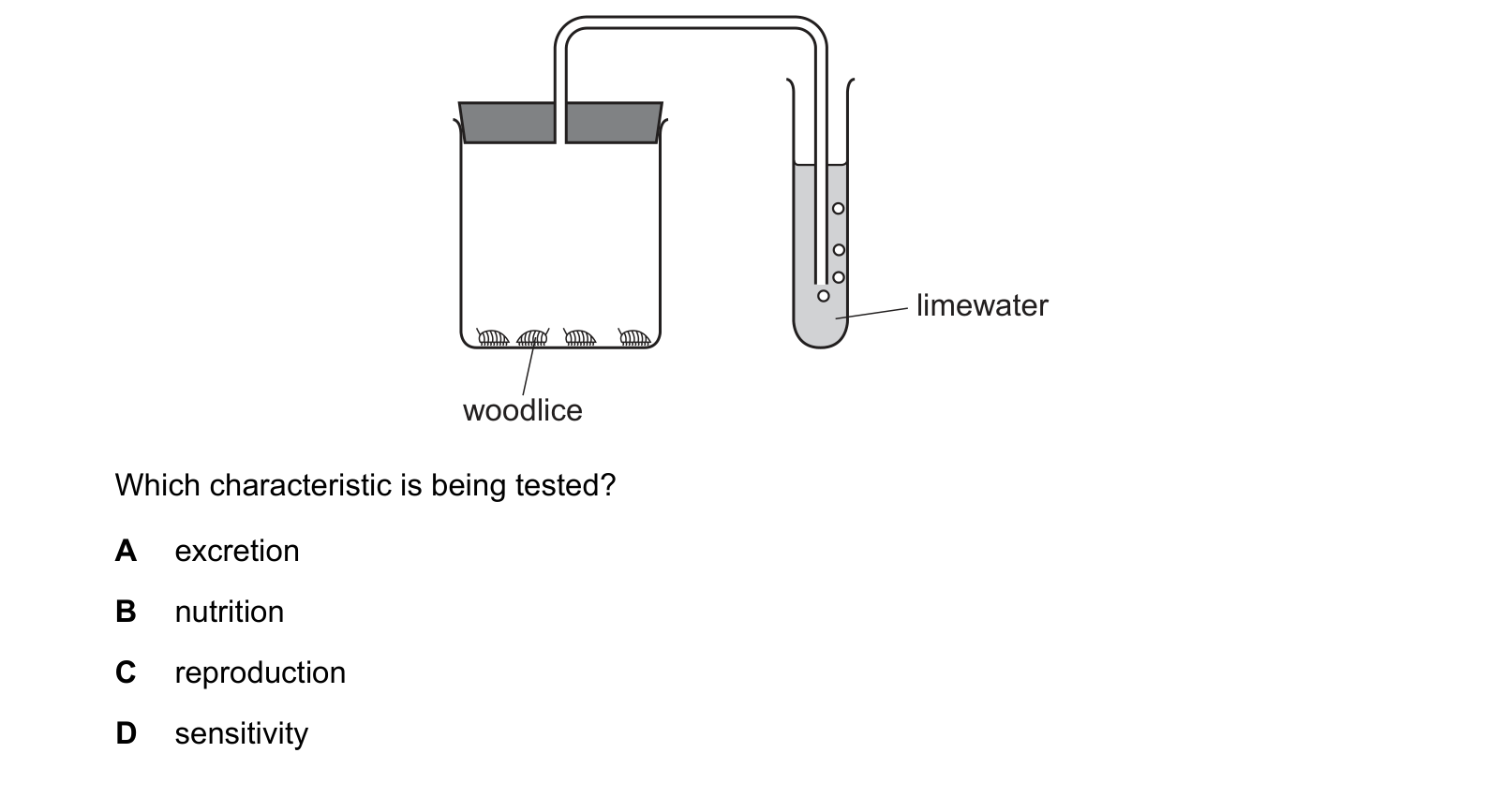
The diagram shows some apparatus that can be used to test for one of the characteristics of life. Which characteristic is being tested?
Answer: A.
The tube of limewater collects gas leaving the container of woodlice and turns milky if carbon dioxide is present, so the apparatus is detecting something the animals give out. Carbon dioxide is a waste product made by respiration in their cells, and removing the waste products of metabolism is the definition of excretion, so that is the characteristic being tested. Nutrition would require food to be supplied and its use followed, and the sealed container offers the woodlice nothing to eat. Sensitivity would require a stimulus such as light or damp to be applied and the animals watched for a response, which nothing in the apparatus provides. Reproduction would need the woodlice followed over generations for new individuals, which a one hour gas test cannot show.
Question 4
A scientist is studying a living organism. She observes that it has the ability to remove the waste products of metabolism. What characteristic of living organisms is being observed?
Answer: A.
Excretion is the removal of the waste products of metabolism, meaning the substances made by chemical reactions inside cells that would become harmful if they were allowed to build up. Urea produced in the liver from surplus amino acids and carbon dioxide produced by respiration are the two examples the syllabus expects. Respiration is the tempting choice because it is the process that generates that carbon dioxide in the first place, but respiration is the energy releasing reaction itself, and disposing of what it makes is a separate characteristic. Nutrition is the intake of food rather than the output of waste, and reproduction is the making of new individuals, so neither matches what the scientist observed.
Question 5
Lions are carnivores that chase, catch and eat zebra. While still chasing zebra, which characteristic of living organisms is not exhibited by the lion?
Answer: B.
Nutrition is the taking in of materials for energy, growth and development, and while the lion is still chasing it has not caught anything, so nothing is being taken in and that characteristic is not yet on show. Movement is obvious in the chase itself, and sensitivity is on display in the way the lion detects the zebra and adjusts its course. Respiration is the tempting answer, because it is the one characteristic here that cannot be seen from the outside, but it is going on faster than ever in the leg muscles, since respiration is the very process releasing the energy that makes the chase possible. The trap in this question is to judge by what is visible rather than by what is actually happening.
These questions are drawn from past CIE 0654 Co-ordinated Sciences papers. You answer, you find out immediately whether you were right, and you get the reasoning for the correct option and for each distractor. Wrong answers go to a mistakes locker so you can come back to exactly those.
Practice is free. You need an account only so your progress and your mistakes are still there next time.
These are the errors that cost marks on characteristics and classification of living organisms, taken from our own topic notes. Read them before you practise and you will recognise the traps in the questions.
Answering "breathing" when the question asks for a characteristic of all living organisms.
Calling the passing of faeces excretion. It is egestion.
Defining respiration as breathing, or as taking in oxygen.
Defining growth as an increase in size only, leaving out dry mass.
Saying respiration has stopped because an activity is not visible.
Including nutrition whenever a plant grows towards light, because photosynthesis will follow.
Attaching the definition of sensitivity to the word movement, when movement needs no detection.
Writing a binomial name with both words capitalised, or the genus in lower case.