Variation and selection
Contents: 8 sections
Two kinds of variation
Continuous variation gives a range of values between two extremes, with individuals spread across the whole range and no distinct groups. Height, body mass, hand span and the size of tomatoes are all continuous. Plotted as a graph you get a smooth curve.
Discontinuous variation gives a small number of distinct categories with nothing in between. Blood group, tongue-rolling ability and sex are discontinuous. Plotted as a graph you get separate bars.
The test to apply is simple: could an individual fall between two of the options? A person is A, B, AB or O and can be nothing in between, so blood group is discontinuous. A tomato can be any size at all, so tomato size is continuous.
What causes each is examined as often as what each is.
- Discontinuous variation is caused by genes alone. The environment cannot move you between two blood groups.
- Continuous variation is caused by genes and the environment together. Your genes set a range for your height and your diet decides where within it you end up.
The pairing to watch is any statement claiming continuous variation is purely environmental or purely genetic. It is both.
Mutation
A mutation is a change in the base sequence of DNA, and mutations are the source of every new allele. Without them there would be no variation for selection to act on, so mutation is where all genetic variety ultimately begins.
Their rate is increased by ionising radiation, such as X-rays and gamma rays, and by some chemicals. Most mutations are neutral or harmful; occasionally one produces an allele that happens to be useful in the conditions the organism lives in.
Adaptive features
An adaptive feature is an inherited feature that helps an organism to survive and reproduce in its environment.
The word inherited does the work. A muscle built by exercise helps you but is not passed on, so it is not an adaptive feature. Only features with a genetic basis can be acted on by selection.
Natural selection
Set it out as a sequence, because that is how the marks are allocated:
- There is variation within a population, caused ultimately by mutation.
- There is competition for resources such as food, water, light or mates, and more offspring are produced than can survive.
- Individuals with features that suit the environment are more likely to survive and to reproduce.
- They pass on the alleles for those features to their offspring.
- Over many generations the frequency of those alleles increases in the population.
Step 4 is where marks are most often lost. An organism passes on alleles, not the feature itself and not anything it acquired during its life. And step 5 is what makes selection an explanation of change: individuals do not evolve, populations do, as the proportions of alleles within them shift.
The other trap is direction. The environment does not create the variation; it selects between variations that already existed. A population of bacteria does not become resistant because an antibiotic is present. Some were already resistant, and the antibiotic removed everything else.
Antibiotic resistance, worked through
This is the example Cambridge uses most, and it is worth having in full.
- A population of bacteria varies, and a random mutation produces one bacterium that is resistant to a particular antibiotic.
- The antibiotic is used, and the bacteria that are not resistant are killed.
- The resistant bacterium survives and reproduces, with no competition left.
- Resistance is passed to its offspring, and bacteria reproduce very quickly.
- Before long the whole population is resistant, and the antibiotic no longer works.
This is natural selection, not artificial selection, because no human chose which bacteria should survive. That distinction is the whole question in one of the commonest items on the topic.
Two practical conclusions follow. Antibiotics should be used only when they are genuinely needed, and a course should always be finished, because stopping early leaves behind the bacteria that were least susceptible.
Selective breeding
Selective breeding, also called artificial selection, is the process in which humans choose the individuals with desirable features and breed them together, repeating this over many generations.
- Choose the parents with the desired feature, such as the highest milk yield or the largest fruit.
- Breed them together.
- Select the offspring showing the feature most strongly.
- Repeat over many generations.
Uses include improving crop plants for yield or disease resistance, and improving domesticated animals for milk, meat or wool.
| Natural selection | Selective breeding | |
|---|---|---|
| Who selects | The environment | Humans |
| Selected for | Features that aid survival and reproduction | Features useful to people |
| Speed | Usually slow | Faster, because the selection pressure is deliberate and severe |
| Result | Organisms adapted to their environment | Organisms useful to humans, often less able to survive in the wild |
The mechanism is the same in both: variation exists, some individuals are chosen to breed, and the alleles for the chosen features become more common. Only the agent of selection differs.
That is why one particular exam statement is wrong: "selective breeding by natural selection is carried out over many generations to improve crop plants". Everything in it is right except the word natural, which must be artificial. Read any question in this topic asking whether it is natural or artificial selection by asking one thing only: did a person decide?
A cost of selective breeding is worth knowing. Repeatedly breeding from the few individuals with the desired feature reduces the variety of alleles in the population, so if a new disease arrives there may be no resistant individuals at all.
Common mistakes
- Calling a characteristic with distinct categories continuous, or one with a range discontinuous.
- Saying continuous variation is caused by the environment alone.
- Saying organisms pass on features they acquired during their lives.
- Saying the environment causes the mutation that is needed, rather than selecting one that already existed.
- Saying an individual evolves. Populations evolve as allele frequencies change.
- Calling antibiotic resistance artificial selection or selective breeding.
- Saying bacteria "learn" or "become immune" to an antibiotic.
- Confusing natural and artificial selection in either direction, when the only test needed is whether a human chose.
- Describing an adaptive feature without saying it is inherited.
- Saying selective breeding has no drawbacks, when it reduces variation in the population.
Check you have it
Question 1
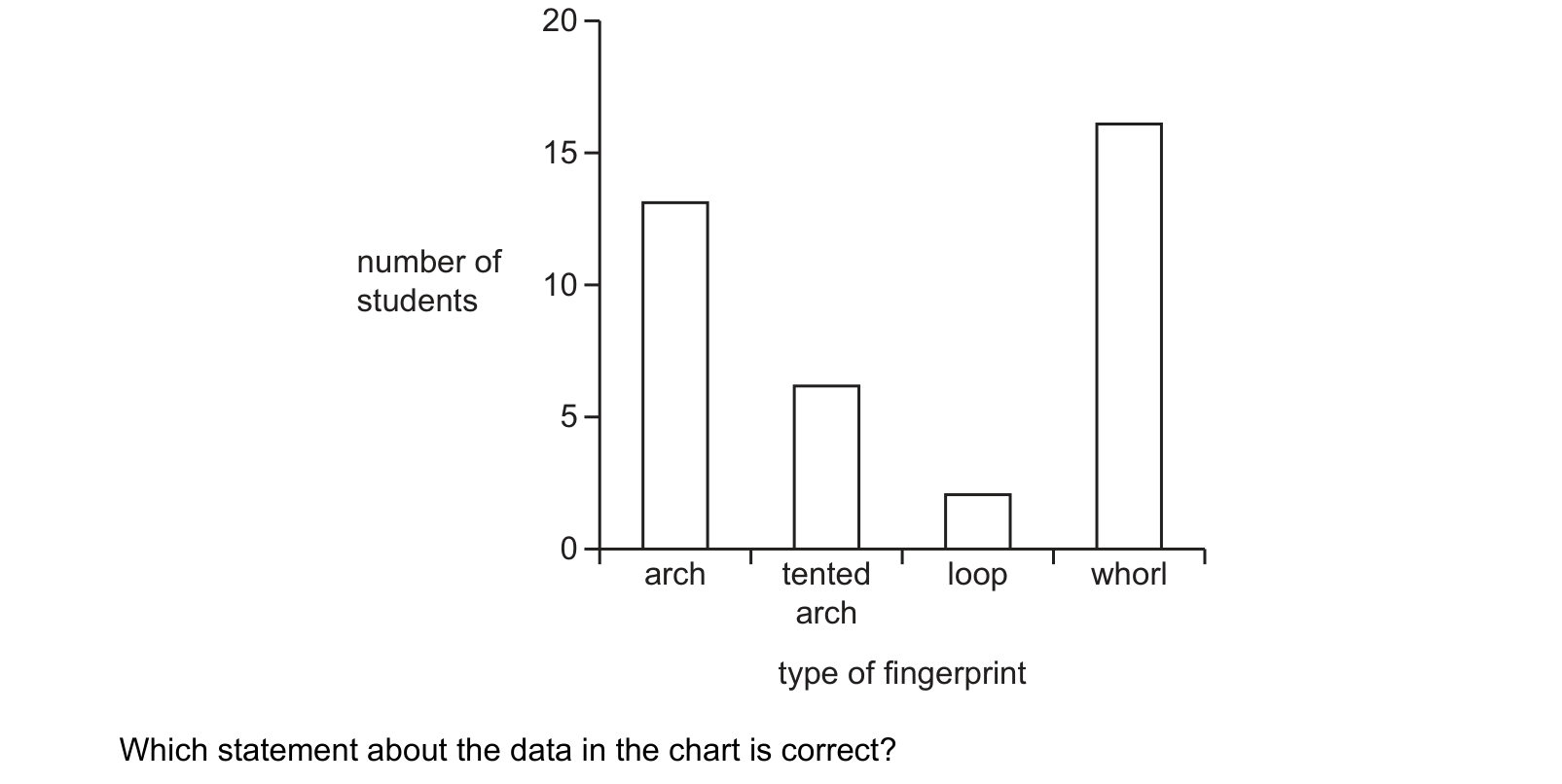
Fingerprints are classified by their shape.
A class of students identified the type of fingerprint they have on the thumb of their left hand.
The chart shows the results. type of fingerprint
Which statement about the data in the chart is correct?
Answer: D.
Question 2
The size of tomatoes is an inherited characteristic with a range of phenotypes between two extremes.
What best describes this?
Answer: A.
Question 3
Which term describes differences between individuals of the same species?
Answer: D.
What the syllabus asks for on this topicSyllabus points
Syllabus points
- Describe continuous and discontinuous variation and give examples of each.
- State that mutation is the source of new alleles.
- Describe adaptive features as inherited features that help survival and reproduction.
- Describe natural selection and explain how it leads to adaptation and evolution.
- Describe selective breeding and explain how it differs from natural selection.
- Explain the development of antibiotic resistance as an example of natural selection.
Related CIE 0654 Co-ordinated Sciences topics
Not the topic you were looking for? Describe what you are stuck on in your own words and we will take you to the notes that answer it.