15 past-paper questions on this unit. Five of them are below. Answer on the page: each one is marked the moment you pick, the correct option is shown whether or not you found it, and the full explanation opens either way.
CIE 0654 Co-ordinated SciencesPaper 1 and Paper 2 MCQsFree account
Variation and selection: five questions to try now
Real past-paper questions, the answer key from the mark scheme, and the explanation that goes with it. No account needed to answer them.
Question 1
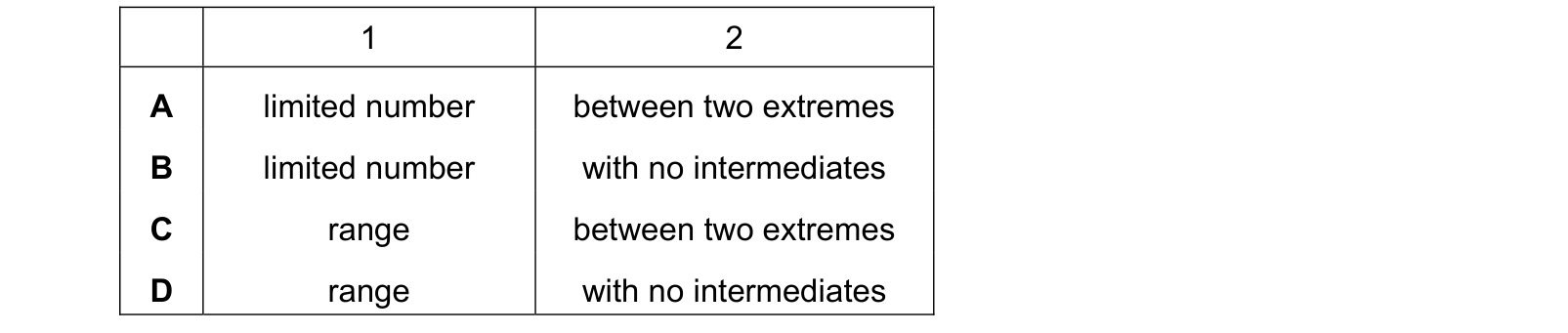
Continuous variation is defined as a ......1...... of phenotypes ......2...... . Which words correctly complete gaps 1 and 2? 1 2 Use the source image for W23 Paper 11, question 11.
Answer: C.
Continuous variation is variation that can take any value across a range, such as human height or mass, because many genes each contribute a small amount and the environment shifts the result as well. The proper definition is therefore a range of phenotypes between two extremes, with every intermediate value represented, which is what C states. B and D both finish with no intermediates, and that gap between distinct classes is the defining mark of discontinuous variation, such as the ABO blood groups. A begins with limited number, which again describes a few separate categories rather than a smooth spread, even though it ends with the correct phrase about two extremes.
Question 2
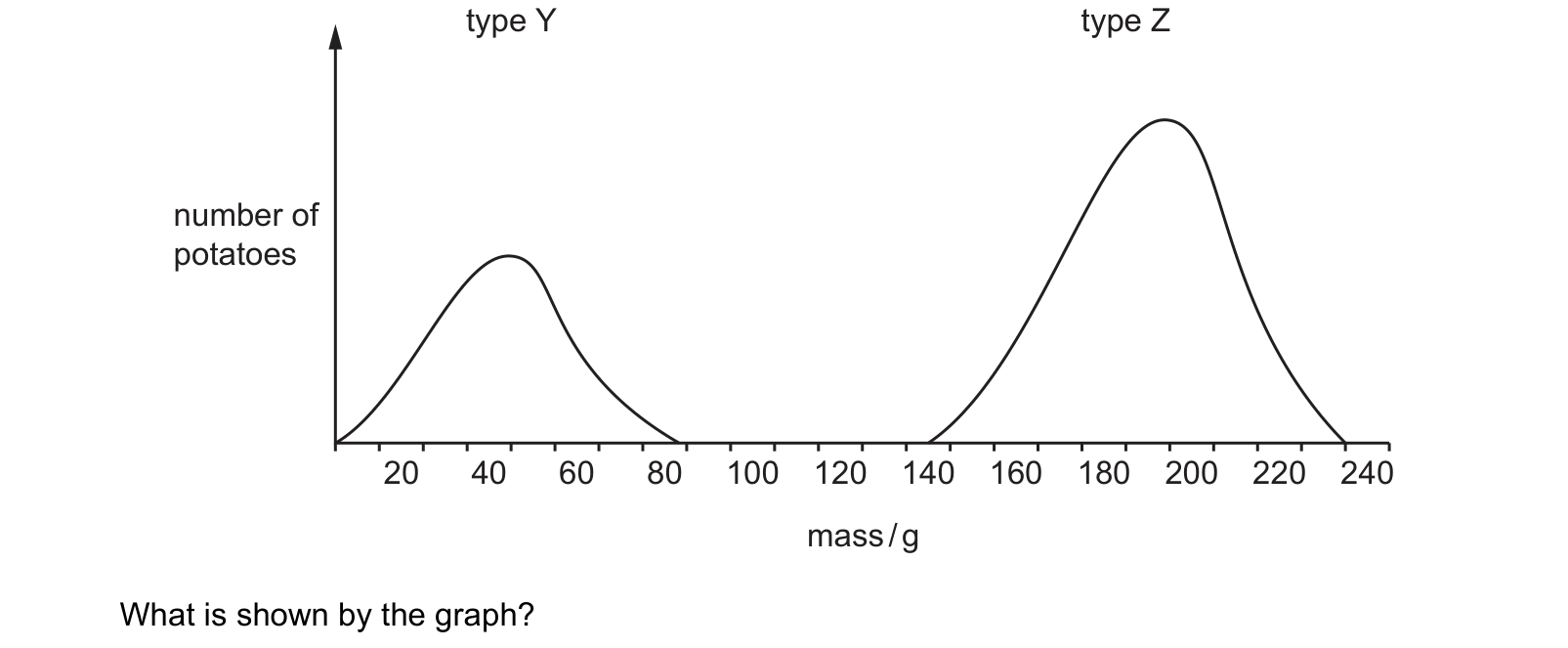
The graph shows the masses of samples of two different types of potato, Y and Z. number of potatoes mass / g What is shown by the graph?
Answer: B.
Continuous variation gives a smooth range of values with every intermediate present, and both curves here are smooth humps spanning a wide span of masses. Type Y runs from about 10 g to about 85 g with no gaps inside that range, which is exactly what continuous variation looks like, so the statement about type Y is the correct one. Calling type Z discontinuous fails for the same reason, since its curve is another smooth hump from about 140 g to about 235 g, and the empty space between the two types is a difference between varieties rather than a break within either one. Saying type Z potatoes are smaller than type Y reads the axis backwards, because the type Z curve sits further to the right and therefore at greater masses. Saying genes do not affect mass goes well beyond the data, and two varieties occupying quite different ranges is evidence that genes do matter.
Question 3
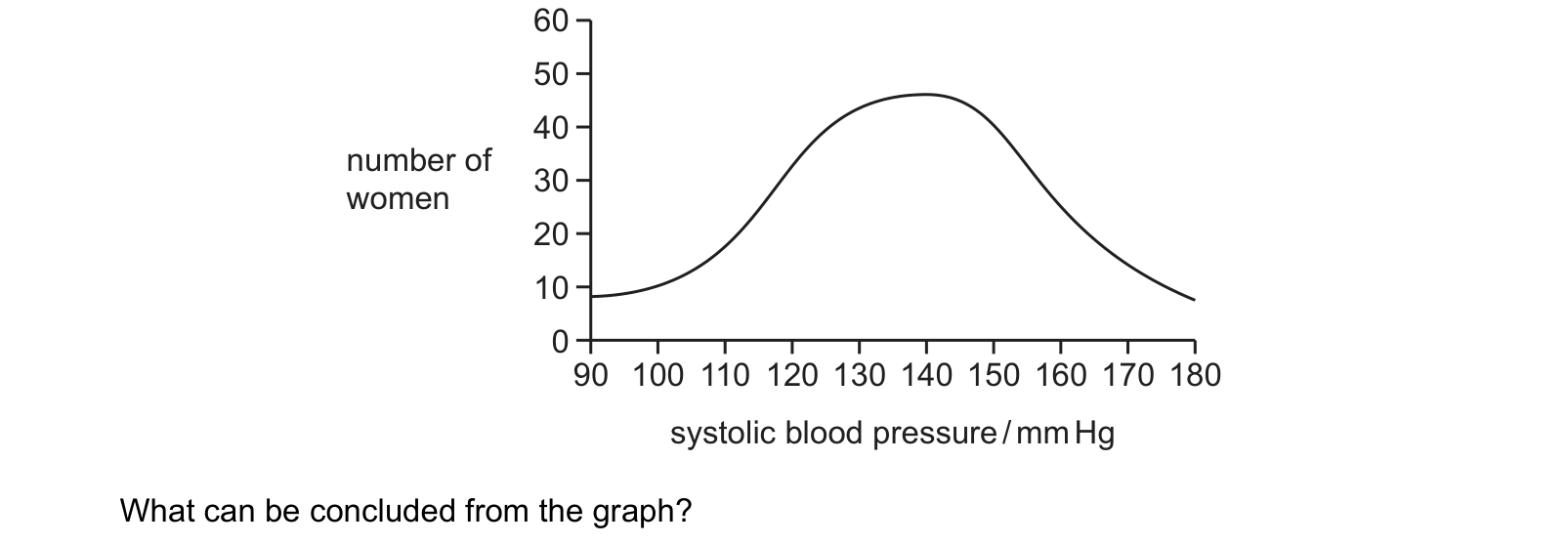
The graph shows the systolic blood pressure of a group of women. systolic blood pressure / mm Hg What can be concluded from the graph?
Answer: A.
Continuous variation gives a smooth range of values with every intermediate present, while discontinuous variation sorts individuals into a few separate categories with gaps between them. The graph is one smooth hump running from 90 to 180 mm Hg with women recorded at every pressure in between, so blood pressure varies continuously and that is what the data show. Calling it discontinuous would need distinct groups separated by gaps, and there is no gap anywhere along this curve. Saying that genes affect blood pressure may well be true, but the graph shows only the spread of the measurements and nothing about their causes. Saying women are more at risk than men would need measurements from men, and no men were included in this sample at all.
Question 4
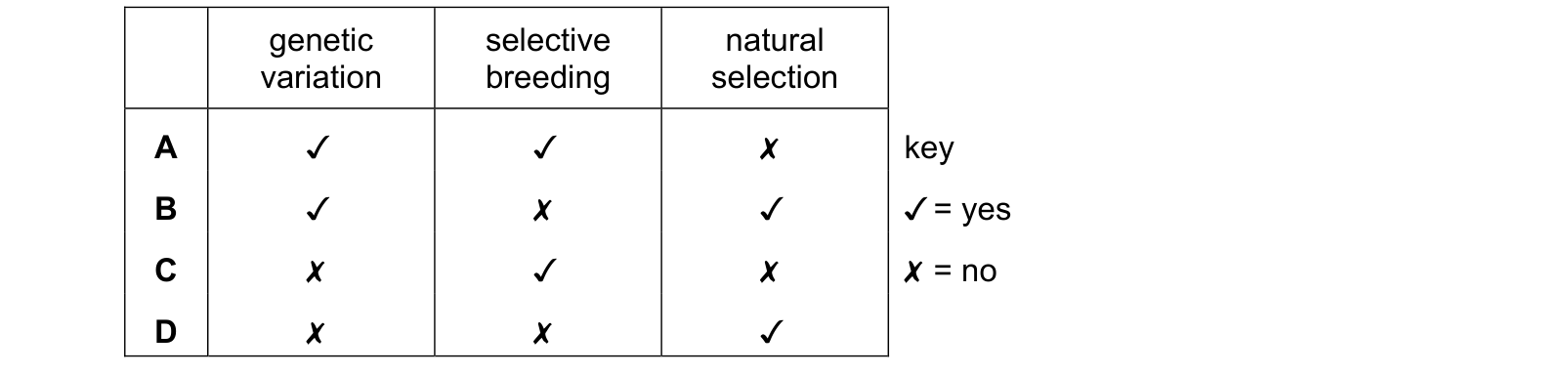
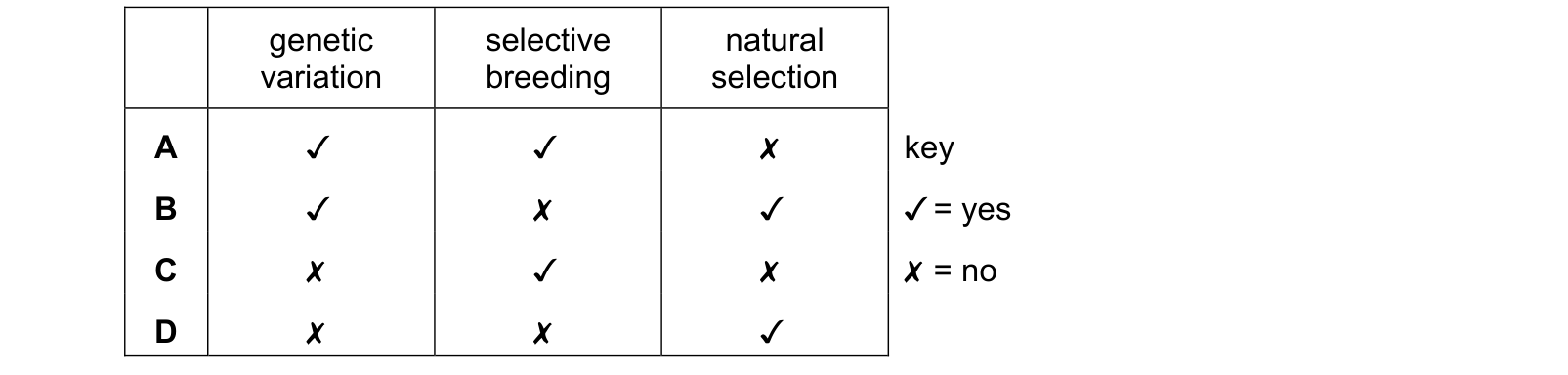
A farmer wants to breed sheep that will produce a high yield of milk. What is required for breeding these sheep? genetic selective natural variation breeding selection Use the source image for S20 Paper 12, question 11.
Answer: A.
Selective breeding has to begin with genetic variation, because the farmer can only pick out animals that already differ in milk yield, and that difference comes from the alleles they carry. The farmer then breeds the highest yielding animals together and repeats the choice generation after generation, which is selective breeding, also called artificial selection. Natural selection is not required, because here the choosing is done by a person deciding which sheep mate, not by the environment deciding which survive long enough to breed. The two rows that mark natural selection as needed have confused who does the selecting. The two rows that deny genetic variation remove the raw material the whole method depends on, since choosing between animals that are all identical would change nothing.
Question 5
A farmer wants to breed sheep that will produce a high yield of milk. What is required for breeding these sheep? genetic selective natural variation breeding selection Use the source image for S20 Paper 22, question 11.
Answer: A.
Selective breeding has to begin with genetic variation, because the farmer can only pick out animals that already differ in milk yield, and that difference comes from the alleles they carry. The farmer then breeds the highest yielding animals together and repeats the choice generation after generation, which is selective breeding, also called artificial selection. Natural selection is not required, because here the choosing is done by a person deciding which sheep mate, not by the environment deciding which survive long enough to breed. The two rows that mark natural selection as needed have confused who does the selecting. The two rows that deny genetic variation remove the raw material the whole method depends on, since choosing between animals that are all identical would change nothing.
These questions are drawn from past CIE 0654 Co-ordinated Sciences papers and filtered to variation and selection. You answer, you find out immediately whether you were right, and you get the reasoning for the correct option and for each distractor. Wrong answers go to a mistakes locker so you can come back to exactly those.
Practice is free. You need an account only so your progress and your mistakes are still there next time.
These are the errors that cost marks on variation and selection, taken from our own topic notes. Read them before you practise and you will recognise the traps in the questions.
Calling a characteristic with distinct categories continuous, or one with a range discontinuous.
Saying continuous variation is caused by the environment alone.
Saying organisms pass on features they acquired during their lives.
Saying the environment causes the mutation that is needed, rather than selecting one that already existed.
Saying an individual evolves. Populations evolve as allele frequencies change.
Calling antibiotic resistance artificial selection or selective breeding.
Saying bacteria "learn" or "become immune" to an antibiotic.
Confusing natural and artificial selection in either direction, when the only test needed is whether a human chose.