54 past-paper questions on this unit. Five of them are below. Answer on the page: each one is marked the moment you pick, the correct option is shown whether or not you found it, and the full explanation opens either way.
CIE 0654 Co-ordinated SciencesPaper 1 and Paper 2 MCQsFree account
Plant nutrition: five questions to try now
Real past-paper questions, the answer key from the mark scheme, and the explanation that goes with it. No account needed to answer them.
Question 1
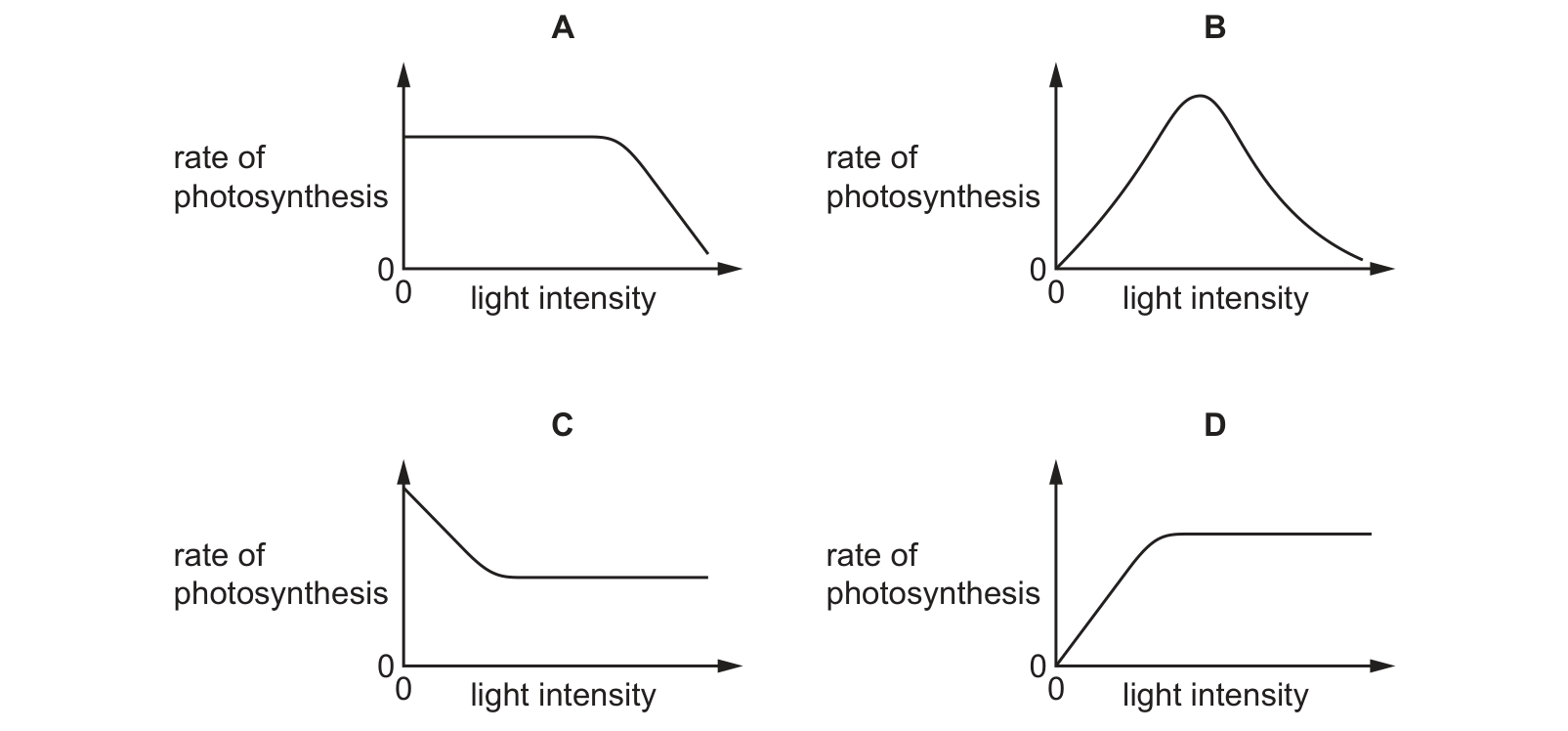
Which graph shows the effect of light intensity on the rate of photosynthesis, if all other factors are kept constant? Use the source image for S22 Paper 21, question 5.
Answer: D.
At low light intensity light is the limiting factor, so the rate climbs steadily as more light is supplied, and once light is plentiful another factor such as carbon dioxide concentration or temperature takes over and the rate levels off. The graph that rises from the origin and then flattens into a horizontal plateau shows both stages, so it is the one that fits. The graph that starts high, holds level and then falls away claims photosynthesis is fastest in darkness and stops in bright light, which is the reverse of the real effect. The bell-shaped curve borrows the pattern that belongs to temperature, where enzymes denature past an optimum, but strong light does not denature the enzymes of photosynthesis in that way. The curve that drops from a high value and then flattens has the rate at its greatest when there is no light at all, which is the one condition in which photosynthesis cannot happen.
Question 2
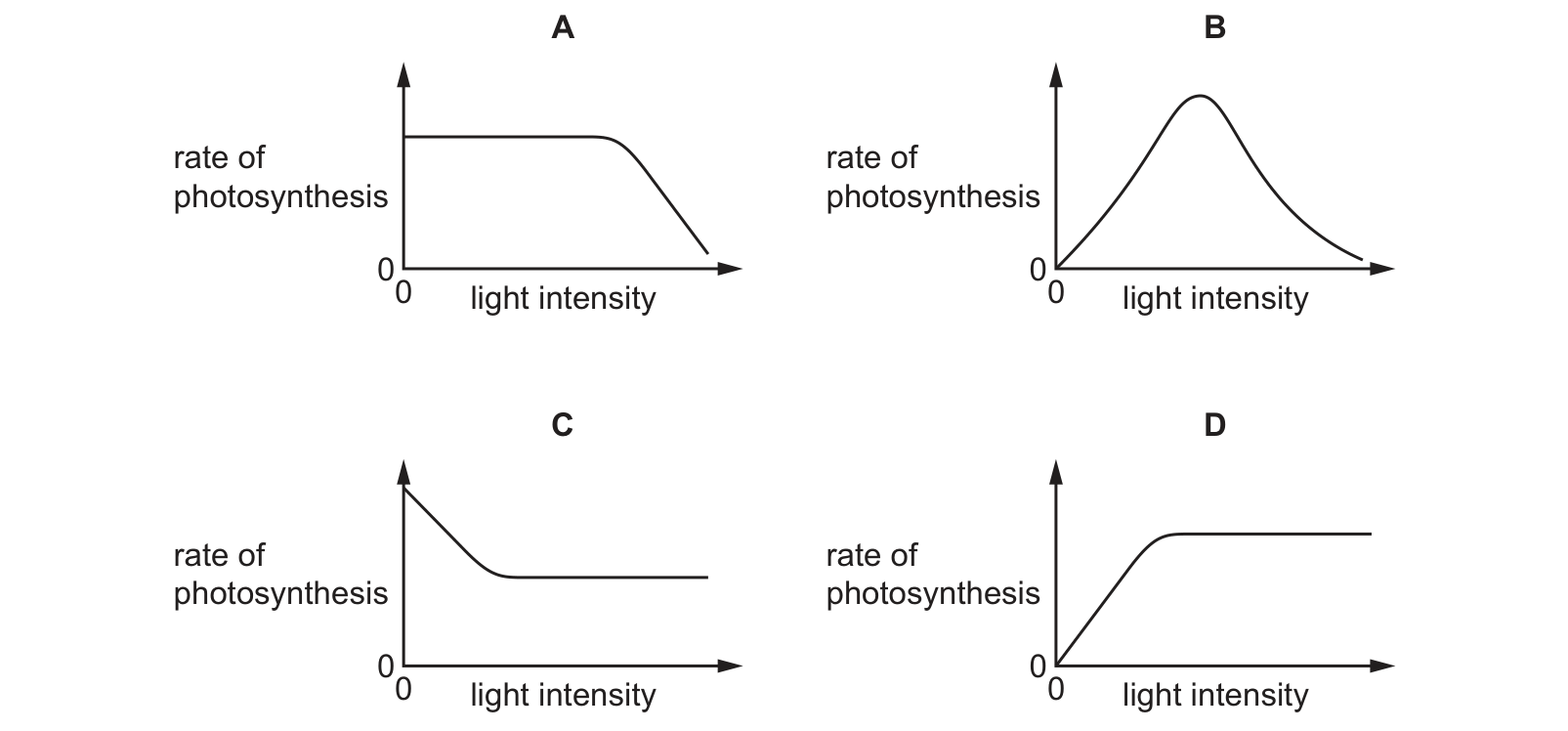
Which graph shows the effect of light intensity on the rate of photosynthesis, if all other factors are kept constant? Use the source image for S22 Paper 22, question 5.
Answer: D.
At low light intensity light is the limiting factor, so the rate climbs steadily as more light is supplied, and once light is plentiful another factor such as carbon dioxide concentration or temperature takes over and the rate levels off. The graph that rises from the origin and then flattens into a horizontal plateau shows both stages, so it is the one that fits. The graph that starts high, holds level and then falls away claims photosynthesis is fastest in darkness and stops in bright light, which is the reverse of the real effect. The bell-shaped curve borrows the pattern that belongs to temperature, where enzymes denature past an optimum, but strong light does not denature the enzymes of photosynthesis in that way. The curve that drops from a high value and then flattens has the rate at its greatest when there is no light at all, which is the one condition in which photosynthesis cannot happen.
Question 3
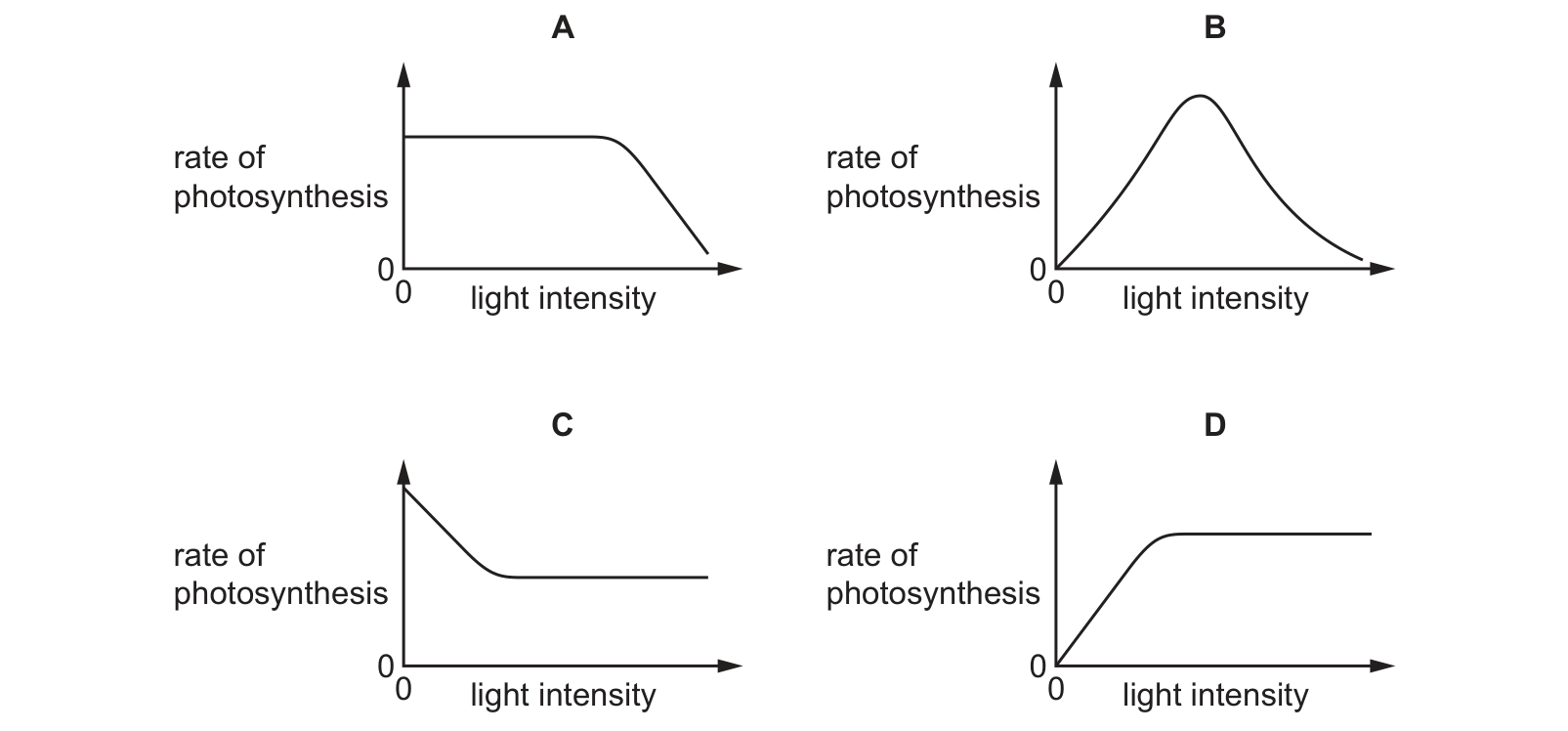
Which graph shows the effect of light intensity on the rate of photosynthesis, if all other factors are kept constant? Use the source image for S22 Paper 23, question 5.
Answer: D.
At low light intensity light is the limiting factor, so the rate climbs steadily as more light is supplied, and once light is plentiful another factor such as carbon dioxide concentration or temperature takes over and the rate levels off. The graph that rises from the origin and then flattens into a horizontal plateau shows both stages, so it is the one that fits. The graph that starts high, holds level and then falls away claims photosynthesis is fastest in darkness and stops in bright light, which is the reverse of the real effect. The bell-shaped curve borrows the pattern that belongs to temperature, where enzymes denature past an optimum, but strong light does not denature the enzymes of photosynthesis in that way. The curve that drops from a high value and then flattens has the rate at its greatest when there is no light at all, which is the one condition in which photosynthesis cannot happen.
Question 4
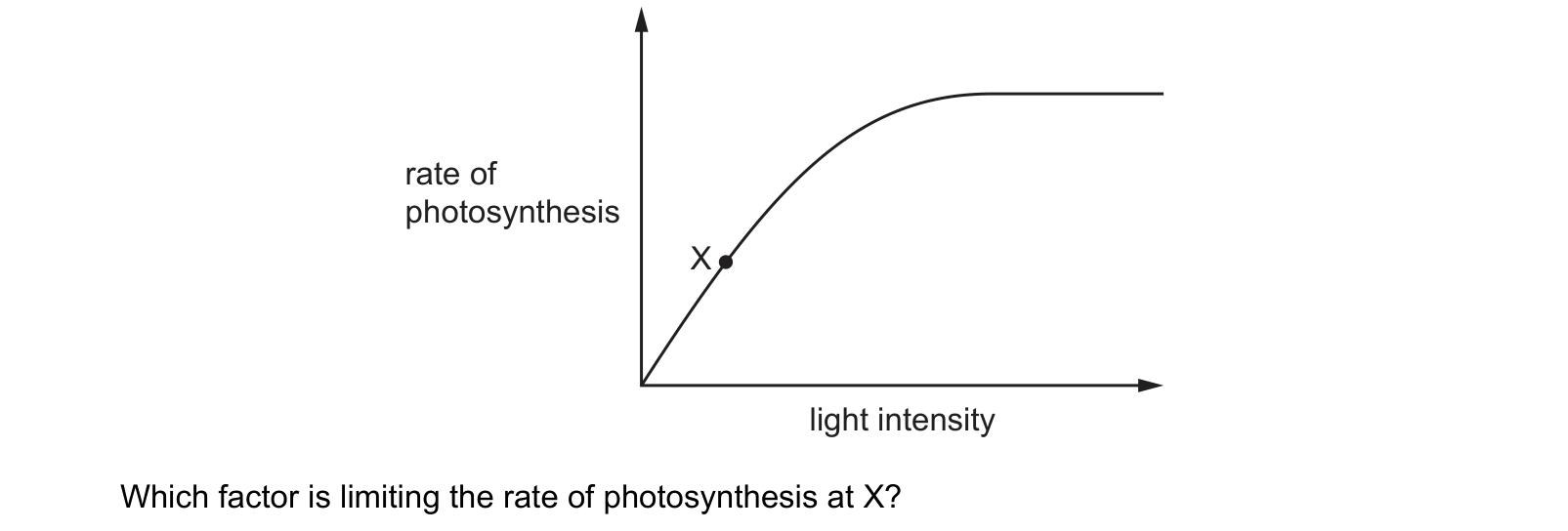
The graph shows the effect of increasing light intensity on the rate of photosynthesis of a submerged aquatic plant. Which factor is limiting the rate of photosynthesis at X?
Answer: C.
A factor is limiting when supplying more of it makes the rate rise, so the answer is read from the slope of the curve at the point named. At X the line is still climbing steeply as light intensity increases, which means more light would give more photosynthesis, so light intensity is the factor holding the rate back there. Carbon dioxide concentration and temperature take over only further to the right, where the curve has flattened and extra light changes nothing. Humidity cannot limit a submerged aquatic plant at all, since its surfaces are under water and it loses no water vapour to the air.
Question 5
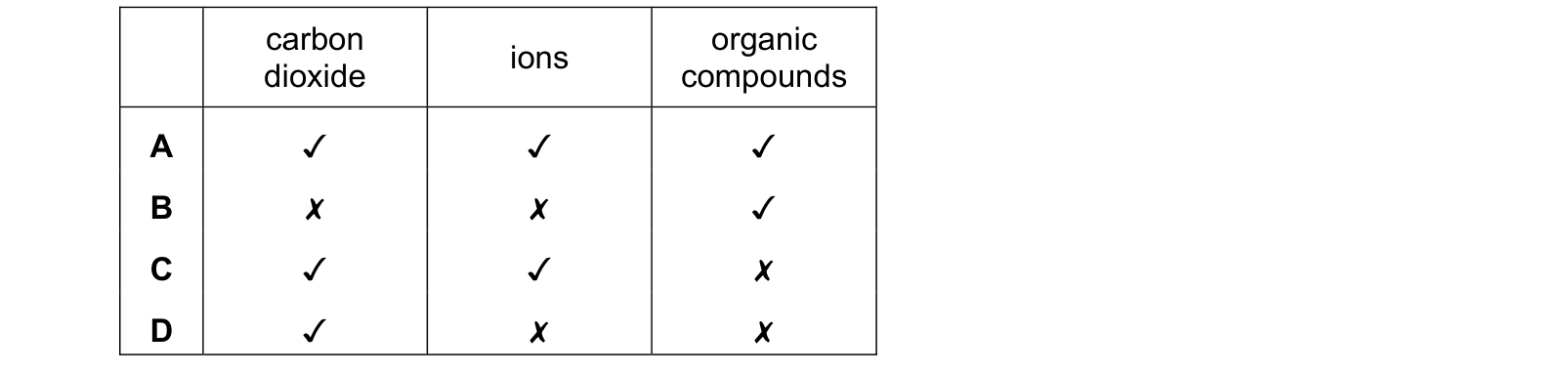
Plant nutrition needs light and water. Which row shows what else needs to be taken in? carbon organic ions dioxide compounds Use the source image for M22 Paper 22, question 1.
Answer: C.
A plant makes its own organic compounds, which is what makes it a producer rather than a consumer, so it takes none in. It does need carbon dioxide, the source of the carbon for the glucose built in photosynthesis, and it also needs mineral ions from the soil, such as nitrate for making amino acids and proteins and magnesium for making chlorophyll. C is the row ticking carbon dioxide and ions while crossing organic compounds. A ticks all three and so treats the plant as though it fed on food that is already made. D crosses ions, which would leave the plant unable to build protein or chlorophyll however much light and carbon dioxide it received.
These questions are drawn from past CIE 0654 Co-ordinated Sciences papers and filtered to plant nutrition. You answer, you find out immediately whether you were right, and you get the reasoning for the correct option and for each distractor. Wrong answers go to a mistakes locker so you can come back to exactly those.
Practice is free. You need an account only so your progress and your mistakes are still there next time.
These are the errors that cost marks on plant nutrition, taken from our own topic notes. Read them before you practise and you will recognise the traps in the questions.
Writing light or chlorophyll on the left-hand side of the equation as a raw material.
Giving "carbon dioxide and water" as the products. Those are the raw materials, and they are the products of respiration.
Saying plants respire only at night. Plants respire constantly; in daylight photosynthesis simply outpaces it.
Saying chlorophyll is used up during photosynthesis.
Swapping the roles of nitrate and magnesium ions.
Using a black container as the control when testing whether carbon dioxide is needed, which changes two variables at once.
Forgetting to destarch the plant before a starch test.
Leaving out the ethanol step, or heating ethanol with a naked flame, which is a safety mark as well as a method mark.