52 past-paper questions on this unit. Five of them are below. Answer on the page: each one is marked the moment you pick, the correct option is shown whether or not you found it, and the full explanation opens either way.
CIE 0654 Co-ordinated SciencesPaper 1 and Paper 2 MCQsFree account
Reproduction: five questions to try now
Real past-paper questions, the answer key from the mark scheme, and the explanation that goes with it. No account needed to answer them.
Question 1
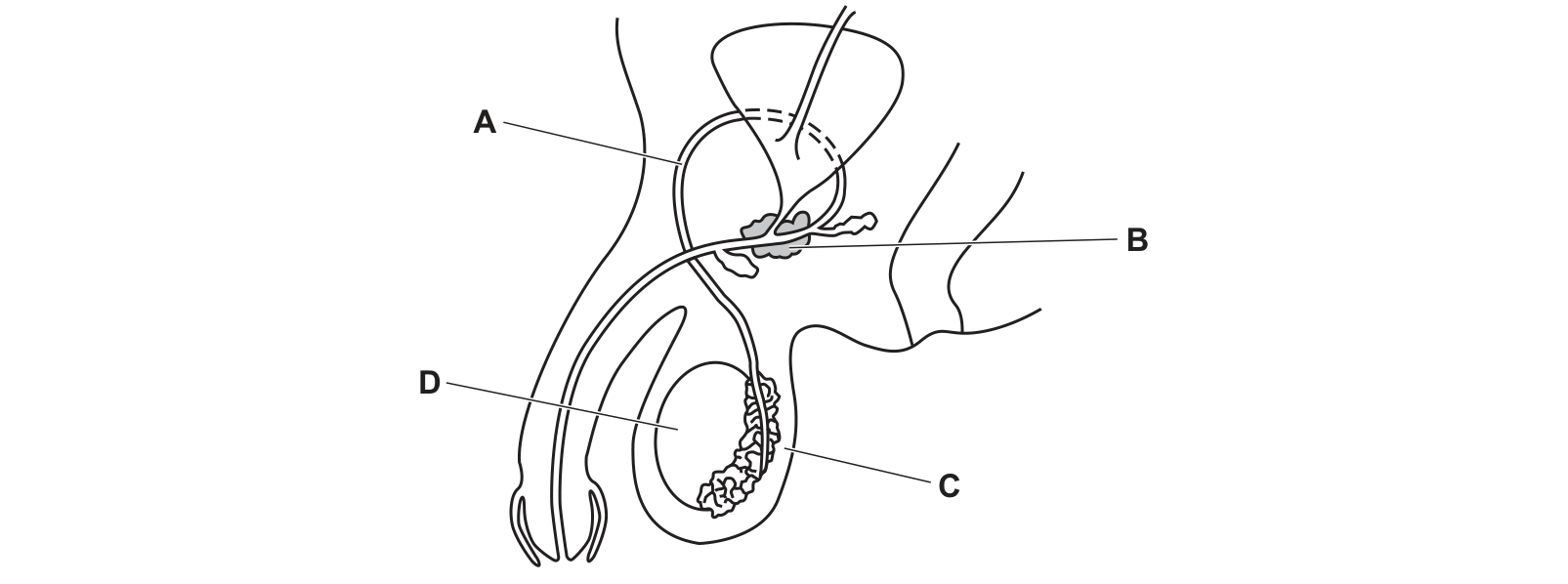
The diagram shows the male reproductive system. Which label is pointing to the structure where sperm are produced? Use the source image for W20 Paper 13, question 10.
Answer: D.
Sperm are made in the testis, the oval organ held inside the scrotum, so the label reaching that oval body is the one to take. The label on the coiled tube wrapped around the outside of it marks the epididymis, where sperm are stored and matured after they have been produced, which is one step later in the process. The label on the small shaded gland below the bladder marks the prostate, which adds fluid to the sperm to make semen but makes no cells itself. The label on the tube looping over the bladder marks the sperm duct, which carries sperm towards the urethra, and a duct is a pipe rather than a site of production.
Question 2
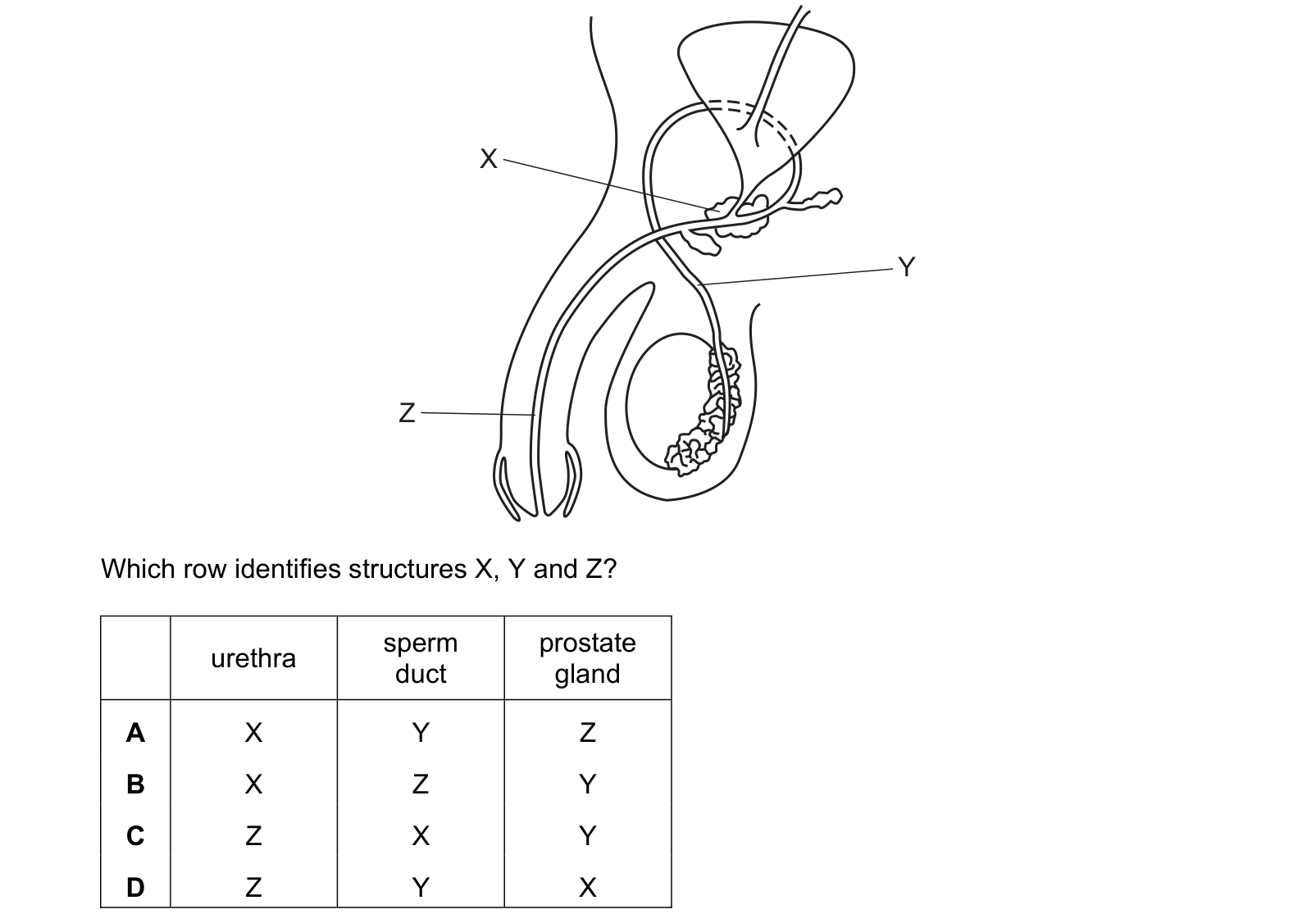
The diagram shows the human male reproductive system. Which row identifies structures X, Y and Z? Each answer gives, in order: urethra; sperm duct; prostate gland.
Answer: D.
Z labels the tube running the length of the penis, which is the urethra and carries both urine and semen out of the body. Y labels the duct running up from the testis and looping over the bladder, which is the sperm duct delivering sperm to that urethra. X labels the small lumpy gland sitting where the two meet below the bladder, which is the prostate gland, and it adds fluid to the sperm to make semen. The two rows calling X the urethra put a gland where the outlet tube belongs, when X is drawn as a compact lump rather than as a tube. The row that names Z correctly but then swaps X and Y asks the prostate to carry sperm up from the testis, a journey a gland fixed beside the bladder cannot make.
Question 3
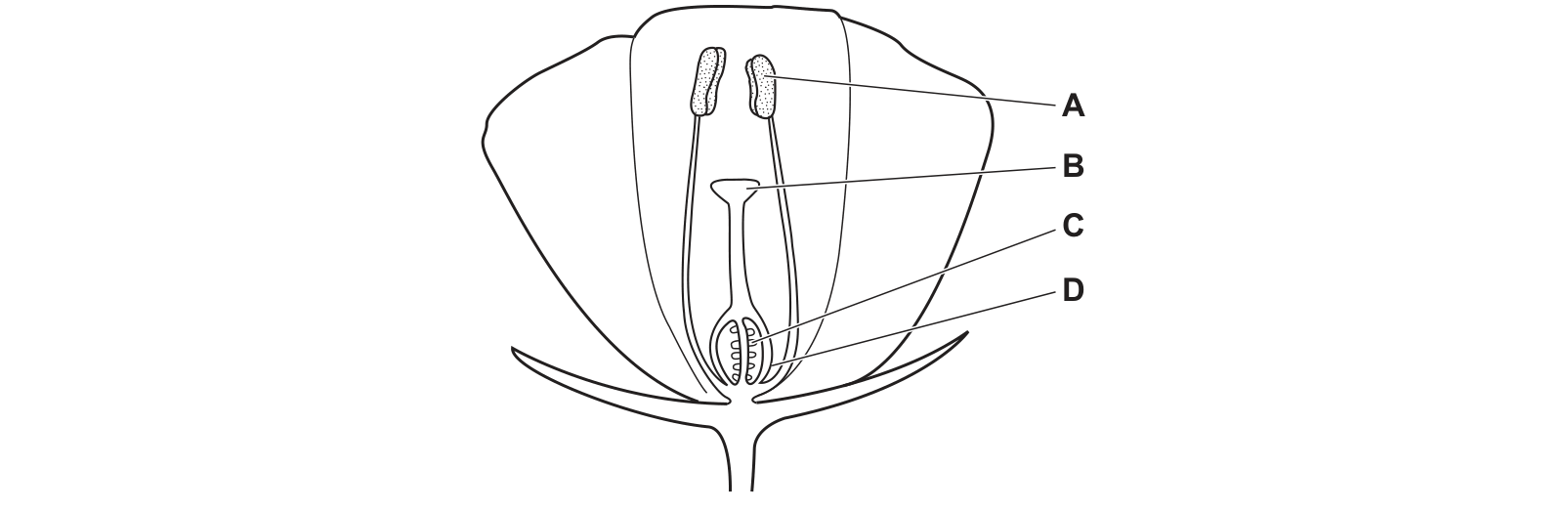
The diagram shows a section through an insect-pollinated flower. When pollination occurs, where must the pollen grains reach? Use the source image for S23 Paper 23, question 10.
Answer: B.
Pollination is the transfer of pollen from an anther to a stigma, so the grains must land on the stigma, the head carried at the top of the central column. The label on that head is the one to take. The labels on the stippled bodies at the tops of the two stalks mark the anthers, which are where the pollen starts its journey rather than where it has to arrive. The remaining two labels mark an ovule and the ovary wall enclosing it, and a male nucleus does reach the ovule, but only after a pollen tube has grown down from the stigma, and that later event is fertilisation rather than pollination.
Question 4
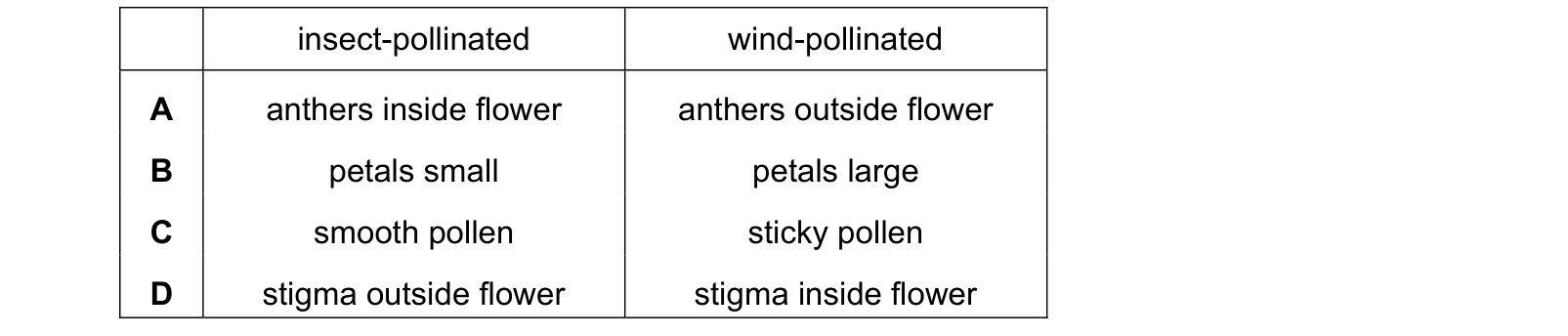
What is a characteristic of an insect-pollinated flower compared with a wind-pollinated flower? Each answer gives, in order: insect-pollinated; wind-pollinated.
Answer: A.
An insect pollinated flower has to make the insect brush against its reproductive parts, so the anthers and stigma sit inside the flower where a visitor pushing in for nectar cannot avoid them. A wind pollinated flower has no visitor to rely on, so its anthers dangle outside on long filaments where moving air can catch the pollen and carry it away, and its stigmas hang out feathery to catch what the wind brings. Each of the other rows names a genuine difference between the two types but puts the two columns the wrong way round, and the petals row is the clearest example, since large bright petals are the advertisement an insect pollinated flower needs while a wind pollinated one has small dull petals or none at all. The pollen row is reversed in the same way, because insect pollen is sticky and spiky so it clings to a body, while wind pollen is smooth and light so it drifts.
Question 5
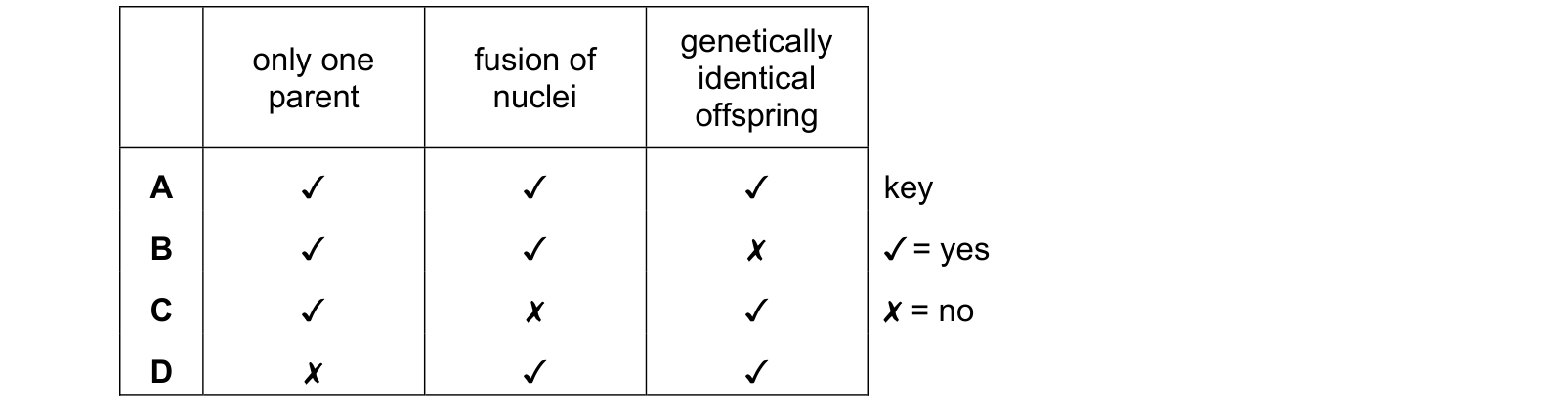
Which row describes asexual reproduction? genetically only one fusion of identical parent nuclei offspring Use the source image for S24 Paper 21, question 10.
Answer: C.
Asexual reproduction produces offspring from a single parent with no gametes and no fusion of nuclei, and because the new cells are made by mitosis the offspring are genetically identical to the parent. The correct row therefore ticks one parent and identical offspring while leaving fusion of nuclei unticked. All three wrong rows tick fusion of nuclei, which is fertilisation and belongs to sexual reproduction rather than to this process. One of them goes further and denies that the offspring are identical, which describes sexual reproduction completely, since mixing two sets of alleles is exactly what makes offspring differ. Another denies that there is only one parent, and a second parent could contribute only through a gamete, which asexual reproduction never uses.
These questions are drawn from past CIE 0654 Co-ordinated Sciences papers and filtered to reproduction. You answer, you find out immediately whether you were right, and you get the reasoning for the correct option and for each distractor. Wrong answers go to a mistakes locker so you can come back to exactly those.
Practice is free. You need an account only so your progress and your mistakes are still there next time.
These are the errors that cost marks on reproduction, taken from our own topic notes. Read them before you practise and you will recognise the traps in the questions.
Using pollination and fertilisation as though they meant the same thing.
Saying the ovary becomes the seed. The ovule becomes the seed; the ovary becomes the fruit.
Saying germinating seeds need light.
Saying fertilisation happens in the uterus. It happens in the oviduct.
Saying the mother's and fetus's blood mix in the placenta.