43 past-paper questions on this unit. Five of them are below. Answer on the page: each one is marked the moment you pick, the correct option is shown whether or not you found it, and the full explanation opens either way.
CIE 0654 Co-ordinated SciencesPaper 1 and Paper 2 MCQsFree account
Biological molecules: five questions to try now
Real past-paper questions, the answer key from the mark scheme, and the explanation that goes with it. No account needed to answer them.
Question 1
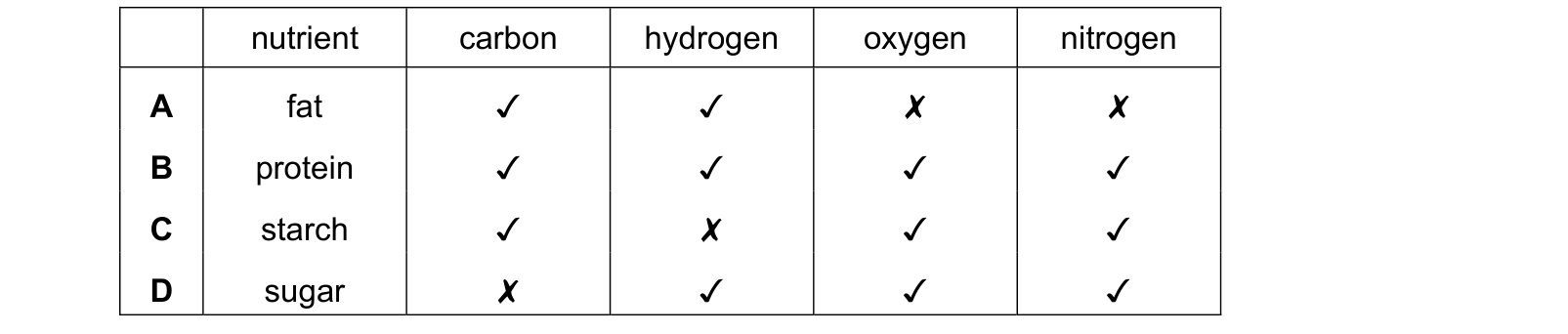
Which row matches the nutrient to the chemical elements that it contains? nutrient carbon hydrogen oxygen nitrogen Use the source image for S21 Paper 12, question 3.
Answer: B.
Proteins are chains of amino acids, and each amino acid carries an amino group, so proteins contain nitrogen as well as the carbon, hydrogen and oxygen found in the other nutrients listed. B is therefore the matching row, ticking all four elements for protein. A denies oxygen to fat, yet fat is an ester built from fatty acids and glycerol, and both parts contain oxygen. C denies hydrogen to starch and also gives it nitrogen, whereas starch is a carbohydrate made only of carbon, hydrogen and oxygen. D takes carbon away from sugar and adds nitrogen instead, which describes no sugar at all, since glucose is C6H12O6.
Question 2
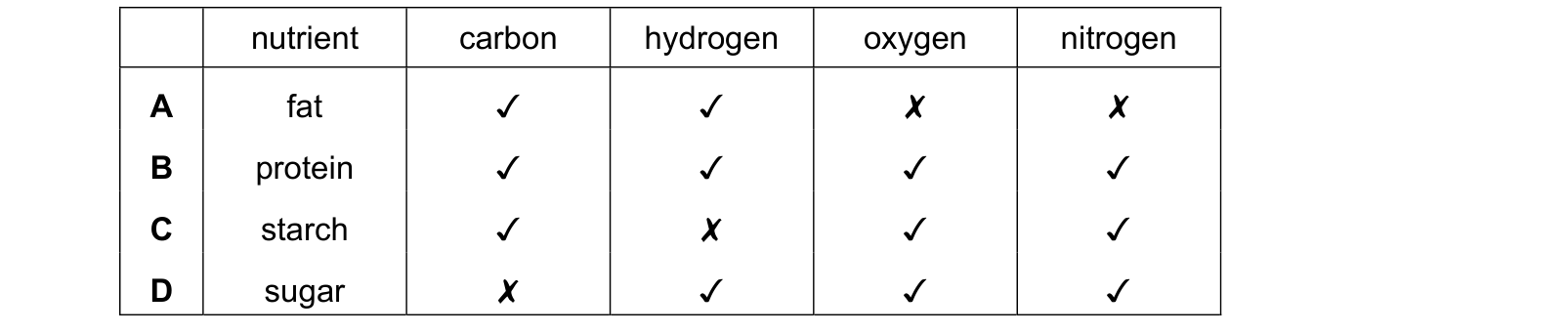
Which row matches the nutrient to the chemical elements that it contains? nutrient carbon hydrogen oxygen nitrogen Use the source image for S21 Paper 13, question 3.
Answer: B.
Proteins are chains of amino acids, and each amino acid carries an amino group, so proteins contain nitrogen as well as the carbon, hydrogen and oxygen found in the other nutrients listed. B is therefore the matching row, ticking all four elements for protein. A denies oxygen to fat, yet fat is an ester built from fatty acids and glycerol, and both parts contain oxygen. C denies hydrogen to starch and also gives it nitrogen, whereas starch is a carbohydrate made only of carbon, hydrogen and oxygen. D takes carbon away from sugar and adds nitrogen instead, which describes no sugar at all, since glucose is C6H12O6.
Question 3
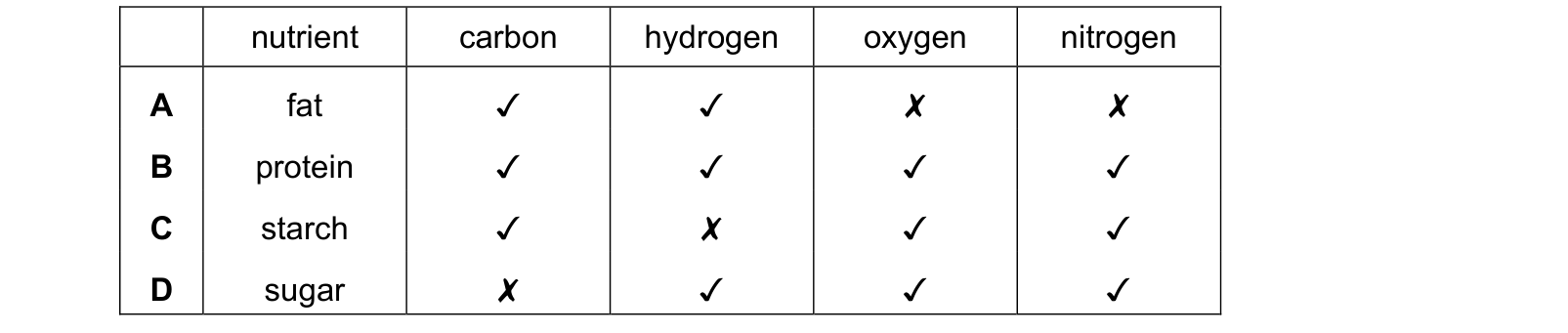
Which row matches the nutrient to the chemical elements that it contains? nutrient carbon hydrogen oxygen nitrogen Use the source image for S21 Paper 22, question 3.
Answer: B.
Proteins are chains of amino acids, and each amino acid carries an amino group, so proteins contain nitrogen as well as the carbon, hydrogen and oxygen found in the other nutrients listed. B is therefore the matching row, ticking all four elements for protein. A denies oxygen to fat, yet fat is an ester built from fatty acids and glycerol, and both parts contain oxygen. C denies hydrogen to starch and also gives it nitrogen, whereas starch is a carbohydrate made only of carbon, hydrogen and oxygen. D takes carbon away from sugar and adds nitrogen instead, which describes no sugar at all, since glucose is C6H12O6.
Question 4
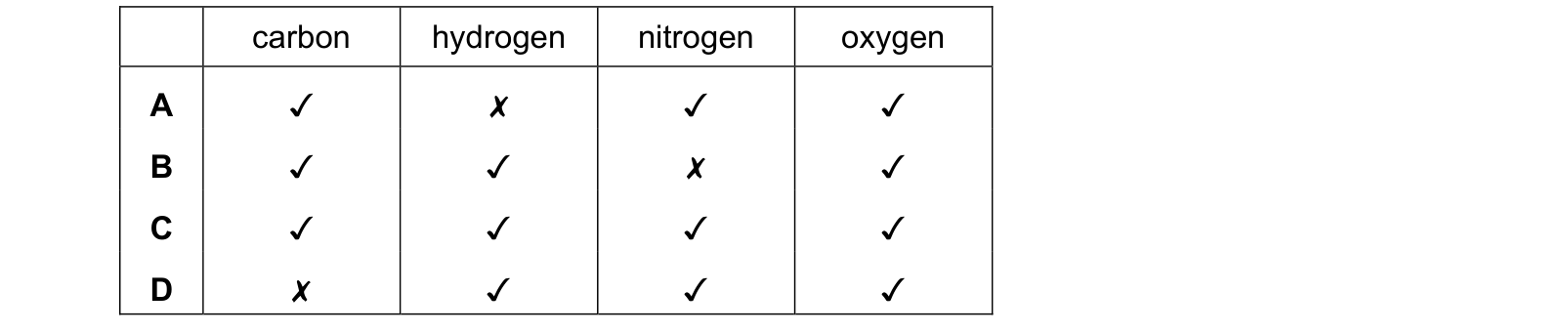
Which row identifies the elements that are found in a protein molecule? carbon hydrogen nitrogen oxygen Use the source image for M24 Paper 22, question 3.
Answer: C.
Proteins are built from amino acids, and every amino acid contains an amino group and a carboxylic acid group, so the elements present are carbon, hydrogen, oxygen and nitrogen, with sulfur in some of them. All four columns therefore need a tick, which is C. B crosses nitrogen, yet nitrogen is the very element that separates proteins from carbohydrates and fats, since those contain only carbon, hydrogen and oxygen. A crosses hydrogen, although hydrogen atoms appear along every carbon chain and in both the amino and the acid groups. D crosses carbon, which is impossible for any organic molecule, because the carbon chain is the backbone of every amino acid.
Question 5
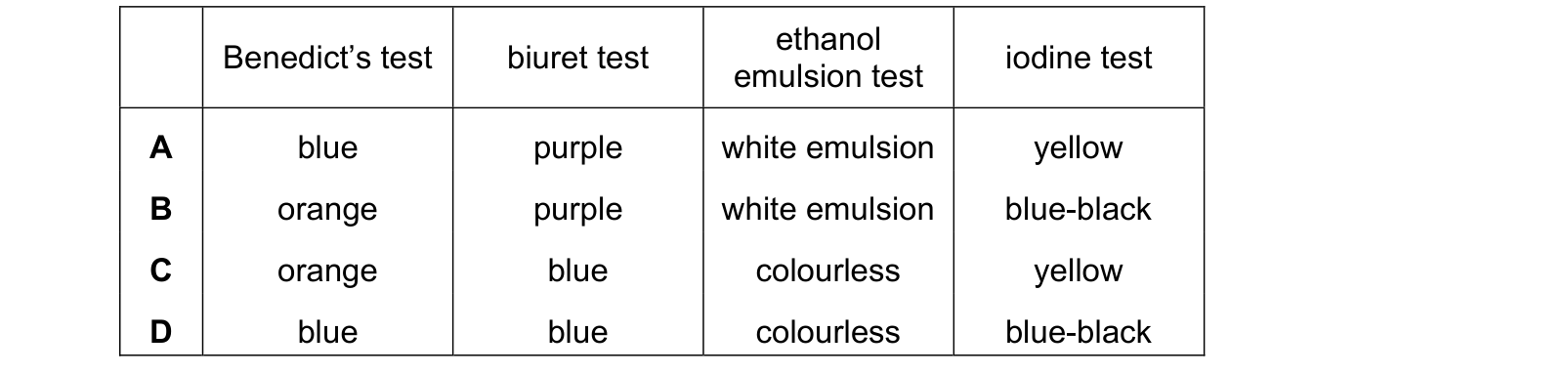
Eggs contain fat, protein and water. Which results are obtained from doing food tests on an egg? Each answer gives, in order: Benedict’s test; biuret test; ethanol emulsion test; iodine test.
Answer: A.
A food test that finds nothing leaves the reagent its original colour, so a negative result still has a colour to report. An egg contains protein, so biuret turns from pale blue to purple, and it contains fat, so the ethanol emulsion test gives a cloudy white emulsion when the mixture is poured into water. It contains no reducing sugar and no starch, so Benedict solution stays blue rather than going orange, and iodine stays yellow brown rather than going blue black. The row giving orange with Benedict and blue black with iodine is the tempting one for anyone reading colour changes as the sign of a working test, but those two changes would mean the egg contained sugar and starch, which the question has already ruled out.
These questions are drawn from past CIE 0654 Co-ordinated Sciences papers and filtered to biological molecules. You answer, you find out immediately whether you were right, and you get the reasoning for the correct option and for each distractor. Wrong answers go to a mistakes locker so you can come back to exactly those.
Practice is free. You need an account only so your progress and your mistakes are still there next time.
These are the errors that cost marks on biological molecules, taken from our own topic notes. Read them before you practise and you will recognise the traps in the questions.
Saying carbohydrates contain nitrogen.
Saying fats are made of amino acids, or proteins of glucose.
Forgetting to heat Benedict's solution.
Giving only the final colour instead of the change.
Saying iodine goes black. It goes blue-black, from orange-brown.