40 past-paper questions on this unit. Five of them are below. Answer on the page: each one is marked the moment you pick, the correct option is shown whether or not you found it, and the full explanation opens either way.
CIE 0654 Co-ordinated SciencesPaper 1 and Paper 2 MCQsFree account
Chemical energetics: five questions to try now
Real past-paper questions, the answer key from the mark scheme, and the explanation that goes with it. No account needed to answer them.
Question 1
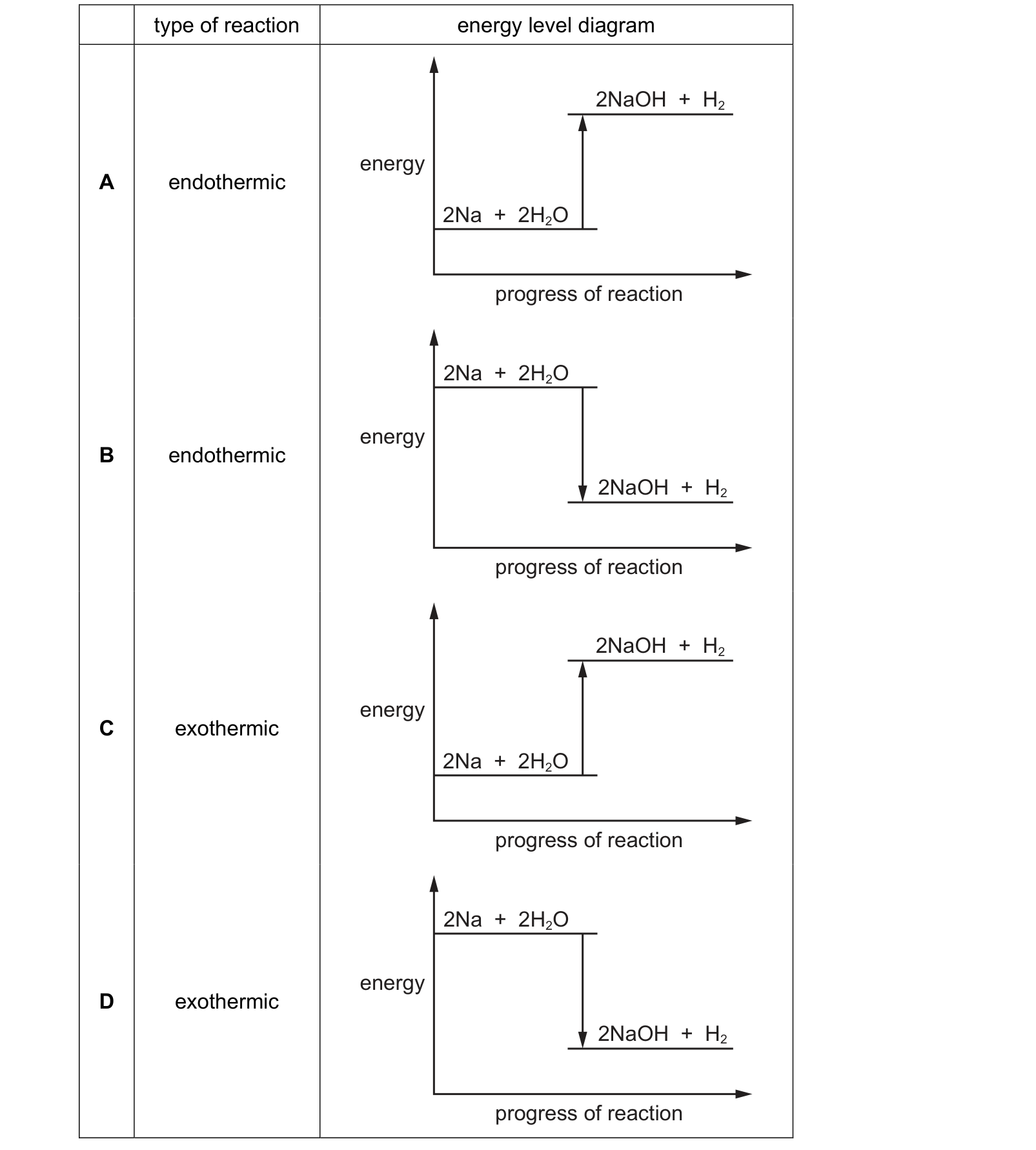
A piece of sodium is added to water. Which row shows the type of reaction and the energy level diagram for the reaction? Use the source image for S24 Paper 21, question 20.
Answer: D.
Sodium reacting with water is strongly exothermic, giving out so much heat that the sodium melts into a ball and the hydrogen released may ignite. An exothermic reaction ends with the products lower in energy than the reactants, because energy has left the chemicals and gone to the surroundings, so the diagram must show 2NaOH plus H2 below 2Na plus 2H2O, and D pairs that diagram with the right label. C carries the correct label but draws the products above the reactants, which is the shape for a reaction that takes energy in. A and B both call the reaction endothermic, which would mean the water grew colder as the sodium reacted, the opposite of what is seen.
Question 2
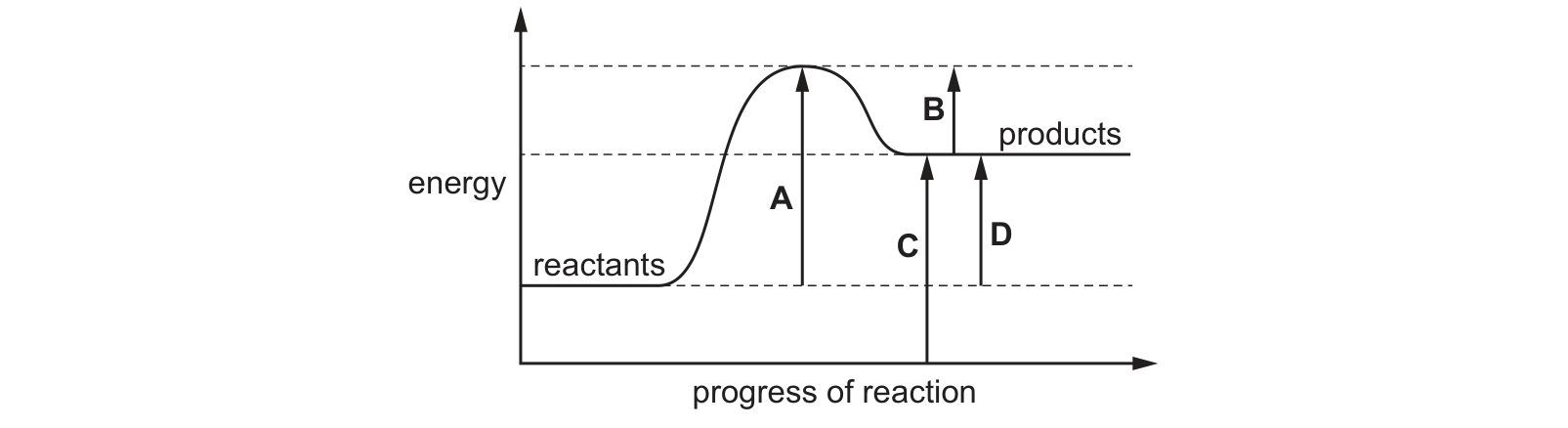
An energy level diagram for a reaction is shown. Which arrow shows the overall energy change for the reaction? Use the source image for S21 Paper 22, question 18.
Answer: D.
The overall energy change of a reaction is the difference in energy between the reactants and the products, so the arrow must run from the reactants level to the products level, which is D. A runs from the reactants up to the top of the hump, and that is the activation energy, the minimum energy colliding particles need before they can react at all. B runs from the products level up to the same peak, so it measures the activation energy of the reverse reaction rather than any overall change. C starts from the axis rather than from a chemical level, so it measures the total energy of the products from zero and not a change at all.
Question 3
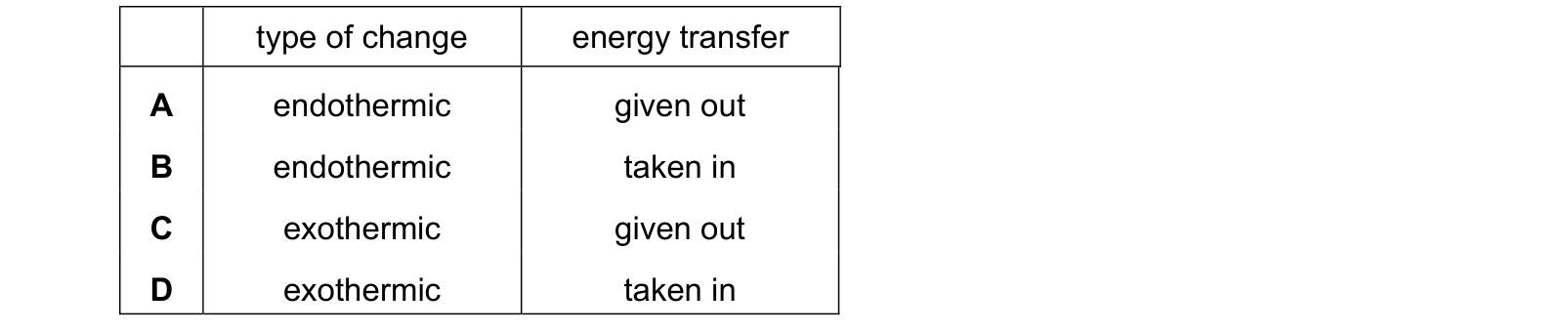
Which row describes the type of energy change and the energy transfer when bonds are broken during a chemical reaction? Each answer gives, in order: type of change; energy transfer.
Answer: B.
Breaking a bond means pulling apart particles that are attracting one another, and that always requires energy to be supplied, so bond breaking takes energy in from the surroundings and is endothermic. Bond forming is the reverse, releasing energy and being exothermic, and whether a whole reaction ends up exothermic or endothermic depends on which of the two totals is larger. The row pairing endothermic with energy given out is the tempting one, because endothermic is the right label here, but the two halves of that row contradict each other: endo means energy going in, so an endothermic step cannot give energy out. Any row calling bond breaking exothermic reverses the process itself, since no bond has ever broken by releasing energy.
Question 4
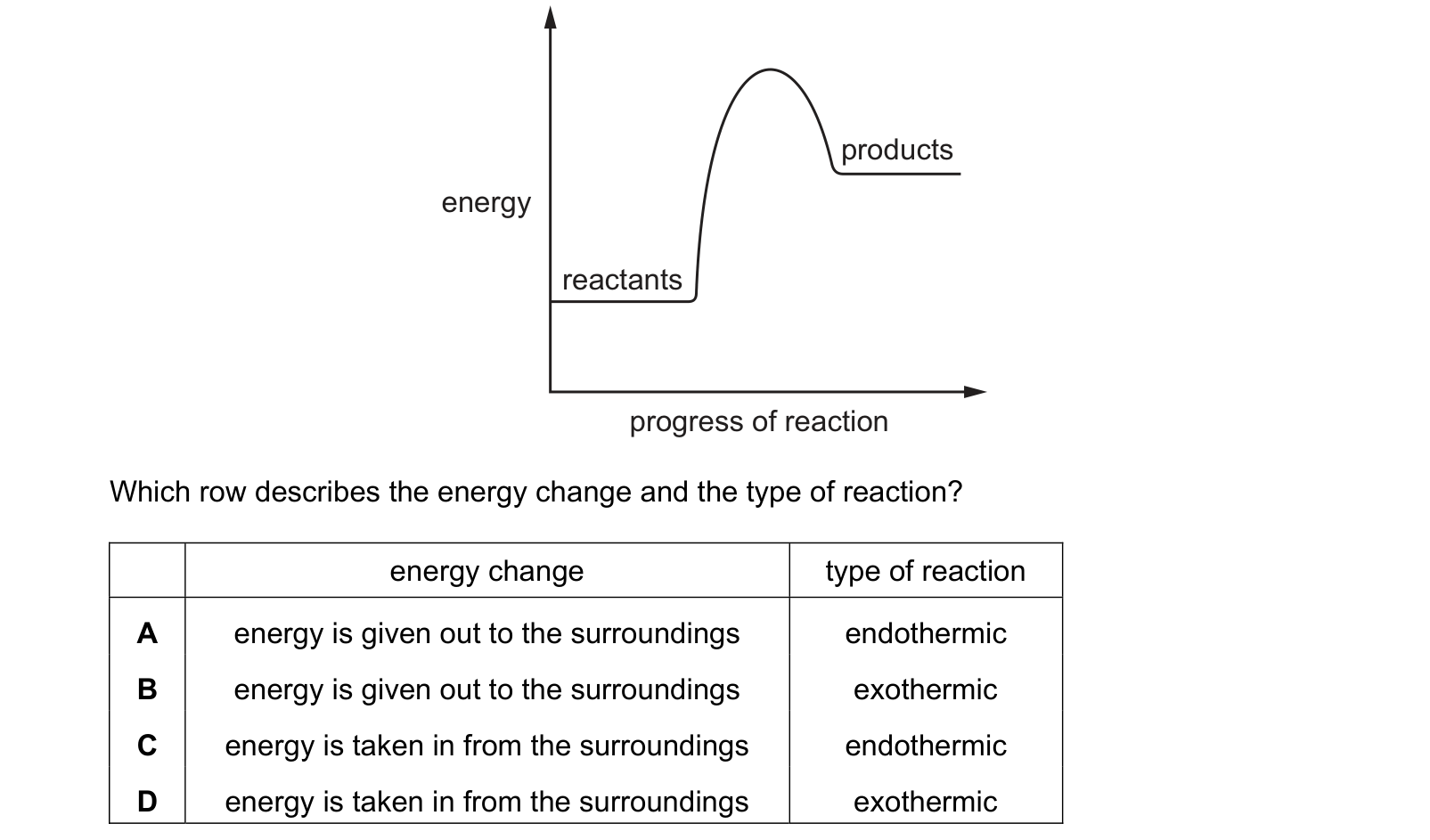
An energy level diagram for a chemical reaction is shown. Which row describes the energy change and the type of reaction? Each answer gives, in order: energy change; type of reaction.
Answer: C.
On this diagram the products sit higher than the reactants, so the mixture has ended with more chemical energy than it began with, and that extra energy can only have come from the surroundings. Taking energy in from the surroundings is the definition of an endothermic reaction, which is why the surroundings feel colder, so C pairs the right change with the right name. B describes the opposite diagram, where the products lie below the reactants and energy is released, giving an exothermic reaction. A and D each contradict themselves, since A says energy is given out and then calls the reaction endothermic, while D says energy is taken in and calls it exothermic.
Question 5
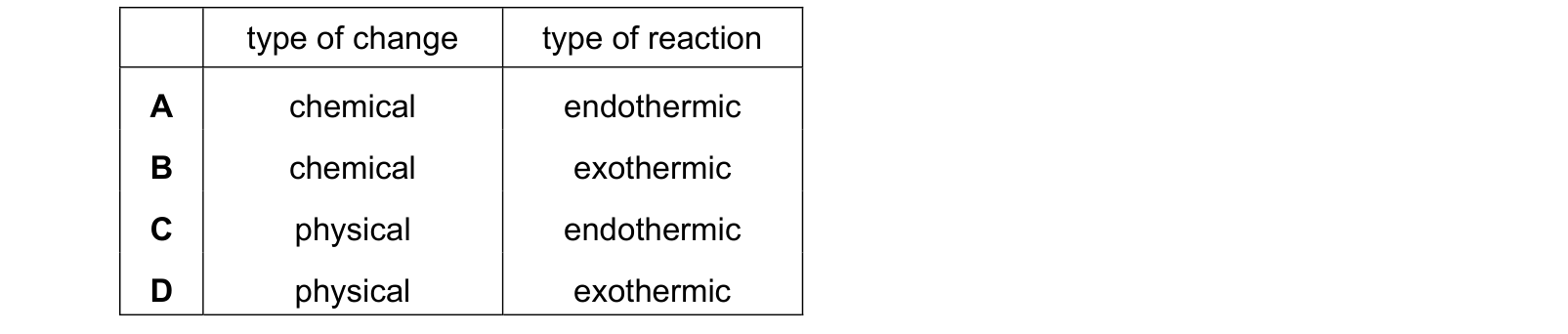
When a match burns, heat and light energy are produced. Which row describes the type of change and the type of reaction taking place? Each answer gives, in order: type of change; type of reaction.
Answer: B.
Burning a match is a chemical change, because the wood and the chemicals in the head combine with oxygen to form new substances such as carbon dioxide, water vapour and ash, and nothing will turn that ash back into a match. It is exothermic, and the question says so in the way it is worded: heat and light energy are produced, which means energy is being given out to the surroundings, so any row calling the reaction endothermic contradicts the information supplied. The physical options are tempting because the match visibly changes and it is easy to think of it as simply being used up, but a physical change leaves the substances themselves intact, as melting wax or boiling water does. The test to apply is whether new substances with new properties have appeared, and here they plainly have.
These questions are drawn from past CIE 0654 Co-ordinated Sciences papers and filtered to chemical energetics. You answer, you find out immediately whether you were right, and you get the reasoning for the correct option and for each distractor. Wrong answers go to a mistakes locker so you can come back to exactly those.
Practice is free. You need an account only so your progress and your mistakes are still there next time.
These are the errors that cost marks on chemical energetics, taken from our own topic notes. Read them before you practise and you will recognise the traps in the questions.
Saying an endothermic reaction makes the surroundings warmer.
Describing a temperature rise as endothermic because "energy is being made".
Saying bond breaking releases energy.
Explaining why a reaction is exothermic by saying it gives out heat, without mentioning bonds.
Giving a positive ΔH for an exothermic reaction.
Calculating bonds made minus bonds broken instead of the other way round.
Forgetting to multiply the bonds by the numbers in the balanced equation.
Saying a higher concentration makes particles collide with more energy.