24 past-paper questions on this unit. Five of them are below. Answer on the page: each one is marked the moment you pick, the correct option is shown whether or not you found it, and the full explanation opens either way.
CIE 0654 Co-ordinated SciencesPaper 1 and Paper 2 MCQsFree account
Movement into and out of cells: five questions to try now
Real past-paper questions, the answer key from the mark scheme, and the explanation that goes with it. No account needed to answer them.
Question 1
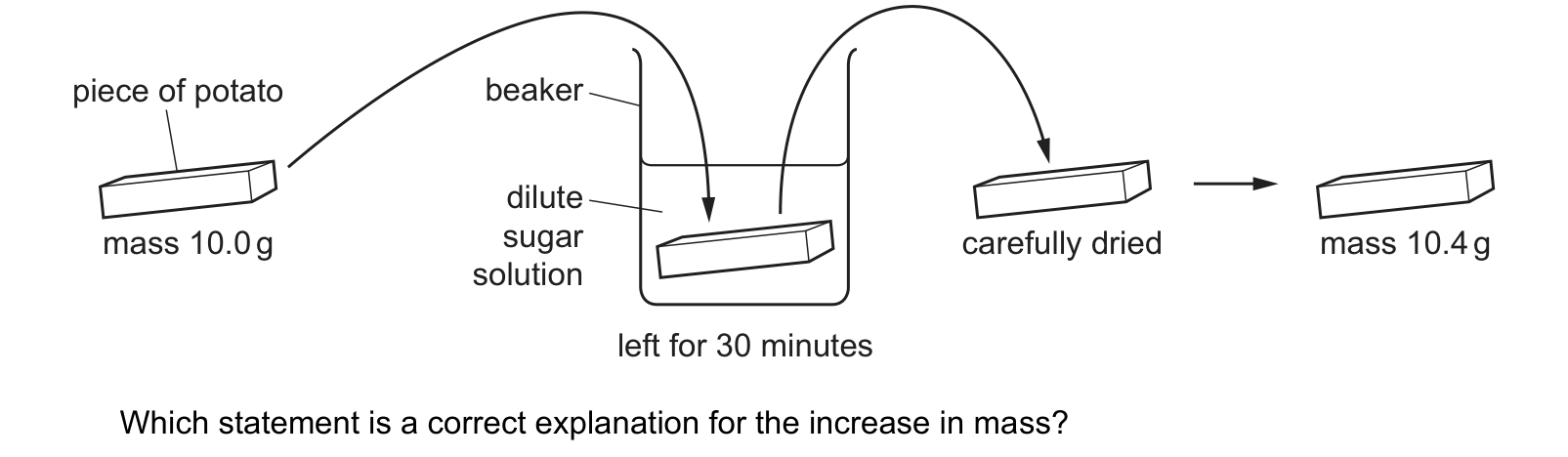
The diagram shows the stages of an experiment. piece of potato beaker mass 10.0 g sugar carefully dried mass 10.4 g Which statement is a correct explanation for the increase in mass?
Answer: C.
Osmosis is the movement of water alone, through a partially permeable membrane, from a dilute solution to a more concentrated one. The sugar solution is dilute, so the cell sap inside the potato cells is the more concentrated of the two and water moves into the cells, which is why the dried piece now weighs 10.4 g instead of 10.0 g. The option describing water moving out of the cells would give a loss of mass and a limp piece of potato, which is the opposite of the result recorded. The two options describing sugar moving are wrong twice over, because osmosis is defined for water rather than for solutes, and sugar molecules are too large to cross the partially permeable membrane freely in either direction.
Question 2
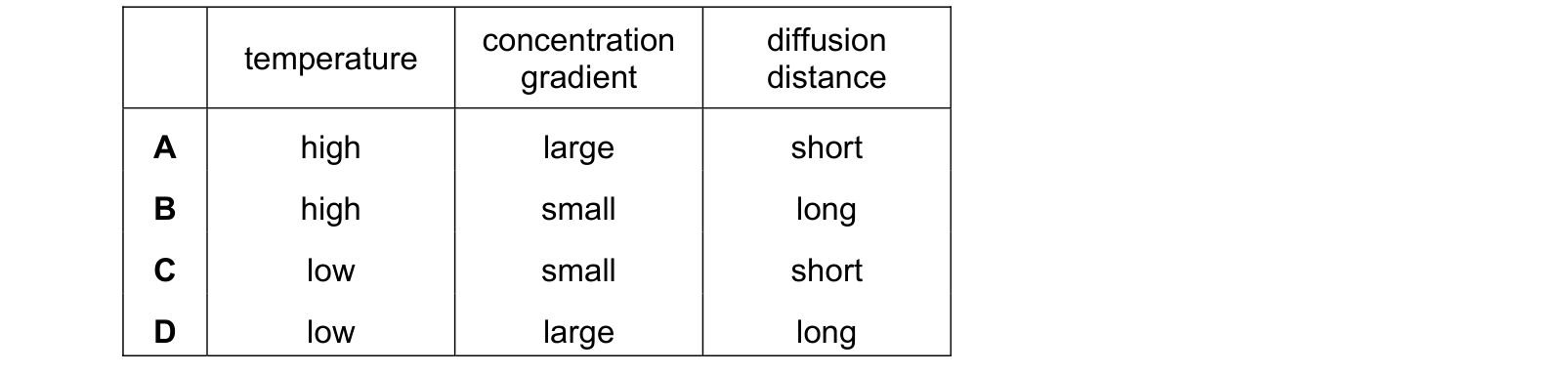
Which conditions will result in the fastest rate of diffusion? Each answer gives, in order: temperature; concentration gradient; diffusion distance.
Answer: A.
Diffusion is the net movement of particles from where they are more concentrated to where they are less concentrated, driven by the random motion of the particles themselves. Raising the temperature gives those particles more kinetic energy so they move faster, a steeper concentration gradient means a larger imbalance driving the net movement, and a shorter distance means each particle has less ground to cover, so all three conditions together give the fastest rate. The row pairing a low temperature with a large gradient is the tempting one, because the gradient is the factor most often remembered, but a steep gradient cannot rescue particles that are moving slowly, since temperature sets the speed at which they travel at all. Any row that lengthens the diffusion distance works against the rate. That is why alveoli and villi have walls only one cell thick.
Question 3
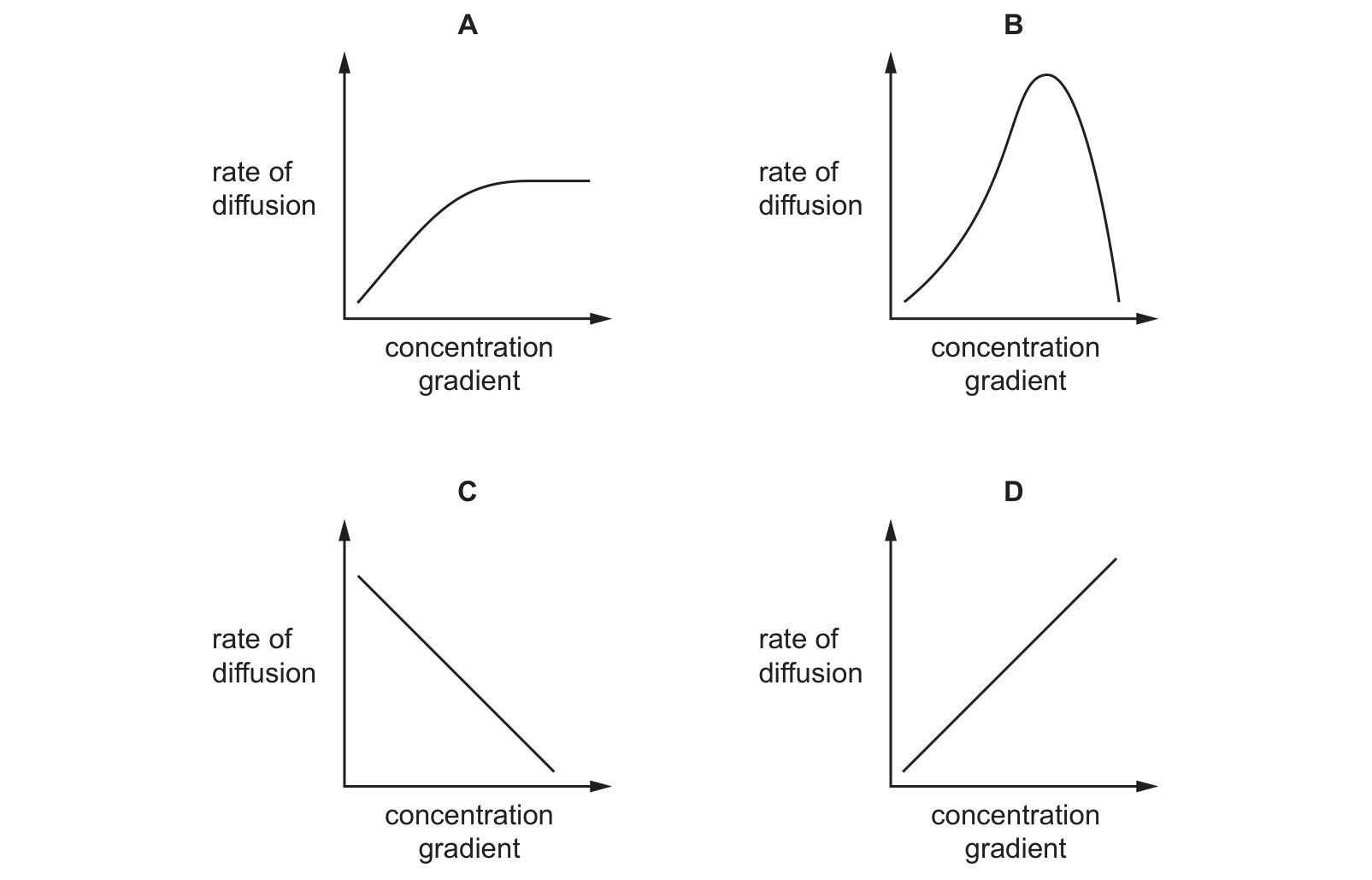
What is the effect of increasing the concentration gradient on the rate of diffusion? Use the source image for M24 Paper 22, question 2.
Answer: D.
Diffusion is the net movement of particles from a region of higher concentration to a region of lower concentration, and the steeper that difference the greater the net movement, so the rate rises in proportion to the gradient. The straight line climbing across the whole axis is that relationship. The graph that rises and then flattens into a plateau belongs to a process that can be saturated, such as facilitated diffusion or active transport through carrier proteins, whereas simple diffusion uses no carrier and so has nothing to run out of. The graph that rises to a peak and then falls would mean that widening the difference in concentration eventually slowed the movement down. The line that falls steadily claims the rate is greatest when the two concentrations are nearly equal, which is the reverse of the definition.
Question 4
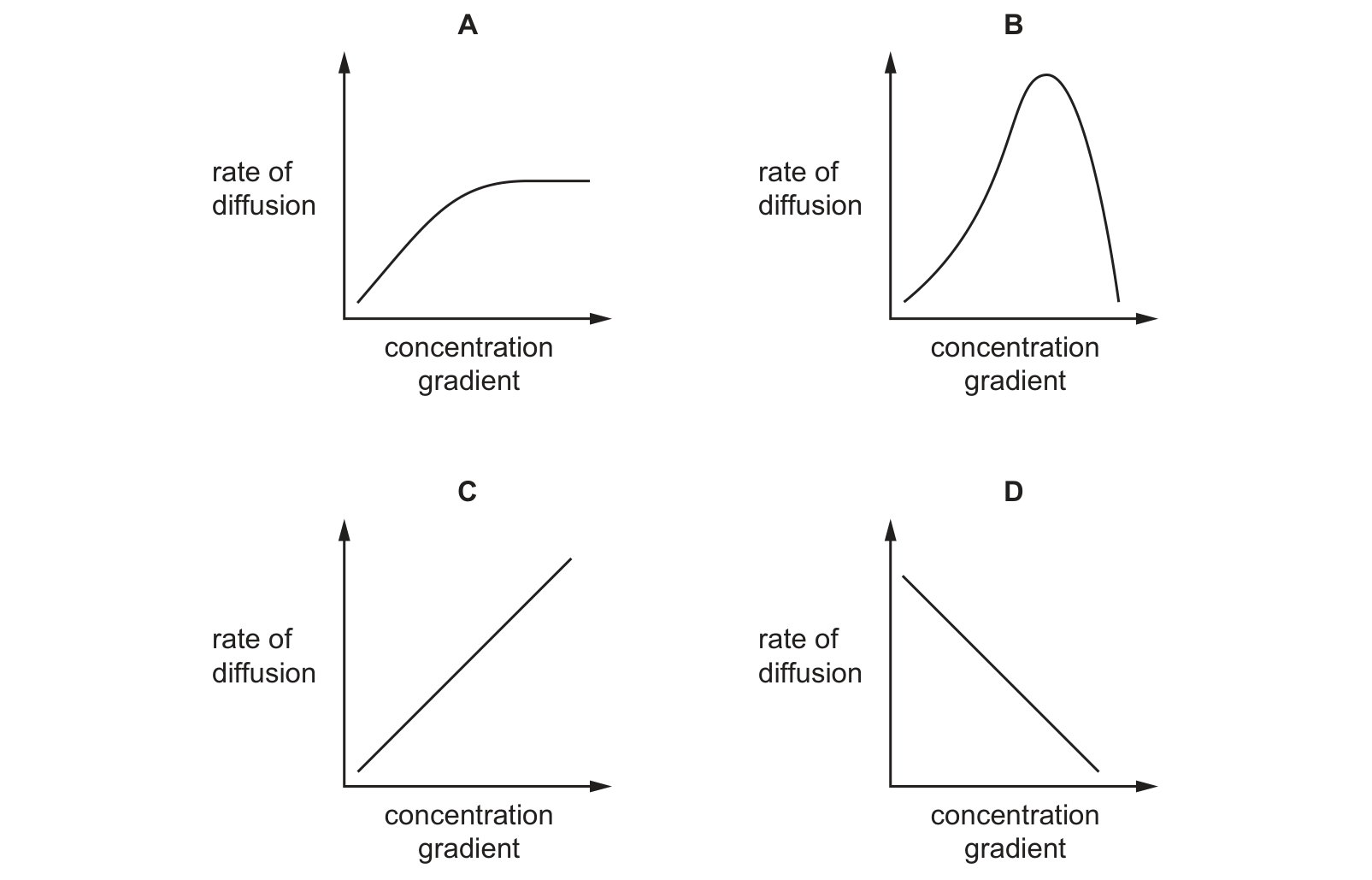
What is the effect of increasing the concentration gradient on the rate of diffusion? Use the source image for S21 Paper 21, question 2.
Answer: C.
Diffusion is the net movement of particles from a region of higher concentration to a region of lower concentration, and the steeper that difference the greater the net movement, so the rate rises in proportion to the gradient. The straight line climbing across the whole axis is that relationship. The graph that rises and then flattens into a plateau belongs to a process that can be saturated, such as facilitated diffusion or active transport through carrier proteins, whereas simple diffusion uses no carrier and so has nothing to run out of. The graph that rises to a peak and then falls would mean that widening the difference in concentration eventually slowed the movement down. The line that falls steadily claims the rate is greatest when the two concentrations are nearly equal, which is the reverse of the definition.
Question 5
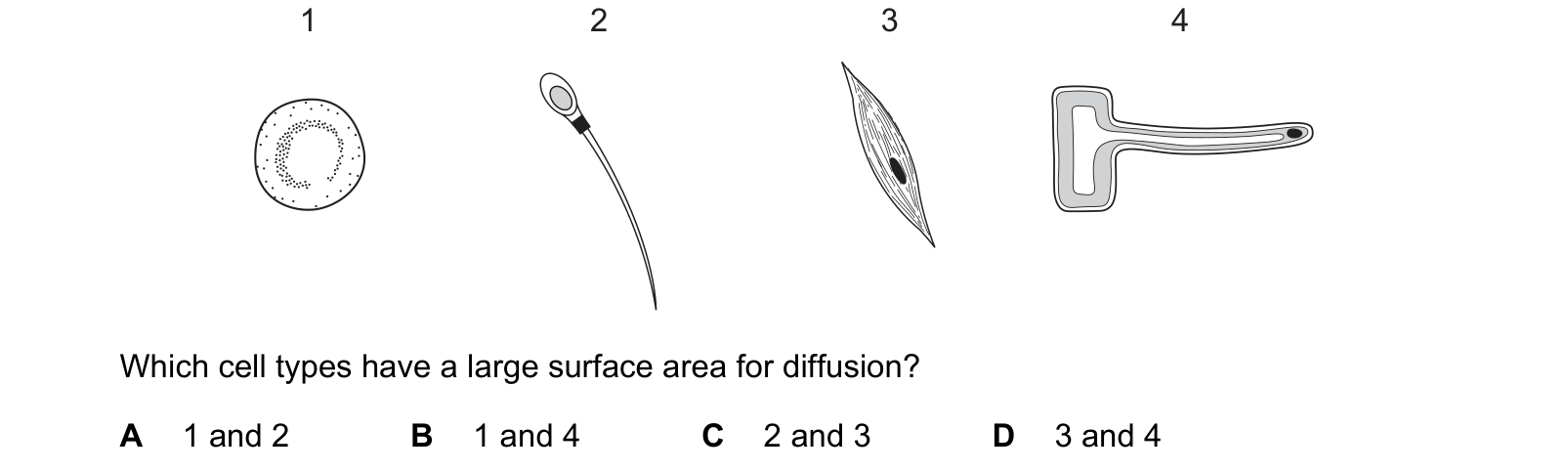
The diagrams show four different cells found in living organisms. 1 2 3 4 Which cell types have a large surface area for diffusion?
Answer: B.
A cell adapted for diffusion has a large surface area compared with its volume, which gives a short path in or out for the substances it exchanges. The red blood cell is a biconcave disc, dimpled on both faces so that no part of its contents lies far from the surface, which speeds the loading and unloading of oxygen. The root hair cell is drawn with an extended narrow projection reaching out into the soil, and that extension greatly increases the area across which water and mineral ions enter. The sperm cell is built for movement instead, with a tail for swimming and a streamlined head that reduces resistance rather than maximising surface. The remaining cell is a narrow spindle with fibres running along its length, a shape built for contracting, so every option containing it or the sperm cell has picked a cell adapted for a different job.
These questions are drawn from past CIE 0654 Co-ordinated Sciences papers and filtered to movement into and out of cells. You answer, you find out immediately whether you were right, and you get the reasoning for the correct option and for each distractor. Wrong answers go to a mistakes locker so you can come back to exactly those.
Practice is free. You need an account only so your progress and your mistakes are still there next time.
These are the errors that cost marks on movement into and out of cells, taken from our own topic notes. Read them before you practise and you will recognise the traps in the questions.
Saying osmosis is the movement of sugar or solute molecules. It is water.
Leaving "partially permeable" out of the definition of osmosis, or writing "cell wall" instead.
Saying water moves from high concentration to low concentration without saying high concentration of what, which reverses the answer if the reader thinks of the solute.
Dropping the word "net" from the definition of diffusion.
Claiming particles stop moving once concentrations are equal.
Saying active transport moves particles down a gradient.
Forgetting to mention energy from respiration when defining active transport.
Listing respiration as a process that uses energy.