92 past-paper questions on this unit. Five of them are below. Answer on the page: each one is marked the moment you pick, the correct option is shown whether or not you found it, and the full explanation opens either way.
CIE 0654 Co-ordinated SciencesPaper 1 and Paper 2 MCQsFree account
Atoms, elements and compounds: five questions to try now
Real past-paper questions, the answer key from the mark scheme, and the explanation that goes with it. No account needed to answer them.
Question 1
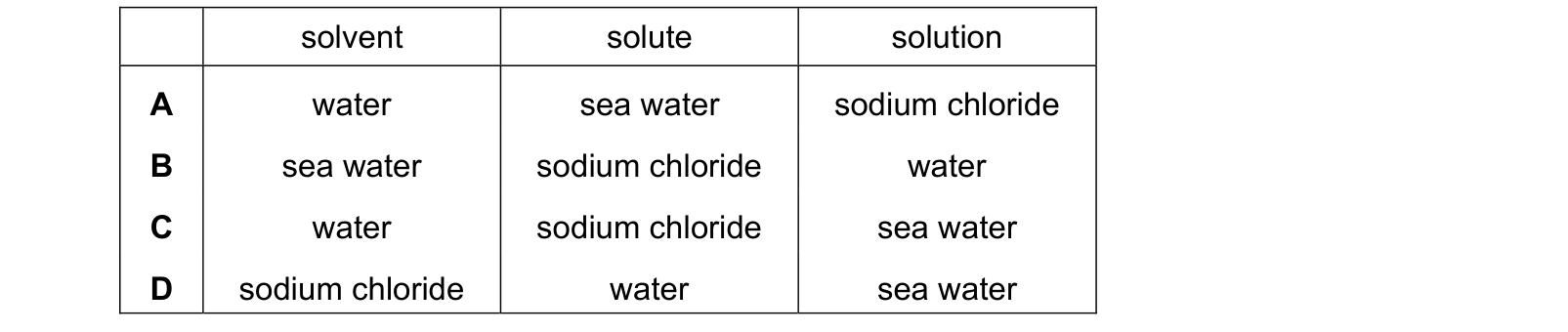
Sea water is a mixture that contains sodium chloride dissolved in water. Which row describes sea water? Each answer gives, in order: solvent; solute; solution.
Answer: C.
The solvent is the liquid that does the dissolving, the solute is the substance dissolved in it, and the solution is what the two of them make together, so water is the solvent, sodium chloride is the solute and sea water is the solution. There is a quick structural check available here, since solute and solvent combine to give the solution, so whatever is named as the solution must be the thing containing the other two, and only sea water fits that. The row calling sea water the solvent is the tempting one, because sea water is indeed what everything else is floating about in, but sea water is the finished mixture rather than the liquid that did the dissolving. Any row calling sodium chloride the solvent has a solid dissolving a liquid, which reverses the roles entirely.
Question 2
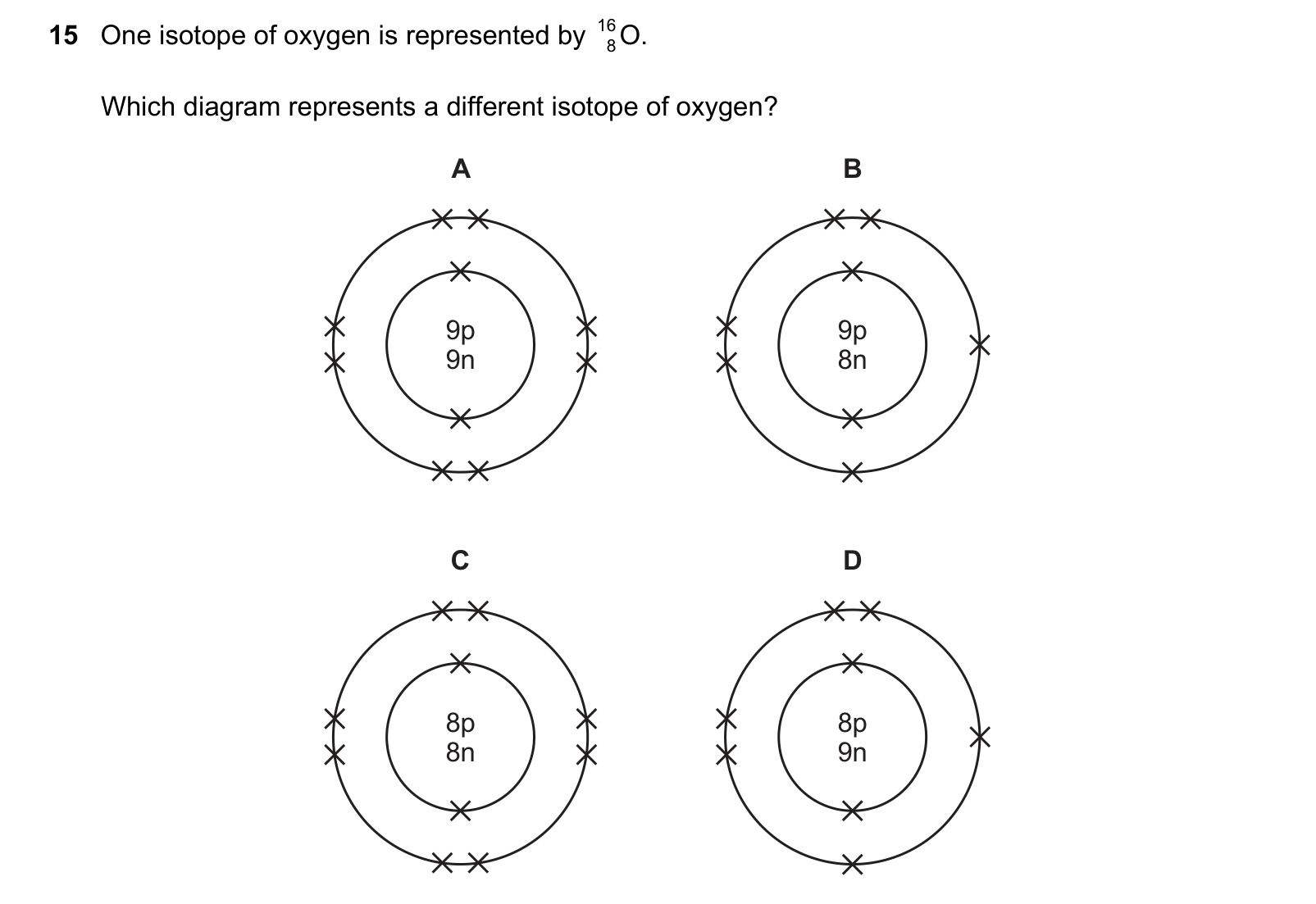
One isotope of oxygen is represented by 16 O. 8 Which diagram represents a different isotope of oxygen? Use the source image for S24 Paper 23, question 15.
Answer: D.
Isotopes of an element have the same number of protons but different numbers of neutrons, because the proton number is what makes the element what it is. The oxygen isotope given has a proton number of 8 and a nucleon number of 16, so it holds 8 protons and 8 neutrons. A different isotope of oxygen must therefore still have 8 protons but some other number of neutrons, and the diagram with 8 protons and 9 neutrons is the only one that does. The diagram with 8 protons and 8 neutrons is the same isotope written out again, not a different one. The two diagrams with 9 protons are not oxygen at all: 9 protons make the element fluorine, whatever the neutron count, so changing the proton number changes the element rather than producing an isotope.
Question 3
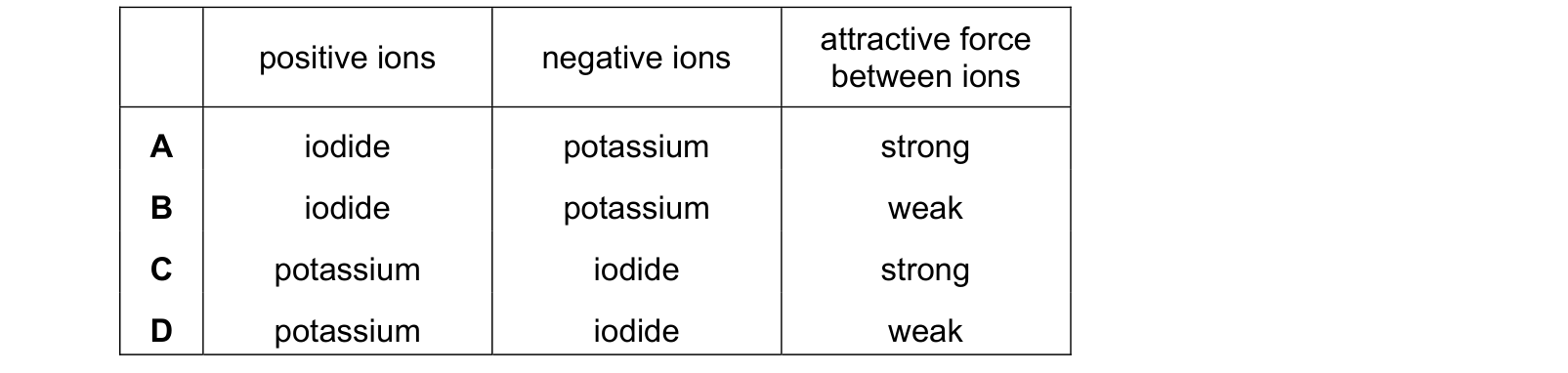
The bonding in potassium iodide is ionic. Which row describes the potassium iodide lattice structure? Each answer gives, in order: positive ions; negative ions; attractive force between ions.
Answer: C.
Potassium is a Group I metal with one electron in its outer shell, and it loses that electron to form a positive ion, while iodine is a Group VII non metal that gains one to form a negative iodide ion. The lattice is then held together by the electrostatic attraction between those opposite charges, and that attraction is strong and acts in every direction. That is why potassium iodide is a hard crystalline solid with a high melting point. The row that makes iodide the positive ion is the tempting one if the two elements are treated as interchangeable partners, but a metal always loses electrons and a non metal always gains them, so the charges can only go one way round. Any row calling the force weak contradicts the properties of the compound, since weak forces would give a substance that melted easily rather than one needing hundreds of degrees.
Question 4
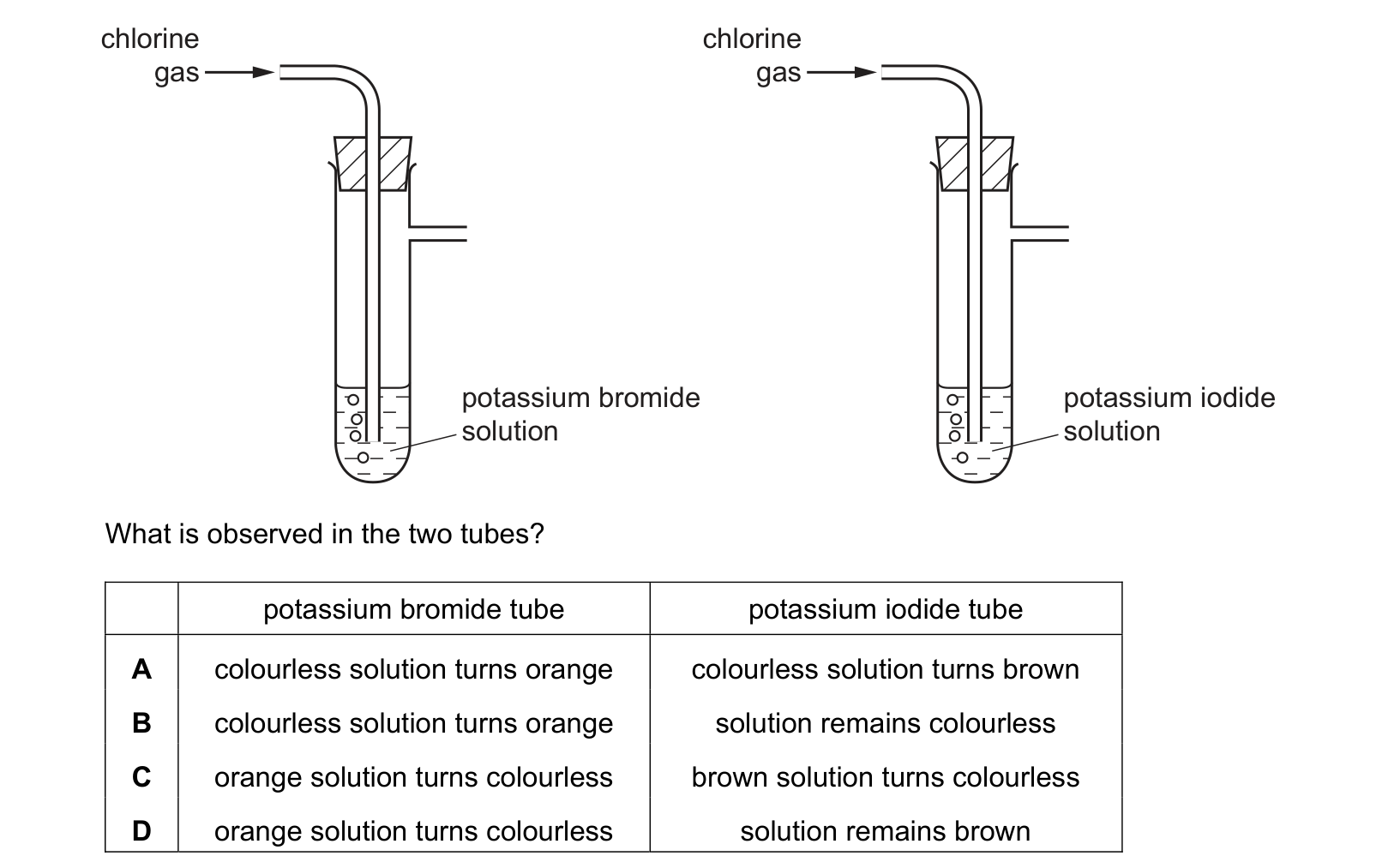
Chlorine gas is bubbled through two separate solutions. chlorine chlorine gas gas What is observed in the two tubes? Each answer gives, in order: potassium bromide tube; potassium iodide tube.
Answer: A.
Chlorine sits above both bromine and iodine in group VII, so it is the more reactive halogen and displaces each of them from its salt. In the potassium bromide tube the chlorine takes the place of the bromide ions and free bromine is released, turning that colourless solution orange, and in the potassium iodide tube the same displacement sets iodine free, turning it brown, which is A. B claims nothing happens in the iodide tube, but chlorine stands further up the group than iodine and displaces it just as readily. C and D both begin with coloured solutions, whereas potassium bromide and potassium iodide solutions are colourless until a halogen is set free in them, so colour appears rather than disappears.
Question 5
Which row does not link a general physical property to the type of element? Each answer gives, in order: type of element; general physical property.
Answer: C.
The question is about general properties, so the row that breaks the pattern is the one claiming non-metals conduct electricity, since non-metals have no delocalised electrons and are insulators. Metals are malleable because their layers of ions slide over one another without the metallic bonding breaking, and they conduct heat well because those same free electrons carry energy through the lattice, so rows A and B are correctly matched. Row D is the trap for students who remember diamond and silicon dioxide melting at enormous temperatures, but those are giant covalent exceptions, and non-metals in general form small molecules with only weak forces between them, so they melt low. Graphite is the matching exception on the other side, a non-metal that does conduct because of its spare delocalised electron, which is well worth knowing but does not overturn the general rule being tested here.
These questions are drawn from past CIE 0654 Co-ordinated Sciences papers and filtered to atoms, elements and compounds. You answer, you find out immediately whether you were right, and you get the reasoning for the correct option and for each distractor. Wrong answers go to a mistakes locker so you can come back to exactly those.
Practice is free. You need an account only so your progress and your mistakes are still there next time.
These are the errors that cost marks on atoms, elements and compounds, taken from our own topic notes. Read them before you practise and you will recognise the traps in the questions.
Saying electrons are shared in ionic bonding, or transferred in covalent bonding.
Saying a solid ionic compound conducts.
Saying "the electrons are free to move" for molten ionic compounds. It is the ions that move.
Saying isotopes have different chemical properties.
Saying an ion has a different number of protons from its atom.
Saying covalent bonds are weak. The bonds are strong; the forces between molecules are weak.
Forgetting that diamond does not conduct even though graphite does.