25 past-paper questions on this unit. Five of them are below. Answer on the page: each one is marked the moment you pick, the correct option is shown whether or not you found it, and the full explanation opens either way.
CIE 0654 Co-ordinated SciencesPaper 1 and Paper 2 MCQsFree account
Respiration: five questions to try now
Real past-paper questions, the answer key from the mark scheme, and the explanation that goes with it. No account needed to answer them.
Question 1
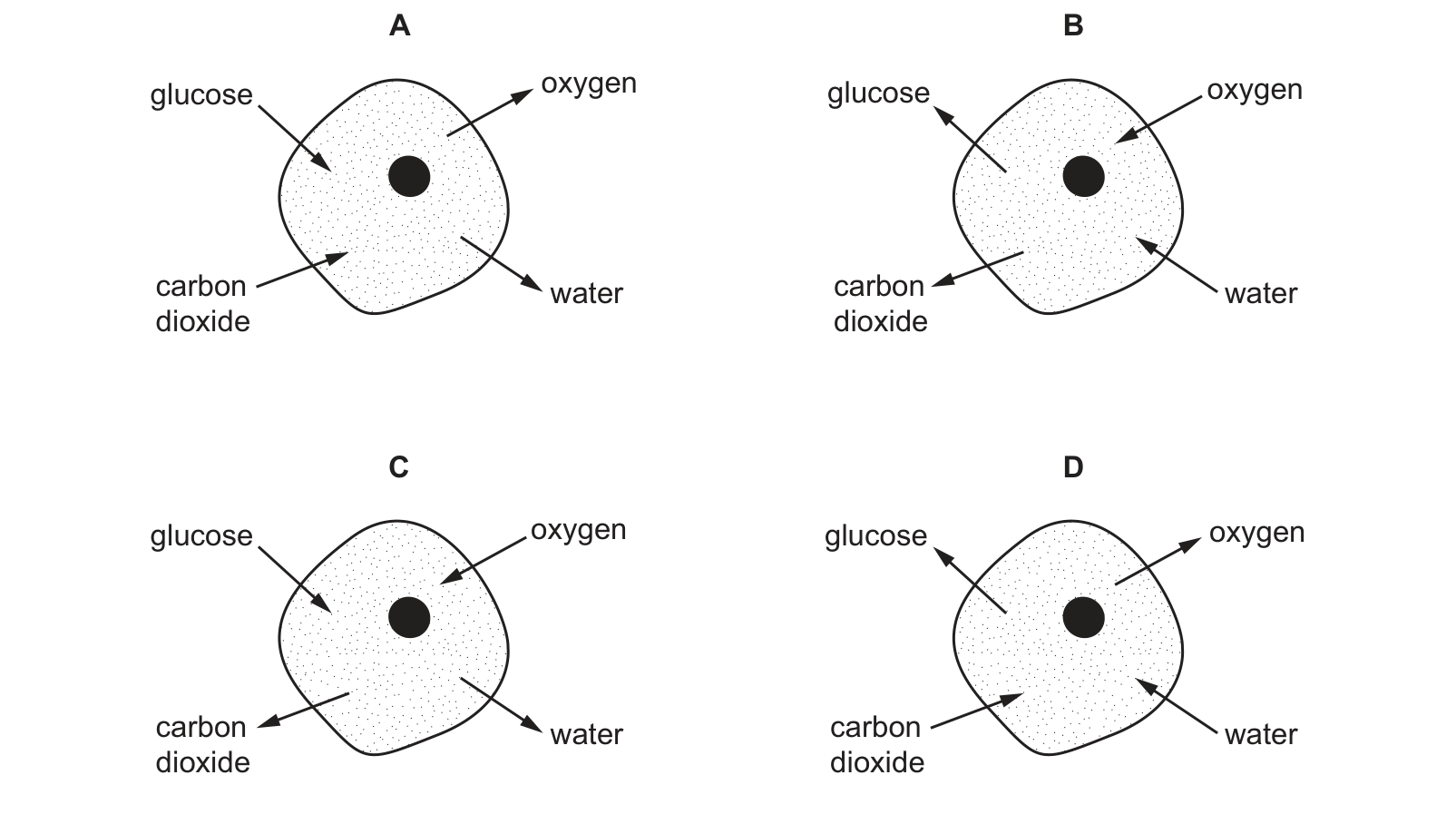
Which diagram of a cell shows the correct movement of substances for the process of aerobic respiration? Use the source image for W22 Paper 12, question 8.
Answer: C.
Aerobic respiration uses glucose and oxygen and produces carbon dioxide and water, so both reactants must have arrows pointing into the cell and both products arrows pointing out of it. Only one diagram does that, with glucose and oxygen entering while carbon dioxide and water leave. The diagram that keeps glucose entering but sends oxygen out and lets carbon dioxide in has swapped the two gases over, which is the pattern of photosynthesis rather than respiration. The diagram that sends glucose out and draws water in has the fuel leaving the cell and a waste product entering it. The diagram with all four arrows reversed writes the equation backwards from beginning to end.
Question 2
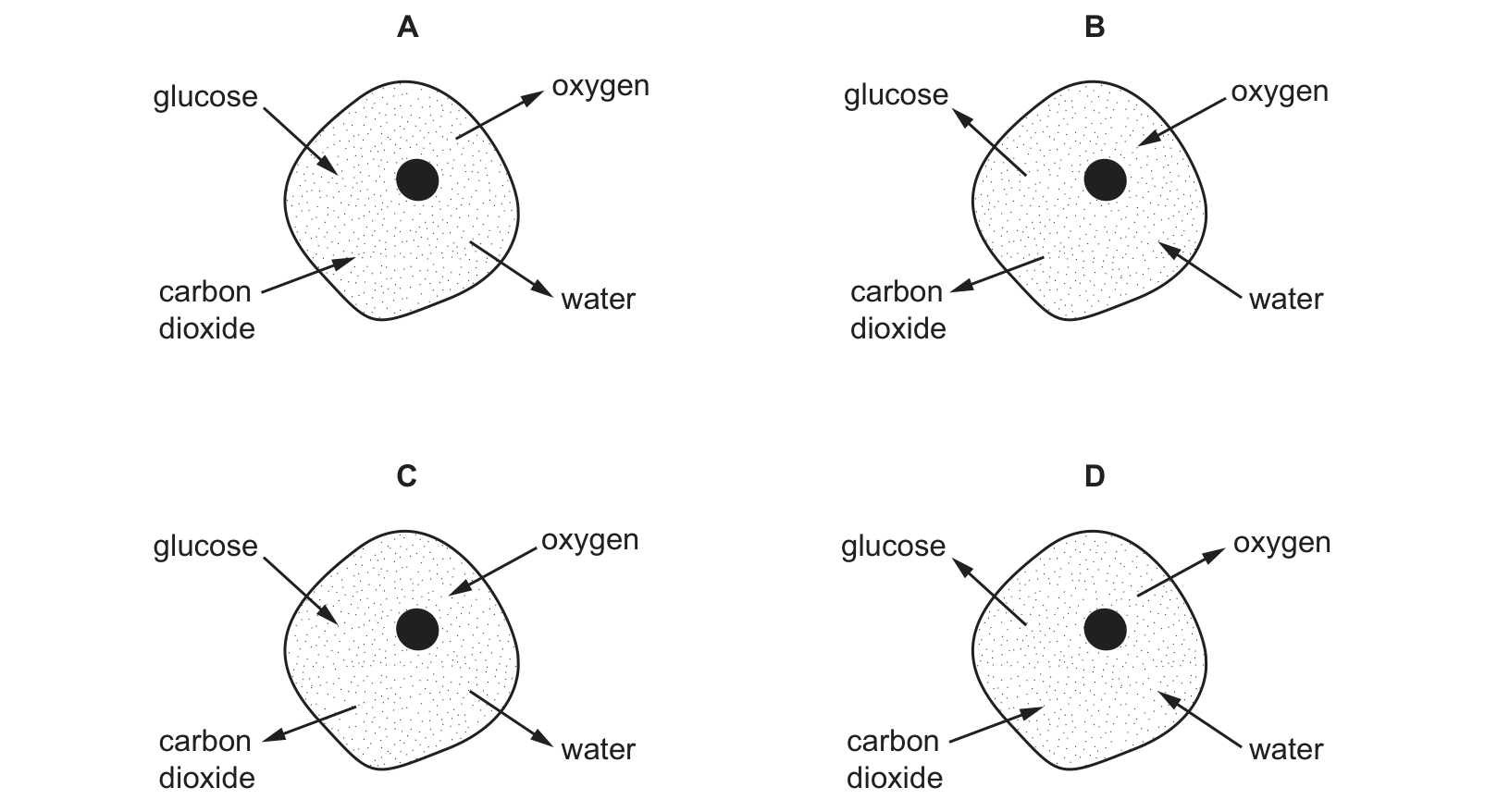
Which diagram of a cell shows the correct movement of substances for the process of aerobic respiration? Use the source image for W22 Paper 22, question 8.
Answer: C.
Aerobic respiration is glucose plus oxygen giving carbon dioxide plus water, so the two reactants need arrows pointing into the cell and the two products need arrows pointing out. C is the only diagram drawn that way, with glucose and oxygen entering while carbon dioxide and water leave. A takes glucose and carbon dioxide in and sends oxygen out, so it borrows the gas movements of photosynthesis while still treating glucose as a raw material. D shows photosynthesis outright, absorbing carbon dioxide and water while releasing glucose and oxygen, which is the reverse of what a respiring cell does. Matching each substance in the word equation to the direction of its arrow sorts these diagrams quickly.
Question 3
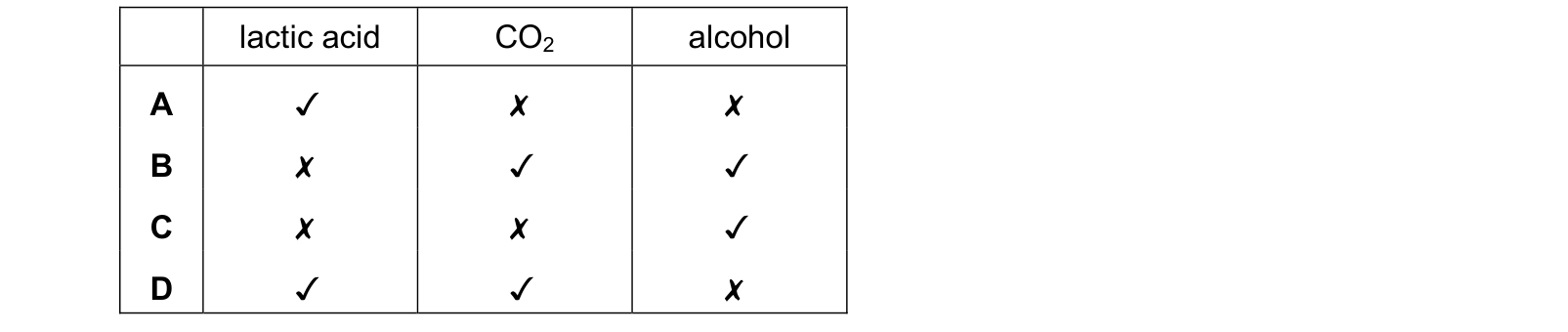
Which row shows the products of anaerobic respiration in yeast cells? lactic acid CO2 alcohol Use the source image for S20 Paper 23, question 8.
Answer: B.
Anaerobic respiration in yeast is fermentation, which breaks glucose down into ethanol and carbon dioxide, so the correct row ticks alcohol and carbon dioxide and leaves lactic acid unticked. Lactic acid is the product of anaerobic respiration in human muscle rather than in yeast, so every row that ticks it has borrowed the animal pathway. The row ticking lactic acid on its own gives the muscle product and misses both yeast products. The row ticking alcohol on its own forgets the carbon dioxide, which is the gas that makes bread dough rise. The row ticking lactic acid together with carbon dioxide mixes the two pathways and still leaves out the ethanol that makes yeast useful in brewing.
Question 4
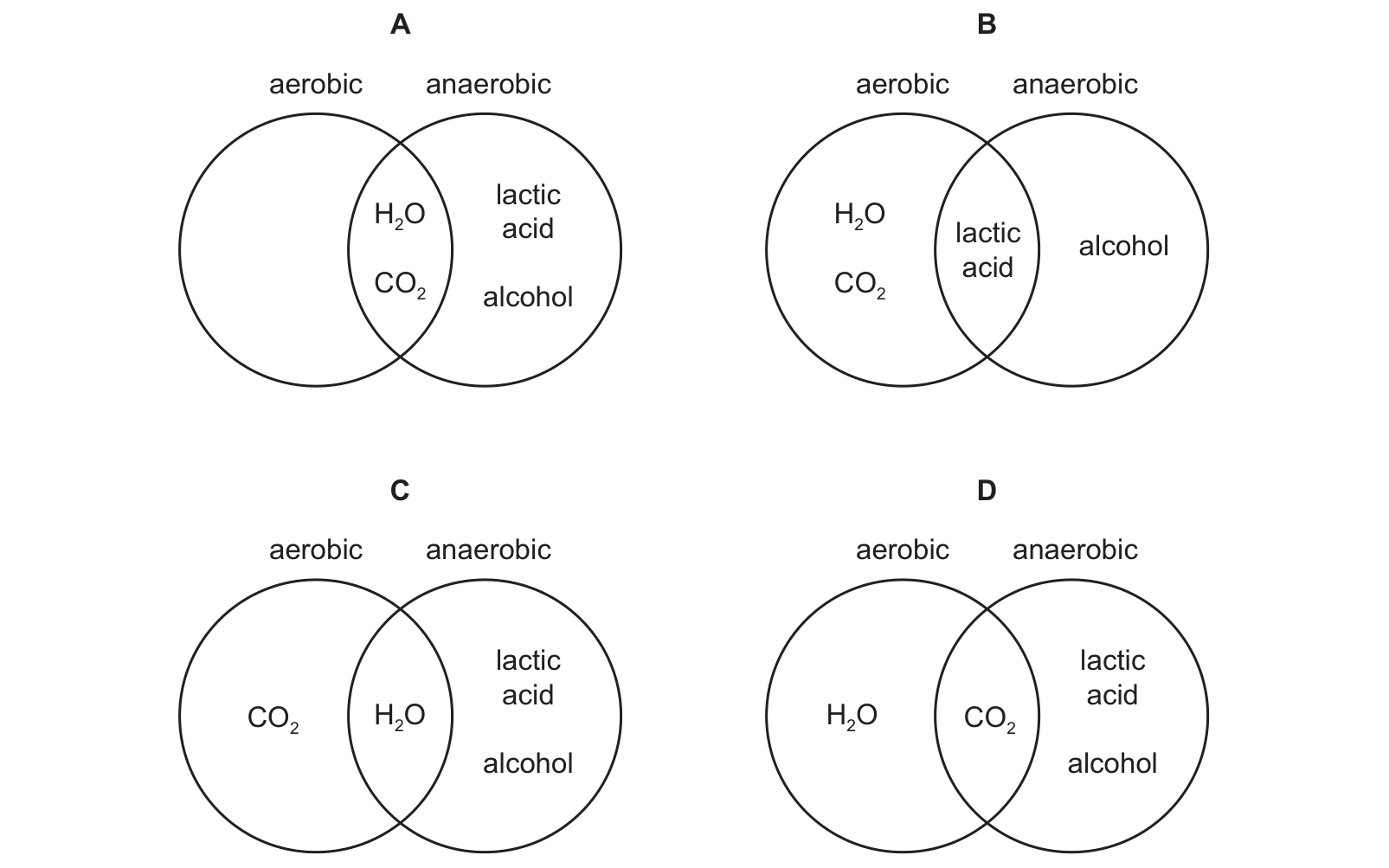
Which diagram gives the possible products of aerobic respiration and anaerobic respiration? Use the source image for W22 Paper 21, question 8.
Answer: D.
Aerobic respiration breaks glucose down fully using oxygen and releases carbon dioxide and water, while anaerobic respiration gives lactic acid in muscle and alcohol together with carbon dioxide in yeast. Carbon dioxide is therefore the one product shared by both routes, so it belongs in the overlap, with water in the aerobic circle alone and lactic acid and alcohol in the anaerobic circle alone. D is the only diagram arranged that way. C swaps the two gases over, putting water in the shared region, but no anaerobic pathway in this syllabus releases water, so water can never be shared. B places lactic acid in the overlap, which would mean aerobic respiration produces it, whereas lactic acid builds up only when the oxygen supply falls short of demand.
Question 5
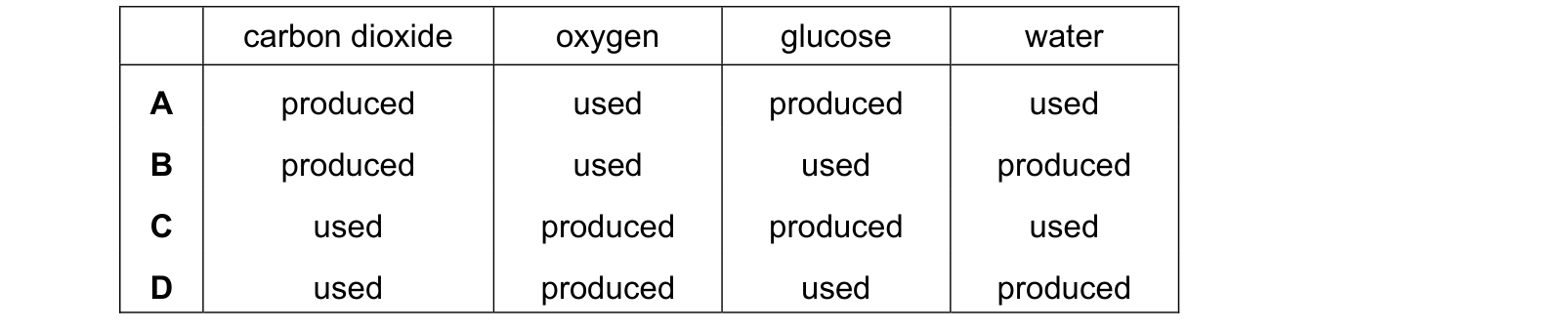
Which substances are used and produced in aerobic respiration? Each answer gives, in order: carbon dioxide; oxygen; glucose; water.
Answer: B.
Aerobic respiration is the oxidation of glucose by oxygen, summarised as glucose plus oxygen giving carbon dioxide plus water plus energy for the cell. Everything on the left of that equation is used up and everything on the right is made, so oxygen and glucose are used while carbon dioxide and water are produced. The tempting wrong row is the one where carbon dioxide is used and oxygen is produced, because that is the pattern for photosynthesis, which runs the same four substances in the opposite direction. A useful way to keep the two apart is that respiration happens in every living cell, day and night, whereas photosynthesis happens only in cells with chloroplasts and only in the light.
These questions are drawn from past CIE 0654 Co-ordinated Sciences papers and filtered to respiration. You answer, you find out immediately whether you were right, and you get the reasoning for the correct option and for each distractor. Wrong answers go to a mistakes locker so you can come back to exactly those.
Practice is free. You need an account only so your progress and your mistakes are still there next time.
These are the errors that cost marks on respiration, taken from our own topic notes. Read them before you practise and you will recognise the traps in the questions.
Saying respiration is breathing.
Saying plants respire only at night.
Writing the photosynthesis equation as the respiration equation, so that oxygen appears as a product.
Saying oxygen is the molecule that holds the energy released.
Writing glycogen or starch in the respiration equation instead of glucose.
Saying anaerobic respiration releases more energy because it is used in a hard sprint.
Saying anaerobic respiration in muscle produces alcohol, or that yeast produces lactic acid.
Saying the oxygen debt is the oxygen you failed to breathe in during the exercise, rather than the extra oxygen needed afterwards to clear the lactic acid.
Revise it first
If any of the above is unfamiliar, work through the notes before practising: Respiration revision notes.