46 past-paper questions on this unit. Five of them are below. Answer on the page: each one is marked the moment you pick, the correct option is shown whether or not you found it, and the full explanation opens either way.
CIE 0654 Co-ordinated SciencesPaper 1 and Paper 2 MCQsFree account
Electrochemistry: five questions to try now
Real past-paper questions, the answer key from the mark scheme, and the explanation that goes with it. No account needed to answer them.
Question 1
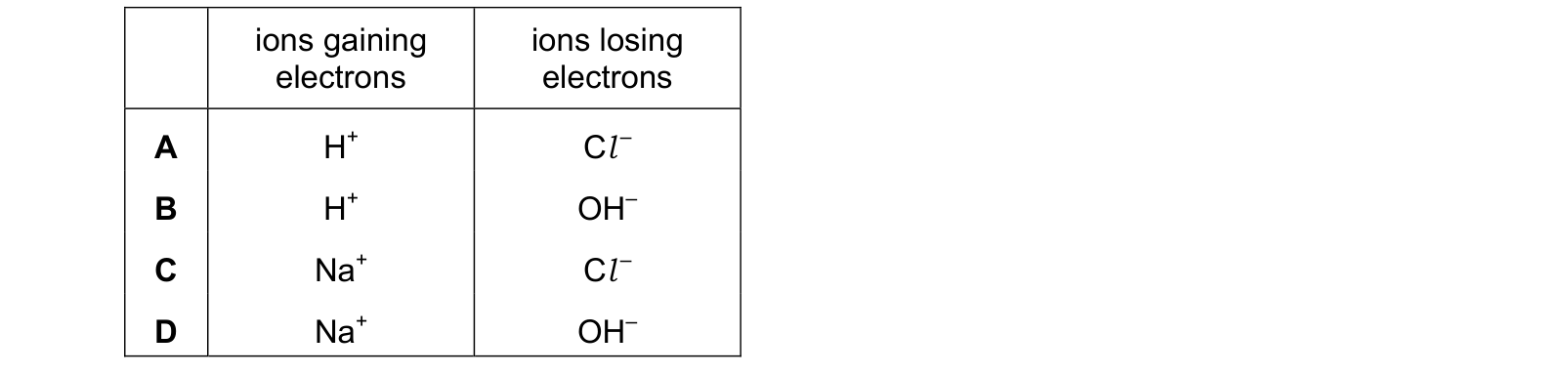
Which ions gain and lose electrons during the electrolysis of concentrated aqueous sodium chloride? Each answer gives, in order: ions gaining electrons; ions losing electrons.
Answer: A.
During electrolysis, ions gain electrons at the negative electrode and lose them at the positive electrode. In concentrated sodium chloride solution the water supplies hydrogen ions and hydroxide ions alongside the sodium and chloride ions, and at the negative electrode the hydrogen ions are discharged in preference to the sodium ions, because sodium is the more reactive metal and its ions hold on to their charge more strongly, so hydrogen gas bubbles off. At the positive electrode the chloride ions are discharged rather than the hydroxide ions, because the solution is concentrated in chloride, and chlorine gas is given off. The pairing of sodium ions with chloride ions is the tempting one, since those are the two ions the compound is made of, but this is an aqueous solution rather than a molten one, and it is only when molten sodium chloride is electrolysed that sodium metal is produced.
Question 2
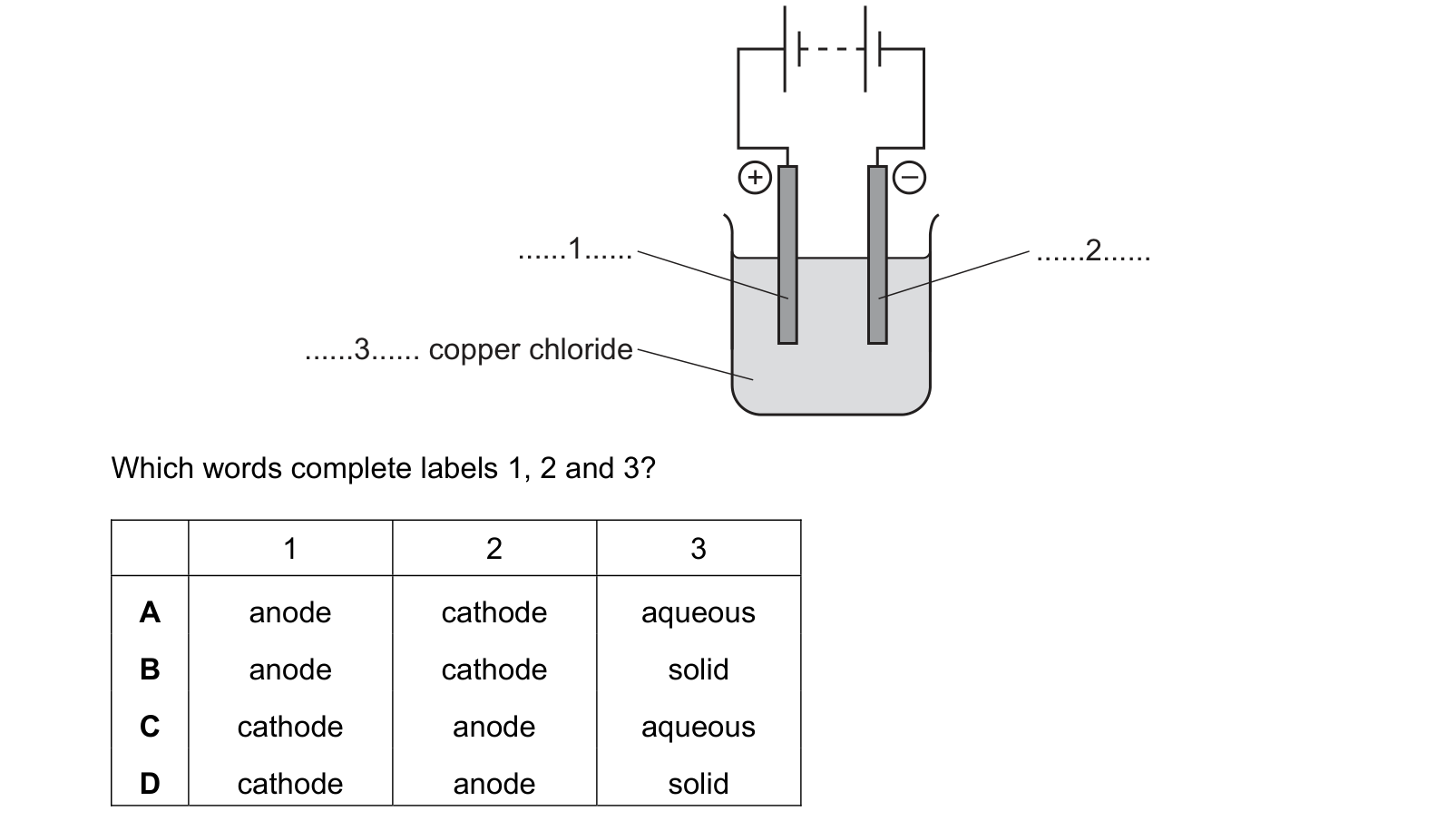
The apparatus used for the electrolysis of copper chloride is shown. Which words complete labels 1, 2 and 3? Use the source image for W23 Paper 13, question 18.
Answer: A.
The electrode wired to the positive terminal is the anode and the one wired to the negative terminal is the cathode, so label 1 is the anode and label 2 is the cathode. The beaker is filled with a liquid and the compound must be free to move its ions, which happens once copper chloride is dissolved in water, so label 3 is aqueous and A is correct. C and D swap the two electrodes, ignoring the plus and minus signs drawn beside them. B and D call the copper chloride solid, yet a solid ionic compound holds its ions locked in a lattice, so no current could flow and no electrolysis could take place.
Question 3
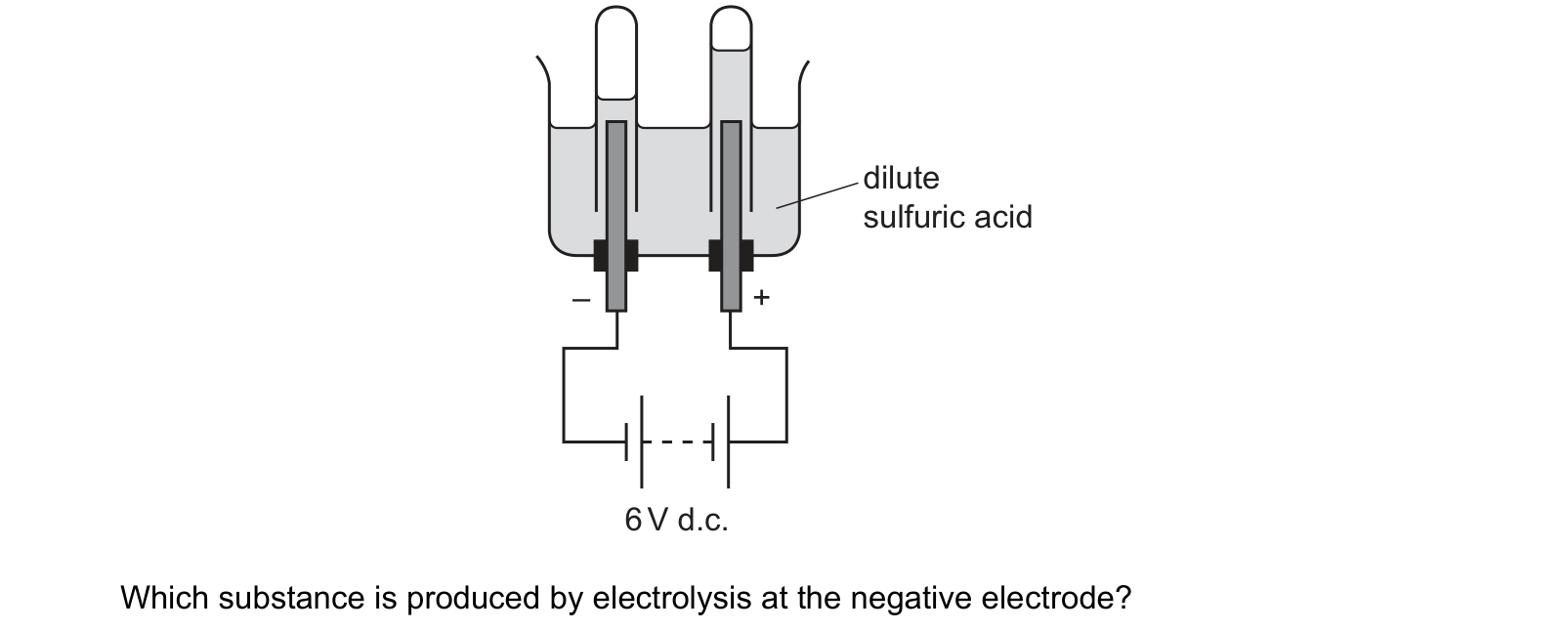
The diagram shows the electrolysis of dilute sulfuric acid using inert electrodes. Which substance is produced by electrolysis at the negative electrode?
Answer: A.
The cathode is the negative electrode, so it attracts positive ions, and the only positive ion in dilute sulfuric acid is the hydrogen ion, which gains an electron there and forms hydrogen gas. A is therefore correct, and the gas collecting over the cathode would burn with a squeaky pop. B, oxygen, is the product at the anode, where negative ions are discharged and water molecules lose electrons. C, sulfur dioxide, would need the sulfur to be reduced under conditions this cell never provides, so the sulfate ions simply stay in solution. D, water vapour, is not an electrolysis product at all, since water here is the solvent being decomposed rather than something made.
Question 4
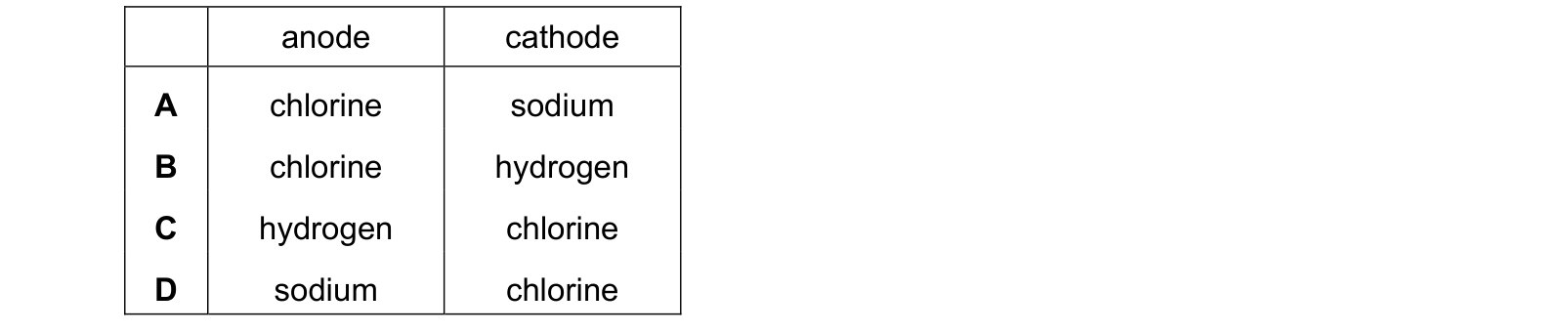
Which elements are formed at the electrodes during the electrolysis of concentrated aqueous sodium chloride? Each answer gives, in order: anode; cathode.
Answer: B.
Negative ions travel to the positive electrode and positive ions to the negative electrode, so chloride ions are discharged at the anode to give chlorine gas, and at the cathode a positive ion is discharged to give hydrogen. The row naming chlorine and sodium is the tempting one, because those are the two elements the compound is made of and it seems only fair that both should appear, but the solution also contains hydrogen ions from the water, and sodium is a more reactive metal than hydrogen, so it is the hydrogen ions that are discharged and the sodium ions that stay in solution. Sodium is only obtained by electrolysing sodium chloride when it is molten, with no water present to offer an alternative. Any row putting hydrogen at the anode has the charges the wrong way round, since a positive electrode cannot attract a positive ion.
Question 5
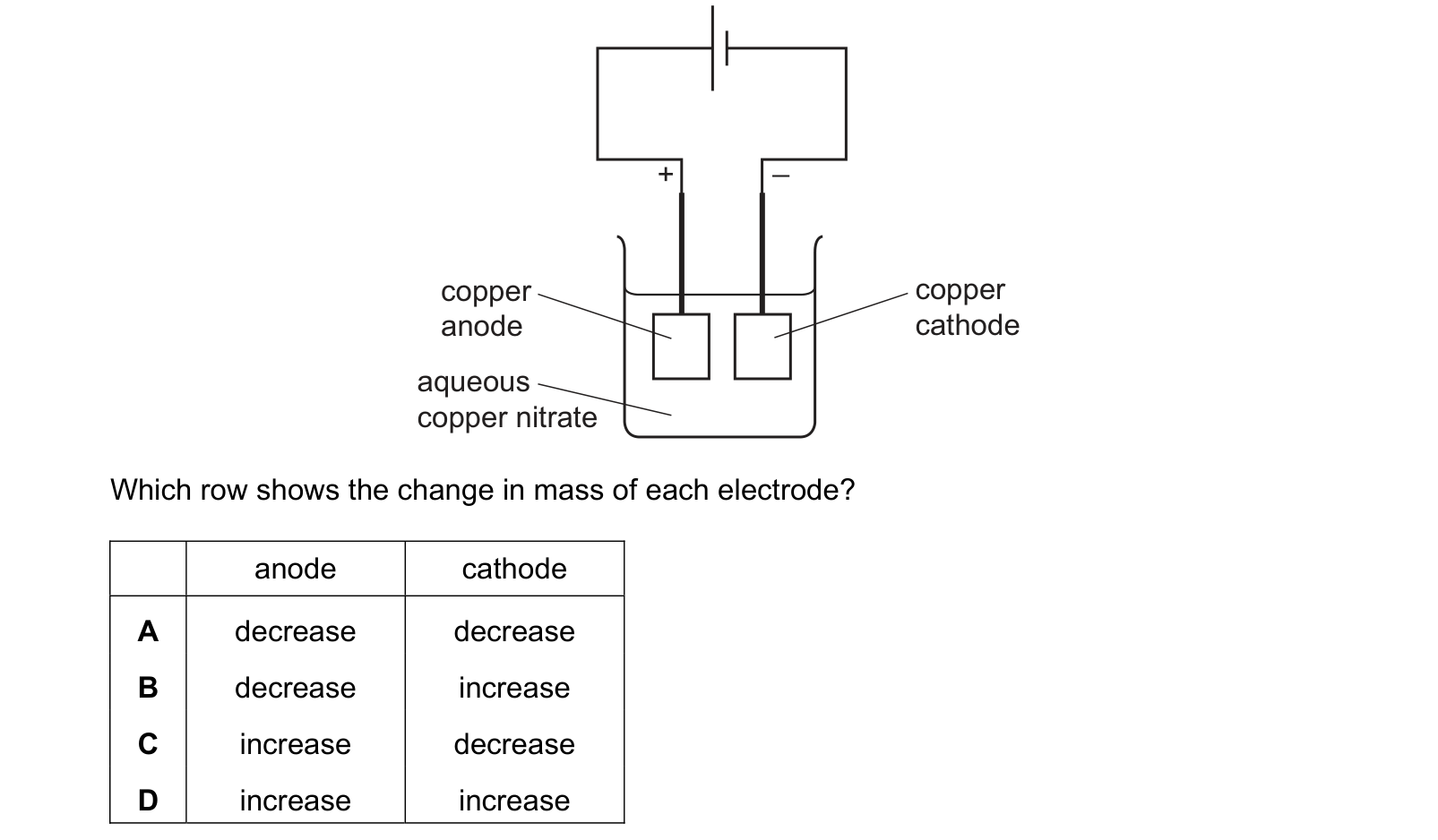
The diagram shows an electroplating experiment. Which row shows the change in mass of each electrode? Each answer gives, in order: anode; cathode.
Answer: B.
In electroplating with a copper anode standing in copper nitrate solution, the anode is the positive electrode, so copper atoms there lose electrons and dissolve as copper ions, and the anode loses mass. Those ions travel to the negative cathode, gain electrons and are deposited as a layer of copper, so the cathode gains mass, which is B. C reverses the two, and the giveaway is that a metal is always deposited at the negative electrode, since metal ions are positive. A and D change both electrodes in the same direction, yet the copper leaving the anode is precisely the copper arriving at the cathode, so one must fall while the other rises and the solution keeps its concentration.
These questions are drawn from past CIE 0654 Co-ordinated Sciences papers and filtered to electrochemistry. You answer, you find out immediately whether you were right, and you get the reasoning for the correct option and for each distractor. Wrong answers go to a mistakes locker so you can come back to exactly those.
Practice is free. You need an account only so your progress and your mistakes are still there next time.
These are the errors that cost marks on electrochemistry, taken from our own topic notes. Read them before you practise and you will recognise the traps in the questions.
Saying oxidation happens at the cathode.
Saying the anode is negative.
Saying anions are oxidised by gaining electrons. Oxidation is losing electrons.
Saying oxygen is produced at the negative electrode.
Putting the metal at the anode, when metal ions are positive and are repelled by a positive electrode.
Saying electrons travel through the electrolyte.
Applying the molten rule to a solution, so that sodium appears at the cathode from sodium chloride solution.
Forgetting that a dilute chloride solution gives oxygen rather than chlorine.