21 past-paper questions on this unit. Five of them are below. Answer on the page: each one is marked the moment you pick, the correct option is shown whether or not you found it, and the full explanation opens either way.
CIE 0654 Co-ordinated SciencesPaper 1 and Paper 2 MCQsFree account
Human influences on ecosystems: five questions to try now
Real past-paper questions, the answer key from the mark scheme, and the explanation that goes with it. No account needed to answer them.
Question 1
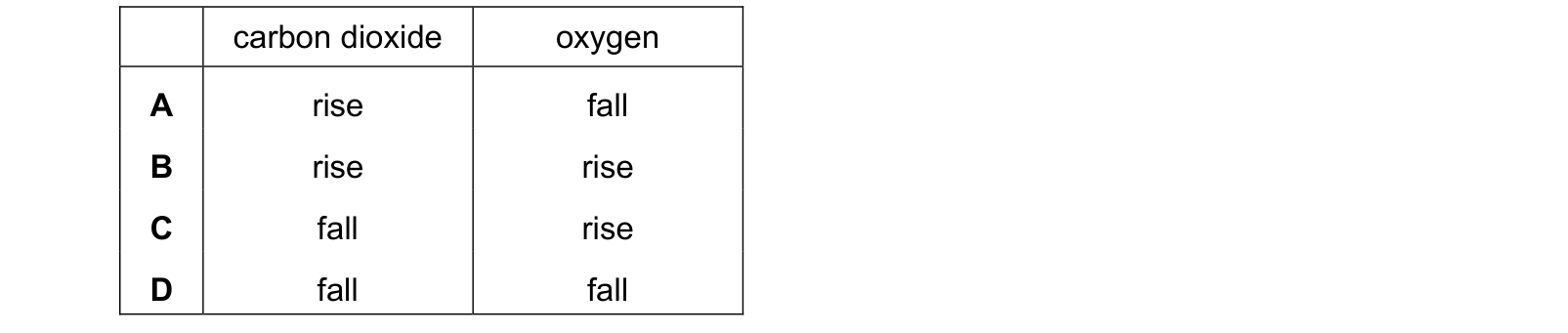
How does deforestation change the concentrations of carbon dioxide and oxygen in the atmosphere? Each answer gives, in order: carbon dioxide; oxygen.
Answer: A.
Photosynthesis takes carbon dioxide out of the air and puts oxygen back, so forests are the main route by which those two gases are exchanged in opposite directions. Clearing large areas of forest therefore slows the uptake of carbon dioxide and slows the release of oxygen at the same time, so carbon dioxide rises while oxygen falls, and burning the felled timber pushes carbon dioxide higher still. The row with both gases rising is the tempting one, because the link between deforestation and rising carbon dioxide is well known and it is easy to stop thinking there, but the same reaction that removes carbon dioxide is the one that produces the oxygen, so these two gases must move in opposite directions. Any row showing carbon dioxide falling reverses the effect entirely, since fewer photosynthesising trees can only mean less carbon dioxide removed.
Question 2
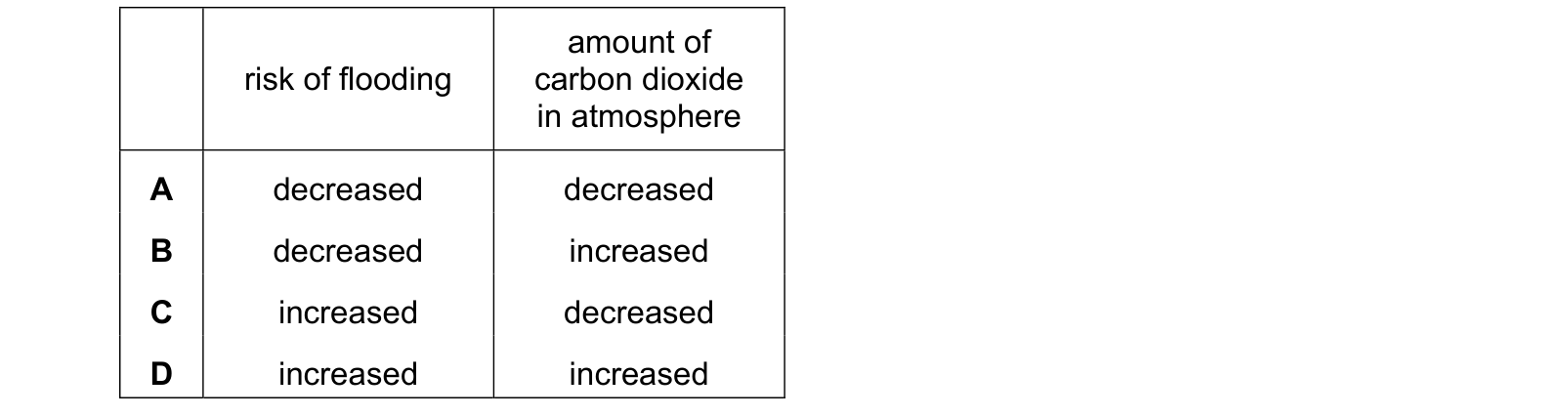
Which row about the effects of deforestation is correct? Each answer gives, in order: risk of flooding; amount of carbon dioxide in atmosphere.
Answer: D.
Tree roots hold the soil open and take up ground water while the canopy intercepts rain before it lands, so felling the trees leaves bare compacted soil where rain runs straight off the surface, and the risk of flooding goes up. At the same time the trees that were removing carbon dioxide by photosynthesis are gone, and the carbon stored in their wood returns to the air as the timber is burnt or left to rot, so atmospheric carbon dioxide goes up as well. Both quantities therefore increase, and any row showing either of them decreasing has to be rejected. The row giving decreased flooding is tempting if you picture the trees only as things that soak up rain and so imagine the cleared land draining faster, but losing that uptake is exactly what sends the water into the rivers instead.
Question 3
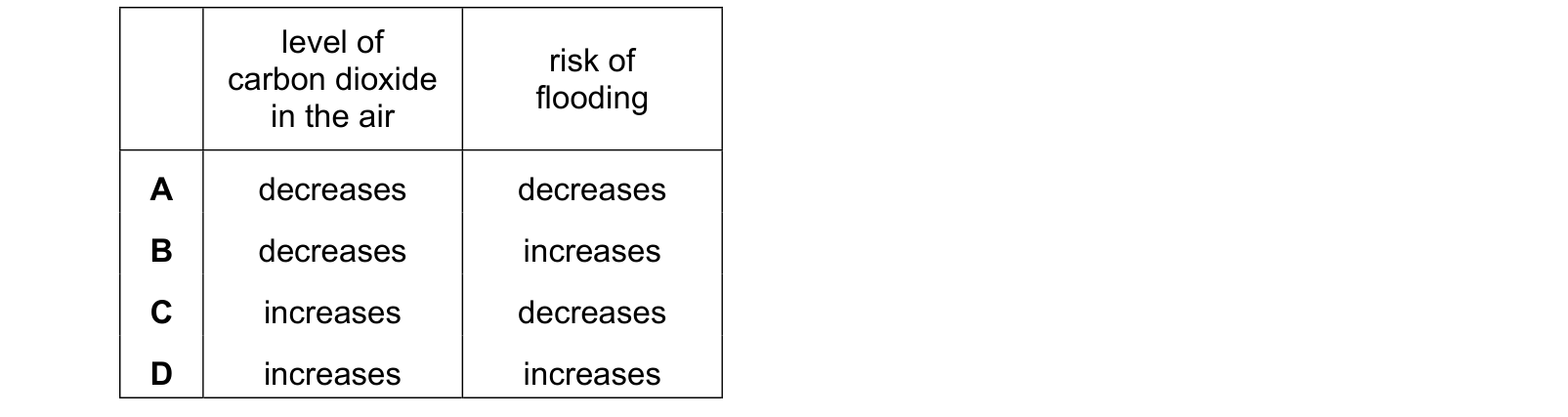
Which row describes the effects of deforestation? Each answer gives, in order: level of carbon dioxide in the air; risk of flooding.
Answer: D.
Trees take carbon dioxide out of the air by photosynthesis and store the carbon in their wood, so felling them removes that uptake and burning or rotting the timber returns the stored carbon to the atmosphere, which sends the carbon dioxide level up. The same clearance leaves bare soil where roots no longer hold the ground open and no canopy intercepts the rain, so water runs straight off the surface into the rivers and the risk of flooding goes up as well. Both effects therefore point the same way, and any row showing one of them falling can be rejected. The row giving a decreased flooding risk is the tempting one if you think of trees merely as things that drink water, but it is the loss of that uptake, along with the loss of the roots that keep the soil open, that puts the water into the rivers instead.
Question 4
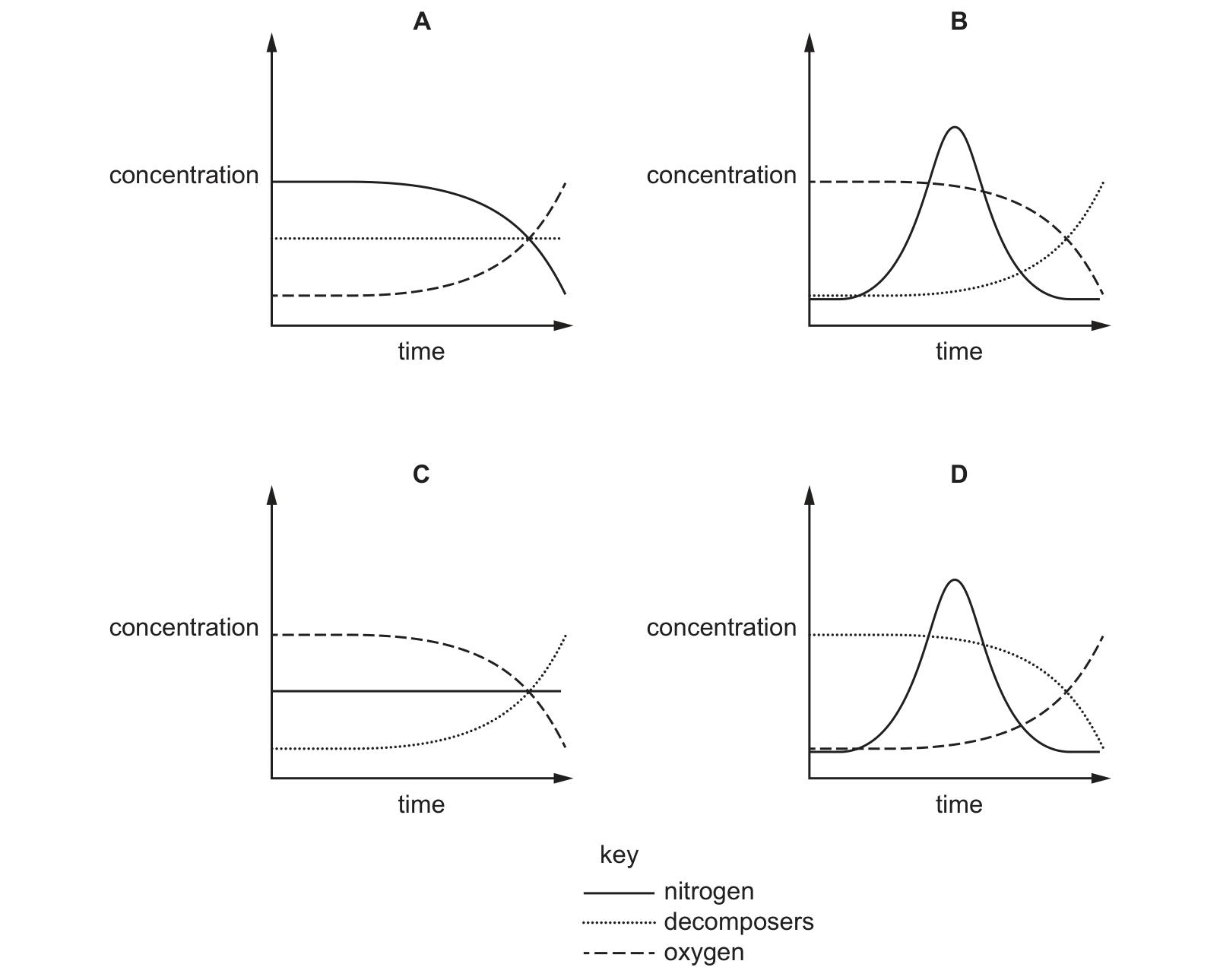
Which graph represents a pollution incident in a lake causing eutrophication? Use the source image for W24 Paper 22, question 13.
Answer: B.
Eutrophication begins when fertiliser rich in nitrate washes into the water, so the nitrogen concentration is the first line to rise, and it falls again as algae take the nitrate up. The algal bloom then blocks the light, the plants beneath die, and decomposer bacteria multiply on the dead material, so the decomposer line climbs later, and their respiration strips the dissolved oxygen, so the oxygen line falls last of all. B is the only graph with that order, a nitrogen spike, then rising decomposers, then falling oxygen. D reverses the last two lines, with decomposers falling while oxygen rises, which would mean the bacteria died back and the water recovered by itself. In A the nitrogen line merely falls from a high start and in C it never changes, so neither marks the sudden input of nutrients that starts the sequence.
Question 5
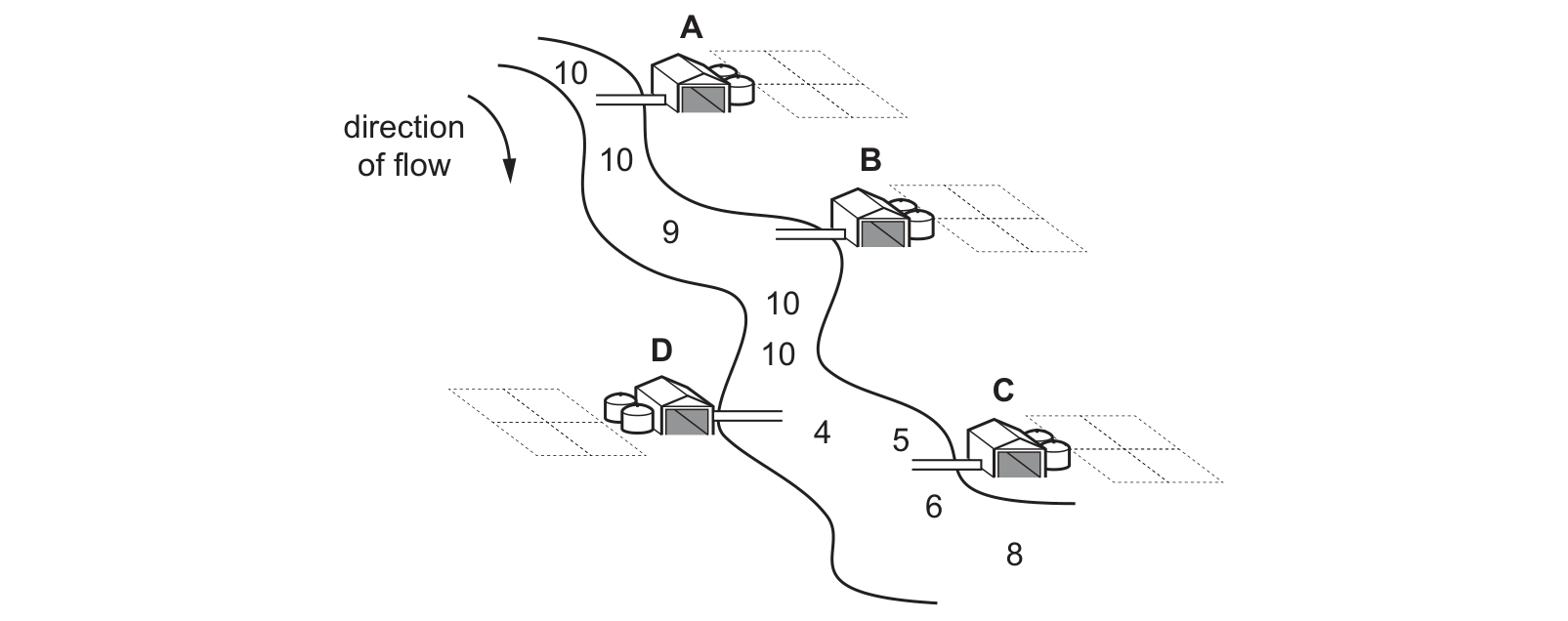
The diagram shows a river and four farms. The numbers in the river show relative oxygen concentrations. From which farm is untreated sewage leaking into the river? Use the source image for W20 Paper 11, question 13.
Answer: D.
Untreated sewage feeds bacteria whose aerobic respiration strips dissolved oxygen out of the water, so the leak is found where the oxygen reading falls sharply as the river flows by one of the farms. The water arrives at 10 and still reads 10 and 9 below the first farm, and 10 both above and below the second, so neither of those is adding anything. Immediately below the farm labelled D the value drops from 10 to 4, which is the sudden loss that sewage causes, so D is the source. Downstream the readings climb back through 5, 6 and 8 as oxygen dissolves in from the air and the bacteria run short of food, so the farm standing beside those rising numbers is receiving polluted water rather than causing the pollution.
These questions are drawn from past CIE 0654 Co-ordinated Sciences papers and filtered to human influences on ecosystems. You answer, you find out immediately whether you were right, and you get the reasoning for the correct option and for each distractor. Wrong answers go to a mistakes locker so you can come back to exactly those.
Practice is free. You need an account only so your progress and your mistakes are still there next time.
These are the errors that cost marks on human influences on ecosystems, taken from our own topic notes. Read them before you practise and you will recognise the traps in the questions.
Pairing deforestation with acid rain, or with eutrophication.
Saying deforestation lowers carbon dioxide because fewer trees respire.
Saying deforestation raises both carbon dioxide and oxygen.
Giving "provides land for farming" as an undesirable effect of deforestation.
Saying eutrophication poisons the fish, rather than removing their oxygen.
Saying the algae themselves use up the oxygen. The decomposers do, as they break the dead algae down.
Blaming warming on the greenhouse effect existing, rather than on its enhancement.
Saying carbon dioxide causes acid rain. Sulfur dioxide and oxides of nitrogen do.