48 past-paper questions on this unit. Five of them are below. Answer on the page: each one is marked the moment you pick, the correct option is shown whether or not you found it, and the full explanation opens either way.
CIE 0654 Co-ordinated SciencesPaper 1 and Paper 2 MCQsFree account
Human nutrition: five questions to try now
Real past-paper questions, the answer key from the mark scheme, and the explanation that goes with it. No account needed to answer them.
Question 1
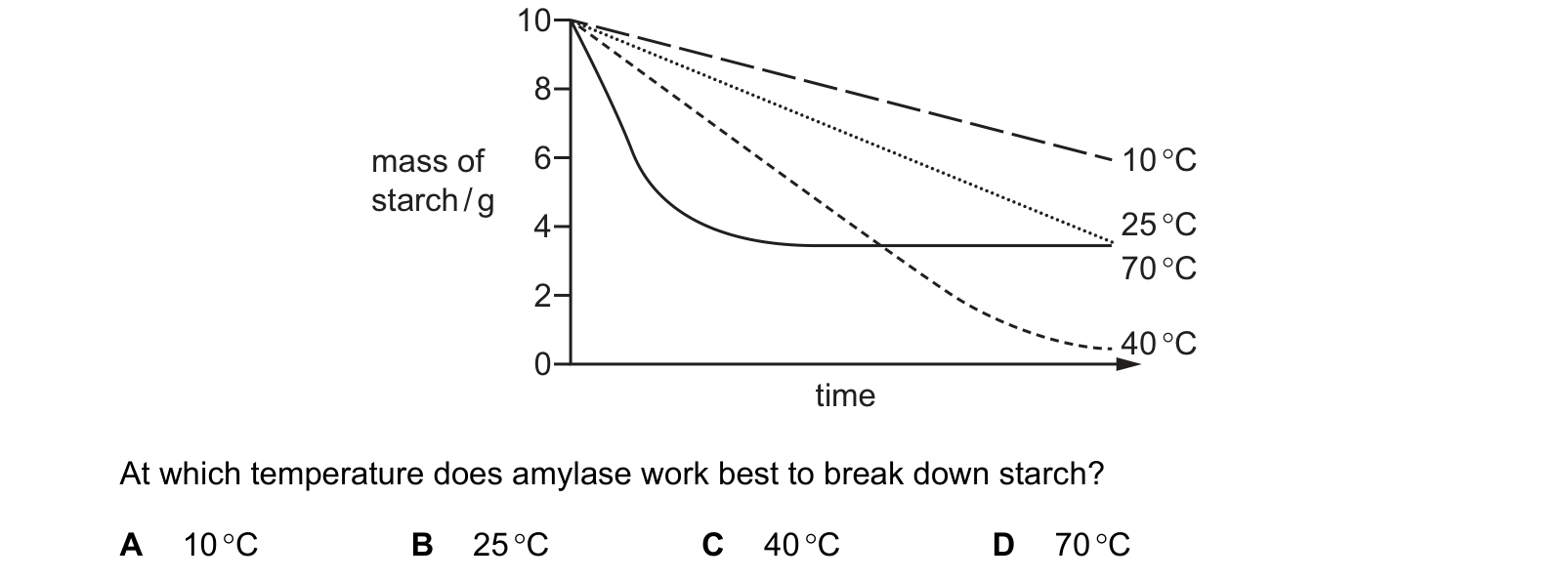
The graph shows the rate at which 10 g of starch is broken down by amylase at four different temperatures. At which temperature does amylase work best to break down starch?
Answer: C.
An enzyme works best at the temperature where it breaks its substrate down completely and quickest, so the line to pick is the one that reaches the bottom of the mass axis. The curve for 40 degrees C is the only one that falls all the way to zero starch, which is what amylase at its optimum does. 70 degrees C is the designed trap, because that line drops most steeply at the very start, but it then flattens at about 3.5 g of starch and never falls again, which is the signature of an enzyme denatured by heat before the job was finished. The line for 25 degrees C is still falling at the end and has removed no more starch than the denatured sample, and the line for 10 degrees C is the shallowest of all, because cold molecules move slowly and collisions between amylase and starch are rare.
Question 2
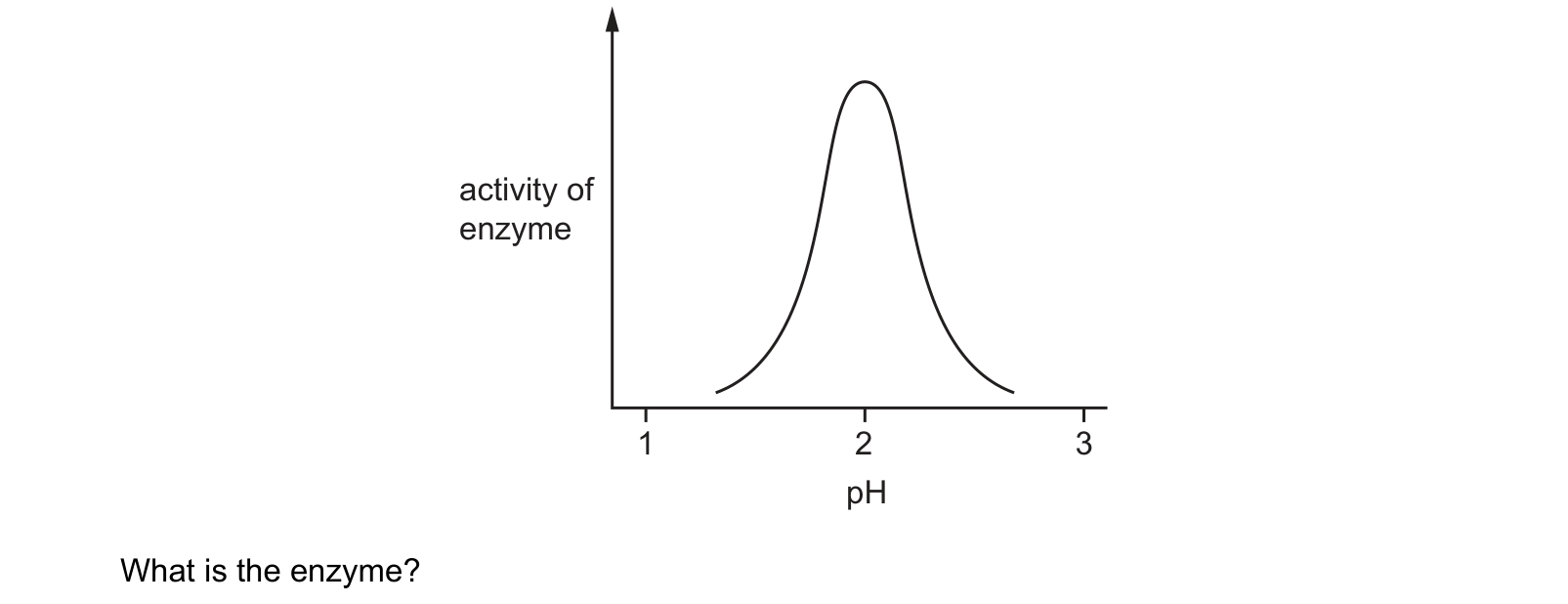
An investigation was carried out to see the effect of pH on the activity of an enzyme found in the human alimentary canal. The graph shows the results obtained. pH What is the enzyme?
Answer: B.
The curve peaks at about pH 2, so this enzyme works best in strongly acidic conditions, and the only strongly acidic part of the alimentary canal is the stomach, where hydrochloric acid is secreted. The enzyme acting on food there is a protease, which digests protein, so the graph belongs to a protease found in the stomach. The two options placing the enzyme in the mouth are ruled out by the pH, since saliva is close to neutral at about pH 7 and an enzyme peaking at pH 2 would do nothing there. Amylase in the stomach fails for the opposite reason, because salivary amylase is destroyed by stomach acid and the stomach secretes protease rather than amylase, so no amylase has its optimum at pH 2.
Question 3
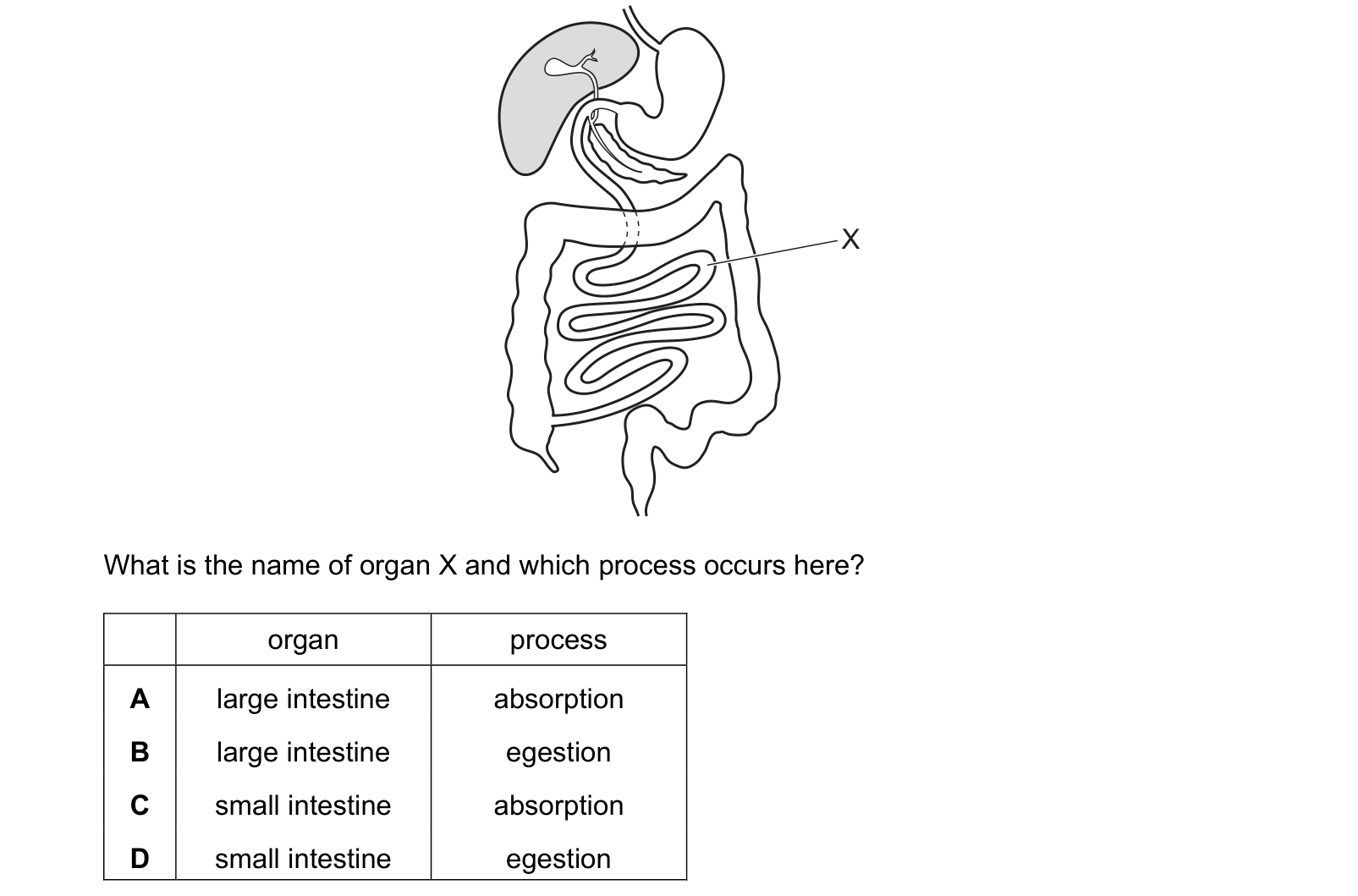
The diagram shows the human alimentary canal. What is the name of organ X and which process occurs here? Each answer gives, in order: organ; process.
Answer: C.
X points to the tightly coiled tube in the middle of the abdomen, which is the small intestine, while the large intestine is the wider tube framing it around the outside. The small intestine is where digestion is completed and where the small soluble products pass through the villi into the blood, so the process there is absorption. The two rows naming the large intestine pick the outer frame rather than the coils the label actually touches, and although the large intestine does absorb water, it is not the organ marked. Egestion is the passing out of undigested material at the anus, which happens at the very end of the gut rather than in the coils of the small intestine.
Question 4
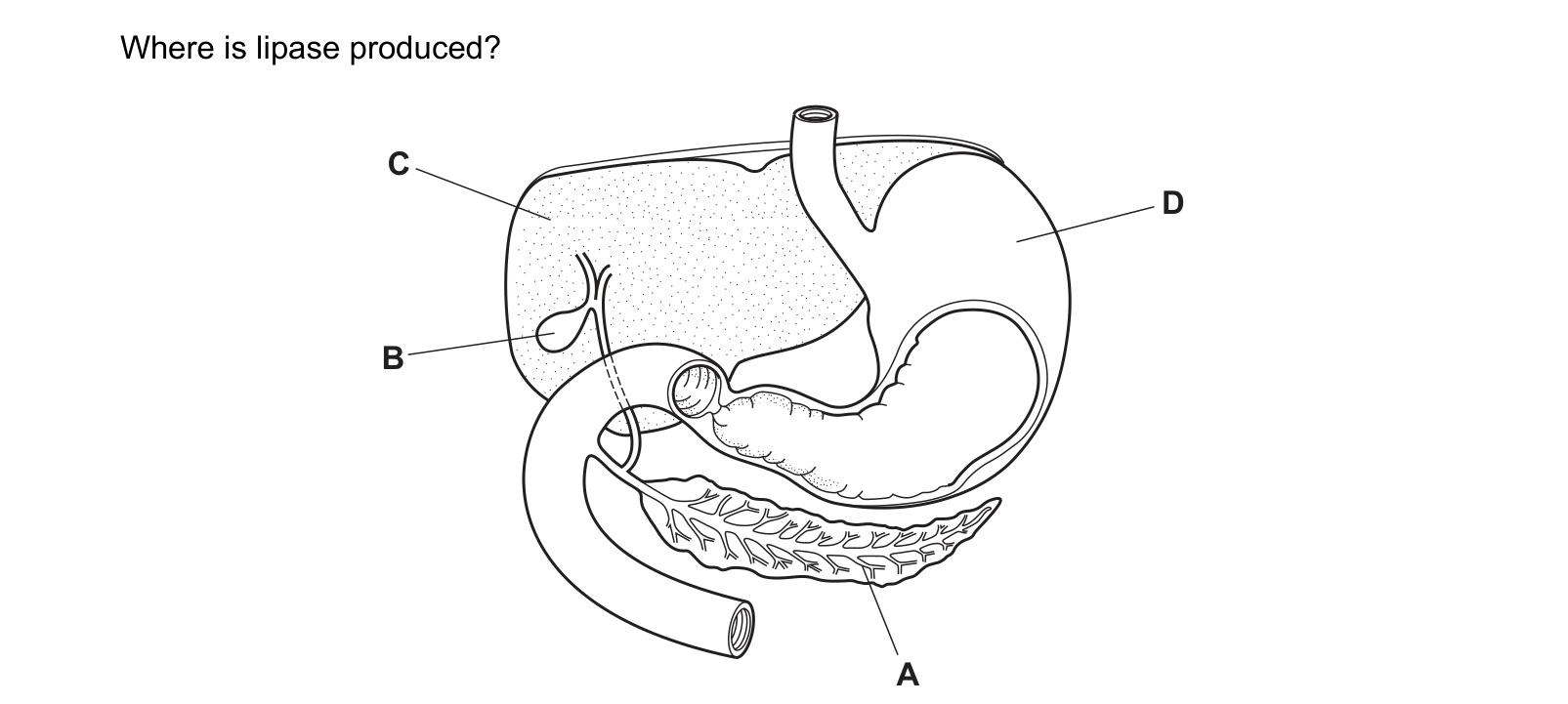
The diagram shows part of the alimentary canal and associated organs. Where is lipase produced? Use the source image for M21 Paper 22, question 6.
Answer: A.
Lipase is the fat-digesting enzyme secreted by the pancreas into the duodenum, so the label on the long frilly organ lying below the stomach and emptying into the first bend of the small intestine is the one to take. The large stippled organ on the left is the liver, and although the liver acts on fats it produces bile, which emulsifies fat into small droplets rather than breaking it down chemically, so no enzyme is made there. The small sac tucked underneath the liver is the gall bladder, which only stores that bile until a fatty meal arrives, and storing a secretion is not producing an enzyme. The wide curved bag on the right is the stomach, whose protease and hydrochloric acid work on protein rather than on fat.
Question 5
The condition kwashiorkor is characterised by a poor growth rate, swelling of the hands and feet, and a bulging stomach. Which component of a balanced diet is lacking in someone with kwashiorkor?
Answer: B.
Kwashiorkor is the form of severe malnutrition caused by too little protein in the diet, even when the energy supplied by carbohydrate is adequate. Protein is needed to build the plasma proteins that hold water in the blood, so when it runs short, fluid collects in the tissues and produces the swollen hands and feet and the distended abdomen described. Protein also supplies the amino acids for growth and repair, which is why the growth rate is poor. C, iron, is the mineral needed for haemoglobin, and a shortage of it causes anaemia with tiredness and pallor rather than swelling. D, vitamin D, controls calcium absorption, so a shortage softens the bones and causes rickets, while too little fibre causes constipation.
These questions are drawn from past CIE 0654 Co-ordinated Sciences papers and filtered to human nutrition. You answer, you find out immediately whether you were right, and you get the reasoning for the correct option and for each distractor. Wrong answers go to a mistakes locker so you can come back to exactly those.
Practice is free. You need an account only so your progress and your mistakes are still there next time.
These are the errors that cost marks on human nutrition, taken from our own topic notes. Read them before you practise and you will recognise the traps in the questions.
Saying bile is an enzyme, or that it digests fat.
Saying emulsification breaks fat into fatty acids.
Saying the stomach is alkaline.
Confusing absorption with digestion, or with assimilation.
Saying water is absorbed in the small intestine only. Most is, but the large intestine absorbs the rest.
Saying fibre is digested for energy.
Listing villi as an adaptation without saying they increase surface area.