88 past-paper questions on this unit. Five of them are below. Answer on the page: each one is marked the moment you pick, the correct option is shown whether or not you found it, and the full explanation opens either way.
CIE 0654 Co-ordinated SciencesPaper 1 and Paper 2 MCQsFree account
Chemical reactions: five questions to try now
Real past-paper questions, the answer key from the mark scheme, and the explanation that goes with it. No account needed to answer them.
Question 1
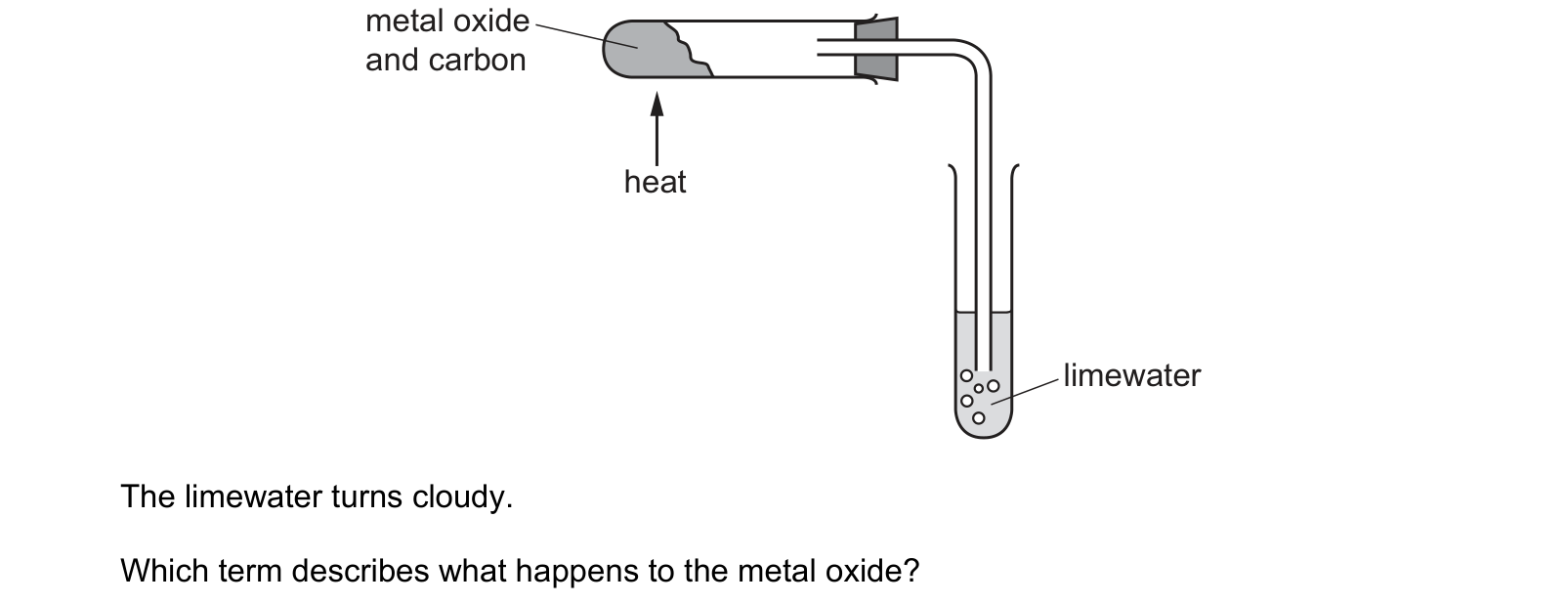
To extract a metal from its ore, a metal oxide is mixed with carbon and heated as shown. The limewater turns cloudy. Which term describes what happens to the metal oxide?
Answer: D.
The limewater turning cloudy shows that carbon dioxide is leaving the tube, so the carbon has taken the oxygen from the metal oxide and become carbon dioxide, leaving the metal behind. Loss of oxygen is reduction, so the metal oxide is reduced and D is correct. C, oxidation, is what happens to the carbon, which gains the oxygen, so it names the wrong half of the same reaction. A, combustion, means burning in a supply of oxygen from the air, whereas here the oxygen comes out of the compound inside a heated tube. B, neutralisation, describes an acid reacting with a base to give a salt and water, and nothing of that kind happens here.
Question 2
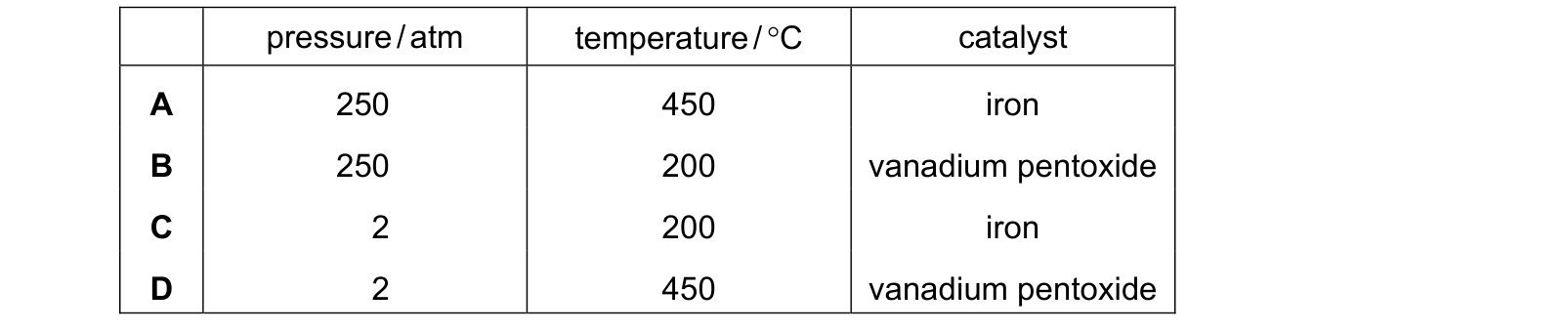
Which row shows the conditions used for making ammonia by the Haber process? Each answer gives, in order: pressure / atm; temperature / °C; catalyst.
Answer: A.
The Haber process combines nitrogen and hydrogen over an iron catalyst at about 450 degrees C and around 250 atmospheres. The high pressure is the deliberate part: four molecules of gas on the left become two on the right, so squeezing the mixture pushes the equilibrium towards ammonia, and the cost of building a pressurised plant is worth paying for the extra yield. The row giving iron with a pressure of only 2 atmospheres is the tempting one, because it names the right catalyst, but 2 atmospheres belongs to the Contact process, where the yield is already high enough that pressurising the plant would be wasted money. Any row naming vanadium pentoxide has borrowed the Contact process catalyst as well, so it is wrong on the same grounds.
Question 3
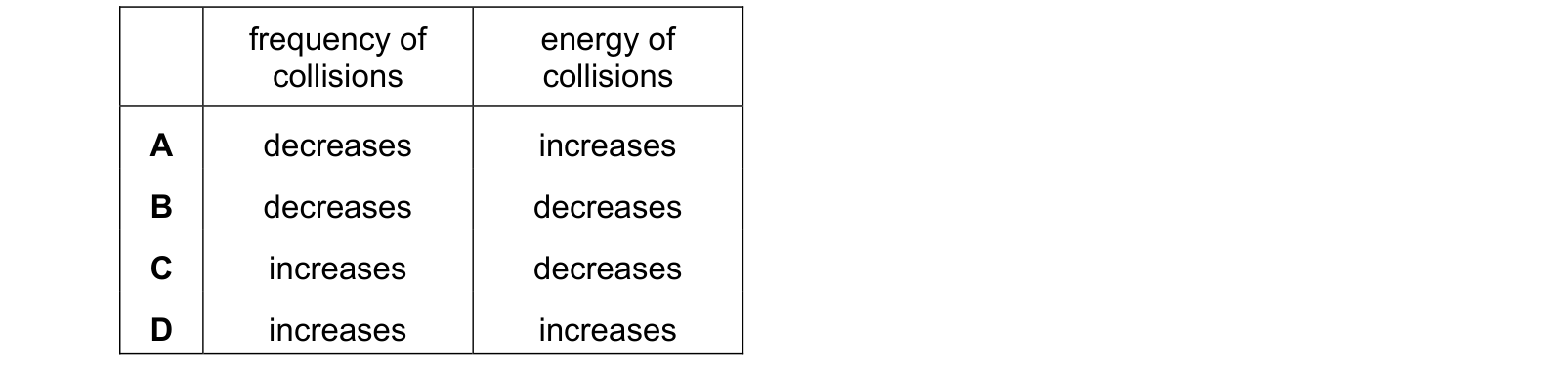
Which row describes the effect of increasing temperature on the collisions between particles in a chemical reaction? Each answer gives, in order: frequency of collisions; energy of collisions.
Answer: D.
Raising the temperature increases the average kinetic energy of the particles, so they move faster, and that has two separate consequences. Moving faster, they cover the space between collisions more quickly, so collisions happen more often, and each collision also involves more energy, so a greater fraction of them exceeds the activation energy. Both effects therefore increase, which is why a modest temperature rise can change a reaction rate dramatically. A and B both have the frequency falling, which would describe cooling, and C keeps the frequency rising while making the collisions gentler, but the same increase in particle speed is responsible for both changes and cannot raise one while lowering the other.
Question 4
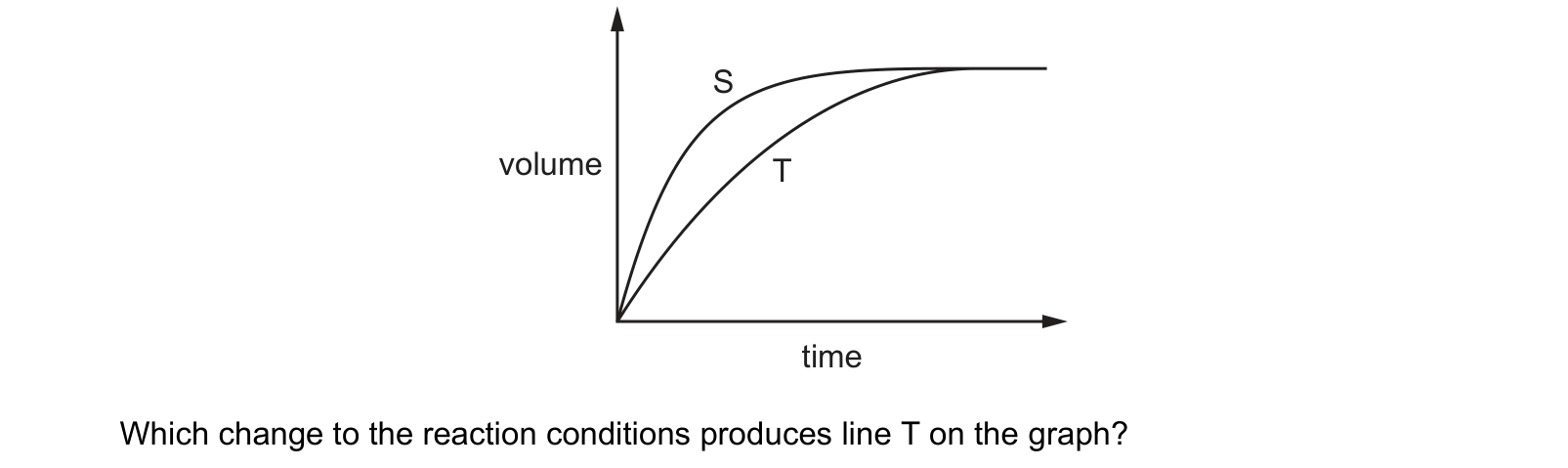
A fixed mass of a solid is reacted with a liquid. The volume of gas given off from the reaction over time is shown by line S. Which change to the reaction conditions produces line T on the graph?
Answer: C.
Line T climbs more slowly than S but levels off at the same height, so the change has to slow the reaction down without altering how much gas is produced in total. Increasing the particle size of the solid does exactly that, because larger lumps expose less surface area for the same fixed mass, so the liquid meets the solid less frequently, while the quantity of solid available to react is unchanged. Increasing the temperature is the tempting distractor, since it is the first change most students reach for, but it makes particles collide more often and with more energy, which draws a steeper curve reaching the same plateau sooner and so sits to the left of S. Adding more catalyst speeds the reaction up in the same way and never changes the final yield, so it too would climb above S rather than below it. Increasing the concentration of the liquid also raises how often the particles meet and steepens the curve, so every option except the particle size one moves the graph the wrong way.
Question 5
A chemical reaction produces a gas. The volume of gas given off over time is measured. The results are shown. time / volume of gas / cm³ During which time period is the rate of reaction greatest?
Answer: A.
Rate of reaction is how much product forms per unit time, so it is the size of the jump in volume across each interval rather than the height the volume has reached. The gas volumes rise by 27, 21, 15, 14, 9, 3 and then 1 cubic centimetre across successive 10 second intervals, so the largest jump, and therefore the greatest rate, is in the first 10 seconds. The interval from 60 to 70 seconds is the tempting choice, because by then the volume of gas collected is at its highest, but only 1 cubic centimetre is produced during it, and the flat readings at 70 and 80 seconds show the reaction has effectively stopped. The rate is greatest at the start because that is when the acid is most concentrated and the metal surface is largest, and it falls steadily as the reactants are used up.
These questions are drawn from past CIE 0654 Co-ordinated Sciences papers and filtered to chemical reactions. You answer, you find out immediately whether you were right, and you get the reasoning for the correct option and for each distractor. Wrong answers go to a mistakes locker so you can come back to exactly those.
Practice is free. You need an account only so your progress and your mistakes are still there next time.
These are the errors that cost marks on chemical reactions, taken from our own topic notes. Read them before you practise and you will recognise the traps in the questions.
Saying a catalyst increases the amount of product.
Saying higher temperature works only because particles collide more often, and missing the energy of the collisions.
Confusing a steeper curve with a higher final level on a rate graph.
Saying dissolving is a chemical change.
Getting OIL RIG backwards.
Saying an exothermic reaction takes in heat because it feels hot.
Saying that at equilibrium the reactions have stopped, or that the quantities are equal.