63 past-paper questions on this unit. Five of them are below. Answer on the page: each one is marked the moment you pick, the correct option is shown whether or not you found it, and the full explanation opens either way.
CIE 0654 Co-ordinated SciencesPaper 1 and Paper 2 MCQsFree account
Thermal physics: five questions to try now
Real past-paper questions, the answer key from the mark scheme, and the explanation that goes with it. No account needed to answer them.
Question 1
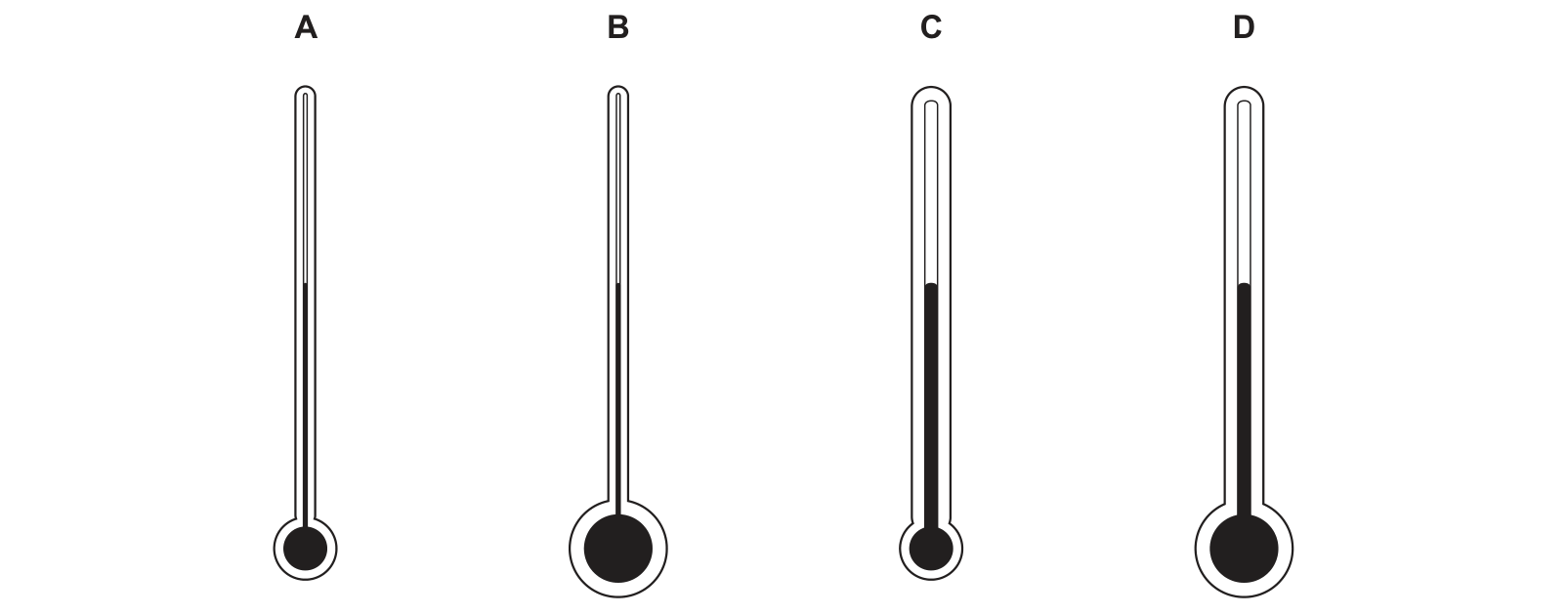
The diagrams show four liquid-in-glass thermometers, all drawn to the same scale. Which thermometer has the greatest sensitivity? Use the source image for W21 Paper 22, question 34.
Answer: B.
A liquid-in-glass thermometer is more sensitive when a given temperature change moves the liquid further along the stem. That happens when the bulb holds a large volume of liquid, so that a small temperature rise expands a lot of liquid, and when the tube is very narrow, so that the extra volume has to travel a long way to be accommodated. The thermometer combining the largest bulb with the narrowest bore is therefore the most sensitive. A thermometer with a small bulb has little liquid to expand, and one with a wide bore swallows the expansion with only a small movement of the thread, so either feature on its own limits the sensitivity whatever the other is like.
Question 2
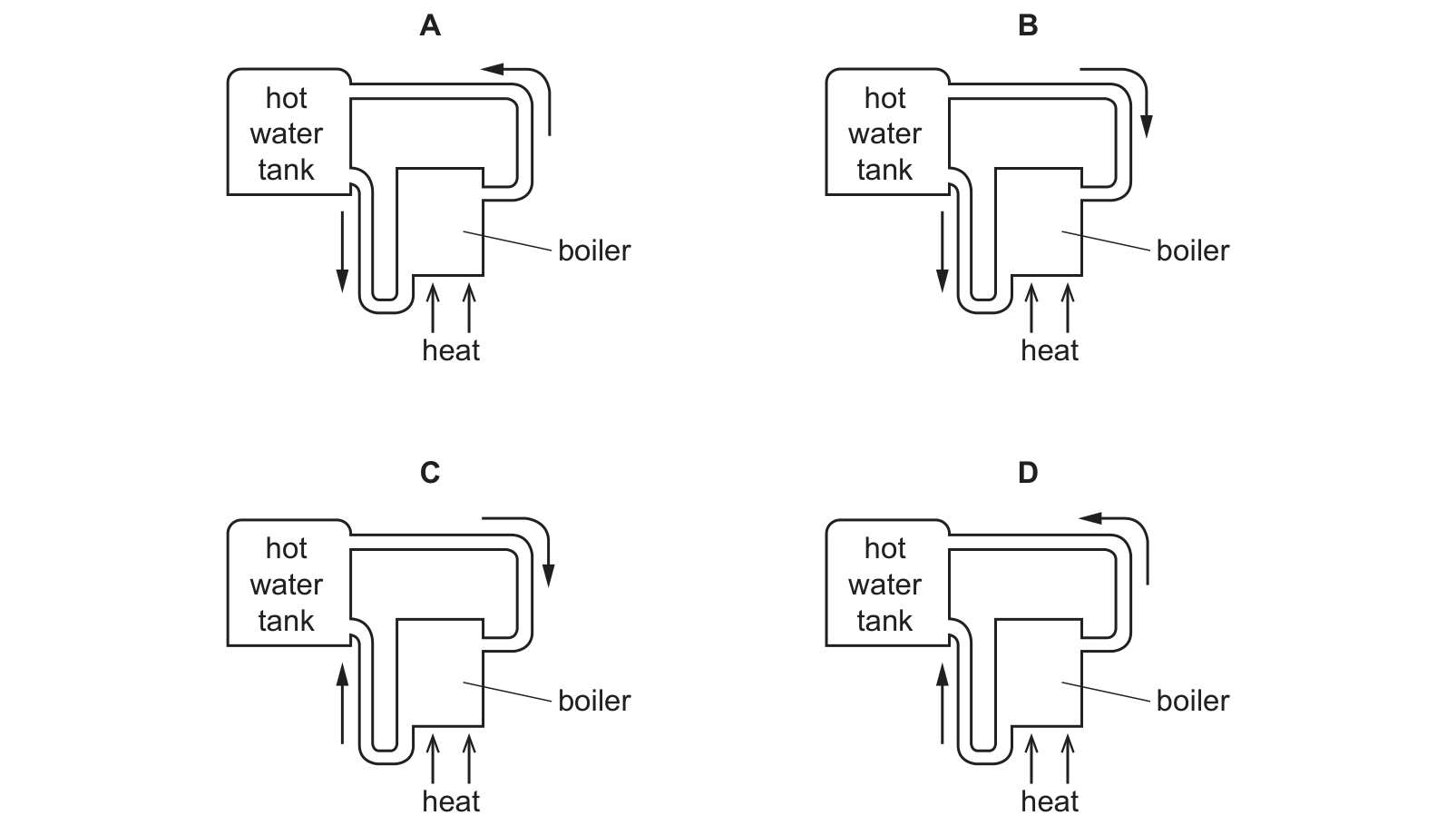
The diagrams show part of a water-heating system which is working by convection. Which diagram shows the flow of water in the system? Use the source image for W24 Paper 12, question 33.
Answer: A.
A convection heating system works because hot water is less dense than cold water and therefore rises. Water heated in the boiler at the bottom expands, becomes less dense and flows upwards to the tank, while the colder, denser water in the tank sinks and returns to the boiler to be heated in its turn. The diagram to choose is the one whose arrows show hot water leaving the top of the boiler and rising to the tank, with the return pipe carrying cold water down into the bottom of the boiler. Any diagram sending hot water downwards from the boiler reverses the density difference, and any diagram returning cold water to the top of the boiler would leave the current with no driving force at all.
Question 3
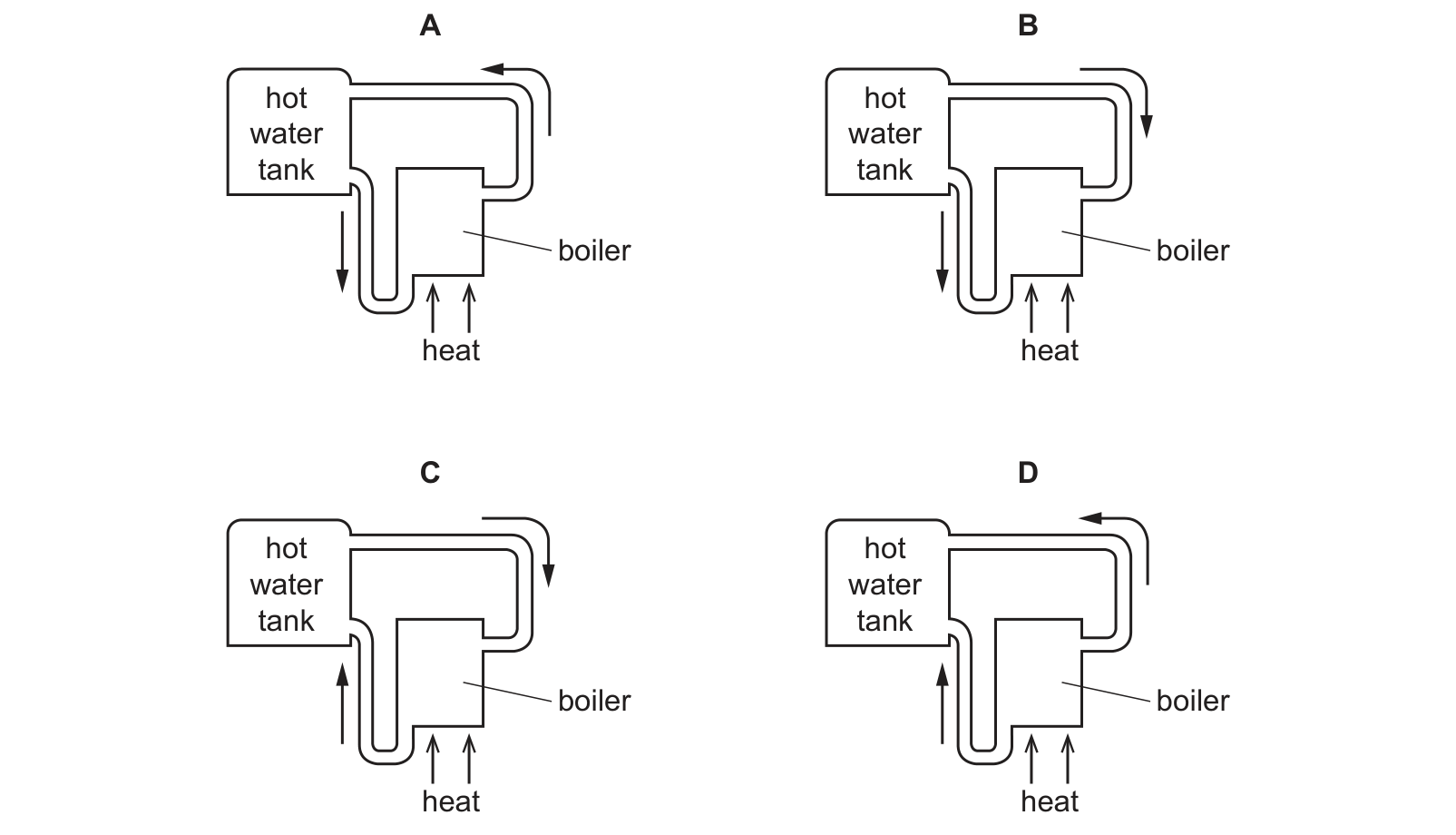
The diagrams show part of a water-heating system which is working by convection. Which diagram shows the flow of water in the system? Use the source image for W24 Paper 13, question 33.
Answer: A.
A convection heating system works because hot water is less dense than cold water and therefore rises. Water heated in the boiler at the bottom expands, becomes less dense and flows upwards to the tank, while the colder, denser water in the tank sinks and returns to the boiler to be heated in its turn. The diagram to choose is the one whose arrows show hot water leaving the top of the boiler and rising to the tank, with the return pipe carrying cold water down into the bottom of the boiler. Any diagram sending hot water downwards from the boiler reverses the density difference, and any diagram returning cold water to the top of the boiler would leave the current with no driving force at all.
Question 4
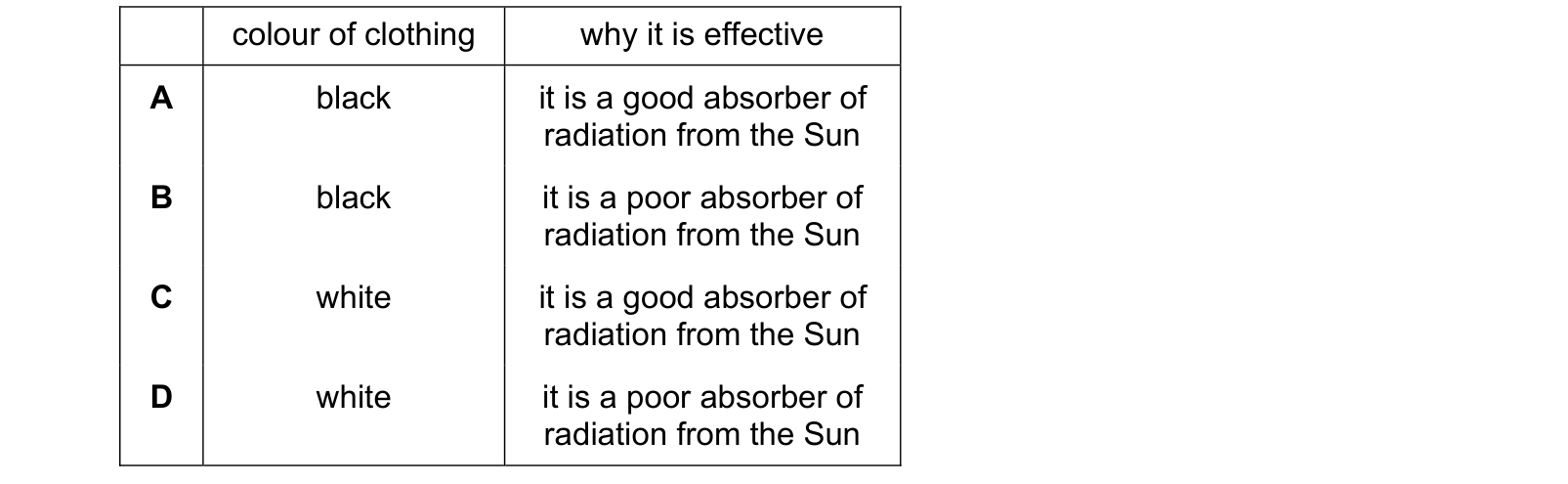
Which colour of outer clothing helps to keep the wearer cool on a hot, sunny day, and why is this clothing effective? Each answer gives, in order: colour of clothing; why it is effective.
Answer: D.
Pale surfaces are poor absorbers and good reflectors of the infrared and visible radiation arriving from the Sun, so white clothing turns most of that energy away before it reaches the wearer. A is the trap for a hurried reader, because the reason it gives is perfectly true, black really is a good absorber of radiation, but that is exactly why black clothing makes the wearer hotter rather than cooler. B pairs black with the claim that it is a poor absorber, which is simply false, and C makes the mirror image mistake by calling white a good absorber. Note that a good absorber is also a good emitter, which is why dark clothing can help radiate heat away in some conditions, but on a hot sunny day the incoming radiation dominates.
Question 5
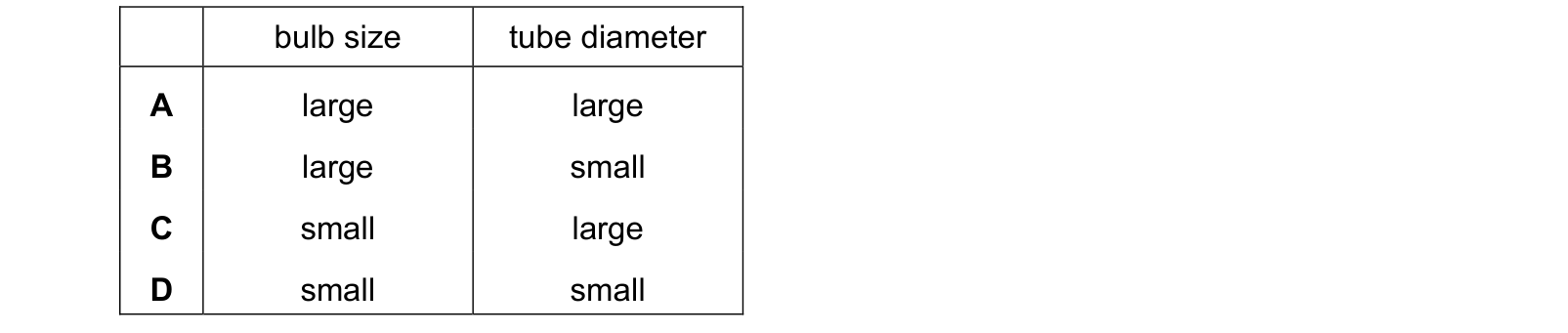
Four liquid-in-glass thermometers are made with different bulb sizes and different tube diameters. Which thermometer is the most sensitive? Each answer gives, in order: bulb size; tube diameter.
Answer: B.
A thermometer is most sensitive when the liquid thread moves furthest along the stem for each degree of temperature change. A large bulb holds more liquid, so a given temperature rise produces a larger increase in volume, and a narrow tube forces that extra volume into a long thread rather than a short fat one. C, small bulb with a large diameter tube, is the least sensitive combination for exactly the opposite reasons, and A goes wrong on the tube alone, since its large bulb is the right choice but its wide bore spreads the same expansion over a much shorter length of stem. D has the narrow tube but a small bulb, so there is less liquid available to expand in the first place.
These questions are drawn from past CIE 0654 Co-ordinated Sciences papers and filtered to thermal physics. You answer, you find out immediately whether you were right, and you get the reasoning for the correct option and for each distractor. Wrong answers go to a mistakes locker so you can come back to exactly those.
Practice is free. You need an account only so your progress and your mistakes are still there next time.
These are the errors that cost marks on thermal physics, taken from our own topic notes. Read them before you practise and you will recognise the traps in the questions.
Saying particles expand when heated. The spacing increases, not the particles.
Saying convection happens in solids.
Saying radiation needs particles. It is the only method that does not.
Saying a shiny surface is a good absorber.
Saying temperature rises while ice is melting.
Confusing boiling with evaporation, or saying evaporation happens throughout the liquid.
Saying a hot object "has more heat". It has more internal energy, and energy is what transfers.