Economic Methodology: five questions to try now
Real past-paper questions, the answer key from the mark scheme, and the explanation that goes with it. No account needed to answer them.
Question 1
Food prices in a country increased by 20% in three months due to an infectious virus. Which statement about the cause of this rise in food prices is normative?
Answer: A.
A Consumers were scared of running out of food.
Explanation:
A normative statement expresses an opinion, belief, or value judgment rather than a verifiable fact. In this case, the statement Consumers were scared of running out of food is a normative statement because it involves consumer sentiments and emotions, which are not directly measurable or quantifiable. It reflects how consumers perceived the situation and reacted based on fear rather than stating a verifiable cause-and-effect relationship.
On the other hand:
B Farm workers demanded higher wages to cover extra hours worked.
C Supply of foreign food was reduced because of closed borders.
D Transport costs increased by 10%.
These statements are positive statements as they represent factual, measurable cause-and-effect relationships. For example, statement B directly links the demand for higher wages by farm workers to the extra hours worked, which is a quantifiable relationship. Similarly, statements C and D provide specific reasons for the rise in food prices that can be objectively measured and verified.
Question 2
Which comment relating to the introduction of charges for previously free medical treatment is normative?
Answer: B.
The other options are positive statements, which is to say claims about fact that evidence could settle. Whether fewer people can afford treatment (A), whether richer citizens pay the higher charges (C), and whether health and productivity fall (D) are all testable in principle. Being difficult to measure does not make a statement normative.
Question 3
What does the assumption ‘ceteris paribus’ mean when economists analyse the way in which the quantity demanded of a good changes?
Answer: C.
The other options describe the opposite. D lets several variables move together, which is what the assumption exists to prevent. A reverses the direction of causation. B names only one of the things held constant, preferences, when the assumption covers all of them at once.
Question 4
The diagram shows an economy’s production possibility curve, PPC, and trading possibility curve, TPC. food TPC PPC O clothing Why is the diagram not able to demonstrate the benefits of international trade?
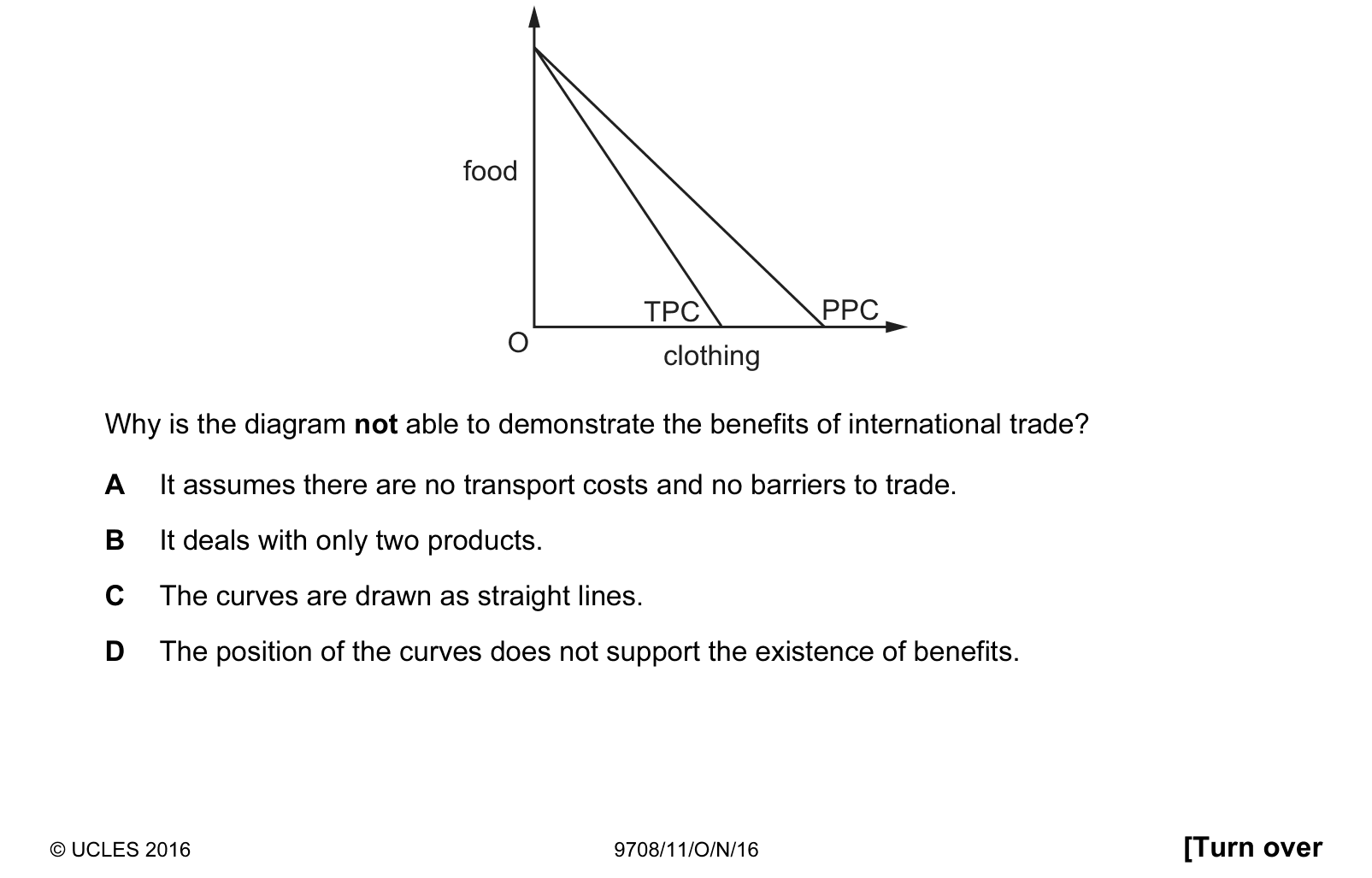
Answer: D.
Question 5
A government proposes to introduce a road congestion charge which would require private motorists to pay a toll for road use. Which statement relating to the proposal is normative?
Answer: D.
What this practice covers
These questions are drawn from past CIE 9708 papers. You answer, you find out immediately whether you were right, and you get the reasoning for the correct option and for each distractor. Wrong answers go to a mistakes locker so you can come back to exactly those.
Practice is free. You need an account only so your progress and your mistakes are still there next time.
What examiners see students get wrong here
These are the errors that cost marks on economic methodology, taken from our own topic notes. Read them before you practise and you will recognise the traps in the questions.
- Economics is not scientific because predictions are imperfect. A discipline can use scientific methods without producing perfectly certain predictions. Economics studies complex human behaviour, so conclusions often involve probability and conditions.
- Positive means correct. Positive means testable in principle. A positive claim can be wrong.
- Normative means negative. "Normative" does not mean pessimistic or critical. It means value-based.
- Any sentence containing a number is positive. A sentence can combine a statistic with a value judgement: > Inflation is 6%, which is unacceptably high. The first part is positive; "unacceptably" is normative.
- Every sentence containing "should" is automatically normative. Usually it is, but students must inspect meaning rather than rely only on a keyword.
- Ceteris paribus means the explanatory variable is fixed. The explanatory variable is allowed to change. Other relevant determinants are held constant.
- Ceteris paribus claims the real world never changes. It is a temporary analytical assumption, not a factual description of the whole economy.
- Short run and long run are fixed calendar periods. They depend on adjustment possibilities.
Revise it first
If any of the above is unfamiliar, work through the notes before practising: Economic Methodology revision notes.