Classification of Goods and Services: five questions to try now
Real past-paper questions, the answer key from the mark scheme, and the explanation that goes with it. No account needed to answer them.
Question 1
Consumers do not use enough of a product to maximise their private benefit because they have imperfect information about the product. How would an economist classify this product?
Answer: C.
Question 2
A good is provided by the government. Consumption by one person does not affect the amount of the good available for others. Which type of good must this be?
Answer: D.
Explanation:
Public goods are goods that are non-rivalrous and non-excludable. Non-rivalrous means that one person's consumption of the good does not reduce the amount available for others. Non-excludable means that individuals cannot be effectively excluded from using the good, even if they do not pay for it. In the case described in the question, the consumption of the good by one person does not affect the amount of the good available for others, indicating that it is a public good.
Complementary goods are goods that are used together, so the fact that consumption by one person does not affect the availability of the good for others does not necessarily make it a complementary good.
Merit goods are goods that the government believes individuals will under-consume, so they provide them to improve welfare. The fact that consumption by one person does not affect others' availability does not necessarily make it a merit good.
Private goods are rivalrous and excludable, meaning that consumption by one person reduces availability for others, which does not align with the characteristics described in the question.
Question 3
A government wishes to ensure adequate flood defences are provided in its coastal areas. Which action is most likely to be undertaken only by the government?
Answer: C.
Explanation:
In this scenario, the most likely action to be undertaken solely by the government is financing the defences. Building, designing, and maintaining the flood defences are activities that could involve various stakeholders such as private contractors, engineers, and local communities. However, financing the defences, especially in the case of large-scale infrastructure projects like flood defences, is a responsibility typically shouldered by the government.
Governments often allocate budgets and seek funding through various mechanisms (taxes, grants, bonds, etc.) to finance infrastructure projects that serve public interests such as flood protection. Building the defences would likely involve construction firms, designing the defences could involve specialised engineering companies, and maintaining the defences may also involve ongoing contracts with maintenance providers. However, the primary responsibility of financing such projects to ensure their implementation is usually the domain of the government.
Question 4
The diagram shows the demand and supply curves for healthcare in a private market. What would happen if the government provides the same amount of healthcare free of charge?
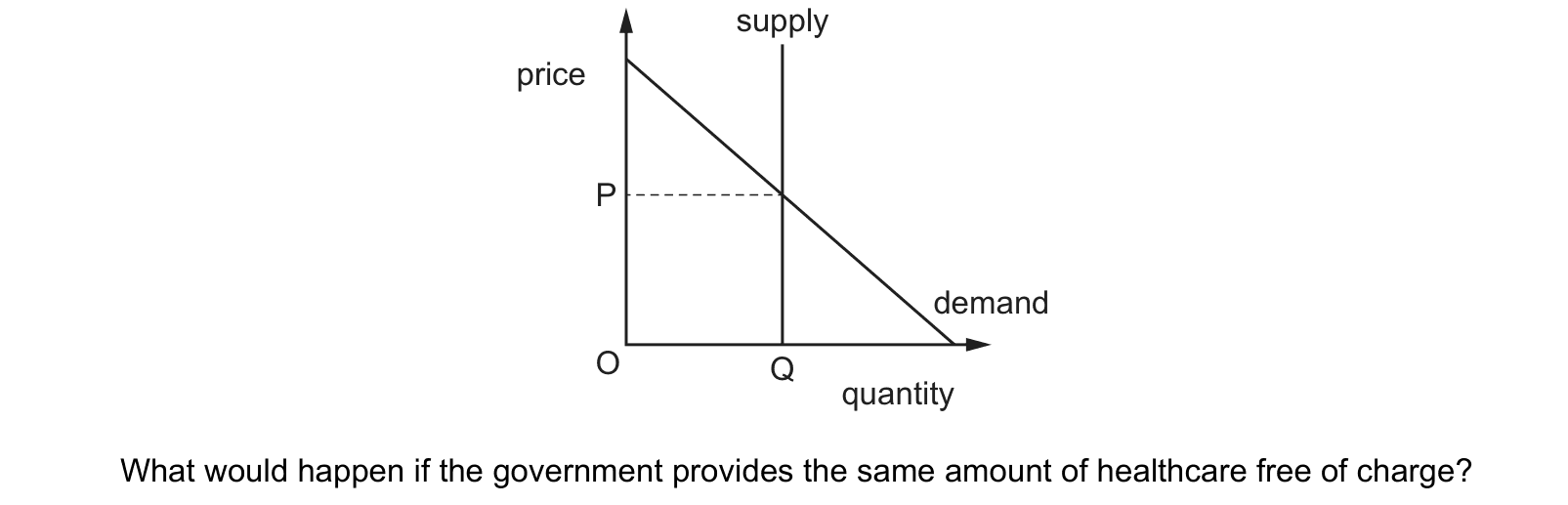
Answer: D.
Question 5
A government wants to prevent the spread of an infectious disease by vaccinating all children. Why might vaccination be classified as a merit good?
Answer: D.
Explanation:
A merit good is a good that is under-consumed when left to the free market forces and has positive externalities. In the case of vaccination, if left to individual choices, not all children may be vaccinated which could lead to the spread of the infectious disease in the community. By vaccinating all children, the government ensures herd immunity and reduces the overall spread of the disease, benefiting society as a whole.
Let's analyse why the other options are not the correct choices:
A - The benefit to society is equal to the benefit received by the individual: While there are societal benefits to vaccination through herd immunity, the primary benefit is still received by the individual who is vaccinated. So, this option does not correctly categorise vaccination as a merit good.
B - The good is excludable: Excludability refers to the ability to exclude individuals from consuming a good if they do not pay for it. In the case of vaccination, it is often not excludable as herd immunity benefits everyone, regardless of their individual contribution. So, this does not categorise vaccination as a merit good.
C - The good is not vital: Vaccination is vital in preventing the spread of infectious diseases and protecting public health. Therefore, this option does not correctly classify vaccination as a merit good.
What this practice covers
These questions are drawn from past CIE 9708 papers and filtered to classification of goods and services. You answer, you find out immediately whether you were right, and you get the reasoning for the correct option and for each distractor. Wrong answers go to a mistakes locker so you can come back to exactly those.
Practice is free. You need an account only so your progress and your mistakes are still there next time.
What examiners see students get wrong here
These are the errors that cost marks on classification of goods and services, taken from our own topic notes. Read them before you practise and you will recognise the traps in the questions.
- Free of charge = free good. Wrong: opportunity cost is the test.
- Government-provided = public good. Wrong: use rivalry and excludability.
- Merit good = public good. Wrong: the definitions use different criteria.
- Demerit good = illegal good. Wrong: many demerit goods are legal.
- Public goods have no opportunity cost. Wrong: they use scarce resources.
- One category only. Wrong: classifications can overlap.
- Merit goods are under-consumed only because they are expensive. The current
- Demerit goods are over-consumed only because of external costs. Topic 1.6
Revise it first
If any of the above is unfamiliar, work through the notes before practising: Classification of Goods and Services revision notes.