Price Elasticity of Supply: five questions to try now
Real past-paper questions, the answer key from the mark scheme, and the explanation that goes with it. No account needed to answer them.
Question 1
The diagram shows two linear supply curves labelled S1 and S2, where S2 is a 45° line. Which statement about the price elasticity of supply is correct?
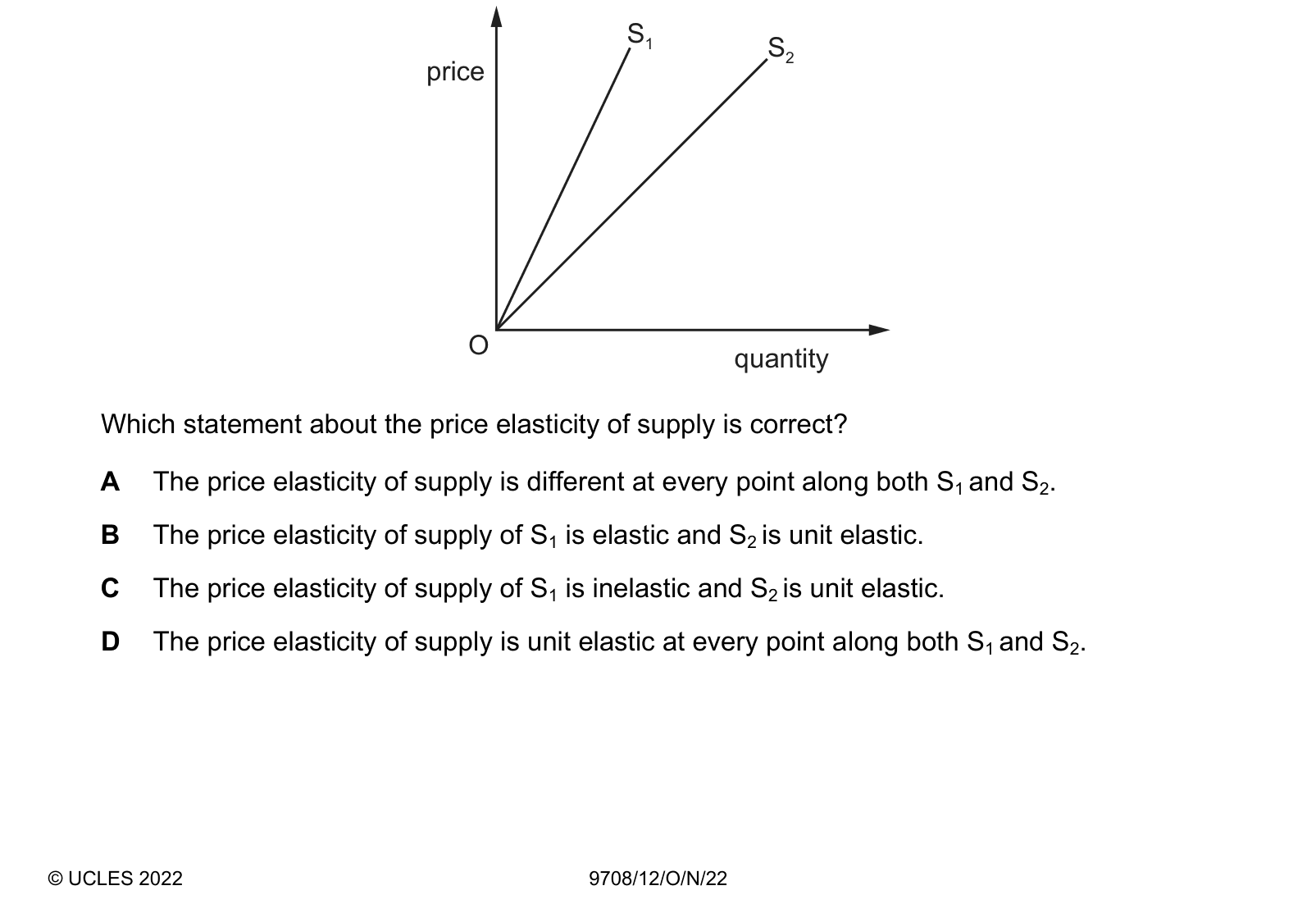
Answer: D.
Question 2
The diagram shows the supply curve for bananas. What is the price elasticity of supply when there is a rise in price from $5 to $6?
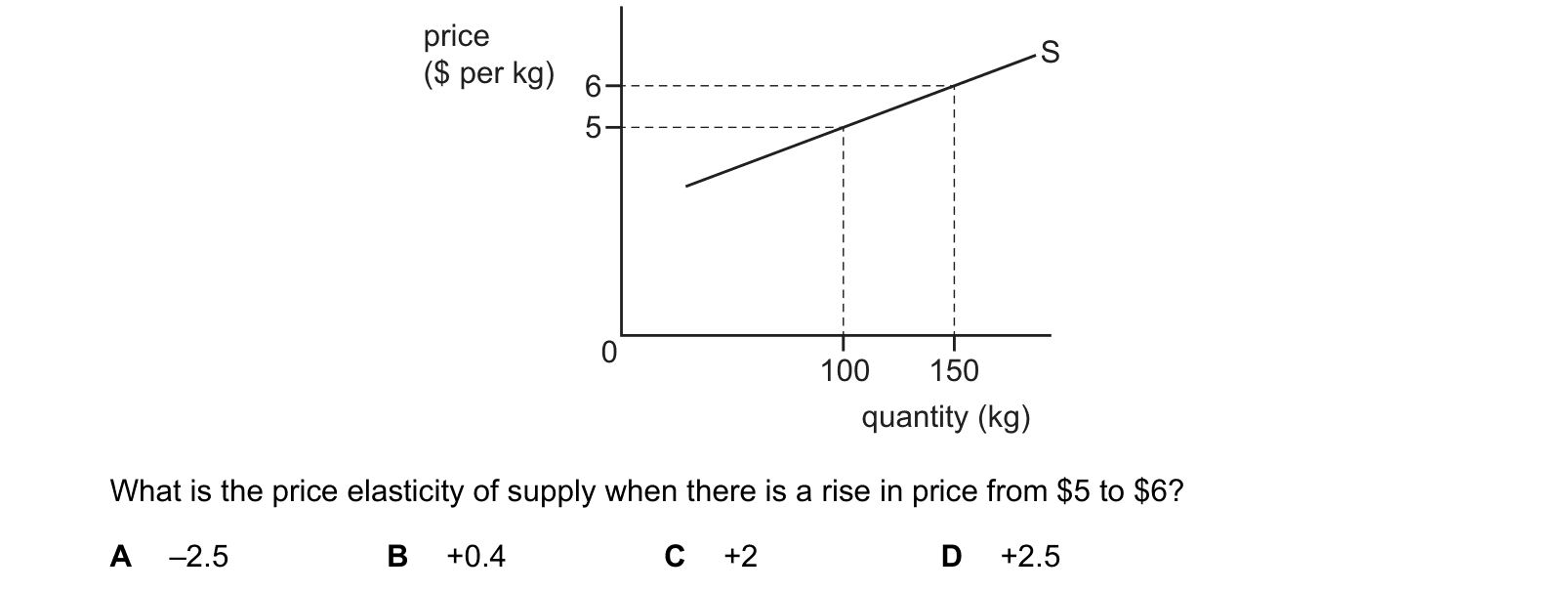
Answer: D.
Question 3
The price elasticity of the supply of yoghurt is estimated to be +1.5.
If the demand for yoghurt rises and price rises by 20%, how much more will be supplied to the market?
Answer: D.
Price elasticity of supply is the percentage change in quantity supplied divided by the percentage change in price. Rearranging, the percentage change in quantity supplied equals PES multiplied by the percentage change in price: 1.5 × 20% = 30%. Because PES is greater than 1, supply is elastic, so quantity responds proportionately more than price, which is why the answer must be larger than 20%.
Why the other options are wrong:
- A, 0.3%, and B, 3.0%, come from misplacing a decimal point, multiplying 1.5 by 0.2 and then reading the result as a percentage rather than as a proportion of the original percentage.
- C, 13.3%, comes from dividing 20 by 1.5 instead of multiplying. This is the most common error in elasticity calculations, and it is easy to catch: since supply is elastic, the quantity change must exceed the price change, so any answer below 20% cannot be right.
Question 4
The supply, S, of a product is determined by the equation S = 10 + 10P, when P is the price of the product.
What is the price elasticity of supply when the price changes from $1 to $2?
Answer: B.
Substitute both prices into the supply equation.
At P = $1: S = 10 + 10(1) = 20 units.
At P = $2: S = 10 + 10(2) = 30 units.
Now compute the percentage changes from the starting values. Quantity supplied rises from 20 to 30, an increase of 10/20 = 50%. Price rises from $1 to $2, an increase of 1/1 = 100%.
Price elasticity of supply = 50% ÷ 100% = 0.5.
Since the figure is below 1, supply is inelastic over this range: quantity responds proportionately less than price.
Why the other options are wrong:
- A, 0, would mean quantity supplied does not respond to price at all, which contradicts the 10P term in the equation.
- C, 1.0, comes from assuming the coefficient of 10 on P implies proportional response, or from comparing the absolute changes (10 units and $1) rather than percentage changes.
- D, 2.0, is the reciprocal, the result of dividing the price change by the quantity change instead of the other way round.
Question 5
What would best explain why the price elasticity of supply (PES) is likely to be lower for fresh vegetables grown within a country compared to the PES of goods manufactured in that country?
Answer: D.
Price elasticity of supply depends above all on how quickly producers can increase output. A manufacturer can add shifts, run machines longer or draw on stocks within days. A vegetable grower cannot: however attractive the price becomes, a crop must be planted and then take a full growing season to mature, and planting is confined to particular months. Output is effectively fixed until the next harvest, so PES is very low in the short run. Fresh produce also cannot be stockpiled to release when prices rise, which removes the other route to responsiveness.
Why the other options are wrong:
- A, flying in foreign supplies, would make total market supply more elastic, not less. It also concerns imports rather than the domestic growers the question asks about.
- B states the general principle that a price rise induces an output rise. That is true of any upward-sloping supply curve and explains nothing about why vegetables are less responsive than manufactures.
- C claims a horizontal supply curve, which means perfectly elastic supply, the exact opposite of a low PES.
What this practice covers
These questions are drawn from past CIE 9708 papers and filtered to price elasticity of supply. You answer, you find out immediately whether you were right, and you get the reasoning for the correct option and for each distractor. Wrong answers go to a mistakes locker so you can come back to exactly those.
Practice is free. You need an account only so your progress and your mistakes are still there next time.
What examiners see students get wrong here
These are the errors that cost marks on price elasticity of supply, taken from our own topic notes. Read them before you practise and you will recognise the traps in the questions.
- PES is negative. Usually wrong. PES is normally positive because price and quantity supplied move in the same direction.
- PES measures a shift of supply. Wrong. PES measures responsiveness along a supply curve.
- A steep curve automatically proves inelasticity in every case. Too simplistic. Elasticity is about proportionate responsiveness.
- Longer time always makes PES perfectly elastic. Wrong. It usually becomes more elastic, not necessarily perfectly elastic.
- No spare capacity means no production can increase at all. Wrong. It becomes harder, not necessarily impossible.
- Primary products always have perfectly inelastic supply. Wrong. They are often relatively inelastic in the short run, not perfectly inelastic in all cases.
- Storage always makes supply elastic. Not always. It can help, but other constraints may still matter.
- Elasticity and slope are exactly the same. Wrong. Related in simple diagrams, but not identical concepts.
Revise it first
If any of the above is unfamiliar, work through the notes before practising: Price Elasticity of Supply revision notes.