Consumer and Producer Surplus: five questions to try now
Real past-paper questions, the answer key from the mark scheme, and the explanation that goes with it. No account needed to answer them.
Question 1
A government introduces an effective minimum price for a product but makes no other intervention in the market.
This policy suggests that the government’s objective is
Answer: A.
The detail that settles this is "makes no other intervention". An effective minimum price is set above the equilibrium, so the market price rises and quantity demanded falls. That reduction in consumption is the goal when a good is a demerit good, alcohol and tobacco are the standard cases, and minimum unit pricing for alcohol works exactly this way.
Crucially, a minimum price above equilibrium also creates a surplus, because producers want to supply more than consumers will buy at that price. If the aim were to support producers' incomes, the government would have to buy up that surplus, which is precisely the further intervention the question rules out. Left unbought, the surplus means producers cannot sell everything they make, so their incomes are not reliably protected.
Why the other options are wrong:
- B, increasing consumption of a merit good, requires a lower price, achieved with a subsidy or free provision. A minimum price does the opposite.
- C, reducing the price of a private good, contradicts what a minimum price does.
- D, supporting producers' incomes, is the strongest distractor and the usual answer when a government also buys the surplus into a buffer stock. With no other intervention, it fails.
Question 2
The diagram shows supply and demand for a good. If price increases from P1 to P2, what will happen to consumer surplus?

Answer: A.
Question 3
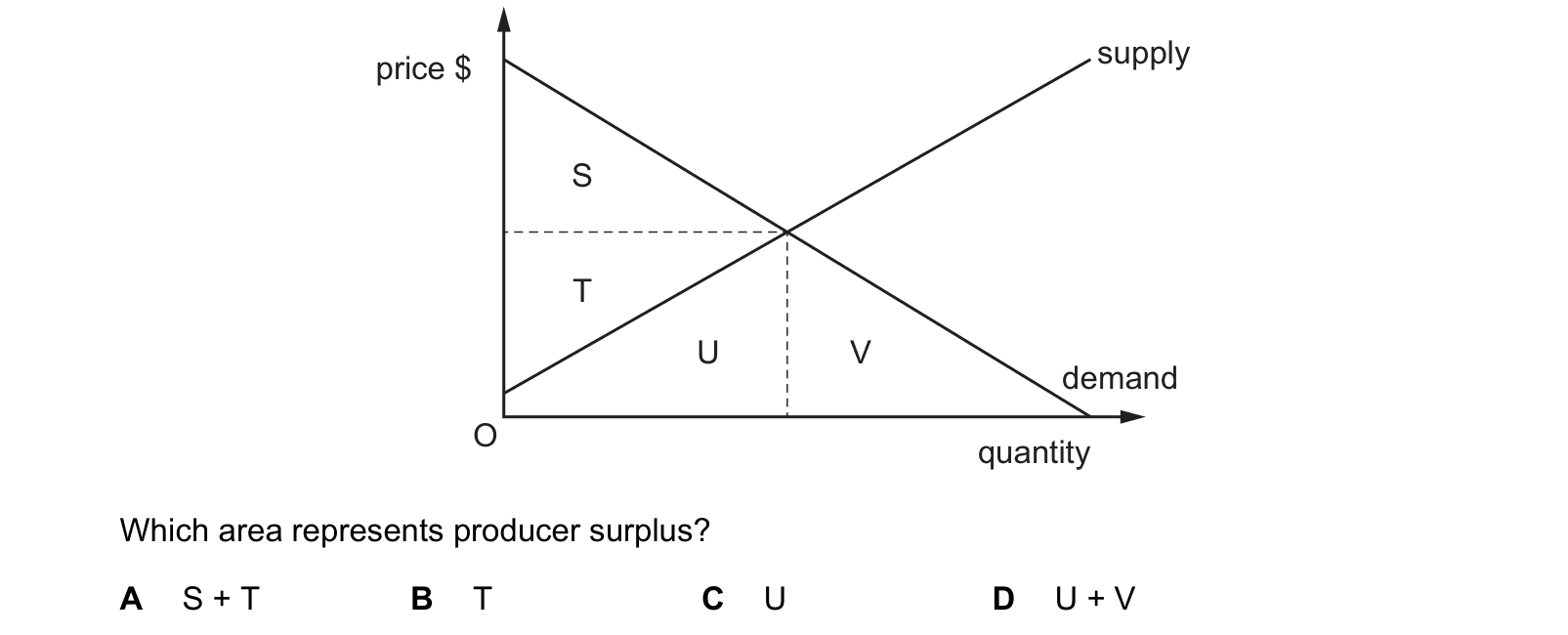
The diagram shows the market supply and demand for a good. Which area represents producer surplus?
Answer: B.
Producer surplus is the area above the supply curve and below the market price. In this case, producer surplus is represented by area T. This is because area T represents the difference between the price at which producers are willing to sell (as indicated by the supply curve) and the price at which they actually sell in the market.
Area S represents the quantity supplied at a price lower than the equilibrium price, so it does not represent producer surplus. Area U represents consumer surplus as it is above the demand curve and below the market price. Area U + V represents the total economic surplus which is the sum of consumer and producer surplus, so it includes both consumer and producer surplus.
Therefore, the correct answer is B) T as it accurately represents the producer surplus in this scenario.
Question 4
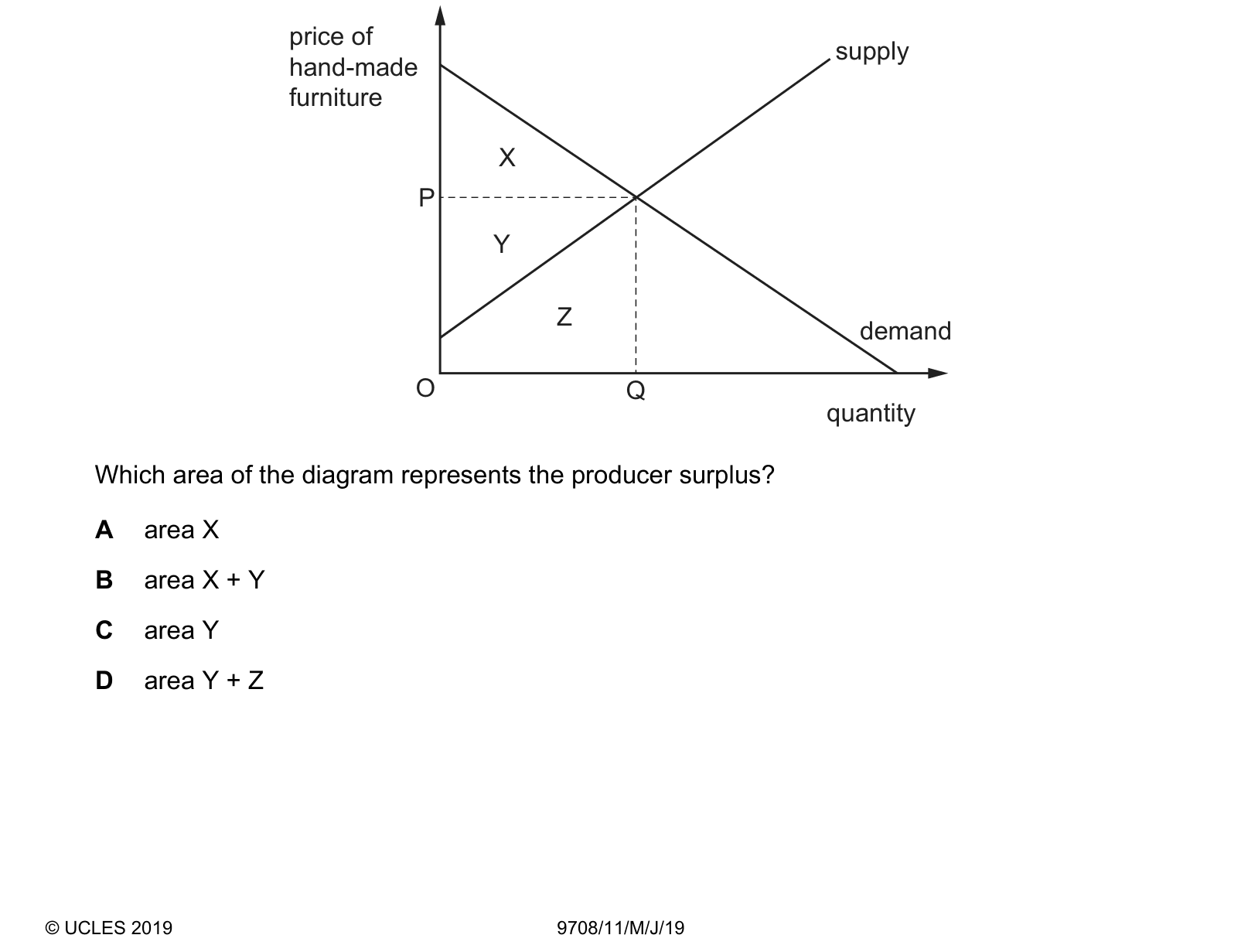
The diagram shows the market for hand-made furniture. Which area of the diagram represents the producer surplus?
Answer: C.
Question 5
A government decides to place a tariff on imports of raw materials.
Which statement about the impact of the tariff is correct?
Answer: A.
A tariff on imported raw materials taxes the inputs domestic firms buy. Their costs of production rise, which shifts the domestic supply curve for finished goods to the left: output falls and prices rise. This is why tariffs on inputs are widely criticised, they protect nothing (raw material extraction is often not a domestic industry at all) while damaging the competitiveness of every domestic firm that uses the material.
Why the other options are wrong:
- B says consumer surplus increases. Higher production costs mean higher final prices, so consumer surplus falls.
- C says government revenue falls. A tariff is a tax, so revenue rises: though the amount depends on how much importing continues, since very high tariffs can choke off the imports they tax.
- D says the price of imports falls and demand rises. A tariff raises the domestic price of imports and therefore reduces the quantity imported. This gets the mechanism exactly backwards.
What this practice covers
These questions are drawn from past CIE 9708 papers. You answer, you find out immediately whether you were right, and you get the reasoning for the correct option and for each distractor. Wrong answers go to a mistakes locker so you can come back to exactly those.
Practice is free. You need an account only so your progress and your mistakes are still there next time.
What examiners see students get wrong here
These are the errors that cost marks on consumer and producer surplus, taken from our own topic notes. Read them before you practise and you will recognise the traps in the questions.
- Consumer surplus is total spending. Wrong. Total spending is price multiplied by quantity. Consumer surplus is the extra benefit above what consumers pay.
- Producer surplus is total revenue. Wrong. It is the amount above producers' minimum acceptable supply price.
- Producer surplus always equals profit. Wrong. Fixed costs create a difference.
- Consumer surplus lies below demand and below price. Wrong. It lies below demand and above price.
- Producer surplus lies above supply and above price. Wrong. It lies above supply and below price.
- Any higher price means consumer surplus falls. Only automatically true for a movement along an unchanged demand curve. If demand shifts, compare the new area.
- Any lower price means producer surplus falls. Only automatically true for movement along an unchanged supply curve. If supply shifts, compare the new area.
- Total surplus measures equality. Wrong. It measures gains from exchange, not distributional fairness.
Revise it first
If any of the above is unfamiliar, work through the notes before practising: Consumer and Producer Surplus revision notes.