The Economic Problem
Contents: 9 sections
The economic problem
People's wants are unlimited, but the resources available to satisfy them are scarce. That is the economic problem, and everything else in the course follows from it.
Because resources are scarce; we must choose, and every choice means giving something up.
- **Scarcity
- choice
- opportunity cost.**
Opportunity cost is the next best alternative given up when a choice is made. Note carefully: it is the next best alternative, not everything you gave up.
The problem applies to everyone:
| Who | Example of a choice |
|---|---|
| Consumers | Spend on a phone, or save the money |
| Producers | Make more of good A, or more of good B |
| Governments | Fund a new hospital, or a new road |
Every economy must answer three questions: what to produce, how to produce it, and for whom.
Economic assumptions
The specification names this separately because every model later in the course rests on it, and examiners ask about the assumptions directly.
Rational behaviour. Economics assumes decision-makers act rationally, meaning each aims to maximise something:
- Consumers maximise utility, the satisfaction they get from what they buy.
- Producers maximise profit.
- Governments aim to maximise social welfare.
Ceteris paribus means "all other things being equal". When we say a price rise reduces quantity demanded, we hold income, tastes and the prices of other goods constant. Without that assumption you could never isolate the effect of one variable, because everything moves at once.
Why the assumptions matter, and where they break. Real consumers act on habit, incomplete information, social pressure and short-term impulse. They do not compute. That does not make the models useless, but it does mean a prediction based on rational behaviour can be wrong, and saying so is worth evaluation marks.
The factors of production
There are four, and each earns a reward, Edexcel asks for both, so learn them as pairs.
| Factor | What it is | Reward |
|---|---|---|
| Land | Natural resources: soil, minerals, water, forests | Rent |
| Labour | Human effort, physical and mental | Wages |
| Capital | Man-made goods used to produce other goods: machines, tools, factories | Interest |
| Enterprise | The entrepreneur who combines the other three and takes the risk | Profit |
Two common confusions worth avoiding. Capital in economics means machinery and equipment, not money. And the entrepreneur is the person who organises the other factors and bears the risk of failure, that risk is why the reward is profit rather than a wage.
Resources can also be classed as renewable (fish, forests, solar energy, they replenish if not over-used) or non-renewable (oil, coal, minerals, a finite stock).
Production possibility frontiers
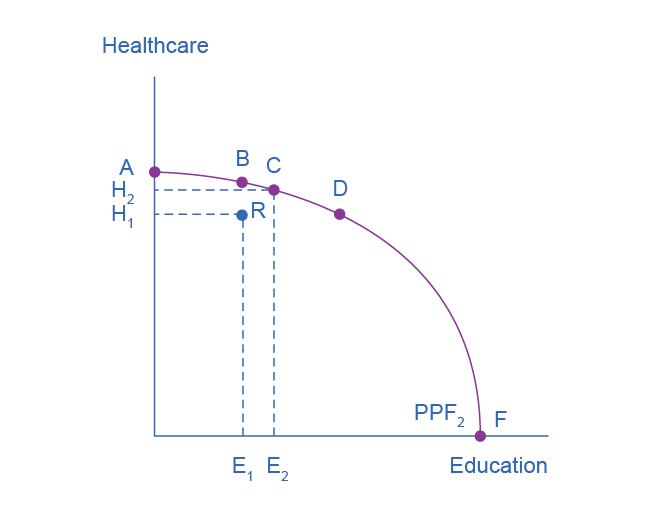
A PPF shows the maximum combinations of two goods an economy can produce when all its resources are fully and efficiently used.
| Position | What it means |
|---|---|
| On the curve | Efficient: all resources used fully |
| Inside the curve | Inefficient: some resources unemployed or wasted |
| Outside the curve | Not achievable with current resources |
Movements and shifts:
- Moving along the curve shows opportunity cost, producing more of one good means producing less of the other.
- Moving from inside towards the curve means using spare resources better; there is no opportunity cost here, which surprises students.
- The whole curve shifting outward shows economic growth, more resources, better resources, or improved technology.
- The curve shifting inward shows a fall in capacity, perhaps a natural disaster or war.
A shift affecting only one good rotates the curve on one axis: a technological advance in farming moves only the food intercept.
Worked example
A country moves resources from producing consumer goods, food, clothes, phones, to producing capital goods (machines, factories, infrastructure).
- The economy moves along its PPF towards capital goods
- fewer consumer goods are produced now, and that lost consumption is the opportunity cost
- but capital goods are used to produce other goods
- so in future years the country can produce more of everything
- the PPF shifts outward.
The trade-off to state clearly:
- Now: people have fewer goods to consume, so living standards are lower today.
- Later: the extra machinery and factories raise the country's productive capacity, so both consumer and capital goods can rise.
Evaluation. The gain depends on the capital being useful, a factory nobody needs shifts nothing. And the sacrifice falls on people today while the benefit goes to people later, which some would say is unfair. If the economy had been operating inside its PPF, with unemployed workers and idle factories; it could have produced more capital goods without giving up any consumer goods at all.
Common exam mistakes
- Saying resources are unlimited; it is wants that are unlimited.
- Defining opportunity cost as everything given up, rather than the next best alternative.
- Saying capital means money. In economics capital means machinery and equipment.
- Mixing up the rewards, land earns rent, labour earns wages, capital earns interest, enterprise earns profit.
- Saying a point inside the PPF is impossible. It is possible but inefficient.
- Confusing a movement along the PPF with a shift of the whole curve.
Exam technique
Learn the four factors with their rewards, that pairing is a common 4-mark question, one mark each.
Always give the exact wording for opportunity cost: "the next best alternative forgone".
When you draw a PPF, label both axes with the two goods and mark the points you are discussing. If the question is about growth, shift the whole curve outward and say what caused it.
For evaluation, use the now versus later trade-off, and remember to ask whether the economy was on the curve or inside it to begin with.
Quick revision
- Scarcity → choice → opportunity cost. Opportunity cost = the next best alternative forgone.
- Every economy answers what, how and for whom to produce.
- Four factors and their rewards: land–rent, labour–wages, capital–interest, enterprise–profit.
- Capital = machinery and equipment, not money.
- Renewable resources replenish; non-renewable ones are finite.
- PPF: on = efficient, inside = inefficient, outside = unattainable.
- Moving along the PPF shows opportunity cost; the curve shifting outward shows economic growth.
- Moving from inside towards the curve has no opportunity cost.
Check you have it
Question 1
Which one of the following is part of the economic problem of scarcity?
Answer: A.
What the syllabus asks for on this topicSpecification points
Specification points
- The economic problem: scarcity, choice and opportunity cost.
- The factors of production and their rewards.
- Production possibility frontiers (PPFs).
Related Edexcel IGCSE topics
Not the topic you were looking for? Describe what you are stuck on in your own words and we will take you to the notes that answer it.