Employment and Unemployment
Contents: 9 sections
What unemployment means
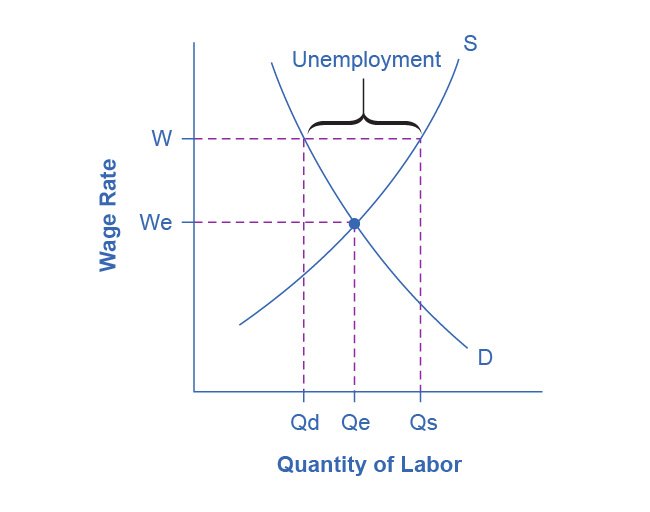
A person is unemployed if they are of working age, without a job, and actively looking for work.
The last part matters. Someone who is retired, in full-time education, or not looking for work is not counted as unemployed; they are economically inactive.
Unemployment rate = (number unemployed ÷ labour force) × 100
The labour force is everyone employed plus everyone unemployed; that is, everyone available for work. It does not include the economically inactive.
How unemployment is measured
The Labour Force Survey (LFS), a large survey asking people whether they are without work, available to start, and have actively looked in the past four weeks. It follows an international standard, so figures can be compared between countries.
The claimant count, the number of people claiming unemployment-related benefits.
| Labour Force Survey | Claimant count | |
|---|---|---|
| Strength | Internationally comparable; counts everyone looking for work | Cheap, quick, uses existing records |
| Weakness | Expensive; a survey, so there is sampling error | Misses those looking for work who cannot claim; changes whenever benefit rules change |
The claimant count is usually lower than the LFS figure, because not everyone looking for work is entitled to benefits.
Both measures understate the problem, because they miss:
- Discouraged workers who have given up looking, so are counted as inactive.
- Underemployment: people working part-time who want full-time hours, or in jobs below their skill level.
Types of unemployment
| Type | Cause | Example |
|---|---|---|
| Frictional | People between jobs, moving from one to another | A worker who left one job and is spending a few weeks finding a better one |
| Structural | Skills or location no longer match the jobs available, as industries decline | Coal miners after pit closures, whose skills do not transfer |
| Cyclical | A fall in demand during a recession, so firms cut staff | Shop workers made redundant when spending collapses |
| Seasonal | Demand for the work varies with the time of year | Ski instructors in summer, farm workers in winter |
| Technological | Machines and computers replace workers | Self-service checkouts replacing cashiers |
Frictional unemployment is not really a problem, some always exists in a healthy economy as people move between jobs, and it is usually short-lived.
Structural unemployment is the most serious, because it is long-lasting. The jobs exist, but the unemployed cannot do them or live in the wrong place. It has two causes worth naming:
- Occupational immobility: workers lack the skills the new jobs need.
- Geographical immobility: workers cannot move to where the jobs are, because of housing costs or family ties.
The type matters because the solution differs. Cyclical unemployment is cured by raising demand; structural unemployment needs retraining and help with moving, and raising demand will not fix it.
Consequences of unemployment
For the unemployed person:
- Lower income, so a lower standard of living and possible poverty.
- Loss of skills the longer they are out of work, making it harder to get a job, so unemployment becomes self-reinforcing.
- Stress, ill health and loss of confidence.
For the government:
- Less tax revenue, because fewer people are earning and spending.
- More spending on benefits.
- Together these worsen the government's finances, a double hit.
For the economy:
- Lost output. Workers who could be producing goods and services are not, so the economy produces less than it could.
- Lower spending, since the unemployed have less money, which reduces demand and may cause further job losses.
For society:
- Higher crime and social problems in areas of long-term unemployment.
- Increased inequality.
A possible benefit, worth mentioning for balance: a pool of available workers means firms can recruit easily and there is less pressure for wages and prices to rise. But the costs far outweigh this.
Worked example
A country's main car factory closes, and 5,000 workers lose their jobs.
- This is structural unemployment
- the workers' skills suited car manufacturing, and the growing jobs in the area are in retail and healthcare
- they are occupationally immobile, so the vacancies stay unfilled while the workers stay unemployed.
The effects spread outwards:
- The 5,000 workers have far less to spend
- local shops, cafés and services lose customers
- those businesses cut staff too
- unemployment rises further in the area
- house prices fall and the local economy declines.
Meanwhile the government collects less income tax from the workers and less VAT from their reduced spending, while paying out more in benefits.
What could be done, and the drawbacks:
- Retraining programmes teach the workers skills the growing industries need. This attacks the real cause, but it takes months or years, and the training must match what employers actually want.
- Help with relocation addresses geographical immobility, but people are reluctant to leave family and communities.
- Attracting new firms to the area with grants and tax breaks brings jobs directly, but it is expensive, and firms may leave once the support ends.
- Raising demand through government spending would help cyclical unemployment, but does little for structural unemployment, because the problem is a skills mismatch, not a shortage of jobs overall.
Judgement: retraining combined with help attracting new employers is the right response, because it deals with the actual cause. The main problem is time, the workers suffer while the retraining takes effect, so short-term support is needed alongside it.
Common exam mistakes
- Saying anyone without a job is unemployed. They must be actively looking for work.
- Confusing unemployed with economically inactive.
- Confusing cyclical with structural unemployment, the causes and solutions are completely different.
- Suggesting higher government spending to fix structural unemployment.
- Giving only the effects on the individual, and forgetting the government and the economy.
- Forgetting that both measures miss discouraged workers and underemployment.
Exam technique
Name the type of unemployment first, then explain the cause, then recommend the matching solution. Recommending demand-side policy for structural unemployment is the classic error and loses marks.
For consequences, organise by who is affected, the individual, the government, the economy, society. Four groups gives four developed points.
For evaluation, use how long it takes for a solution to work, and the point that long-term unemployment causes loss of skills, making the problem worse over time.
Quick revision
- Unemployed = of working age, without a job, and actively seeking work.
- Unemployment rate = (unemployed ÷ labour force) × 100.
- Measured by the Labour Force Survey (international standard) and the claimant count (benefits records, usually lower).
- Both miss discouraged workers and underemployment.
- Types: frictional (between jobs), structural (skills/location mismatch), cyclical (recession), seasonal, technological.
- Structural is the most serious: occupational and geographical immobility.
- Cyclical → raise demand. Structural → retraining and relocation help.
- Costs: lost income and skills; less tax and more benefits for the government; lost output for the economy; crime and inequality for society.
Check you have it
Question 1
Which one of the following types of unemployment is caused by changes in the business cycle?
Answer: D.
Question 2
Which one of the following is an example of frictional unemployment?
Answer: B.
Question 3
What is the main cause of frictional unemployment?
Answer: C.
What the syllabus asks for on this topicSpecification points
Specification points
- Unemployment and how it is measured.
- The causes (types) of unemployment.
- The consequences of unemployment.
Related Edexcel IGCSE topics
Not the topic you were looking for? Describe what you are stuck on in your own words and we will take you to the notes that answer it.