Competition and the Labour Market
Contents: 9 sections
Competitive markets
A competitive market has many firms selling similar products, with low barriers to entry so new firms can join easily.
Effects on consumers:
- Lower prices, because any firm charging much more loses customers to rivals.
- Better quality and service, as firms compete for customers.
- More choice between suppliers.
- Innovation, as firms look for an advantage.
Effects on firms: profit margins are small, so firms must keep costs down to survive. Efficient firms prosper, inefficient ones fail.
Monopoly
A monopoly is a market dominated by one firm, strictly a single seller, though in practice any firm with a very large market share has monopoly power.
Barriers to entry keep rivals out:
- Economies of scale: the existing firm's costs are far below any newcomer's (2.1).
- Legal barriers: patents and licences.
- Control of an essential resource or supply chain.
- Strong brand loyalty built by heavy advertising.
- High start-up costs.
Disadvantages of monopoly:
- Higher prices, because consumers have nowhere else to go.
- Less choice for consumers.
- Less incentive to innovate or improve quality, since there is no competitive pressure.
- Possible inefficiency, because the firm can survive without controlling costs.
Advantages of monopoly, a top answer needs these too:
- Economies of scale may make the firm's costs so low that prices are actually lower than many small firms could manage.
- High profits can fund research and development, producing better products over time.
- In some industries, water pipes, rail track, having one network is cheaper than duplicating it. This is a natural monopoly, and competition would raise costs.
Governments therefore regulate monopolies rather than always breaking them up: capping prices, setting quality standards, and blocking mergers that would reduce competition too far.
The demand for and supply of labour
Demand for labour comes from employers. It is called derived demand, because firms want workers not for their own sake but for what they produce. If demand for the product falls, demand for the workers falls too.
What affects demand for labour:
- Demand for the product the workers make.
- Productivity: more productive workers are worth more to a firm.
- The cost of machinery: if machines become cheap, firms may replace workers with capital.
- The wage rate itself, the higher the wage, the fewer workers firms want.
Supply of labour comes from workers. The higher the wage, the more people are willing to do the job.
What affects supply of labour:
- The wage offered, and wages in other jobs.
- Qualifications and training needed: long training means fewer people qualify, so supply is low.
- Working conditions: danger, unsocial hours and unpleasant work reduce supply.
- Size of the population and migration.
- Non-money benefits: job satisfaction, status, holidays, pensions.
Wage determination
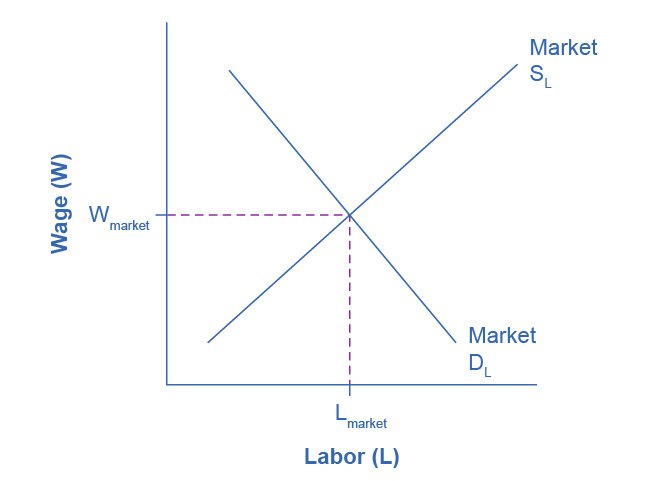
The equilibrium wage is set where the demand for labour equals the supply of labour, exactly like price in a goods market (1.2).
Why some jobs pay more than others:
| Reason | Explanation |
|---|---|
| Skills and qualifications | Long training limits supply, so wages are high: surgeons, pilots |
| Productivity | Workers producing more valuable output are worth more to employers |
| Danger or unpleasantness | Some jobs must pay more to attract anyone at all |
| Trade unions | Organised workers can bargain collectively for higher pay |
| Government policy | A national minimum wage sets a legal floor |
| Discrimination | Some groups are paid less regardless of their productivity |
The general rule: wages are high where demand for labour is high and supply is low. Surgeons are paid well because few people can do the job (low supply) and their work is highly valued (high demand). Cleaners are paid less because almost anyone can do it (high supply).
The national minimum wage is a legal lowest wage. It raises pay for the lowest earners and reduces poverty, but if it is set well above the equilibrium wage, firms may hire fewer workers, cut hours, or raise prices to cover the cost.
Worked example
A large supermarket chain becomes the only supermarket in a small town after its rivals close.
- The chain now has monopoly power
- shoppers have nowhere else to go
- the firm can raise prices without losing many customers
- choice falls, and there is less pressure to keep the shop clean, well-stocked or well-staffed.
As the town's main employer, it also has power in the labour market: workers have few alternative employers, so the supermarket can hold wages down.
But there are two sides:
- The chain's economies of scale mean its costs are much lower than a small independent shop's, so prices may still be lower than they would be with several small shops.
- It can stock a far wider range of products than a small shop could.
- It provides employment in the town.
Evaluation. Whether shoppers are better or worse off depends on whether the firm passes its lower costs on as lower prices, or keeps them as profit, and with no competition; it has little reason to pass them on. The government could respond by regulating prices, or by making it easier for new shops to open. Making entry easier is usually better, because the threat of a new competitor keeps prices down without the government having to guess the right price.
Judgement: monopoly power here is likely to harm shoppers and workers in the long run, even though the chain's scale brings genuine advantages. The best remedy is more competition rather than price controls.
Common exam mistakes
- Saying monopoly is always bad, without the economies of scale and natural monopoly arguments.
- Forgetting that labour demand is derived from demand for the product.
- Explaining wage differences only by skill, ignoring the supply side, how many people can do the job.
- Confusing demand for labour (from firms) with supply of labour (from workers).
- Saying a minimum wage only helps workers, without mentioning possible job losses.
- Treating a large market share as proof of a bad outcome, without asking about barriers to entry.
Exam technique
For any wage question. Always discuss both demand and supply. "Doctors earn more because they are skilled" is half an answer; "training takes years so few people qualify, meaning supply is low, while their work is highly valued, meaning demand is high" is a full one.
For monopoly, give advantages and disadvantages and then judge which matters more in the case described.
For evaluation, ask whether cost savings are actually passed on to consumers, and whether new firms could realistically enter the market.
Quick revision
- Competitive markets: many firms, low barriers
- lower prices, more choice, better quality, innovation.
- Monopoly: one dominant firm, protected by barriers to entry
- higher prices, less choice, less innovation.
- But monopoly may bring economies of scale, funds for R&D, and is cheaper for a natural monopoly.
- Demand for labour is derived from demand for the product.
- Demand for labour depends on product demand, productivity, and the cost of machinery.
- Supply of labour depends on the wage, qualifications needed, conditions, and population.
- The equilibrium wage is where demand for labour meets supply.
- High pay = high demand + low supply.
- A minimum wage raises low pay but may cost jobs if set too high.
What the syllabus asks for on this topicSpecification points
Specification points
- Competitive markets and monopoly; the effects on price and choice.
- The demand for and supply of labour; wage determination.
Related Edexcel IGCSE topics
Not the topic you were looking for? Describe what you are stuck on in your own words and we will take you to the notes that answer it.