International Trade and Globalisation
Contents: 8 sections
International specialisation and trade
International specialisation is when a country concentrates on producing the goods and services it makes best, most efficiently and at lowest cost, and trades for everything else.
A country's advantages come from:
- Natural resources: oil, minerals, fertile land, climate.
- Labour: its size, cost and skills.
- Capital and technology: advanced machinery and infrastructure.
- Built-up expertise and reputation in an industry.
A country with fertile land and sunshine can grow food far more cheaply than one that must heat greenhouses. It makes sense for it to grow food and import the machinery it cannot make efficiently.
Advantages of specialisation and trade:
- Lower prices, since goods are made by whoever produces them most cheaply.
- Greater choice: access to goods a country could never produce itself.
- Economies of scale, because firms produce for a world market rather than a domestic one.
- Higher output and incomes worldwide.
- More competition, forcing firms to become efficient and innovate.
Disadvantages:
- Over-dependence on one product. If its world price falls, the whole economy suffers. This is the most important disadvantage and the one examiners look for.
- Using up non-renewable resources, which are finite.
- Structural unemployment if the specialised industry later declines (3.3).
- Loss of self-sufficiency in essentials such as food and energy, which matters if supply is interrupted.
- Environmental costs of intensive production and transporting goods around the world.
Globalisation
Globalisation is the growing connection between the world's economies through trade, investment, migration and the spread of technology and ideas.
Causes: falling transport costs, especially containerisation; the internet and improved communications; the removal of trade barriers; and the growth of multinational companies.
Multinational companies (MNCs) produce in more than one country. They locate abroad to reach new markets, obtain cheaper labour or raw materials, get around trade barriers by producing inside the market, and benefit from lower taxes.
| Benefits to the host country | Drawbacks to the host country |
|---|---|
| Jobs and wages | Jobs may be low-skilled; managers brought in from abroad |
| Investment and new capital | Profits sent back home, not reinvested locally |
| Technology and skills transferred | Local firms may be forced out of business |
| Tax revenue for the government | Tax avoidance by shifting profits between countries |
| More choice for consumers | Environmental damage; use of weak labour laws |
| Higher output and exports | The company can leave if conditions change elsewhere |
Free trade and protectionism
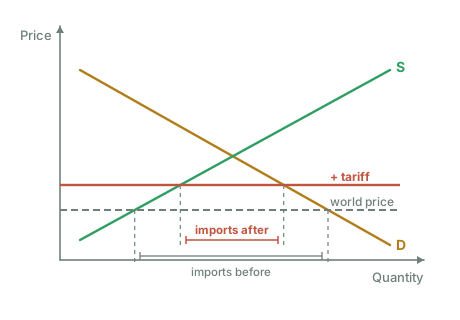
Free trade is trade without government barriers. Its benefits are the advantages of specialisation listed above: lower prices, more choice, economies of scale, competition, and higher world output.
Protectionism is restricting trade to shield domestic industries.
| Method | What it is | Key point |
|---|---|---|
| Tariff | A tax on imports | Raises the price of imports and raises revenue for the government |
| Quota | A limit on the quantity imported | Restricts supply so price rises, but no revenue for the government |
| Subsidy to domestic producers | A payment to home firms | Lowers their costs so they can undercut imports; paid for by taxpayers |
| Embargo | A total ban | Usually for political reasons |
| Administrative barriers | Complex paperwork and strict standards | Makes importing slow and expensive |
The tariff-versus-quota distinction is a favourite exam question: both raise the price of imports, but only a tariff generates government revenue.
Reasons for protection:
- Infant industries: new domestic industries need shelter until they grow big enough to compete.
- Protecting jobs in industries facing cheap imports.
- Preventing dumping: foreign firms selling below cost to destroy domestic rivals.
- Strategic industries: food, energy and defence, where depending on imports is risky.
- Raising government revenue through tariffs.
Arguments against protection:
- Higher prices and less choice for consumers.
- Higher costs for domestic firms that use imported parts, so protecting one industry harms others.
- Inefficiency, because sheltered firms face less pressure to improve.
- Retaliation: other countries impose their own barriers, so exports fall and jobs are lost elsewhere. This is the most important consequence to state.
- Lower world output, as the benefits of specialisation are reduced.
Worked example
A government puts a tariff on imported steel to protect its domestic steel industry.
- Imported steel becomes more expensive
- buyers switch to home-produced steel
- output and employment in the steel industry rise
- and the government collects tariff revenue.
But following the chain further is what earns the higher marks:
- Firms that use steel: car makers, builders, now pay more for a key material → their costs rise → their prices rise and they become less competitive against foreign rivals.
- Consumers pay more for cars and buildings.
- The protected steel firms face less competition, so they have less reason to become efficient.
- Other countries retaliate with tariffs on this country's exports → export industries lose sales and cut staff → the jobs saved in steel may be outnumbered by jobs lost elsewhere.
Judgement: the tariff helps a visible group, steel workers, at a cost spread thinly across consumers and other industries. It is defensible as a temporary measure while the industry modernises or workers retrain. As a permanent policy it protects inefficiency and invites retaliation.
Common exam mistakes
- Confusing a tariff (a tax, raises revenue) with a quota (a quantity limit, no revenue).
- Saying protection saves jobs without mentioning jobs lost through retaliation and higher input costs.
- Forgetting that consumers pay for protection through higher prices.
- Listing MNC benefits without the drawbacks, especially profits sent abroad.
- Treating globalisation as just another word for trade, it also covers investment, migration and technology.
- Giving the infant industry argument without noting that protection is meant to be temporary.
Exam technique
For protection questions, work through the groups affected: domestic producers, consumers, firms using imports, exporters facing retaliation, and the government. Five groups gives you five developed points.
Name the method precisely and state its distinctive feature, "a tariff, which unlike a quota raises revenue for the government".
For evaluation, the strongest points are retaliation, the effect on firms that use the imported good, and whether the protection is temporary or permanent.
Quick revision
- International specialisation = producing what you make best and trading for the rest.
- Benefits: lower prices, more choice, economies of scale, competition, higher world output.
- Costs: over-dependence, resource depletion, structural unemployment, loss of self-sufficiency.
- Globalisation driven by containerisation, communications, falling trade barriers and MNCs.
- MNCs bring jobs, investment, technology and tax, but send profits home and can leave.
- Tariff = a tax on imports, raises revenue. Quota = a quantity limit, no revenue.
- Reasons for protection: infant industries, jobs, dumping, strategic industries, revenue.
- Against: higher prices, higher input costs, inefficiency, and above all retaliation.
Check you have it
Question 1
International trade that takes place with no restrictions is known as
Answer: C.
Question 2
Which one of the following is an impact of globalisation?
Answer: B.
What the syllabus asks for on this topicSpecification points
Specification points
- International specialisation and trade.
- Globalisation and the role of multinational companies.
- Free trade and protectionism.
Related Edexcel IGCSE topics
Not the topic you were looking for? Describe what you are stuck on in your own words and we will take you to the notes that answer it.