Exchange Rates
Contents: 9 sections
What an exchange rate is
The exchange rate is the price of one currency in terms of another, for example £1 = $1.25.
Two systems:
- Floating: the rate is set by the demand for and supply of the currency, with no government intervention.
- Fixed: the government or central bank sets the rate and maintains it by buying or selling its own currency using reserves.
The vocabulary depends on the system, and examiners check it:
| Term | Meaning | System |
|---|---|---|
| Appreciation | The currency rises in value | Floating: caused by the market |
| Depreciation | The currency falls in value | Floating: caused by the market |
| Revaluation | The currency is deliberately raised | Fixed: a policy decision |
| Devaluation | The currency is deliberately lowered | Fixed: a policy decision |
Using "devaluation" for a market-driven fall is the most common error in this topic.
How a floating rate is determined
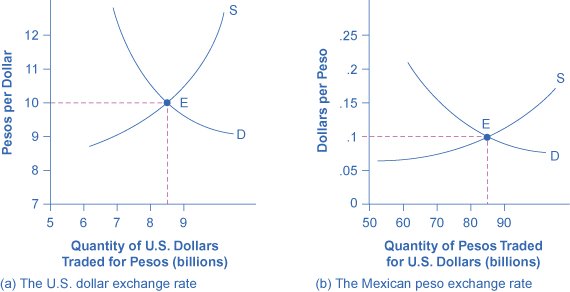
The rate settles where demand for the currency equals supply of it.
Demand for a country's currency comes from:
- Foreigners buying its exports; they must obtain the currency to pay.
- Foreign investment coming into the country.
- Speculators who expect the currency to rise.
- Tourists visiting the country.
Supply of the currency comes from:
- Residents buying imports; they must sell their currency to obtain foreign currency.
- Investment going abroad.
- Residents travelling abroad as tourists.
What causes the rate to change:
| Change | Effect on the currency |
|---|---|
| Exports rise | Appreciation: more demand for the currency |
| Imports rise | Depreciation: more supply of the currency |
| Domestic interest rates rise | Appreciation: foreign savers move money in |
| Domestic inflation higher than abroad | Depreciation: exports become less competitive |
| Foreign investment flows in | Appreciation |
| Speculators expect a rise | Appreciation now |
The effects of a depreciation
The core effect: exports become cheaper abroad, imports become dearer at home.
A memory aid: SPICED, Stronger Pound, Imports Cheaper, Exports Dearer. A depreciation is the reverse.
- The currency falls
- domestic goods cost less in foreign currency
- demand for exports rises
- foreign goods cost more at home
- demand for imports falls
- the current account may improve
- higher demand for domestic output raises output and employment.
But there are costs:
- Imported goods cost more, so the cost of living rises.
- Imported raw materials and components cost more, raising firms' costs and causing cost-push inflation (3.4).
- The improvement depends on how much demand changes. If people keep buying much the same quantity of imports despite the higher price, the country simply pays more for them, and the current account may worsen at first.
The effects of an appreciation
The mirror image: exports become dearer and imports cheaper.
- Exporters lose competitiveness, so export sales fall.
- Output and employment may fall in export industries.
- Imports are cheaper, which lowers the cost of living and helps firms using imported materials, so an appreciation reduces inflationary pressure.
- The current account is likely to worsen.
Worked example
A country's currency depreciates by 15% against its trading partners.
- Its goods now cost 15% less in foreign currency
- foreign buyers demand more
- export sales rise
- meanwhile imports cost 15% more, so households and firms buy fewer of them
- the current account improves
- higher demand for domestic output means firms produce more, so output and employment rise.
The costs, which the best answers include:
- Imported food, fuel and consumer goods all cost more
- the cost of living rises, hitting poorer households hardest.
- Firms using imported components face higher costs
- cost-push inflation, which gradually cancels out the competitiveness gain.
- If people carry on buying roughly the same quantity of imports, because there is no domestic alternative for oil, or medicines, or certain foods, the country simply pays more for the same goods, and the current account may not improve at all.
Evaluation. The gain is likely to be temporary. As imported costs feed through into higher prices and wages, domestic goods become expensive again and the initial advantage disappears. A depreciation therefore buys competitiveness for a while rather than creating it, only higher productivity makes a country competitive in a lasting way.
Different groups are affected very differently: exporters and firms competing with imports gain, while importers and consumers lose.
Judgement: a depreciation helps exporters and employment in the short run, but only improves the current account if buyers actually change what they purchase, and it raises inflation, which eventually undoes part of the advantage.
Common exam mistakes
- Using devaluation for a market movement; that is depreciation.
- Getting SPICED backwards.
- Saying a depreciation is simply good, ignoring imported inflation.
- Forgetting that a depreciation raises the cost of imported raw materials for domestic firms, not just finished goods.
- Confusing demand for and supply of the currency. Remember that imports supply the domestic currency.
- Assuming the current account must improve, without asking whether buyers actually change their behaviour.
Exam technique
State clearly whether the currency has appreciated or depreciated before discussing any effects, and use the correct word for the exchange rate system.
Then trace the chain: exchange rate → export and import prices → quantities bought → current account → output and employment.
For evaluation, use imported inflation, the fact that different groups gain and lose, and the point that a depreciation is a short-term fix compared with raising productivity.
Quick revision
- Exchange rate = the price of one currency in another.
- Floating = set by demand and supply. Fixed = set by the authorities.
- Appreciation / depreciation = market. Revaluation / devaluation = policy decision.
- Demand for the currency comes from exports and inward investment; supply from imports and outward investment.
- Higher interest rates → appreciation. Higher domestic inflation → depreciation.
- SPICED: Strong Pound, Imports Cheaper, Exports Dearer.
- A depreciation helps exporters, output and employment, but causes imported inflation.
- An appreciation hurts exporters but eases inflation.
- The gain from a depreciation is temporary unless productivity rises.
Check you have it
Question 1
In an exchange rate system without government intervention, a rise in the exchange rate is known as
Answer: A.
What the syllabus asks for on this topicSpecification points
Specification points
- The foreign exchange rate and how it is determined.
- The effects of appreciation and depreciation.
Related Edexcel IGCSE topics
Not the topic you were looking for? Describe what you are stuck on in your own words and we will take you to the notes that answer it.