Demand, Supply and Price
Contents: 9 sections
Markets and the price mechanism
A market is any place where buyers and sellers come together to trade, a shop, a website, a stock exchange.
In a market economy nobody decides what gets produced. Prices do the work, through three functions:
- Rationing: when a good is scarce its price rises, so it goes to those willing and able to pay most.
- Incentive: a higher price makes production more profitable, so firms produce more and new firms enter.
- Signalling: prices carry information. A rising price tells producers that consumers want more of this good, and tells consumers to use less of it.
Together these move resources to where consumers want them, without anyone giving an instruction.
Demand
Demand is the quantity consumers are willing and able to buy at each price. "Able" matters, wanting something without the money to pay is not demand.
The demand curve slopes downwards: as price falls, quantity demanded rises, because the good is now cheaper than substitutes and because buyers' money goes further.
The distinction Edexcel tests constantly:
- A change in the good's own price causes a movement along the curve, an extension (price falls) or a contraction (price rises).
- A change in anything else causes the whole curve to shift.
What shifts demand:
| Factor | Effect |
|---|---|
| Income | Higher income → more demand for normal goods; less for inferior goods |
| Price of substitutes | A substitute gets dearer → demand for this good rises |
| Price of complements | A complement gets dearer → demand for this good falls |
| Tastes and fashion | Becoming popular → demand rises |
| Advertising | Successful advertising → demand rises |
| Population | More people → more demand |
| Expectations | Expecting a price rise → demand rises now |
| Seasons | Ice cream in summer, coats in winter |
Supply
Supply is the quantity producers are willing and able to sell at each price. It slopes upwards, because a higher price makes production more profitable and covers the higher costs of producing extra units.
What shifts supply:
| Factor | Effect |
|---|---|
| Costs of production | Higher wages or raw material costs → supply falls (shifts left) |
| Technology | Better technology → supply rises |
| Taxes on producers | Higher taxes → supply falls |
| Subsidies | Subsidies → supply rises |
| Number of firms | More firms → supply rises |
| Weather and disasters | A bad harvest → supply falls |
Market equilibrium
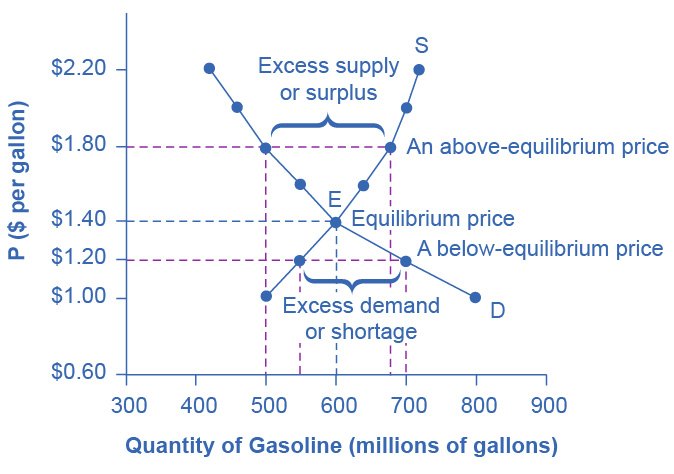
Equilibrium is the price where quantity demanded equals quantity supplied. The market clears, every buyer willing to pay that price finds a seller, and vice versa.
| Situation | What happens |
|---|---|
| Price above equilibrium | Excess supply (a surplus): unsold stock builds up → firms cut price → equilibrium restored |
| Price below equilibrium | Excess demand (a shortage): queues and empty shelves → sellers raise price → equilibrium restored |
Working out the effect of a change. Use this order every time:
- Decide which curve moves
- decide which way it moves
- read off the new price and quantity.
| Change | Result |
|---|---|
| Demand rises | Price up, quantity up |
| Demand falls | Price down, quantity down |
| Supply rises | Price down, quantity up |
| Supply falls | Price up, quantity down |
Notice that demand shifts move price and quantity in the same direction, while supply shifts move them in opposite directions. That is a quick way to check your answer.
Worked example
A disease destroys a large part of the world's coffee crop.
- Fewer coffee beans can be produced
- supply shifts left
- at the old price there is now excess demand
- the price is bid up
- as price rises, quantity demanded contracts along the demand curve
- a new equilibrium is reached at a higher price and lower quantity.
The three functions of the price mechanism at work here:
- Rationing: the higher price means less coffee is bought, matching demand to the smaller supply.
- Signalling: the high price tells growers everywhere that coffee is scarce and valuable.
- Incentive: the high price makes coffee growing more profitable, so farmers plant more.
- In the long run the incentive draws resources in
- supply rises again
- the price falls back. The market has fixed the shortage on its own.
Evaluation. The adjustment is slow, because coffee trees take years to mature, so the high price lasts a long time. It also rations by ability to pay, so poorer consumers are priced out first, which many would call unfair. And prices in a related market move too: as coffee becomes dear, demand for tea (a substitute) rises, raising its price as well.
Common exam mistakes
- Confusing a movement along a curve with a shift of the curve. Only the good's own price causes a movement.
- Saying "demand falls" when price rises; that is a contraction, not a fall in demand.
- Shifting both curves when only one thing has changed.
- Confusing excess demand (a shortage at too low a price) with an increase in demand.
- Forgetting that demand needs willingness and ability to pay.
- Getting substitutes and complements the wrong way round.
Exam technique
Always draw the diagram. Label both axes (Price and Quantity), label the original curves D1 and S1, the new curve D2 or S2, and mark both equilibrium prices and quantities with dotted lines.
Say which curve shifts and why before describing the result, the reason is where the marks are.
For evaluation, use the time period (supply is slower to adjust in the short run), fairness (rationing by ability to pay), and related markets (substitutes and complements).
Quick revision
- Price mechanism functions: rationing, incentive, signalling.
- Demand needs willingness AND ability to pay; the curve slopes down.
- Supply slopes up because higher prices are more profitable.
- Own price → movement along. Anything else → shift.
- Demand shifters: income, substitutes, complements, tastes, advertising, population, expectations, seasons.
- Supply shifters: costs, technology, taxes, subsidies, number of firms, weather.
- Equilibrium = quantity demanded equals quantity supplied.
- Above equilibrium → excess supply; below → excess demand.
- Demand shift → price and quantity move the same way. Supply shift → opposite ways.
Check you have it
Question 1
Which one of the following factors may cause a shift of the demand curve?
Answer: B.
Question 2
Which one of the following would occur when there are unsold goods in a market?
Answer: B.
Question 3
Which one of the following statements is correct?
Answer: C.
What the syllabus asks for on this topicSpecification points
Specification points
- The role of markets and the price mechanism.
- Demand and supply, and the factors that shift them.
- Market equilibrium and the effects of price changes.
Related Edexcel IGCSE topics
Not the topic you were looking for? Describe what you are stuck on in your own words and we will take you to the notes that answer it.