Market Failure
Contents: 10 sections
What market failure means
Market failure happens when the free market, left alone, produces too much or too little of a good, so resources are not allocated in the way that is best for society.
The price mechanism (1.2) works well in many markets, but it only takes account of the costs and benefits falling on the buyer and the seller. Anything falling on other people is invisible to it.
Externalities
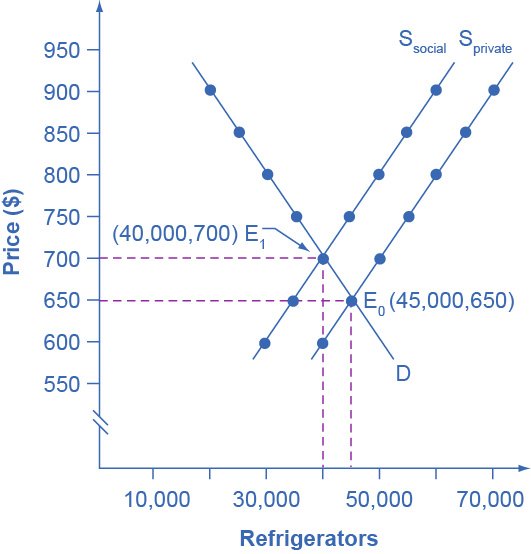
An externality is a cost or benefit that affects a third party, someone not involved in the buying or selling.
| Term | Meaning |
|---|---|
| Private cost | The cost to the producer or consumer |
| External cost | The cost falling on third parties |
| Social cost | Private cost + external cost |
| Private benefit | The benefit to the producer or consumer |
| External benefit | The benefit to third parties |
| Social benefit | Private benefit + external benefit |
Negative externalities, third parties suffer a cost.
- A factory pollutes a river
- the firm pays only its private costs of production
- local people bear the cost of dirty water and poor health
- social cost is greater than private cost
- the good is over-produced and its price is too low.
Examples: pollution, congestion, noise, litter, passive smoking.
Positive externalities, third parties gain a benefit.
- A person is vaccinated
- they gain protection (private benefit)
- but other people are also less likely to catch the disease (external benefit)
- social benefit is greater than private benefit
- the good is under-consumed.
Examples: vaccination, education, public transport, planting trees.
- **The rule to remember: negative externalities
- the market produces too much. Positive externalities
- the market produces too little.**
Merit, demerit and public goods
Merit goods are goods that are better for people than they realise, so they are under-consumed if left to the market, education, healthcare, insurance, exercise. People underestimate the benefit because it is long-term and uncertain. Merit goods usually generate positive externalities too.
Demerit goods are worse for people than they realise, so they are over-consumed, cigarettes, alcohol, gambling, junk food. The harm is delayed, so people underestimate it. They usually generate negative externalities as well.
Public goods have two special features:
- Non-excludable: you cannot stop someone who has not paid from using it.
- Non-rival: one person using it does not reduce the amount available to anyone else.
Examples: street lighting, national defence, flood defences, lighthouses.
- Because you cannot stop non-payers from benefiting, people have no reason to pay, the free-rider problem
- so no firm can make a profit supplying it
- the market provides none at all.
That is why public goods must be provided by the government and paid for through taxation. This is the most extreme form of market failure: not the wrong amount, but nothing at all.
Government intervention
| Method | How it works | Problem with it |
|---|---|---|
| Indirect taxes | Raise the price of a good with negative externalities, so less is bought | Hard to set the right amount; regressive; may create a black market |
| Subsidies | Lower the price of a good with positive externalities, so more is bought | Expensive: the money has an opportunity cost |
| Regulation and laws | Ban or limit: age limits, emission standards, bans on smoking indoors | Costly to enforce; people may break the rules |
| Government provision | The state supplies the good directly: defence, street lighting, schools | Funded by taxpayers; the state may be inefficient |
| Information and advertising | Health campaigns and labelling correct what people believe | Slow; people may ignore it |
| Tradable permits | Firms are given a limit on pollution and can trade allowances | Complicated to run; the limit may be set too high |
Government failure happens when intervention makes things worse rather than better, for example if a tax is set at the wrong level, if enforcement costs more than the benefit, or if a ban simply pushes activity into an illegal market.
The mixed economy
The specification treats this as its own area, and questions ask you to compare systems rather than just define one.
A market economy allocates resources entirely through the price mechanism, with private ownership of the factors of production and no government direction.
- For: the price signal responds quickly, competition drives efficiency and innovation, and consumers get what they are willing to pay for.
- Against: public goods are not provided at all, merit goods are under-provided, externalities are ignored, and income inequality can be extreme.
A planned (command) economy allocates resources through government decision, with state ownership.
- For: can provide public and merit goods directly, can pursue equality, avoids unemployment from market fluctuations.
- Against: no price signal to reveal what people want, weak incentives to cut cost or innovate, and the information problem of planning millions of decisions centrally.
A mixed economy combines both: a private sector allocating most goods through markets, and a public sector providing public goods, merit goods and a safety net, plus regulation and taxation to correct market failure.
Almost every real economy is mixed. The examinable question is not which system a country has but where the balance sits, and it differs by sector: healthcare may be largely public while food retail is largely private, in the same country.
Worked example
A city has serious traffic congestion and air pollution.
- Drivers pay their private costs, fuel, insurance, wear on the car
- but they also impose external costs on everyone else: delays, dirty air and higher accident risk
- social cost is greater than private cost
- so too many car journeys are made.
What the government could do, and the drawbacks:
- A congestion charge raises the private cost of driving towards the social cost, so fewer journeys are made. But if there is no decent bus or train alternative, people simply pay it, and it hits poorer drivers hardest, so it is regressive.
- Improving public transport gives people a real alternative, which makes the charge work far better. But it is expensive and takes years to build.
- Emission standards on vehicles cut pollution per car directly. But they do nothing about congestion, and enforcement costs money.
Judgement: the charge works best combined with better public transport, because people can only change their behaviour if there is something to change to. Used on its own it raises revenue without cutting journeys much.
Common exam mistakes
- Mixing up the direction: negative externalities mean over-production, positive mean under-production.
- Saying a public good is "a good the government provides". The definition is non-excludable and non-rival.
- Confusing merit goods (under-consumed, people underestimate the benefit) with demerit goods (over-consumed).
- Forgetting the free-rider problem, which is the reason public goods are not supplied at all.
- Listing government policies without giving a drawback of any of them.
- Forgetting that intervention can cause government failure.
Exam technique
Always identify who the third party is, "local residents suffer from the noise" is worth far more than "there are negative externalities".
Use the vocabulary precisely: private cost, external cost, social cost. Stating that social cost exceeds private cost, and therefore the good is over-produced, is the core chain.
For any policy question, give the policy, explain how it corrects the failure, then give one drawback. That structure earns evaluation marks reliably.
Quick revision
- Market failure = the market produces too much or too little for society's good.
- Social cost = private cost + external cost. Social benefit = private benefit + external benefit.
- Negative externality → over-production. Positive externality → under-consumption.
- Merit goods are under-consumed; demerit goods are over-consumed, both because people misjudge the effects.
- Public goods are non-excludable and non-rival → the free-rider problem → the market supplies none.
- Interventions: indirect taxes, subsidies, regulation. State provision, information, tradable permits.
- Government failure = intervention that makes the allocation of resources worse.
What the syllabus asks for on this topicSpecification points
Specification points
- Market failure and its causes: externalities, and merit, demerit and public goods.
- Government intervention to correct market failure.
Related Edexcel IGCSE topics
Not the topic you were looking for? Describe what you are stuck on in your own words and we will take you to the notes that answer it.