7 past-paper questions on this unit. Five of them are below. Answer on the page: each one is marked the moment you pick, the correct option is shown whether or not you found it, and the full explanation opens either way.
CIE 0620 ChemistryPaper 1 and Paper 2 MCQsFree account
Naming organic compounds: five questions to try now
Real past-paper questions, the answer key from the mark scheme, and the explanation that goes with it. No account needed to answer them.
Question 1
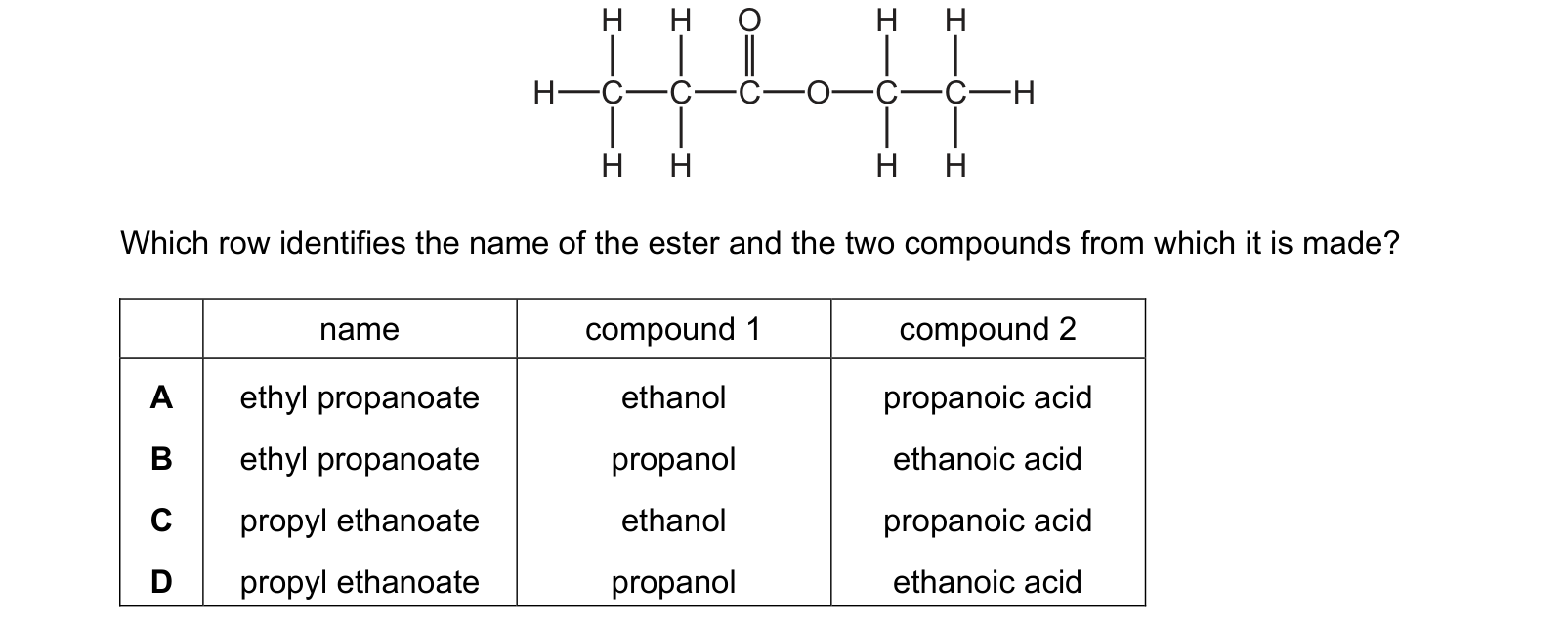
The structure of an ester is shown. H H O H H Which row identifies the name of the ester and the two compounds from which it is made? Each answer gives, in order: name; compound 1; compound 2.
Answer: A.
An ester takes its first name from the alcohol and its second from the acid, and the single bonded oxygen in the middle divides the molecule into those two halves. To the right of that oxygen sit two carbons, and that fragment came from the alcohol, so the first word is ethyl and the alcohol was ethanol. To the left, counting in the carbon that carries the double bonded oxygen, there are three carbons, so the acid was propanoic acid and the second word is propanoate. The rows naming propyl ethanoate have read the two halves the wrong way round, which would require propanol and ethanoic acid instead. The carbon of the C=O group belongs to the acid half, and failing to count it is exactly what turns propanoate into ethanoate.
Question 2
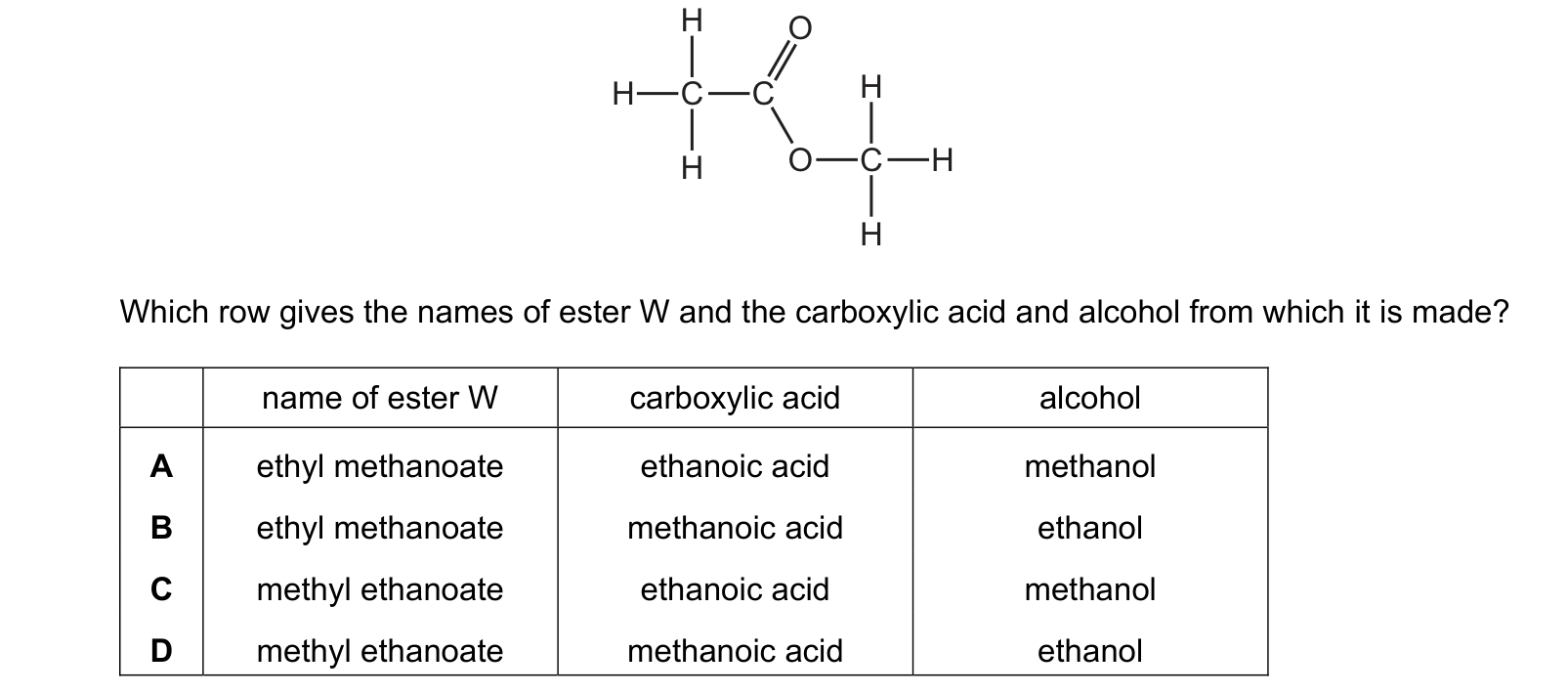
The structure of ester W is shown. Which row gives the names of ester W and the carboxylic acid and alcohol from which it is made? Each answer gives, in order: name of ester W; carboxylic acid; alcohol.
Answer: C.
Split the structure at the oxygen atom that has two single bonds. On one side a CH3 group is joined to the carbon carrying the C=O, so the acid part has two carbon atoms and the acid is ethanoic acid. On the other side a single CH3 is attached to that oxygen, one carbon atom, so the alcohol is methanol. The name takes its first word from the alcohol and its second from the acid, which makes W methyl ethanoate. The rows offering ethyl methanoate have exchanged the two halves, giving the acid one carbon atom and the alcohol two, which would require the carbonyl carbon to hold a hydrogen atom rather than a methyl group.
Question 3
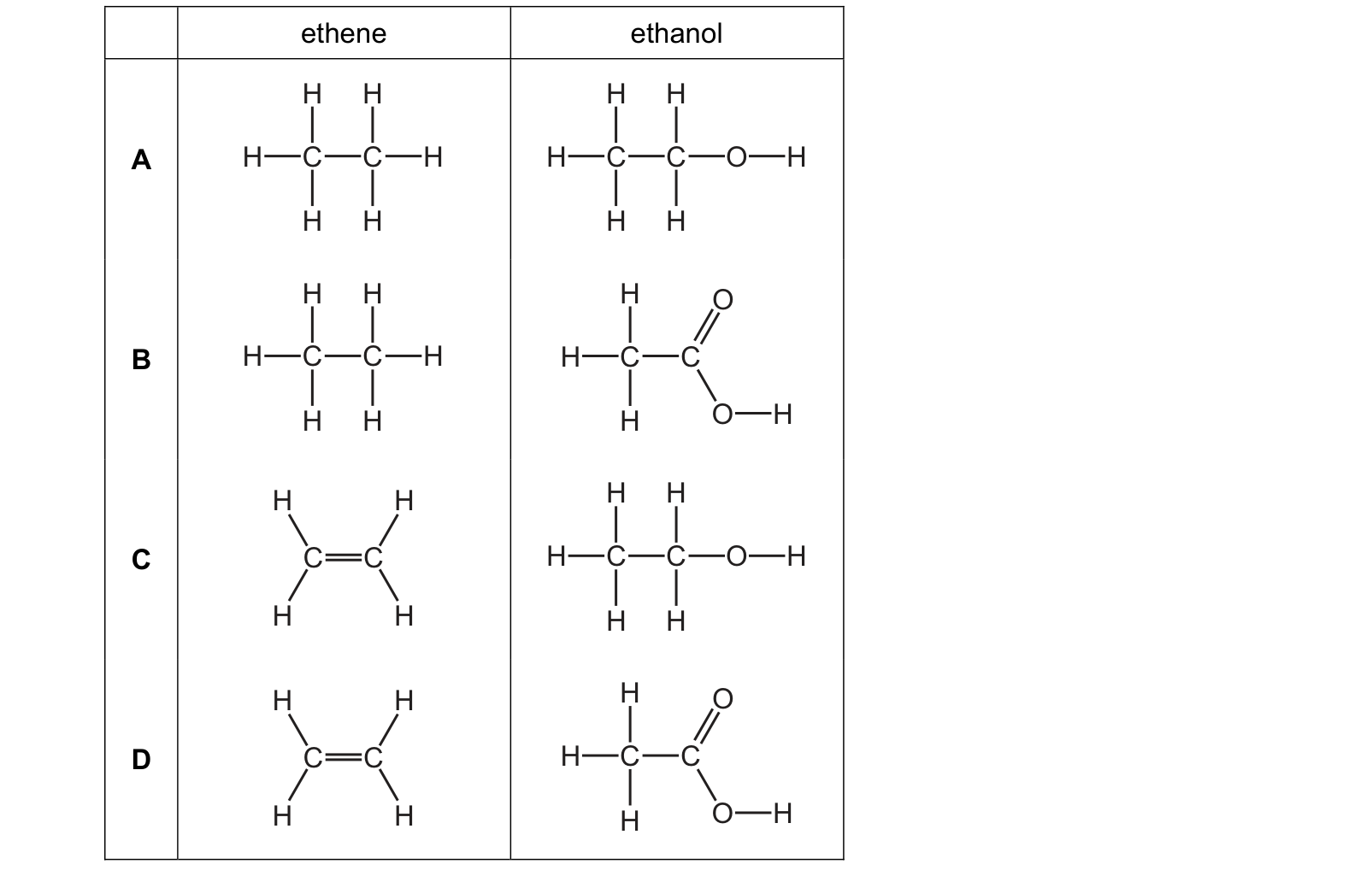
Which structures represent ethene and ethanol? Each answer gives, in order: ethene H H; ethanol H H.
Answer: C.
Ethene and ethanol differ in two independent ways, and a row has to get both right. Ethene is an alkene, C2H4, so its two carbon atoms must be joined by a double bond with two hydrogen atoms on each. Ethanol is an alcohol, C2H5OH, so it needs a saturated two-carbon chain with a single OH group on the end. Rows drawing ethene with four single bonds have drawn ethane instead, and rows whose second structure has one carbon carrying both a double bonded oxygen and an OH have drawn ethanoic acid, which is what ethanol turns into on oxidation rather than ethanol itself.
Question 4
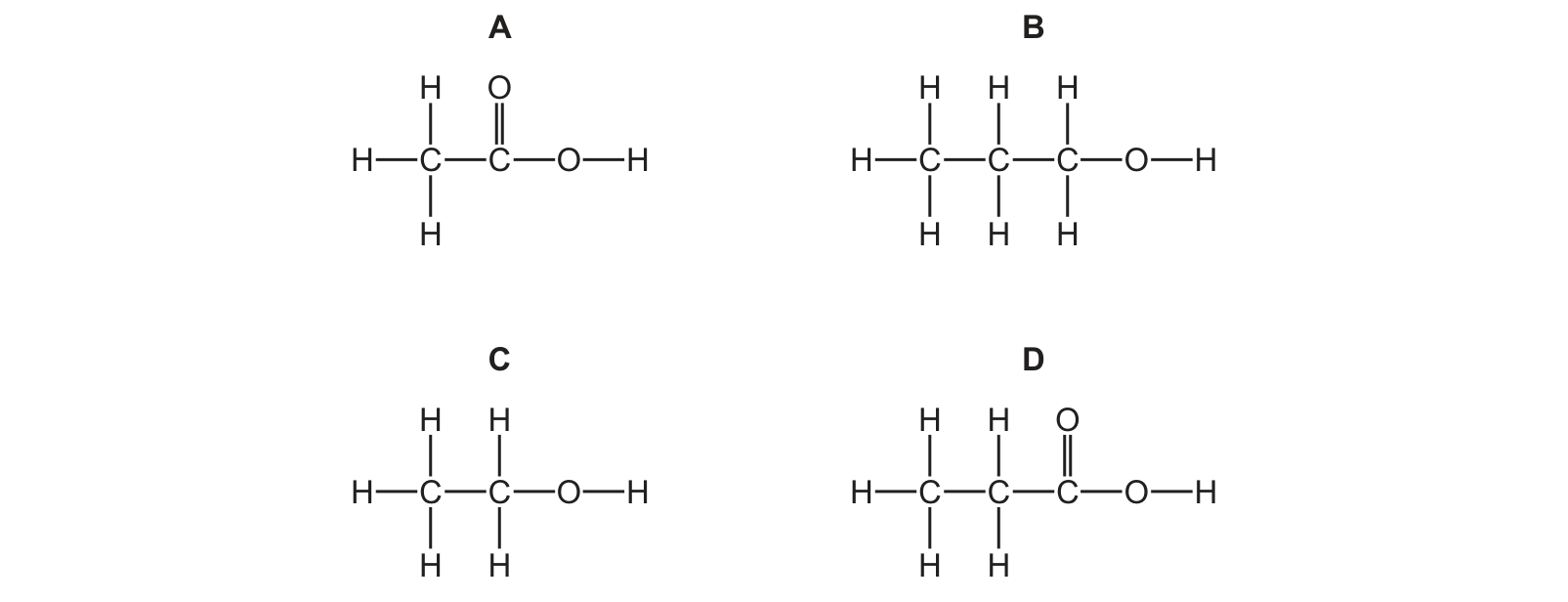
Which diagram shows the displayed formula of ethanol? Use the source image for W23 Paper 11, question 37.
Answer: C.
A displayed formula shows every atom and every bond, so the drawing has to match C2H5OH exactly: two carbon atoms joined by a single bond, five hydrogen atoms and an OH on the end. One diagram shows precisely that and is the answer. Two of the others carry a carbon double bonded to an oxygen as well as an OH, which is the COOH group, making them ethanoic acid and propanoic acid rather than alcohols. The remaining diagram is an alcohol but has three carbon atoms in its chain, so it is propan-1-ol, one carbon atom too many for ethanol.
Question 5
Methanoic acid and propan-1-ol react to form an ester. What is the structural formula of the ester?
Answer: A.
Esterification joins the OH of the alcohol to the COOH of the acid with the loss of water, so the acid part ends up on the left of the COO group and the alcohol part on the right. Methanoic acid is HCOOH, whose carbonyl carbon holds a hydrogen atom rather than a carbon chain, and propan-1-ol supplies CH2CH2CH3, so the ester is HCOOCH2CH2CH3. CH3CH2COOCH3 has those two counts swapped, three carbon atoms on the acid side and one on the alcohol side, which makes it methyl propanoate. CH3COOCH2CH3 is ethyl ethanoate, from ethanoic acid and ethanol, and CH3CH2CH2COOH is not an ester at all but butanoic acid, since it ends in COOH rather than in COO joined to another chain.
These questions are drawn from past CIE 0620 Chemistry papers and filtered to naming organic compounds. You answer, you find out immediately whether you were right, and you get the reasoning for the correct option and for each distractor. Wrong answers go to a mistakes locker so you can come back to exactly those.
Practice is free. You need an account only so your progress and your mistakes are still there next time.
These are the errors that cost marks on naming organic compounds, taken from our own topic notes. Read them before you practise and you will recognise the traps in the questions.
Naming CH₃CH₂COOH as butanoic acid by forgetting that the COOH carbon counts.
Writing ethanoic acid as CH₃CHO, which is an aldehyde, or as CH₃COH.
Numbering from the wrong end and producing propan-3-ol or but-3-ene.
Putting a position number on ethanol, ethene or any carboxylic acid.
Reversing an ester name, so that ethanol and methanoic acid are said to give methyl ethanoate.
Assuming "butene" is one compound. Without a number it could be but-1-ene or but-2-ene.